
Chart of the Week
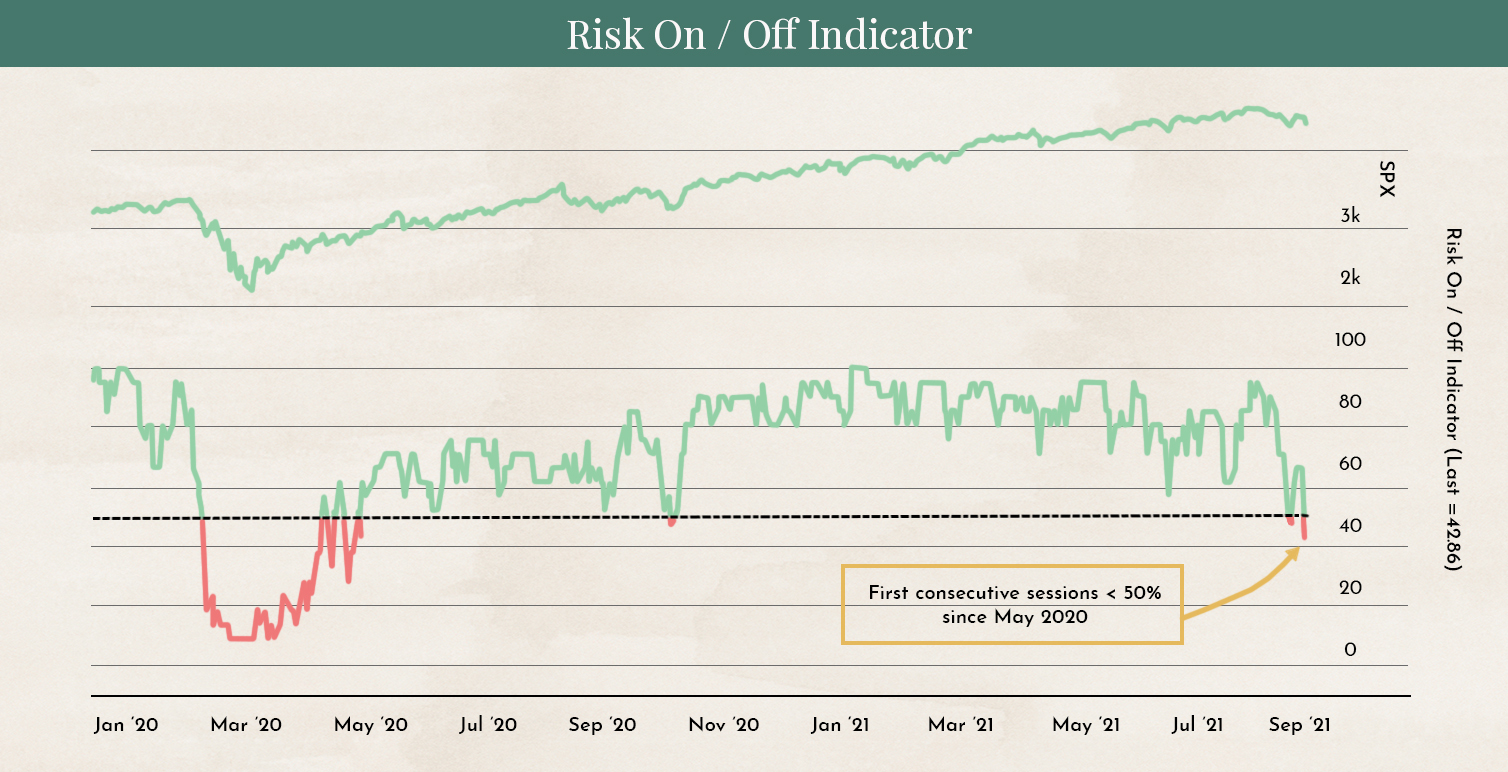
The chart above shows the price performance of the S&P 500 stock index in the United States and below the Risk-ON / Risk-OFF indicator. Investor behavior can be divided into two patterns. Risk-ON: Investors are carefree and prefer high-risk investments such as technology stocks or leveraged investments that rise two or three times more than the market. Risk-OFF: Investors become concerned about the condition of the market and sell their stocks or invest in conservative companies such as Nestlé or Coca-Cola.
Why This Matters:
In a Risk-ON phase, even small corrections are used as opportunities to buy additional stocks. Larger corrections are unlikely during such a market phase. More on this topic can be found here. As the chart shows, investors have displayed a pronounced Risk-ON behavior since the Covid crash last year. A reversal is now beginning to emerge. For the past two weeks, corrections have no longer been automatically used by investors as buying opportunities. Additional caution is therefore warranted.
US Sovereign Default
Could the United States go bankrupt? It sounds very unrealistic, but unfortunately it is not impossible. In the United States, Congress sets a debt ceiling that limits how much debt the government is allowed to accumulate. Since 1960, this limit has been raised more than 80 times. The current limit stands at USD 28.5 trillion. This limit is about to be reached and could create major problems for the government. It would then have to decide whether to stop paying government employees, suspend social spending, or halt interest payments. Choosing the last option would effectively amount to a sovereign default.
The US Congress is currently deeply divided, and the Republicans are unwilling to support an increase in the debt ceiling. The Democrats could pass it on their own with their majority, but only through a lengthy process. Similar situations occurred in 2011 and 2013, when a default was avoided through various emergency measures. However, during that process, rating agencies stripped the United States of its top AAA credit rating for bonds. This led to higher interest rates and weaker stock markets.
The US government’s fiscal year does not end on December 30, but on September 30. At the very last minute on September 30, politicians were able to reach a partial agreement. Government operations can now continue until December 3, but the dispute is ongoing.
What makes this situation different from 2011 and 2013 is the continuing Covid crisis and all the risks associated with it. There is also the danger that politicians may underestimate the issue based on the limited consequences seen in 2011 and 2013. At the moment, we estimate the probability of negative effects on the stock market at around 20%. So there is no immediate major danger, but the situation must be monitored closely.
China declares all cryptocurrencies illegal
China’s largest real estate developer, Evergrande, is facing bankruptcy. The company has USD 300 billion in debt.
If the company collapses, many Chinese banks that have granted loans to Evergrande or its suppliers could also collapse. To prevent Chinese citizens from withdrawing their money from local banks and looking for alternatives, the government announced a drastic step last week: all cryptocurrencies are now illegal.
This is not the first time China has intervened in the crypto market. However, this move surpasses all previous measures.
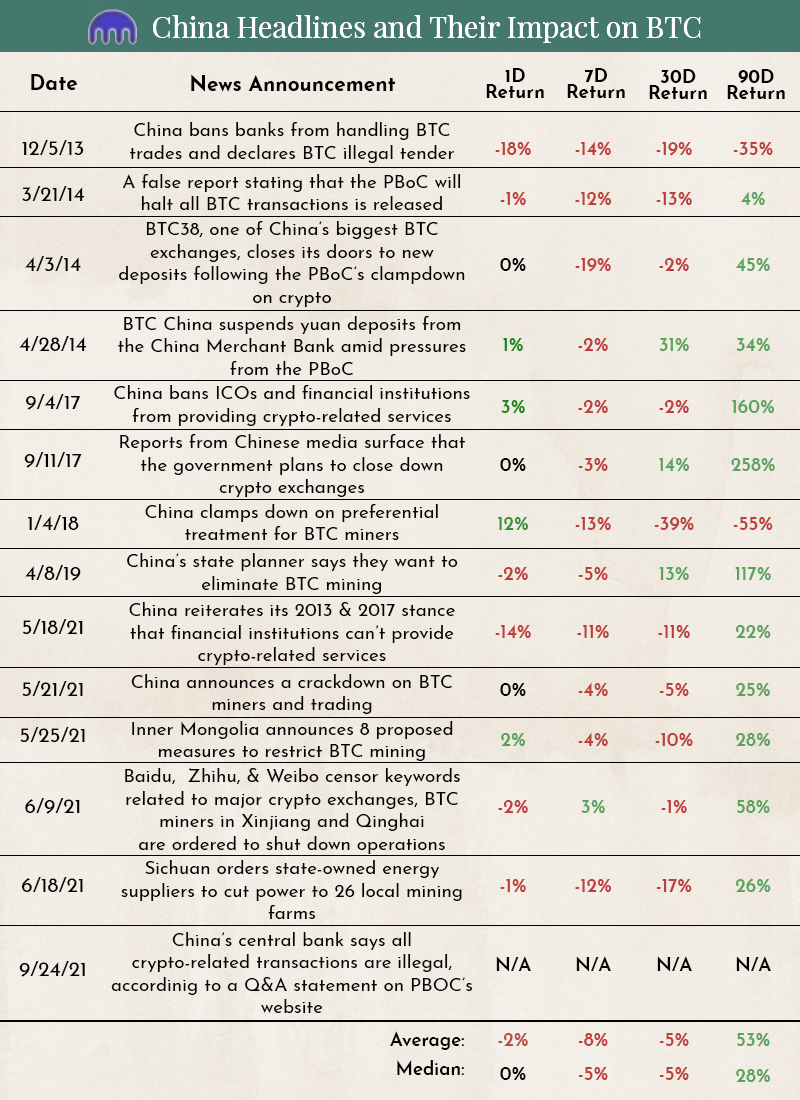
The chart shows all crypto regulations since 2013 and Bitcoin's return one day, one week, 30 days, and 90 days after the government announcement. The conclusion is clear: after a new regulation, Bitcoin corrects for up to 30 days, then rises again. If you buy 30 days after such a regulatory announcement, you have an 85% probability of making a profit.
This also aligns quite well with current Bitcoin seasonality.
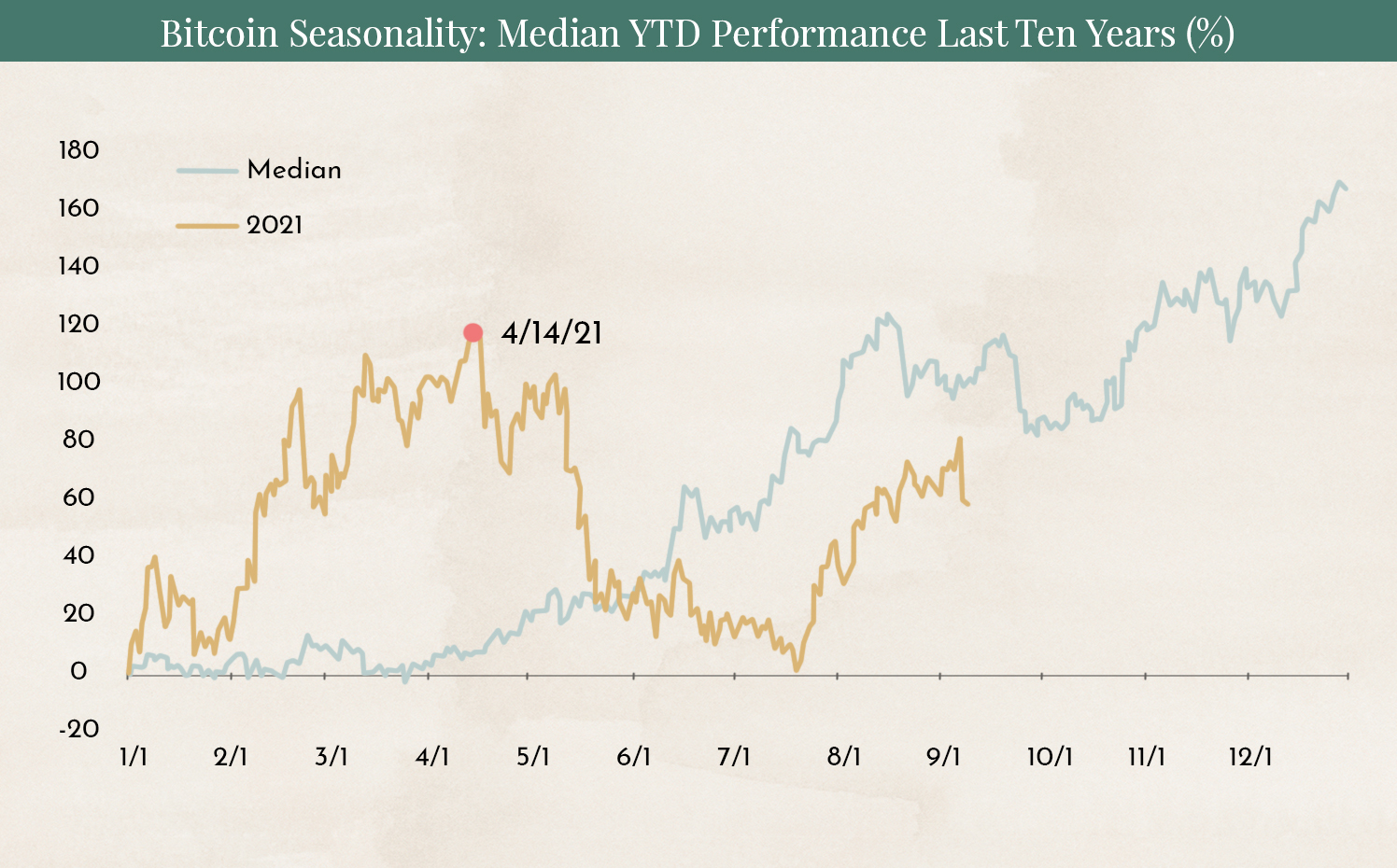
The chart shows in blue the average annual performance of Bitcoin over the past 10 years. From January to April, the price barely moves. From May to August, it rises. September and October tend to show negative returns before the price rises sharply again in November.
To be fair, this seasonality has not really worked so far in 2021 (black line in the chart). However, it is quite possible that we will see the usual pattern again by the end of the year — rising prices from the end of October into early November.
Until two months ago, China was still one of the most active countries in Bitcoin mining. However, it is unclear how many Chinese citizens actually own Bitcoin. Older figures suggested around 7%, which would be enormous given the country’s population size. Current figures are unavailable because almost all providers of such statistics have removed Chinese data from their websites in recent days to protect Chinese users.
The big question now is what all the Chinese Bitcoin holders will do. Will they immediately sell all their Bitcoin, or will they hold and hide it?
Due to the extremely high volatility, we do not use cryptocurrencies in long-term wealth management.
Disclaimer:
The content in these blogs is intended solely for general information purposes and to give potential clients an impression of how we work. It does not constitute recommendations intended to lead to the purchase or sale of assets and does not constitute investment advice. Marmot.finance cannot assess whether or how the statements made align with your investment objectives and risk profile. Anyone making investment decisions based on these blog posts does so entirely at their own responsibility and risk. Marmot.finance cannot be held liable for any losses incurred based on information contained in these blog posts. The products mentioned are not recommendations, but are intended to demonstrate how Marmot.finance works and selects such products. Marmot.finance is also completely independent and does not receive any compensation in any form from product providers.


.webp)





.jpeg)




.jpeg)

.svg)


