

Investment portfolio diversification is the process of allocating capital across different asset classes, sectors, and geographies to reduce investment risk and protect your financial security. For investors in Switzerland, where wealth is often concentrated in ultra-prime real estate and a handful of Swiss blue-chip stocks, investment portfolio diversification in Switzerland reducing risk is not just a textbook principle. It is a practical necessity. Institutions like Fidelity Investments, Petiole Asset Management, and Alpen Partners AG all point to the same conclusion: spreading your capital across uncorrelated assets is the most reliable way to protect long-term wealth.
What asset classes should Swiss investors include for effective diversification?
Asset allocation across stocks, bonds, and short-term investments remains the primary defence against market volatility in 2026. These three categories form the core of any well-structured portfolio because they tend not to move in the same direction at the same time. When equities fall, bonds often hold steady or rise, cushioning the overall impact on your wealth.
Beyond the core, alternative assets add a second layer of protection. Commodities, infrastructure, and specialised credit behave differently from public markets and from each other. Petiole Asset Management notes that true diversification requires sectors and asset classes that do not move in sync with public equities. This is where private equity and infrastructure funds earn their place in a Swiss portfolio.
Swiss investors face a specific structural problem. The Swiss Market Index is heavily concentrated in three companies: Nestlé, Novartis, and Roche. If you hold a standard Swiss equity fund, you are not as diversified as you might think. Broadening into international equities, private market assets, and fixed income across multiple currencies addresses this concentration risk directly.
Local real estate in, for example, Gstaad, is a different matter. Ultra-prime property in Gstaad costs between 30,000 and 40,000 EUR per square metre. That level of capital commitment creates significant illiquidity. Real estate here serves a legacy and privacy function rather than a growth or income function. It should be treated as a separate category in your overall wealth picture, not as a substitute for a liquid, diversified portfolio.

| Asset Class | Risk Level | Typical Return | Liquidity | Correlation to Swiss Equities |
|---|---|---|---|---|
| Swiss Equities | Medium-High | Medium-High | High | Very High |
| Global Equities | Medium-High | Medium-High | High | Medium |
| Government Bonds | Low-Medium | Low-Medium | High | Low |
| Private Equity | High | High | Very Low | Low |
| Infrastructure | Medium | Medium | Low | Low |
| Commodities | Medium-High | Variable | Medium | Low |
| Gstaad Real Estate | Medium | Low-Medium | Very Low | Very Low |
Pro Tip: You can start a diversified portfolio in Switzerland with as little as 500–1,000 CHF using ETFs with fees below 0.2%. You do not need to wait until you have significant capital to begin spreading risk.
How does geographic diversification reduce risk for Gstaad investors?
Geographic diversification means more than simply buying an international stock fund. Many global indices are highly correlated, particularly during market downturns when assets that normally behave independently tend to fall together. Real geographic protection comes from including economies with genuinely different growth drivers, such as Japan, India, and Brazil, alongside Western markets.
Jurisdictional diversification adds another dimension that many investors overlook. Holding assets outside Switzerland protects your wealth from domestic fiscal policy changes, banking regulation shifts, and political risks that could affect your portfolio’s legal or tax structure. Alpen Partners AG describes 2026 as a year of deliberate portfolio structuring across jurisdictions and currencies, not just asset classes. This is a meaningful shift from how most Swiss investors have historically approached wealth management.
Home-bias is the single most common mistake among Swiss investors. Your familiarity with Swiss companies and the Swiss franc creates a natural pull towards domestic assets. That comfort comes at a cost. A portfolio concentrated in Switzerland is exposed to Swiss economic cycles, Swiss regulatory decisions, and the performance of a very small number of large companies.
The benefits of broadening your geographic reach include:
Reduced exposure to any single country’s economic cycle. Protection from domestic regulatory or tax changes. Access to faster-growing economies that Swiss markets do not capture. Greater currency diversification, which can act as a natural hedge.
Currency costs are a real consideration when investing internationally. Traditional Swiss banks charge fees of 1.5%–2% on currency exchange, which adds up quickly when you are moving capital between CHF, EUR, and USD. Specialist currency intermediaries can save up to 1,000 CHF per transaction. That freed-up capital compounds over time.
Pro Tip: Before converting CHF to invest internationally, compare rates from a specialist currency provider against your bank’s rate. The difference is often larger than you expect, and the savings go directly into your investment.
For investors who want to understand how holding assets outside Switzerland fits into a broader international strategy, specialist advisers focused on cross-border wealth can provide useful context.
What role does portfolio rebalancing play in managing risk?
Rebalancing is the practice of periodically adjusting your portfolio back to its original target allocation. Without it, strong-performing assets grow to dominate your portfolio, and your actual risk level drifts away from your intended one. Disciplined rebalancing protects your portfolio profile from the unintended consequences of market fluctuations.
Here is how a basic rebalancing process works in practice.
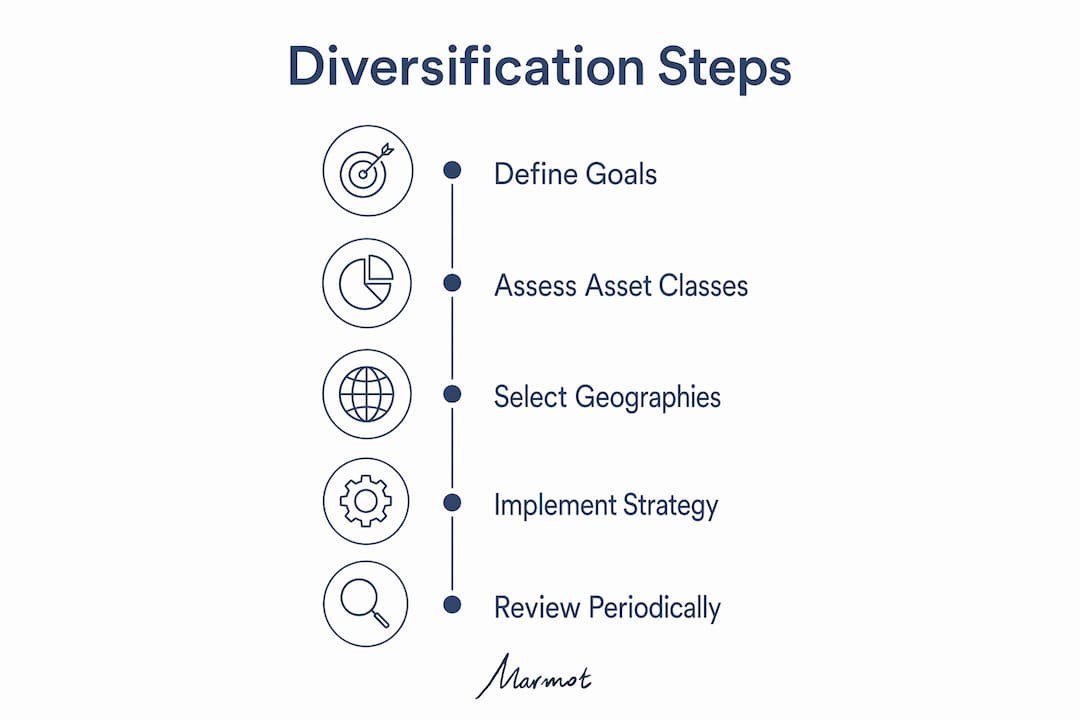
First, define your target allocation clearly. For example, 50% global equities, 30% bonds, 10% alternatives, and 10% cash. Second, review your portfolio at a set interval, either quarterly or semi-annually. Third, identify which asset classes have drifted more than 5% from their target. Fourth, sell a portion of the overperforming assets and use the proceeds to top up the underperforming ones. Fifth, document the rationale for each change so you can review your decisions objectively later.
This process sounds simple, but it requires discipline. When equities have performed well, selling them feels counterintuitive. When bonds have underperformed, buying more feels uncomfortable. That discomfort is exactly the point. Rebalancing forces you to buy low and sell high in a systematic way, without relying on market timing or gut feeling.
For Gstaad investors managing portfolios in CHF, EUR, and USD, rebalancing also creates an opportunity to review currency exposure. If one currency has strengthened significantly, rebalancing can reduce concentration in that currency and restore a more balanced exposure across your accounts.
Pro Tip: Set a calendar reminder for a portfolio review every six months. You do not need to rebalance every time, but the discipline of looking at your allocation regularly prevents drift from becoming a serious risk problem.
How do behavioural factors and costs affect diversification success?
Behavioural finance research from Fidelity shows that investors feel losses more acutely than gains. This asymmetry leads to panic selling during market downturns, which destroys the long-term benefits of a well-structured portfolio. A diversified portfolio acts as a psychological buffer. When one asset class falls sharply, others hold steady, and the overall drop feels less severe. That steadiness makes it easier to stay the course.
The practical implication is straightforward. A portfolio aligned with your actual risk tolerance and time horizon is one you are more likely to hold through difficult periods. If your portfolio is too aggressive for your temperament, you will sell at the wrong moment. If it is too conservative, you will not reach your financial goals. Getting the balance right from the start is the most important behavioural decision you can make.
Costs matter too, particularly for investors moving capital across borders. Currency conversion fees from traditional banks erode returns quietly and consistently. Specialist intermediaries can save up to 1,000 CHF per transaction compared to standard bank rates. Over a decade of regular international investing, those savings are material.
A few practical habits that protect your diversification strategy over time:
Write down your investment rationale before making any change. Review your portfolio against your goals, not against short-term market news. Separate your emotional reaction to market moves from your investment decisions. Work with an adviser who will challenge you when your instincts conflict with your strategy.
Pro Tip: When markets fall sharply, read your original investment plan before doing anything. Most panic decisions look obviously wrong in hindsight. Your written rationale is your best defence against your own instincts.
Key takeaways
Effective portfolio diversification in Gstaad requires spreading capital across uncorrelated asset classes, multiple geographies, and different jurisdictions, then maintaining that structure through disciplined rebalancing and cost-aware execution.
| Point | Details |
|---|---|
| Core asset allocation | Balance equities, bonds, and alternatives to reduce exposure to any single market event. |
| Combat home-bias | Broaden beyond Nestlé, Novartis, and Roche into international and private market assets. |
| Jurisdictional spread | Hold assets outside Switzerland to protect against domestic regulatory and fiscal changes. |
| Rebalance regularly | Review allocation every six months and restore target weights to prevent risk drift. |
| Control currency costs | Use specialist intermediaries for FX conversions to save up to 1,000 CHF per transaction. |
What I have learned about diversification for Gstaad investors
By Sophie Steinmann
The most consistent pattern I see among investors in Gstaad is not recklessness. It is over-confidence in familiar assets. Swiss investors are sophisticated, but sophistication does not protect against home-bias. Holding Nestlé, Novartis, and Roche alongside a Gstaad property and calling it a diversified portfolio is a very common and very costly mistake.
What I have found actually works is treating local real estate and liquid investments as two entirely separate conversations. Your Gstaad property is a legacy asset. It preserves wealth and offers privacy. It is not a substitute for a liquid, internationally diversified portfolio. Once investors accept that distinction, the conversation about building a genuinely diversified portfolio becomes much clearer.
Private markets are underused by most investors I speak with. Infrastructure funds, private equity, and specialised credit add genuine diversification because they do not move with public markets. The illiquidity is real, but for investors with a long time horizon, it is manageable and often rewarded.
The behavioural piece is where most strategies fall apart. A perfectly constructed portfolio is worthless if you abandon it during the first serious correction. The investors who build wealth over time are not the ones with the cleverest strategies. They are the ones who stay invested, rebalance calmly, and do not confuse short-term noise with long-term risk.
— Sophie Steinmann
How Marmot supports Gstaad investors in building diversified portfolios
If you are based in Gstaad and want to move beyond concentrated Swiss holdings into a genuinely diversified portfolio, Marmot is built for exactly that conversation.

Marmot is a FINMA-accredited wealth manager working with investors across Switzerland and Europe, managing portfolios in CHF, EUR, and USD. The team combines personal consultations with practical digital tools to build strategies tailored to your financial profile, your risk tolerance, and your long-term goals. Whether you are starting from scratch or reviewing an existing portfolio, get in touch with Marmot to explore how a structured, diversified approach can reduce your risk and strengthen your financial position over time.
FAQ
What is investment portfolio diversification?
Portfolio diversification is the practice of spreading capital across different asset classes, sectors, and geographies to reduce the impact of any single investment performing poorly. It does not eliminate risk, but it reduces concentration risk significantly.
Why is diversification particularly important for Gstaad investors?
Gstaad investors often hold significant wealth in illiquid local real estate and a small number of Swiss blue-chip stocks. This concentration creates meaningful exposure to Swiss economic and regulatory risks, which geographic and asset diversification directly addresses.
How often should i rebalance my portfolio?
A semi-annual review is a practical starting point for most investors. Rebalance when any asset class drifts more than 5% from its target allocation, as disciplined rebalancing prevents unintended risk from building up over time.
Does Gstaad real estate count as portfolio diversification?
Gstaad real estate serves a legacy and capital preservation function, not a growth or income one. It should be treated separately from your liquid investment portfolio rather than counted as a diversifying asset within it.
How can I reduce currency costs when investing internationally?
Using a specialist currency intermediary instead of a traditional Swiss bank can save up to 1,000 CHF per transaction on foreign exchange conversions, freeing up more capital to invest and compound over time.
This article is for general educational purposes only and does not constitute investment, tax, or legal advice. Portfolio decisions should be based on your personal circumstances, risk tolerance, liquidity needs, and professional advice.

.webp)





.jpeg)


.svg)


