

Cross-border financial planning in Zürich for international professionals is the deliberate coordination of Swiss and home-country financial, tax, and investment affairs to achieve legal compliance, tax efficiency, and long-term wealth growth. The industry term for this discipline is international wealth management, and it covers everything from Swiss cantonal tax rates and double taxation treaties to FBAR reporting and pension alignment. If you have recently relocated to Zürich, or are preparing to, getting this right from the start will save you significant money and considerable stress.
Zürich sits at the centre of one of the world’s most stable financial systems, yet it presents real complexity for internationally mobile professionals. Switzerland has over 100 double taxation treaties, but these are not automatic. They require formal applications, a certificate of residence, and genuine economic substance. Understanding what that means for your specific situation is where most expats fall short.
What are the key tax considerations for international professionals in Zürich?
Zürich’s tax system operates on three levels: federal, cantonal, and communal. This layered structure means your effective tax rate depends heavily on where in Switzerland you live or incorporate. Zürich’s effective corporate tax rate is approximately 19.7%, compared to Zug’s 11.85%. For a business generating CHF 500,000 in profit, that difference translates to potential savings of CHF 280,000 over five years. That is not a marginal consideration. It is a structural decision worth making deliberately.
For personal income tax, Swiss cantons apply a residency test. You become tax resident in Switzerland once you establish a domicile or spend a qualifying period in the country. Your home country may apply its own test simultaneously, which is where double taxation treaties become critical. Switzerland’s treaty network is extensive, but treaty benefits are not automatic. You must apply formally, demonstrate genuine residence, and satisfy anti-avoidance clauses including the principal purpose test.
Cantonal tax rates: a quick comparison
| Canton | Effective corporate tax rate | Key advantage |
|---|---|---|
| Zürich | ~19.7% | Financial hub, talent pool, infrastructure |
| Zug | ~11.85% | Low tax, proximity to Zurich, holding company base |
| Geneva | ~13.99% | International organisations, private banking |
| Basel-Stadt | ~13.04% | Pharma sector, strong legal framework |
One area that catches many professionals off guard is the treatment of restricted stock units (RSUs) and carried interest. Switzerland taxes these differently from most home countries, and without coordinated advice, you can end up paying tax twice on the same income. The OECD Pillar Two rules, which came into full effect in 2026, add another layer for professionals connected to multinational groups, introducing a global minimum tax of 15% that affects how Swiss structures are assessed internationally.
Pro Tip: Swiss tax rulings provide binding confirmation of your tax treatment before you act. They typically take 4–8 weeks to process, so apply well before implementing any new financial structure.
How to comply with FBAR and FATCA reporting when based in Zürich
Reporting obligations are the part of expat financial planning that most people underestimate until they receive a penalty notice. If you are a US person living in Zürich, two obligations apply regardless of where your income is earned. FBAR filings are mandatory for any foreign bank account exceeding $10,000 in aggregate at any point during the year. FATCA Form 8938 applies to foreign financial assets over $50,000. Both are annual requirements, and non-compliance carries substantial penalties.
The practical challenge is that Swiss bank accounts, Swiss pension products, and investment accounts all count towards these thresholds. Your Swiss 3a pension pillar, for example, may be tax-efficient in Switzerland but offer no equivalent tax advantage under US rules. For US citizens specifically, Swiss pension products can trigger Passive Foreign Investment Company (PFIC) rules, creating unexpected tax liabilities at home. This is a known trap that expats in Switzerland frequently encounter when they set up accounts without specialist advice.
Non-US expats face their own reporting obligations. Many European countries require residents to declare worldwide assets and income, even while living abroad. The UK, Germany, and France each have their own controlled foreign company rules and exit tax provisions that can apply when you leave. Coordinating your Swiss filings with your home-country obligations is not optional. It is the foundation of compliant cross-border wealth management.
Pro Tip: Engage a tax adviser who holds qualifications in both Switzerland and your home country. A Swiss-only adviser will not flag your FBAR obligation. A home-country-only adviser will not understand your Swiss cantonal position. You need both perspectives in the same conversation.
What practical steps should you take before relocating to Zürich?
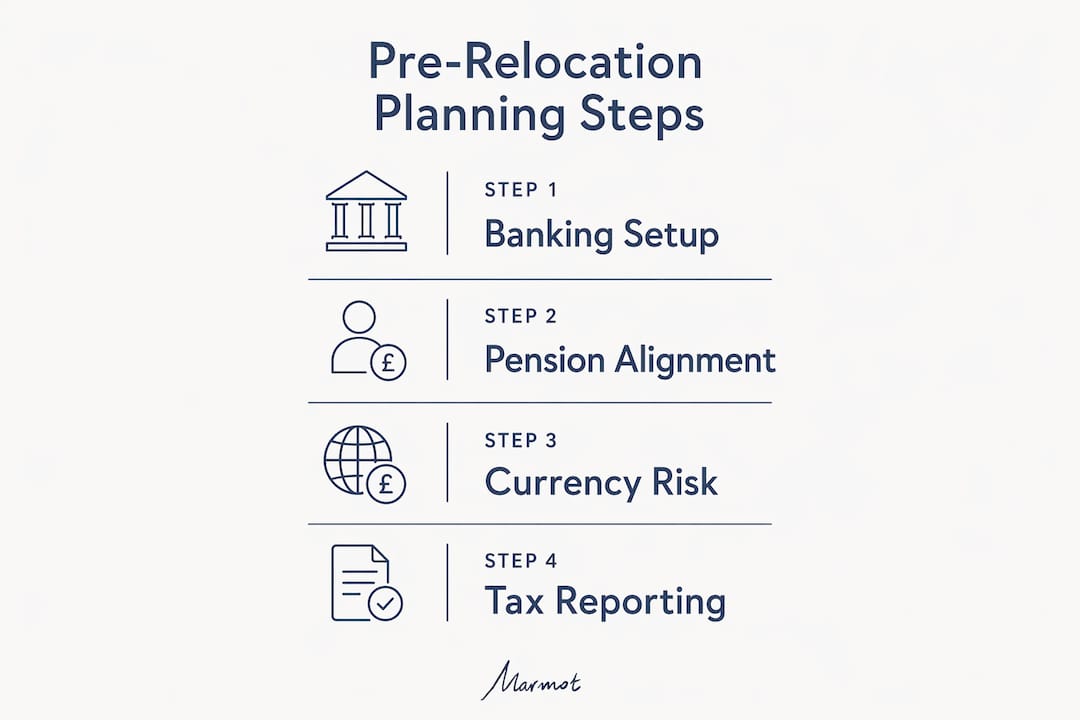
Starting your financial planning at least 6 months before your move is the single most effective thing you can do to avoid costly mistakes. The administrative and tax complexity of relocating to Switzerland is real, and many of the most important decisions, such as choosing your canton of residence, structuring your employment contract, and aligning your pension, need to be made before you arrive.
In the first phase, focus on your banking and credit foundation. Swiss banks require proof of income, employment contracts, and often a reference from your previous bank. Setting up a Swiss current account and understanding how Swiss credit scoring works will save you weeks of friction when you need a mortgage or a rental deposit guarantee later. Marmot’s wealth management in Zurich overview covers the key banking and administrative steps in detail.
In the second phase, align your pension arrangements. Switzerland operates a three-pillar pension system. The first pillar is the state pension (AHV). The second is your occupational pension through your employer. The third is voluntary private savings, including the 3a account. Understanding how your existing pension from your home country interacts with Swiss pillar two is critical, particularly if you have defined benefit entitlements or employer contributions that cannot simply be transferred. Marmot’s guide to the Swiss 3rd pillar explains the mechanics clearly.
In the third phase, address currency risk. Experts recommend maintaining 3–6 months of local expenses in CHF as a liquidity buffer and tracking your global assets in a single base currency. This prevents forced conversions at unfavourable exchange rates when you need to move money quickly. If you hold assets in GBP, EUR, and USD simultaneously, a clear currency strategy is not a luxury. It is basic risk management.
How do financial advisers support expats with wealth management in Zürich?
Specialised expat financial advisers who understand multiple jurisdictions are the single most valuable resource for internationally mobile professionals. The scope of what a good adviser covers goes well beyond investment returns. It includes estate planning, insurance structuring, mortgage planning, and the coordination of tax and legal advice across borders.
Cross-border investment management in Zürich requires particular care. Swiss-domiciled funds may not be recognised or tax-efficient in your home country. Conversely, investment vehicles you hold from before your move may create reporting headaches in Switzerland. A qualified adviser will map your existing assets, identify gaps in your pension and inheritance planning, and build a structure that works across both jurisdictions. This is precisely the kind of fragmented financial picture that catches expats out when they face a major life event without a coherent plan in place.
Estate planning is another area where cross-border complexity is often ignored until it is too late. Switzerland applies forced heirship rules under certain conditions, and your home country may have its own inheritance tax regime that applies to worldwide assets. Without coordinated advice, your estate could be subject to double taxation or distributed in ways you did not intend. Engaging advisers who understand both Swiss law and your home-country rules is the only way to prevent this. The ch.ch publishes detailed insights on Swiss pension gaps and forced heirship strategies that are worth reading alongside your adviser’s recommendations.
Marmot works with international professionals to build personalised wealth strategies that account for Swiss regulatory requirements, cross-border tax obligations, and long-term financial goals. If you want to understand how coordinated adviser teams prevent double taxation on income types like pensions and RSUs, that coordination starts with having the right people in the room from day one.
Key takeaways
Cross-border financial planning in Zürich requires early action, coordinated advisers, and a clear understanding of both Swiss cantonal rules and your home-country obligations.
| Point | Details |
|---|---|
| Start planning early | Begin at least 6 months before relocating to address tax, banking, and pension decisions. |
| Choose your canton carefully | Zürich’s 19.7% corporate rate versus Zug’s 11.85% creates meaningful long-term savings. |
| File FBAR and FATCA correctly | US persons must report foreign accounts over $10,000 and assets over $50,000 annually. |
| Align your pension across borders | Swiss pillar products may not be tax-efficient in your home country, especially for US citizens. |
| Manage currency risk proactively | Hold 3–6 months of CHF expenses as a liquidity buffer and track global assets in one base currency. |
What I have learned from working with expats in Zürich
Working with internationally mobile professionals over many years, I have noticed one pattern more than any other. People arrive in Zürich with a strong grasp of their home-country finances and assume Switzerland will work the same way. It does not. The cantonal system alone surprises most people. The idea that your tax rate changes depending on which side of a municipal boundary you live on is genuinely unfamiliar to professionals from countries with national tax systems.
The second thing I see consistently is underestimation of the pension complexity. Swiss pillar two is generous, but it does not automatically replace what you left behind. If you had a defined benefit pension in the UK or Germany, you need to understand what happens to those accrued rights when you leave, and whether Switzerland will recognise them for treaty purposes. Getting this wrong at the start of your career in Zürich can cost you years of retirement income.
My honest recommendation is to treat your first year in Zürich as a financial setup year. Do not make major investment decisions until you understand your full tax position. Do not assume your home-country adviser understands Swiss rules. And do not wait for a problem to appear before engaging a specialist. Proactive preparation is the difference between expats who thrive financially in Switzerland and those who spend years unwinding avoidable mistakes.
— Sophie Steinmann
How Marmot supports international professionals in Zurich

Marmot is a FINMA accredited wealth manager with deep experience supporting international professionals and families in Switzerland. If you are relocating to Zürich or already managing finances across borders, Marmot’s team combines personal consultations with practical digital tools to build a financial plan that works for your specific situation. From Swiss pension alignment and cantonal tax planning to cross-border investment management in CHF, EUR, and USD, Marmot covers the full picture. You do not need to piece together advice from multiple sources. Get in touch with Marmot to start a conversation about your cross-border financial plan.
FAQ
What is cross-border financial planning in Zürich?
Cross-border financial planning in Zürich is the coordination of Swiss and home-country tax, investment, pension, and reporting obligations for internationally mobile professionals. It covers cantonal tax optimisation, double taxation treaty applications, FBAR and FATCA compliance, and pension alignment across jurisdictions.
How does Switzerland’s cantonal tax system affect international professionals?
Your effective tax rate in Switzerland depends on your canton of residence or incorporation. Zürich’s corporate rate is approximately 19.7%, while Zug’s is 11.85%. Choosing the right canton at the outset can generate substantial savings over time.
Do I need to file FBAR if I live in Zürich?
Yes, if you are a US person. FBAR is mandatory for any foreign bank account exceeding $10,000 in aggregate at any point during the year, regardless of where you live. Swiss accounts, pension products, and investment accounts all count towards this threshold.
When should I start financial planning before moving to Zürich?
Start at least 6 months before your move. This gives you time to address cantonal residency decisions, set up Swiss banking, align your pension arrangements, and apply for any relevant tax rulings before they are needed.
Can Swiss pension products cause tax problems in my home country?
Yes, particularly for US citizens. Swiss 3a pension accounts may trigger PFIC rules under US tax law, creating unexpected liabilities. It is worth reviewing any Swiss pension product with an adviser who understands both Swiss and home-country tax treatment before contributing.


.webp)





.jpeg)



.png)

.svg)


