
.png)
Financial planning for expats in Switzerland managing international finances is defined as the coordinated process of aligning tax obligations, currency exposure, banking structures, and pension arrangements across two or more countries simultaneously. For this article we take the example of Horgen, situated on the western shore of Lake Zürich. This town attracts a significant number of international professionals and families, each carrying financial ties to their home countries. Getting this coordination right from the outset protects wealth, avoids costly compliance failures, and creates a stable financial foundation. Investment management comprises only 5–10% of what expat financial planning actually involves. The remaining focus falls on cross-border tax, currency management, and pension structure, which means the planning work is far more complex than simply choosing where to invest. Expats should also build an emergency fund covering 3–6 months of living expenses, with a 15–20% buffer added for unforeseen relocation costs.
What are the key tax considerations for expats living in Switzerland?
Swiss tax residency begins the moment you establish your primary home in Switzerland. From that point, the Swiss Federal Tax Administration, along with the relevant cantonal authority in Zürich, expects annual filings that declare worldwide income and assets. This obligation does not replace your home country’s requirements. It sits alongside them.
For British expats, HMRC continues to assess tax residency using the Statutory Residence Test, which considers days spent in the UK, ties to the country, and employment patterns. For American expats, the Internal Revenue Service requires annual filings regardless of where you live. US expats must file FBAR if foreign account balances exceed $10,000, and FATCA Form 8938 if foreign assets exceed $50,000. These thresholds apply per calendar year and carry significant penalties for non-compliance.
Double Taxation Agreements, commonly called DTAs, are the primary tool for avoiding being taxed twice on the same income. Switzerland has DTAs with over 100 countries, including the United Kingdom, the United States, and Germany. Coordinating Swiss and home-country filings using these agreements can significantly reduce tax liabilities, but the process requires precise, consistent reporting across both jurisdictions. A single inconsistency between filings can trigger enquiries from both tax authorities.
Dual-qualified tax advisors, meaning professionals who hold credentials in both Swiss and your home country’s tax law, are the most effective resource here. Consulting dual-qualified tax professionals is the clearest way to ensure compliance and make full use of treaty benefits. Generalist accountants who know only one system frequently miss treaty elections that could save thousands of francs annually.
Pro Tip: File your Swiss and home country returns in the correct sequence. Swiss cantonal deadlines often fall before IRS or HMRC deadlines, so completing the Swiss return first gives you accurate figures to carry into your home country filing, which maximises treaty credits.
How should expats in Switzerland manage multi-currency finances and banking?
Currency management is one of the most underestimated aspects of living abroad. Expats in Horgen typically receive income in Swiss francs, hold savings in their home currency, and carry financial obligations in both. Managing this without a clear structure leads to poor conversion rates, unexpected shortfalls, and, in some cases, frozen accounts.
The most practical structure is the hub-and-spoke banking model. This approach uses a home country account as the central hub, with a Swiss bank account and one or more multi-currency fintech accounts acting as spokes. Each account serves a specific purpose: the home account maintains long-term savings and existing obligations, the Swiss account handles local expenses and payroll, and the fintech accounts manage currency conversion and international transfers.
- Open a Swiss bank account before or immediately upon arrival to receive your first salary payment without delay.
- Maintain your home country account as the primary hub for savings, investments, and existing direct debits.
- Add a multi-currency account such as Wise or Revolut to handle transfers between currencies at competitive rates.
- Keep a buffer of at least one month’s Swiss living expenses in CHF at all times to cover gaps between salary payments and currency transfers.
- Review your transfer timing regularly. Converting larger sums less frequently often produces better rates than repeated small transfers, though this depends on market conditions.
Account freezes are a common risk for expats who rely solely on a local bank. Banks in both Switzerland and home countries sometimes flag accounts as dormant or flag unusual international activity. A multi-account structure prevents a single freeze from cutting off access to all funds.
Pro Tip: Plan your cash flow across currencies at least three months ahead. Knowing when large CHF expenses fall, such as Swiss health insurance premiums or quarterly tax instalments, lets you time currency conversions to avoid selling at unfavourable rates.
What should expats consider about pensions and retirement planning in Switzerland?
Switzerland operates a three-pillar pension system. The first pillar is the state pension, known as AVS or AHV, funded through mandatory contributions from both employer and employee. The second pillar is the occupational pension, managed through your employer’s pension fund. The third pillar, Pillar 3a, is a voluntary, tax-advantaged private savings vehicle that expats can contribute to if they earn a Swiss income.
Swiss pension optimisation for expats involves several specific actions that go well beyond simply contributing to a workplace scheme.
- Pillar 3a contributions reduce your taxable income in Switzerland each year, up to the annual maximum set by the Federal Social Insurance Office. For 2026, this limit applies to employed individuals and is worth claiming every year you remain in Switzerland.
- Voluntary buybacks into your second pillar pension fund allow you to fill gaps caused by years spent working abroad before arriving in Switzerland. These buybacks are tax-deductible and can represent significant savings for higher earners.
- AVS gap years occur when you were not contributing to the Swiss state system. Voluntary contributions can fill some of these gaps, though the rules are complex and depend on your nationality and residency history.
- Vested benefits accounts hold your second pillar funds if you leave Switzerland before retirement. These accounts are subject to specific rules on when and how funds can be withdrawn, and the tax treatment differs depending on your destination country.
Pension coordination across borders requires understanding different vesting rules and tax treatments in Switzerland and your home country. Withdrawing pension funds at the wrong time, or in the wrong sequence, can trigger tax liabilities in both countries simultaneously.
What practical steps can expats take to prepare their finances before relocating to Switzerland?
Preparation before the move determines how smoothly the first six months in Switzerland unfold. Expats who arrive without a financial structure in place spend considerable time and money correcting avoidable problems.
- Build a relocation budget with a buffer. A 15–20% contingency on top of your estimated relocation costs accounts for deposits, agency fees, furniture, and the inevitable surprises that come with any international move.
- Establish an emergency fund. Three to six months of living expenses, held in an account you can access from day one in Switzerland, provides the financial stability needed while your Swiss salary and banking arrangements settle in.
- Clarify your income timeline. Know exactly when your first Swiss salary will arrive and whether there is a gap between your last home country payment and your first Swiss one. That gap is where cash flow problems begin.
- Open multi-currency accounts before departure. Wise and Revolut accounts can be opened and verified while you are still in your home country, which saves time and avoids the frustrating situation of needing a Swiss address to open an account you need before you have a Swiss address.
- Document all existing assets and accounts. Create a clear record of every bank account, investment account, pension, and property holding across all jurisdictions. This record becomes the foundation for your Swiss tax filing and any future cross-border reporting.
Pro Tip: Use a dedicated financial tracking tool or spreadsheet to log every account, its jurisdiction, its currency, and its reporting obligations. Missed filings are almost always the result of poor record-keeping rather than deliberate non-compliance.
How can expats in Switzerland build a long-term financial plan that actually works?
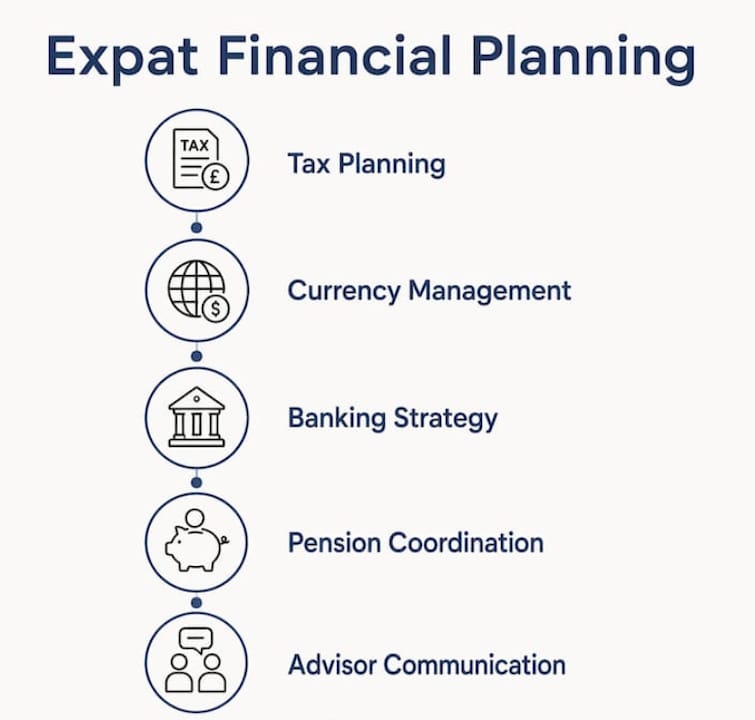
The most effective long-term financial plans for expats treat tax, currency, banking, and pension as one integrated system rather than four separate problems. Expat financial planning is heavily focused on coordinating tax and currency issues rather than asset management alone. This distinction matters because expats who focus primarily on investment returns while neglecting structural issues frequently face tax penalties or currency losses that outweigh any investment gains.
Asset location, meaning which accounts hold which types of investments, matters considerably for tax efficiency. Holding certain assets in a Swiss Pillar 3a account rather than a taxable brokerage account can reduce the annual tax drag significantly. Structuring investment accounts by domicile, aligned to reduce reporting complications, is a recognised approach among advisors who specialise in cross-border clients.
Currency risk does not disappear once you have a Swiss bank account. If your long-term financial goals are denominated in a currency other than CHF, such as GBP or USD, then the value of your Swiss savings fluctuates relative to those goals every time exchange rates move. Managing this requires a deliberate allocation across currencies, not simply holding everything in the currency you happen to earn. For tax-efficient wealth structuring in Switzerland, the interplay between currency allocation and account structure is particularly important.
Maintaining regular contact with advisors in all relevant jurisdictions is not optional. Tax laws change, treaty interpretations shift, and your personal circumstances evolve. An annual review with both your Swiss advisor and your home country tax professional is the minimum standard for staying compliant and financially efficient. Planning for eventual repatriation or onward relocation should also begin well before the move, as unwinding Swiss pension and tax positions takes time and benefits from advance preparation. Marmot’s cross-border financial planning expertise covers precisely this kind of integrated, long-term thinking for expats in the Zürich region.
Key takeaways
Effective financial planning for expats in Switzerland requires integrating tax coordination, multi-currency banking, Swiss pension optimisation, and structured asset location into one coherent plan from the outset.
What I have learned from working with expats in Switzerland
Sophie Steinmann’s perspective
The single most common mistake I see is expats treating their Swiss finances as entirely separate from their home country finances. They open a Swiss account, start contributing to a pension, and assume the two worlds do not interact. They do, constantly, and the interactions carry real financial consequences.
The expats who manage this well share one habit: they start planning before they arrive. Not weeks before, but months before. They have already spoken to a tax advisor in their home country about what leaving means for their residency status. They have already opened a multi-currency account. They have already mapped out their pension positions. By the time they land in Switzerland, the structure is in place and they are simply executing a plan.
The second lesson is that the Swiss system rewards those who engage with it actively. Pillar 3a contributions, second pillar buybacks, and cantonal tax deductions are not automatic. You have to claim them, understand them, and time them correctly. Expats who treat Swiss tax as something that simply happens to them leave meaningful money on the table every year.
Working with advisors who understand both sides of the border is not a luxury. For expats managing assets in CHF, EUR, and USD across multiple jurisdictions, it is the only approach that consistently avoids costly surprises.
— Sophie Steinmann
How Marmot supports expats with cross-border wealth management
Marmot is a FINMA-accredited wealth manager with specific expertise in cross-border financial planning for expats living in Switzerland. Marmot manages accounts in CHF, EUR, and USD, which makes it well placed to support clients with multi-currency financial structures.
Marmot’s advisory approach combines personal consultations with practical financial tools, covering pension optimisation, tax-efficient structuring, and long-term wealth management for international clients. For expats who want a structured, compliant, and clearly explained financial plan, Marmot’s expert wealth management service is the natural starting point. Contact Marmot to arrange a consultation tailored to your specific cross-border circumstances.
FAQ
What does financial planning for expats in Switzerland involve?
Financial planning for expats in Switzerland covers tax coordination across jurisdictions, multi-currency banking, Swiss pension optimisation, and structured asset management. Investment selection is a small component; the majority of planning value comes from tax, currency, and structural decisions.
How do Double Taxation Agreements help expats in Switzerland?
DTAs between Switzerland and your home country prevent the same income from being taxed twice. Applying them correctly requires coordinated filings in both countries, ideally with a dual-qualified tax advisor managing both returns.
What is the Swiss Pillar 3a and why does it matter for expats?
Pillar 3a is Switzerland’s voluntary private pension scheme, offering annual tax deductions on contributions for those with Swiss earned income. Expats who contribute consistently reduce their Swiss taxable income each year and build a tax-advantaged retirement asset.
How much should expats save before relocating to Switzerland ?
Expats should build an emergency fund covering 3–6 months of living expenses and add a 15–20% buffer to their total relocation budget to cover unexpected costs such as deposits, fees, and gaps between income payments.
Do US expats in Switzerland have additional reporting requirements?
Yes. US expats must file FBAR if foreign account balances exceed $10,000 and FATCA Form 8938 if foreign assets exceed $50,000. These obligations apply annually regardless of Swiss tax residency status.
Recommended
- Cross-Border Financial Planning in Zürich for International Professionals | Marmot Finance
- Estate Planning Essentials in Switzerland for Affluent Families | Marmot Finance
- Swiss Pension Optimisation in Lausanne | Marmot Finance
- Tax-Efficient Wealth Structuring in Switzerland: Investor guide | Marmot Finance


.webp)





.jpeg)





.svg)


