

The female investor lifecycle is a practical investment framework that guides women in growing wealth strategically at every stage of life, reflecting their unique financial circumstances and long-term goals. Women face structural challenges that standard financial planning rarely addresses: longer life expectancy, career breaks for caregiving, and persistent wage gaps all affect how wealth accumulates over time. A striking 91% of women say that managing their own investments provides critical empowerment. That figure makes one thing clear: financial literacy for female investors is not optional. It is the foundation of lasting financial independence.
What are the key stages of the female investor lifecycle?
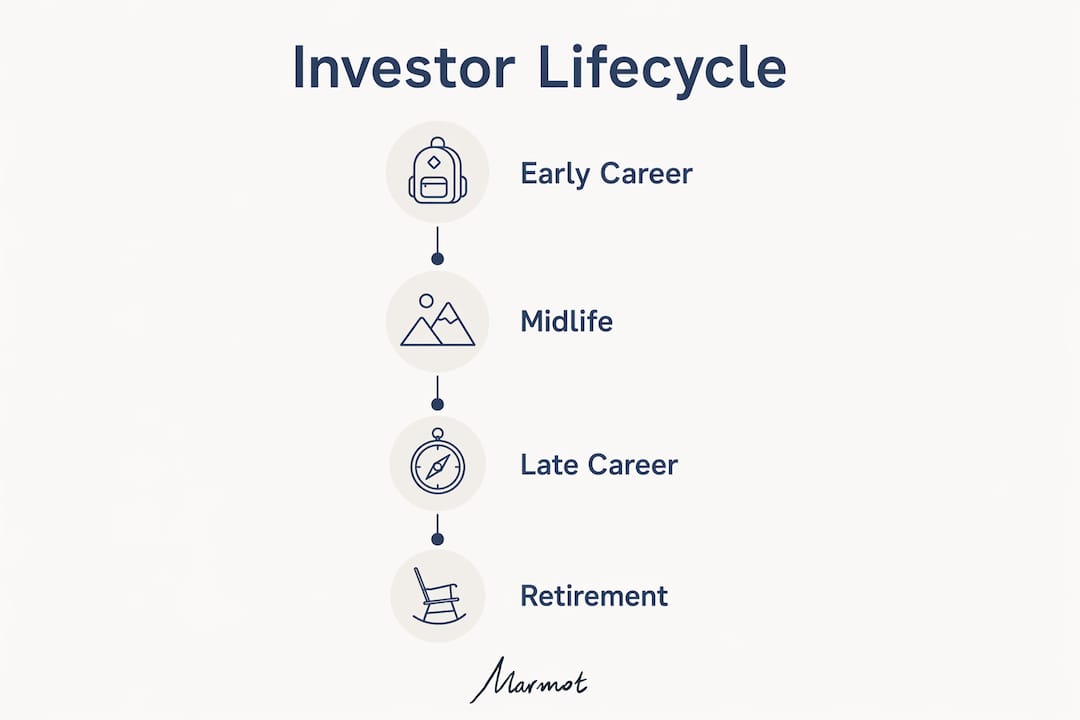
The female investor lifecycle maps wealth-building priorities across three broad phases, each with distinct risk tolerance, income patterns, and investment horizons. Understanding which phase you are in shapes every decision, from asset allocation to account type.
Early career: growth and accumulation (approximately ages 22–40)
The early career phase is the most powerful stage for long-term wealth building, because time is the primary asset. A woman who begins investing consistently at 25 has a significant compounding advantage over one who waits until 35. Risk tolerance is naturally higher here, since there is time to recover from market downturns. The priority is growth: high equity allocations, regular contributions, and building an emergency fund covering 3–6 months of expenses before investing surplus income.
Midlife: balancing growth and stability (approximately ages 40–55)

Midlife brings peak earning potential alongside competing financial demands: mortgages, school fees, and often caregiving responsibilities for both children and ageing parents. Portfolio construction shifts toward a blend of equities and fixed income, with greater attention to liquidity. Career breaks during this phase, which disproportionately affect women, can interrupt pension contributions and compound savings. Planning explicitly for these gaps is a defining feature of sound female investing strategies at this stage.
Pre-retirement and retirement: preservation and income (approximately ages 55 and beyond)
Capital preservation becomes the central goal as retirement approaches. The portfolio shifts toward bonds, dividend-paying equities, and cash equivalents. Women live longer than men on average, which means retirement savings must stretch further. Longevity planning, estate planning, and income generation from invested assets all become pressing priorities during this phase.
-
Prioritise building an emergency fund before directing surplus cash into investments.
-
Increase equity exposure in early career years and reduce it gradually as retirement nears.
-
Account explicitly for career breaks when projecting pension and savings contributions.
-
Review beneficiary designations and estate documents at each major life transition.
Pro Tip: Set a calendar reminder to review your portfolio allocation every year in january, and again after any significant life event such as a new job, marriage, or the birth of a child.
How can women implement tailored investment strategies at each life stage?
Portfolio construction for women follows the same core principles as any long-term investing plan, but the specific choices matter enormously when aligned with life stage realities.
Asset allocation by life stage
Portfolio allocation should shift progressively from growth-oriented to income-oriented as a woman moves through each phase of life. A useful starting framework looks like this:
| Life stage | Equity allocation | Fixed income and cash | Primary goal |
|---|---|---|---|
| Early career (20s–30s) | 80–90% | 10–20% | Long-term growth |
| Midlife (40s–50s) | 50–70% | 30–50% | Balanced growth and stability |
| Pre-retirement (55+) | 30–50% | 50–70% | Capital preservation and income |
These ranges are starting points, not rigid rules. A woman with a stable public-sector salary and no dependants at 45 may comfortably hold a higher equity allocation than the midlife bracket suggests. The best portfolio is dynamic, changing with your life’s realities rather than adhering strictly to textbook timelines.
The case for passive index funds
Passive index funds outperform roughly 85–90% of active stock pickers over long-term periods. That is a compelling argument for simplicity. Index funds tracking broad markets, such as the Swiss Market Index or a global equity index, carry expense ratios as low as 0.03–0.05%, meaning almost all of the return stays with the investor. For women building wealth across decades, the cost advantage compounds significantly.
Tax-advantaged accounts and liquidity
In the Swiss context, the Pillar 3a voluntary pension account offers tax deductions on contributions, making it a priority vehicle for employed women. For those with international exposure, structures equivalent to Roth accounts in other jurisdictions offer a useful feature: contributions can be withdrawn tax-free and without penalty at any time, effectively creating a flexible emergency fund alongside long-term growth. This dual function makes them particularly valuable for women who anticipate career interruptions.
Automating contributions removes the need to make an active decision each month. Investing CHF 500 monthly into a diversified index fund requires one decision, not twelve. That simplicity reduces decision fatigue and keeps wealth-building on track through busy or stressful periods.
Pro Tip: Set up an automatic monthly transfer to your investment account on the same day your salary arrives. Treating investing as a fixed expense, rather than an afterthought, is the single most reliable habit among long-term wealth builders.
What common challenges do women face in building wealth?
Women hold 52% of investment assets in households but make only 32% of investment decisions. That gap between ownership and agency is the central challenge in woman wealth building. Closing it requires addressing both structural barriers and behavioural patterns.
The most common obstacles include:
-
The confidence gap. Many women delay investing because they feel they do not know enough yet. Research consistently shows that female-led portfolios outperform male-led ones over time, largely because women trade less and react less to short-term market noise. The hesitation is not justified by the outcomes.
-
Excess cash holdings. Holding more cash than a 3–6 month emergency fund is a common pattern among women investors. That excess cash loses real value to inflation every year. Redirecting it into a diversified portfolio is one of the highest-impact adjustments available.
-
The perfection trap. Waiting for the perfect moment to invest is a form of delayed action with a measurable cost. 85% of women report regretting that they did not start investing sooner. The market does not reward waiting for certainty.
-
Decision paralysis. Too many choices can lead to no choice at all. Simplifying the investment menu to two or three diversified funds removes this barrier entirely.
The practical solution to most of these challenges is automation combined with education. Setting up automatic contributions to a low-cost index fund, then building financial knowledge gradually, is more effective than waiting until confidence feels complete. Confidence in investing grows through action, not through preparation alone. Marmot’s finance for women resources address these barriers directly, with practical first steps tailored to women at different starting points.
How should portfolios evolve through life changes and later stages?
Life events, not birthdays, are the real triggers for portfolio review. Marriage, a career break, an inheritance, or a shift to part-time work all change the financial picture in ways that a fixed allocation cannot accommodate.
The following sequence reflects how a thoughtful approach to portfolio evolution might look across a woman’s financial life:
-
Establish the foundation. Build an emergency fund, then begin contributing to a pension or tax-advantaged account. This is the non-negotiable first step before any investment portfolio is constructed.
-
Grow through accumulation. During early and midlife career years, direct surplus income into a diversified equity-heavy portfolio. Reinvest dividends automatically. Review family financial milestones annually to keep goals aligned with life changes.
-
Rebalance after major events. Rebalancing annually or after significant life events maintains alignment between the portfolio and current goals. A portfolio that started at 80% equities will drift higher after a strong market year and needs trimming back to target.
-
Shift toward income. From the mid-50s onward, gradually increase fixed income and dividend-paying equity holdings. The goal shifts from growing the pot to generating reliable income from it.
-
Plan for longevity and legacy. Women’s longer life expectancy means retirement savings must last, potentially, 30 years or more. Estate planning, including wills, powers of attorney, and beneficiary designations, should be reviewed every three to five years.
The women’s wealth building roadmap published by Marmot provides a structured framework for each of these transitions, adapted to the Swiss and European regulatory context.
Key takeaways
Women who align their investment approach with their life stage build wealth more consistently and with less stress than those who apply a one-size-fits-all strategy.
| Point | Details |
|---|---|
| Start early and automate | Monthly contributions to a low-cost index fund, set up automatically, outperform sporadic lump-sum investing over time. |
| Match allocation to life stage | Shift from high equity in early career to higher fixed income pre-retirement, adjusting for personal circumstances. |
| Address the confidence gap | Female-led portfolios historically outperform; hesitation is the real risk, not the market. |
| Rebalance after life events | Review and rebalance annually and after major changes such as marriage, career breaks, or inheritance. |
| Plan for longevity | Women’s longer life expectancy requires retirement income planning that extends well beyond standard projections. |
What I have learned from working with female investors
The most consistent pattern I observe among women who build real, lasting wealth is not that they picked the right stocks or timed the market well. It is that they started, stayed consistent, and did not let perfect become the enemy of good.
What surprises many women I work with is the realisation that their natural investing instincts, patience, discipline, and a reluctance to trade on impulse, are genuine advantages. Studies from Wells Fargo and Vanguard attribute the outperformance of female investors directly to these traits. The financial industry has spent decades telling women they need to be bolder. The data suggests the opposite: the habits women already have are exactly what long-term wealth building requires.
The one area where I do push women to act differently is on cash. Holding large cash reserves feels safe, but it is a slow drain on wealth. Inflation erodes purchasing power every year. Moving excess cash into a diversified portfolio, even gradually, is one of the most concrete steps a woman can take toward financial independence. If you are unsure where to begin, starting with the basics is always the right move.
My honest advice: do not wait until you feel ready. Build the habit first. The knowledge follows.
— Sophie Steinmann
How Marmot supports women at every investing stage
Marmot is Switzerland’s only FINMA-accredited wealth manager built exclusively for women and families. Over 350 women have already worked with Marmot to build structured, personalised investment plans that reflect their actual life circumstances, not a generic template. Marmot’s hybrid approach combines one-to-one financial coaching with digital tools, including the Money Makeover Quiz, to give every client a clear picture of where they stand and what to do next. Whether you are at the beginning of your investing life or approaching retirement, Marmot’s expert wealth management team can help you build a plan that works for your stage, your goals, and your timeline.
FAQ
What is the female investor lifecycle?
The female investor lifecycle is a framework that maps investment priorities, risk tolerance, and portfolio strategies to the distinct financial stages of a woman’s life, from early career through to retirement and estate planning.
How much should a woman invest each month?
Investing 10–15% of gross income is a widely used benchmark. Starting with a smaller amount and increasing contributions over time works well, because long-term compounding rewards consistency more than size.
Why do women often outperform male investors?
Female investors outperform because they trade less frequently, react less to short-term market volatility, and maintain consistent contributions. Research from Wells Fargo and Vanguard attributes this advantage to patience and discipline.
What is the biggest investing mistake women make?
Holding excess cash beyond a 3–6 month emergency fund is one of the most common and costly errors. That cash loses real value to inflation each year and would generate significantly more wealth if invested in a diversified portfolio.
How often should a woman rebalance her portfolio?
Annual rebalancing is the standard recommendation, with additional reviews triggered by major life events such as marriage, a career change, or approaching retirement. Consistent rebalancing keeps the portfolio aligned with current goals and risk tolerance.

.webp)





.jpeg)


.svg)


