
.jpg)
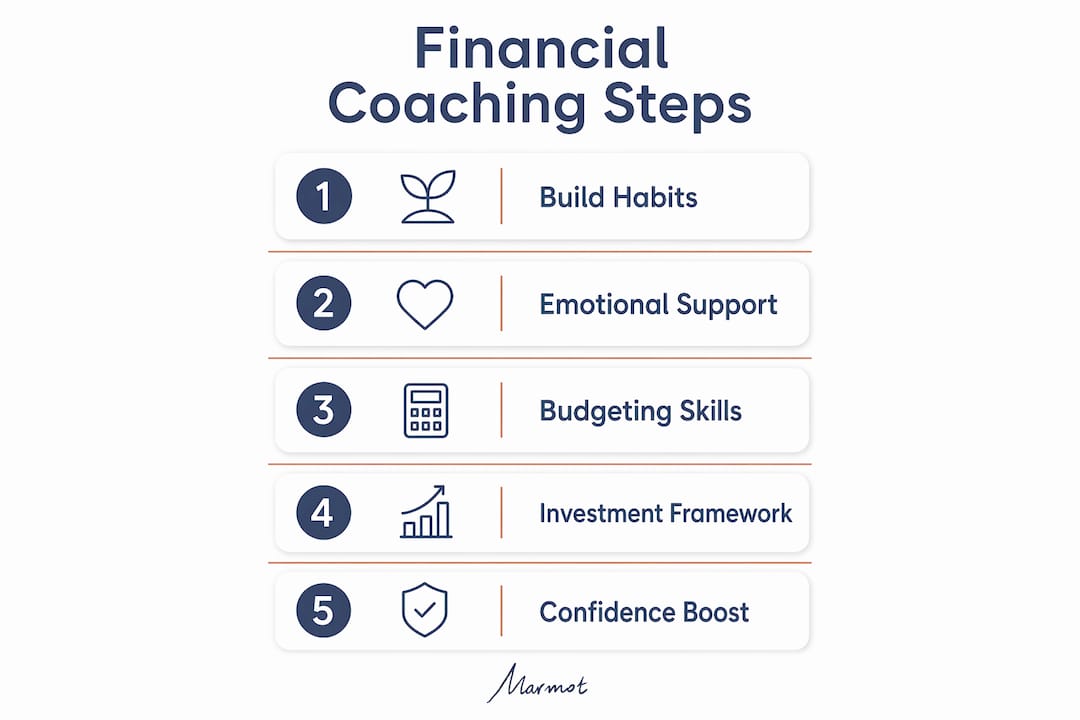
A financial coach for women is a professional who builds the behavioural foundation that makes real investing possible. Where a financial adviser recommends products, a coach reshapes how you think about and act with money. This distinction matters enormously, especially in Switzerland, where women face a specific combination of pay gaps, career interruptions, and a complex pension system that demands more than generic advice. The role of a financial coach for women goes far beyond budgeting tips. It is about building the confidence and habits that turn financial awareness into lasting independence.
How does financial coaching differ from financial advising?
Financial coaches focus on budgeting, saving habits, and the behavioural side of money rather than recommending specific investments. They cannot legally select stocks or construct portfolios for you. That is the domain of a licensed financial adviser or a FINMA-regulated wealth manager. The distinction is not a technicality. It shapes what you should expect from each professional and how you use them together.
Think of it this way. A woman in Zürich going through a divorce needs two things at once: someone to help her process the emotional weight of suddenly managing finances alone, and someone to restructure her portfolio. A coach handles the first. An adviser handles the second. Confusing the two leads to missing behavioural gains that are genuinely necessary for long-term financial independence.
In Switzerland, the regulatory environment reinforces this split. FINMA licences cover investment advice and asset management. Financial coaching sits outside that framework, which means coaches have more freedom to work on mindset, accountability, and money habits without the compliance overhead of regulated advice. For women in cities like Lausanne or Basel who are building financial confidence from scratch, this is actually an advantage. A coach can meet you where you are emotionally, without the formality of a regulated advisory relationship.
Pro Tip: If you are unsure whether you need a coach or an adviser, ask yourself this: do you know what you should be doing with your money but keep not doing it? That is a coaching problem. Do you not know what to invest in? That is an advisory problem. Most women need both.
Why is financial coaching especially important for women in Switzerland?
Women’s financial lives do not follow a straight line. Career breaks for caregiving, part-time work during school years, and the Swiss three-pillar pension system all interact in ways that create real gaps in retirement readiness. Life-stage transitions such as divorce, widowhood, and caregiving directly affect cash flow and long-term wealth accumulation. A financial coach helps you adapt your plan to these realities rather than pretending they do not exist.
The emotional dimension is just as real. Financial coaching helps women convert awareness into action by addressing the anxiety and shame that often surround money. Many women know they should be investing more into their third pillar or reviewing their pension fund contributions, but they delay because the whole subject feels overwhelming. Coaching breaks that cycle by creating small, repeatable steps that build momentum.
The numbers make the urgency clear. An HSBC and Ipsos survey from 2026 found that only 32% of women feel prepared for long-term care costs, and just 29% feel ready for the financial demands of ageing. That is a striking gap given that women in Switzerland typically live several years longer than men, meaning their retirement savings need to stretch further. Coaching that is aligned to life stages directly addresses this preparedness gap.
“Financial coaching is not about fixing what is broken. It is about building what was never taught.” This framing, drawn from the work of Her Time Therapy, captures why so many women in Switzerland find coaching transformative. The Swiss education system does not teach personal finance. Coaching fills that gap in a way that is personal, practical, and free of judgement.
Women in St Moritz managing inherited wealth, women in Zug navigating equity compensation from international employers, and women in Lucerne returning to work after a career break all face different versions of the same challenge: turning financial knowledge into consistent financial behaviour. That is precisely what a good coach delivers.
What asset allocation strategies do coaches recommend for women in Switzerland?
A financial coach does not pick your investments, but a good one will help you build the decision-making framework that makes asset allocation consistent and sustainable. For women investors in Switzerland, that framework typically involves three core asset classes: Swiss equities, private equity, and Swiss real estate.
Swiss equities, particularly through the SMI or broadly diversified Swiss equity funds, offer stability and dividend income in CHF. For women who hold CHF accounts, this reduces currency risk while providing exposure to globally competitive companies like Nestlé, Roche, and Novartis. Private equity, accessed through Swiss-based funds or platforms available to qualified investors, offers higher long-term return potential at the cost of liquidity. A coach helps you decide how much illiquidity you can genuinely tolerate given your life stage and cash flow needs.
Swiss real estate, whether through direct ownership or listed real estate funds such as those traded on the SIX Swiss Exchange, provides inflation protection and income. For women in Davos, Verbier, or Zermatt who may already own property, a coach helps assess whether that concentration is appropriate or whether diversification into financial assets makes more sense.
The practical role of coaching here is automating investment decisions and building routines that survive market volatility. Women who have a clear, pre-agreed asset allocation and automatic monthly contributions are far less likely to make emotional decisions during a market downturn. The coach’s job is to set up that structure and hold you accountable to it.
| Asset class | Role in a Swiss women’s portfolio |
|---|---|
| Swiss equities (SMI/broad funds) | Core CHF-denominated growth and dividend income |
| Private equity | Long-term return enhancement for investors with sufficient liquidity |
| Swiss real estate funds (SIX-listed) | Inflation protection and stable income without direct property management |
| Third pillar (Pillar 3a) | Tax-efficient retirement savings, maximised annually |
| EUR/USD diversification | Currency diversification for international clients managing multi-currency accounts |
Pro Tip: Maximise your Pillar 3a contribution every year before looking at other investment vehicles. In 2026, the limit for employed women is CHF 7,258. It is the most tax-efficient investment available to you in Switzerland and coaching helps you build the habit of treating it as non-negotiable.
How does ongoing coaching improve financial confidence and independence?
The evidence on this is clear. CFP Board research shows that clients working with qualified financial professionals maintain better emergency funds, feel more financially comfortable, and report lower financial stress over time. The same study found that 73% of clients strongly trust their advisers compared to 52% for those without professional support. Although this research is not Switzerland-specific, it supports the broader value of ongoing professional guidance. Trust is not a soft metric. It translates directly into consistent behaviour and better long-term outcomes.
For women in Switzerland, this ongoing relationship is particularly valuable because financial circumstances change frequently. A woman in Basel who starts coaching while employed full-time will have very different needs five years later if she takes a career break or receives an inheritance. Coaching as a partnership means those transitions are planned for rather than reacted to.
The confidence gains are cumulative. Women who work with a coach over 12 to 24 months consistently report that they feel more capable of making financial decisions independently. That is the goal. Good coaching does not create dependency. It builds the financial competence that eventually makes the coach less necessary. For women in Zug, Wollerau, or Küsnacht managing significant assets, that growing confidence is what separates reactive wealth management from genuinely goal-based investing.
You can explore financial independence strategies that complement coaching and help you build a clear roadmap for where you want to be financially in five, ten, and twenty years.
Key takeaways
A financial coach for women builds the behavioural habits and emotional confidence that make consistent, goal-based investing possible across every life stage.
| Point | Details |
|---|---|
| Coaching vs advising | Coaches address behaviour and mindset; advisers handle portfolio construction and regulated investment recommendations. |
| Life-stage alignment | Coaching is most valuable during transitions such as divorce, career breaks, and inheritance, when financial plans need to adapt quickly. |
| Swiss asset allocation | A balanced portfolio of Swiss equities, private equity, real estate funds, and Pillar 3a contributions forms a strong foundation for women investors. |
| Confidence and trust | CFP Board research shows professionally supported clients report significantly higher trust, lower stress, and better financial preparedness. |
| Ongoing accountability | Regular coaching checkpoints prevent emotional decision-making and keep investment strategies on track through market volatility. |
Why I think most women underestimate what coaching actually does
Most women I speak with come to coaching expecting to be told what to invest in. When they realise that is not what coaching does, some are initially disappointed. But the ones who stay and do the work almost always say the same thing six months later: they wish they had started sooner.
The reason is simple. Knowing what to do with money is not the hard part. The hard part is doing it consistently when life gets complicated, when markets fall, when a relationship ends, or when an unexpected expense derails a savings plan. That is where coaching earns its value. It is not the advice itself. It is the structure and accountability that makes the advice stick.
I have seen women in Zürich with sophisticated investment knowledge who still had not set up a Pillar 3a because the admin felt overwhelming. I have worked with clients in Geneva who understood diversification perfectly but kept their entire net worth in a single property because selling felt emotionally impossible. Coaching addresses the gap between knowing and doing. That gap is where most financial plans fail.
The other thing I would say is this: do not wait until you feel ready. The women who benefit most from coaching are not the ones who already have everything sorted. They are the ones who are willing to look honestly at their financial habits and commit to changing them. That takes courage, not expertise.
— Sophie Steinmann
How Marmot supports women investors across Switzerland

Marmot is Switzerland’s only FINMA-accredited wealth manager built exclusively for women and families. The approach combines personal coaching with a structured investment strategy, covering Swiss equities, private equity, and real estate across key Swiss locations including Zürich, Basel, Geneva, and Davos. Whether you are managing a CHF, EUR, or USD account, Marmot tailors your asset allocation to your life stage and goals rather than applying a generic template. Over 350 women have already worked with Marmot to build genuine financial independence. If you are ready to move from knowing to doing, explore wealth management for women or learn more about wealth management in Geneva to see how personalised coaching and investment management work together in practice.
FAQ
What does a financial coach for women actually do?
A financial coach helps women build healthy money habits, overcome emotional barriers around spending and saving, and create accountability structures for reaching financial goals. Unlike a financial adviser, a coach does not recommend specific investments or manage a portfolio.
How is financial coaching different from financial advising in Switzerland?
Financial advisers in Switzerland operate under FINMA regulation and provide licensed investment advice and portfolio management. Financial coaches work outside that regulatory framework, focusing on behaviour, budgeting, and financial confidence rather than product recommendations.
When should a woman in Switzerland consider working with a financial coach?
The most valuable times are during major life transitions such as divorce, returning to work after a career break, receiving an inheritance, or approaching retirement. These are moments when financial plans need to adapt and emotional clarity is just as important as technical knowledge.
Can financial coaching improve investment returns for women?
Coaching does not directly select investments, but research from CFP Board shows that professionally supported clients maintain better financial habits, lower stress, and more consistent investment behaviour, all of which contribute to stronger long-term outcomes.
How do I choose a financial coach as a woman in Switzerland?
Look for a coach with experience working with women on Swiss-specific financial challenges, including the three-pillar pension system and Swiss tax planning. Clarity on what the coach does and does not cover, particularly around investment advice, is a good sign of professionalism. You can also read more about financial advice for women to understand what a tailored approach looks like in practice.

.webp)





.jpeg)




.png)

.svg)


