

Financial risk management is the practice of safeguarding your investment portfolio by systematically identifying, assessing, and mitigating financial risks through diversification, due diligence, and regulatory compliance. For investors in Küsnacht, this means aligning your risk strategies with Swiss regulations, including FINMA guidance and FinSA suitability requirements, while using practical tools to protect what you have built. Whether you manage a discretionary portfolio or work with a wealth manager, understanding how to manage financial risks is the foundation of any sound investment strategy. The goal is not to eliminate risk entirely. It is to understand it clearly and act on it deliberately.
What are the key risks investors face in Küsnacht portfolios?
FINMA’s 2026 guidance identifies four primary risk categories in individual portfolio management: concentration, liquidity, valuation, and conflicts of interest. Each one can quietly erode your portfolio if left unaddressed.
Concentration risk arises when too large a share of your portfolio sits in a single asset, sector, or geography. A Küsnacht investor with heavy exposure to Swiss real estate or a single technology stock faces significant downside if that market shifts. Concentration is one of the most common failures FINMA flags in its oversight of portfolio managers.
Liquidity risk is the risk that you cannot sell an investment quickly without taking a significant loss. Complex or illiquid products, such as certain structured notes or private equity funds, can lock up capital at exactly the wrong moment. FINMA’s guidance specifically highlights failures in disclosing liquidity constraints to clients.
Valuation risk occurs when the stated price of an asset does not reflect its true market value. This is particularly relevant for alternative investments and over-the-counter instruments, where pricing is less transparent. Investors who do not scrutinise valuations regularly can hold positions that look healthy on paper but carry hidden losses.
Conflicts of interest represent a subtler but equally serious risk. FINMA’s guidance points to frequent issues with inadequate product governance, where managers select products that benefit them rather than the client. Transparent conflict management is not optional under Swiss law. It is a core obligation for any regulated wealth manager operating in Küsnacht.
Under Swiss FinSA and FinIA, portfolio managers must also meet suitability and appropriateness requirements before making investment decisions on your behalf. FinSA standards require full documentation of your financial situation, objectives, risk tolerance, and investment experience. Non-compliance exposes firms to direct liability.
How can investors implement practical risk management techniques?
Diversification and portfolio rebalancing are the foundational tools of investment risk management. They reduce the probability of large losses and help maintain your intended asset allocation as markets move. These are not one-time fixes. They are ongoing processes that require regular attention.
Beyond diversification, downside protection tools give you a more active layer of defence. Put options, stop-loss orders, and derivatives each offer ways to limit losses in falling markets, but they come with trade-offs. Put options cost a premium. Stop-loss orders can trigger in volatile markets before a recovery. Derivatives require careful management to avoid introducing new risks. The effectiveness of any downside protection tool depends on its timing, cost, and alignment with your actual drawdown tolerance.
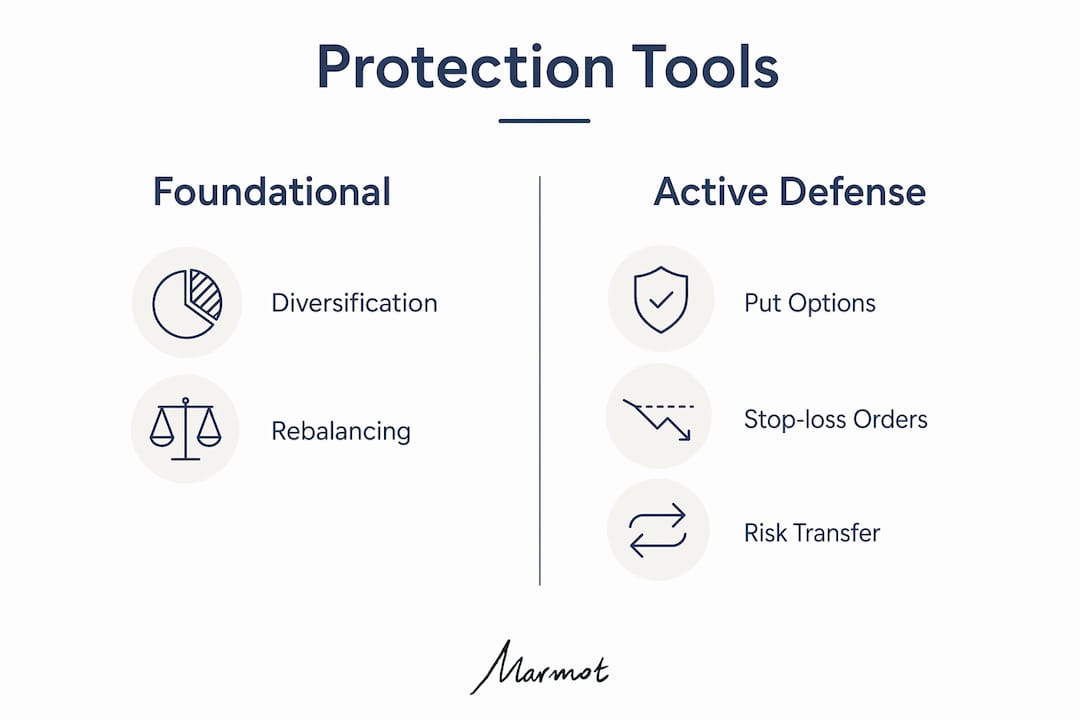
The table below compares the main protection tools available to Küsnacht investors.
| Tool | How it works | Key trade-off |
|---|---|---|
| Diversification | Spreads exposure across assets, sectors, and geographies | Reduces upside concentration as well as downside |
| Portfolio rebalancing | Restores target allocation after market movements | Requires discipline and may trigger tax events |
| Put options | Gives the right to sell at a set price, limiting losses | Costs a premium that reduces net returns |
| Stop-loss orders | Automatically sells when price falls below a threshold | Can trigger prematurely in short-term volatility |
| Risk transfer (insurance) | Shifts specific risks to a third party | Adds cost; requires careful contract terms |
Risk transfer through insurance or contractual agreements shifts the financial impact of certain risks to a third party. This approach is most cost-effective when internal mitigation is impractical or when the potential loss exceeds your capacity to absorb it. For families and high-net-worth investors in Küsnacht, this might mean using structured insurance products alongside a diversified portfolio.
Integrating these tools into a risk budgeting framework is what separates reactive investing from deliberate planning. Risk budgeting means deciding in advance how much risk you are willing to accept across your portfolio, then allocating protection tools accordingly. This keeps the cost of protection proportionate to your actual exposure rather than ad hoc.
Pro Tip: Review your downside protection tools at least once a quarter. Market conditions change, and a put option or stop-loss level set six months ago may no longer reflect your current risk profile or portfolio composition.
What are the steps for ensuring regulatory compliance and suitability?
Swiss FinSA sets a clear process for suitability assessments in discretionary portfolio management. Following this process protects both you and your manager.
Step 1: Document your financial profile. Your manager must record your current financial situation, including assets, liabilities, income, and liquidity needs. This is not a formality. It is the baseline against which every investment decision is measured.
Step 2: Clarify your investment objectives. Are you focused on capital preservation, income generation, or long-term growth? Your objectives determine which asset classes and risk levels are appropriate. A Küsnacht investor approaching retirement has different objectives from one building wealth over a 20-year horizon.
Step 3: Assess your risk tolerance and experience. FinSA requirements include a formal assessment of your experience with financial instruments and your capacity to absorb losses. This shapes which products your manager can recommend or include in your portfolio.
Step 4: Retain all supporting documentation. Your manager must keep records that demonstrate each investment decision was suitable at the time it was made. This documentation protects you if a dispute arises and provides a clear audit trail for regulators.
Step 5: Update your profile regularly. Life changes. A divorce, inheritance, career shift, or change in health can all alter your financial situation and risk tolerance. Your manager should revisit your profile at least annually and after any significant life event.
Step 6: Disclose and manage conflicts of interest. Your manager must identify any conflicts between their interests and yours, disclose them clearly, and take steps to mitigate them. This includes disclosing any fees, commissions, or incentives tied to specific products in your portfolio.
Proper Küsnacht wealth management integrates all six steps into a continuous cycle rather than treating compliance as a box-ticking exercise.
How does ongoing monitoring and conflict management enhance portfolio protection?
Regular risk monitoring enables rapid responses when market conditions shift or your risk profile changes. Detecting when risk levels exceed your tolerance early means your manager can make adjustments before losses compound. Waiting for an annual review is not enough in volatile markets.
Product-level due diligence is a specific obligation under FINMA’s 2026 guidance. Your manager cannot treat the initial selection of a product as a permanent decision. They must monitor each product’s ongoing suitability, liquidity profile, and valuation regularly. This is particularly relevant for complex instruments like structured products or alternative funds, where conditions can change significantly after purchase.
Conflict of interest management sits at the heart of good portfolio governance. Effective conflict controls within Swiss wealth management firms support transparent product selection and improve due diligence quality. When your manager has clear policies for identifying and managing conflicts, you can trust that product recommendations reflect your interests rather than theirs.
Regular communication between you and your manager is the practical mechanism that makes all of this work. A quarterly review call, a written update on portfolio changes, and a clear explanation of any new products or shifts in strategy keep you informed and in control. Investors who stay engaged with their managers are better placed to catch problems early and make confident decisions when circumstances change. You can also explore investment strategies for 2026 to stay informed about broader market approaches that complement your risk management framework.
Key takeaways
Effective financial risk management in Küsnacht requires combining Swiss regulatory compliance, practical protection tools, and continuous portfolio monitoring to preserve and grow your investments with confidence.
| Point | Details |
|---|---|
| Know your key risks | Concentration, liquidity, valuation, and conflicts of interest are the four risks FINMA flags most often. |
| Use layered protection tools | Combine diversification, rebalancing, and downside protection instruments within a risk budgeting framework. |
| Follow the FinSA suitability process | Document your financial profile, objectives, and risk tolerance, and update them regularly. |
| Monitor continuously | Review products and portfolio risk levels at least quarterly, not just annually. |
| Demand conflict transparency | Ask your manager how they identify and manage conflicts of interest in product selection. |
Why suitability assessments are more than paperwork
I have spoken with many investors in Küsnacht who assume their manager’s suitability assessment is a compliance formality. A form gets signed, a box gets ticked, and everyone moves on. That assumption is one of the most expensive mistakes I see.
Suitability assessments under FinSA require active engagement, evidence retention, and follow-up. They are living documents, not one-time signatures. When I look at portfolios that have underperformed or suffered avoidable losses, the pattern is almost always the same: the risk profile was set once and never revisited, or the documentation does not reflect what actually happened in the portfolio.
The other pitfall I see regularly is over-concentration. Investors who have built wealth through a single business or sector often carry that same concentration bias into their investment portfolios. It feels familiar and therefore safe. It is not. Spreading exposure across asset classes, currencies, and geographies is not a sign of indecision. It is the most reliable way to protect what you have built.
My honest advice is this: ask your manager to show you how they document suitability decisions and how they manage conflicts of interest. If they cannot answer clearly, that tells you something important. Good wealth management in Küsnacht is built on transparency, not complexity.
— Sophie Steinmann
How Marmot supports investors in Küsnacht with risk management
Marmot is a FINMA-accredited wealth manager with deep expertise in building portfolios that balance growth with genuine risk protection for investors in Küsnacht and across Switzerland.

Marmot combines personal consultations with clear digital tools to help you understand your risk profile, meet FinSA suitability requirements, and build a portfolio aligned with your real financial goals. Whether you are focused on capital preservation, long-term growth, or preparing for retirement, Marmot’s approach puts your interests at the centre of every decision. Over 350 clients have already improved their financial outcomes with Marmot’s guidance. If you are ready to take a clearer view of your investment risks, speak with Marmot’s team to get started.
FAQ
What is financial risk management in investment portfolios?
Financial risk management is the process of identifying, assessing, and mitigating risks that could reduce the value of your investments. It includes diversification, downside protection tools, regulatory compliance, and ongoing portfolio monitoring.
What risks does FINMA highlight for Küsnacht portfolio managers?
FINMA’s 2026 guidance identifies concentration, liquidity, valuation, and conflicts of interest as the primary risks in individual portfolio management. Managers are required to address all four through ongoing due diligence and transparent disclosure.
What is a suitability assessment under Swiss FinSA?
A suitability assessment is a formal process where your portfolio manager documents your financial situation, investment objectives, risk tolerance, and experience before making investment decisions on your behalf. Records must be retained to demonstrate compliance.
How often should I review my investment risk profile?
Your risk profile should be reviewed at least annually and after any significant life change, such as a career shift, inheritance, or change in family circumstances. Markets and personal situations both evolve, and your portfolio should reflect that.
How does risk transfer work as an investment protection strategy?
Risk transfer shifts the financial impact of specific risks to a third party, typically through insurance or contractual agreements. It is most effective when the cost of internal mitigation exceeds the cost of transferring the risk to a specialist provider.


.webp)





.jpeg)




.png)

.svg)


