A family in Meggen that inherits wealth has three jobs, in this order: complete the legal formalities with the local division authority, understand what Lucerne tax and Swiss inheritance law mean for each heir, and only then decide how to invest what has arrived. Most mistakes happen when the third step is rushed before the first two are finished. This guide walks through all three in plain language, with the Meggen and Canton Lucerne specifics, and explains how we at Marmot Finance think about the investment side.
Marmot Finance
Plan Your Next Financial Chapter
Marmot Finance helps women and families in Switzerland shape tailored investment strategies around their financial profile, with personal consultations and digital tools.
TL;DR
- Any will that turns up must be handed to the Meggen division authority (Teilungsbehörde) straight away, even if you think it is invalid.
- In Canton Lucerne, spouses and partners are exempt from inheritance tax, and descendants pay nothing up to CHF 100,000. Above that, a rate of 1 to 2% can apply depending on the municipality.
- Since 1 January 2023, children's compulsory share is smaller and parents no longer have one, so older wills may deserve a fresh look.
- Do not invest in a hurry. Settle debts, taxes and liquidity needs first, then build a plan around the family's goals and time horizon.
The first weeks: what to do in Meggen
The first steps are legal rather than financial, and they are simpler than most families fear. According to the municipality of Meggen, anyone who finds a will of a deceased person must submit it immediately to the division authority, even if they consider it invalid. The duty comes from Art. 556 of the Swiss Civil Code. It is not for the family to decide whether a document counts. The authority opens it and informs the people named in it.
If a will turns up in a drawer weeks later, the same rule applies. If you want to understand your obligations in more detail, wills and estates legal support can help you see how a document is checked and by whom. For Swiss matters, a lawyer admitted in Switzerland should handle the actual advice.
The second early step concerns debts. If it is hard to tell whether the deceased left more assets than liabilities, the heirs may ask for a public inventory. Meggen's own procedure page says this request must be made within one month of the death. One month is short, and it is easy to miss while a family is grieving. If there is any doubt about debts, ask the division authority about it in the first days rather than the first weeks.
A sensible checklist for the first month looks like this, written as a sequence rather than a to-do list to be ticked off in a hurry:
- Hand over any will or inheritance contract to the division authority.
- Gather statements for every bank account, pension asset, insurance policy and property.
- Decide with the whole family whether a public inventory is needed.
- Keep cash available for funeral costs, tax payments and running costs of any property.
- Leave invested assets alone until you know who owns what.
That last point is the one we repeat most often. Selling positions or moving money in the first weeks usually creates tax and legal questions that did not need to exist.
Who inherits, and what changed in 2023
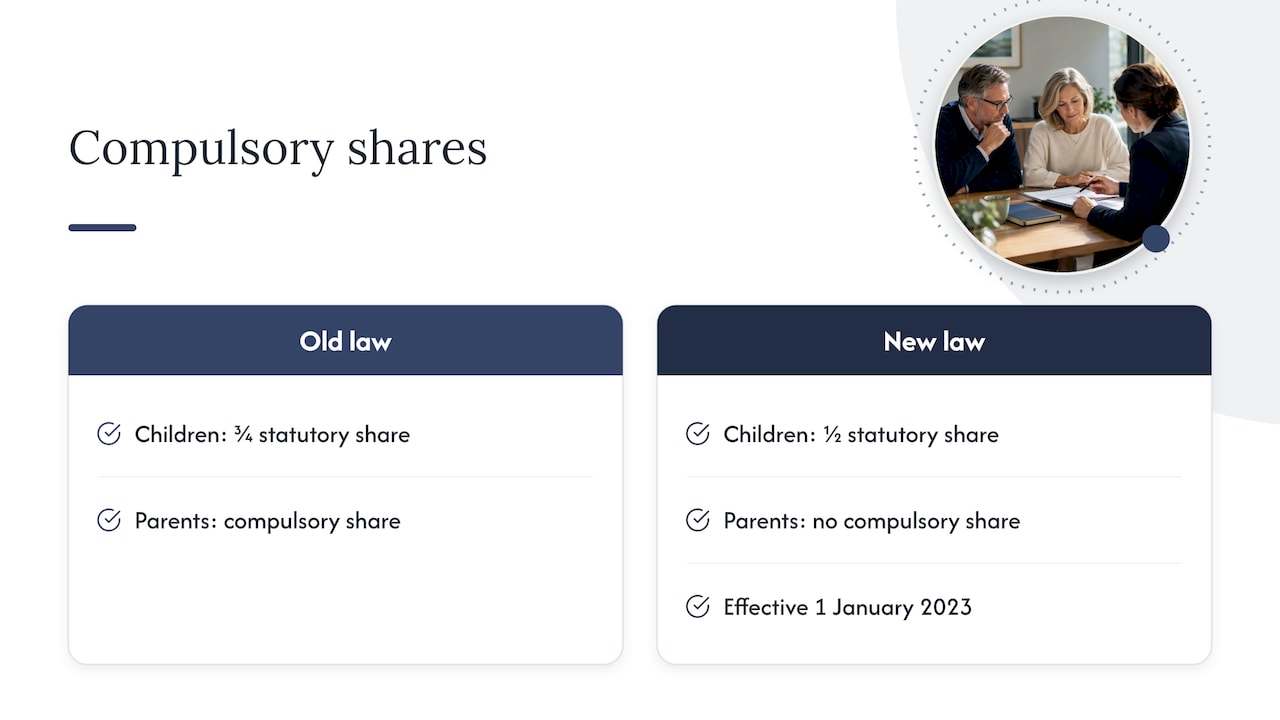
Swiss law protects close relatives through compulsory shares. A testator can decide freely over only the part of the estate that is not reserved. The rules changed with the revision of the inheritance law. The Federal Council's own announcement confirmed that children's compulsory portion falls to one half of their statutory share, down from three quarters, and parents lose theirs altogether. The revised law came into force on 1 January 2023.
In practical terms, the freely disposable part of an estate is larger than it used to be. A parent with two children and a spouse has more room to favour one person, support a stepchild, leave something to a charity or protect a family business. A will drafted before 2023 may not reflect the room the law now gives you, and it may no longer say what the person would want today.
Two further changes matter in family situations. According to a summary by a Swiss law firm, the right to a compulsory share between spouses is lost when divorce proceedings have been started, when spouses proceed by mutual consent, or when they have lived apart for more than two years. The same summary notes that the deceased may now assign half of the estate to the surviving spouse as property and the other half as usufruct, which is the right to use and earn income from assets without owning them.
For a family, this means the answer to "who gets what" depends on three things: the date of death, the family situation at that date, and what documents exist. If you are an heir and not sure which rules apply to you, ask a notary or lawyer before accepting any division proposal.
Inheritance tax in Meggen and Canton Lucerne
Swiss inheritance tax is cantonal, so the rules in Meggen are not the rules in Zug or Zurich. The Canton Lucerne tax office states that spouses, registered partners and life partners are exempt from inheritance tax, and descendants are exempt up to CHF 100,000.
Above CHF 100,000, the same page explains that direct descendants pay 1 to 2% where the deceased lived in a municipality that levies the tax on descendants, or, if the deceased lived outside the canton, where the inherited property is located in such a municipality. This is a point many families miss: the tax on children is not set only by the canton but also depends on the municipality. Before assuming any figure, ask the Lucerne tax office or the Meggen municipality how the rule applies to the exact case, including the deceased's last place of residence.
A simple example shows the scale. Suppose a child inherits CHF 400,000 from a parent who lived in a municipality that taxes descendants. The first CHF 100,000 is free. At a rate between 1 and 2%, the tax on the remaining CHF 300,000 would be roughly CHF 3,000 to CHF 6,000. That is an illustration only, since the exact calculation depends on the official rate and the case. It is not a reason for panic, but it is a bill that arrives with a deadline, so keep liquidity for it.

Relatives further away, such as siblings, nieces, nephews or unrelated beneficiaries, are treated differently, and the rates tend to be higher. If your family includes such heirs, read the canton's page in full or ask an adviser.
One more reminder from the cross-border side: wealth that moves between cantons or countries may be taxed by more than one authority. We come back to this below.
Planning a will to protect heirs and avoid disputes
Most inheritance disputes do not come from greed. They come from unclear intentions and uneven information. A Swiss legal overview on estate planning describes the aim of a diligent planner as a smooth, conflict-free transition to heirs, achieved by reducing potential sources of conflict. The same paper recommends documenting significant gifts made during a lifetime and stating how they affect the recipient's later inheritance claim.
That advice is easy to apply at home. If parents helped one child with a deposit for a flat in Meggen, write down whether this counts as an advance on the inheritance. If they did not, the other children may feel the family was treated unequally, and in Switzerland such gifts can also matter legally.
A few habits that reduce friction:
- Talk about the plan while everyone is well. A short family meeting is more useful than a perfect document that no one has read.
- Name an executor who is trusted by all and who has the time and nerves for it.
- Review the will after major events: a divorce, a birth, a business sale, a move abroad, and the 2023 reform if the will is older.
- Keep a clear list of assets, accounts and advisers, stored where the family can find it.
A will is a legal document and should be drafted or checked by a Swiss lawyer or notary. We are wealth managers, not lawyers, and we work alongside the legal specialists our clients choose.
Cross-border families and expatriates
Meggen is close to Lucerne and attracts international families. Many have a foreign passport, property in another country, or children studying abroad. In these cases two questions come first: which authorities deal with the estate, and which country's inheritance law applies.
A law firm's overview of the revision of Swiss international inheritance law explains that these are separate questions. The authority that handles the estate is not automatically the one whose law governs it. It also notes that foreign nationals living in Switzerland can choose the inheritance law of their home country, and that the revised rules aim to align Swiss practice more closely with the European Succession Regulation.
What this means in practice for a family:
- If the deceased held a foreign passport, check whether a choice of law was made and written down.
- If there are properties or accounts abroad, find out early whether a foreign authority claims jurisdiction and whether foreign inheritance tax can apply.
- If the family may move, for example to an EU country or back to a home country, review the plan before the move, not after.
We work with Swiss and European clients and manage accounts in CHF, EUR and USD. For cross-border cases, our role is the investment part. Legal questions about applicable law and tax filings in several countries belong with specialist lawyers and tax advisers, and we are glad to coordinate with them.
Turning an inheritance into a plan
Once the legal position is clear and the tax is paid, the money still has to be put to work. This is where many families feel stuck. An inheritance is often large compared with anything they have managed before, and it may come with emotions attached.
A calm order of questions helps.
Start with liquidity and debts
Set aside cash for taxes, outstanding bills, and any renovation or maintenance costs for inherited property. Then look at expensive debt. Paying off a loan with a high interest rate is a guaranteed return, which no portfolio can promise. A mortgage is a more personal decision, since it depends on the rate, the tax treatment and how comfortable you feel owing money.
Define what the money is for
The same sum can serve very different aims: a safety buffer, a home purchase, education for children, a pause in your career, retirement income, or wealth that is meant to pass on to the next generation. Each aim has its own time horizon, and the horizon decides how much risk is sensible. Money needed in two years should not sit in shares. Money meant for a child who is five years old can usually stay invested for far longer.
Look at what you actually received
Inherited wealth is rarely a neat pile of cash. It may contain a house, a concentrated holding in one company, a private pension asset, a portfolio of single stocks or a collection of old bank accounts. Concentration is a risk in its own right. If much of the value sits in one property or one company, spreading the rest of the money widely often makes sense. Broad ETFs and funds across regions and sectors are the usual building blocks for that part.
Do not decide in the first months of grief
There is rarely a financial reason to invest the whole sum immediately. Parking the money in a safe account for a few months while you work through the plan costs little, and avoids choices you may regret. When you do invest, many families prefer to do it in steps rather than in one move.
Keep costs and taxes in view
Fees reduce returns every year, so compare total costs, not only the headline rate. Tax treatment also differs between assets: in Switzerland, individuals pay wealth tax on assets at cantonal level, and the details depend on the canton. Your tax adviser can say how the inherited assets change your annual return.
The next generation and the long view
For a family, inherited wealth is not a single event. It is a transfer that continues over decades. Two questions come up again and again: how do you prepare children to handle money, and how do you avoid having the same discussion in 30 years?
We suggest simple, regular practice. Let teenagers see a real portfolio, even a small one, and explain why it is built the way it is. Give young adults a small amount to manage with a clear rule: they can make mistakes, but they must tell you what they learned. Introduce the topic of values early, because many younger heirs care about sustainability and want their money to reflect that. Thematic strategies, for example around sustainability, can make that conversation more concrete.
And for women in particular, who often inherit later in life and also tend to outlive their partners, it pays to be involved in decisions before an inheritance arrives. A woman who has never been involved in the family's money has to learn quickly at the worst moment. That is a reason to learn early, not a reason to hand control away.
Our perspective: clarity before returns
At Marmot Finance, we work exclusively with women and families in Switzerland and Europe, and inheritance conversations are some of the most important we have. Our observation is that the first question is almost never "which fund?" It is "what do we want this money to do for us, and who can I talk to without feeling judged?"
That is why our approach is hybrid. You can speak to a person, and you can also use digital tools such as the Money Makeover Quiz and a financial planner to get an overview at your own pace. Our portfolios are built around ETFs and funds, personalised to your situation, and we offer sustainability, gender and Best Talents themes for clients who want their values reflected. As a FINMA accredited wealth manager, we keep the legal and tax parts with the specialists and focus on what we do best: a calm, clear investment plan that fits the family's life.
If you have just inherited, our advice is the same as above. Do the legal steps first, keep some cash, and give yourself time. When you are ready, we will sit down with you and build the plan step by step.
How Marmot can help
We offer three levels of wealth management, and the management fee is charged annually on the assets we manage. According to our pricing page, Marmot Easy costs 0.65% per year, Marmot Premium 1.0-0.8% per year, and Marmot Select 0.8-0.4% per year, with the rate depending on the amount managed. We manage accounts in CHF, EUR and USD. For a first overview of what wealth management with Marmot looks like, including financial coaching, start there. If you prefer to learn first, our educational webinars and community events are open to women and families who are not yet clients.
FAQ
Do I have to hand in a will in Meggen even if I think it is invalid?
Yes. Under Art. 556 of the Civil Code, anyone who finds a will must submit it immediately to the division authority, according to the municipality of Meggen. The authority, not the finder, decides how it is dealt with. Delay can create legal problems for you.
Do children pay inheritance tax in Canton Lucerne?
Descendants are exempt up to CHF 100,000 according to the Canton Lucerne tax office. Above that, 1 to 2% can apply if the municipality of the deceased, or of the inherited property for an out-of-canton deceased, levies the tax on descendants. Check the exact position with the tax office.
Did the 2023 reform change who must inherit?
Yes. Children's compulsory portion was reduced from three quarters to one half of their statutory share, and parents no longer have a compulsory portion. The change gives the testator more freedom, so older wills are worth reviewing.
Should I invest an inheritance straight away?
Usually there is no need. Clarify the legal position, pay taxes and debts, and keep cash for near-term needs first. Then match the investments to your goals and time horizon, ideally in steps, with an adviser you trust.
Sources
- Verfahren, Teilungsamt Meggen
- Revidiertes Erbrecht tritt am 1. Januar 2023 in Kraft, admin.ch
- Entry into force of the reform of the Swiss Civil Code, succession law
- Erbschafts- und Schenkungssteuern, Kanton Luzern
- Estate Planning: the Swiss perspective
- Revision of Switzerland's international inheritance law, Lexology