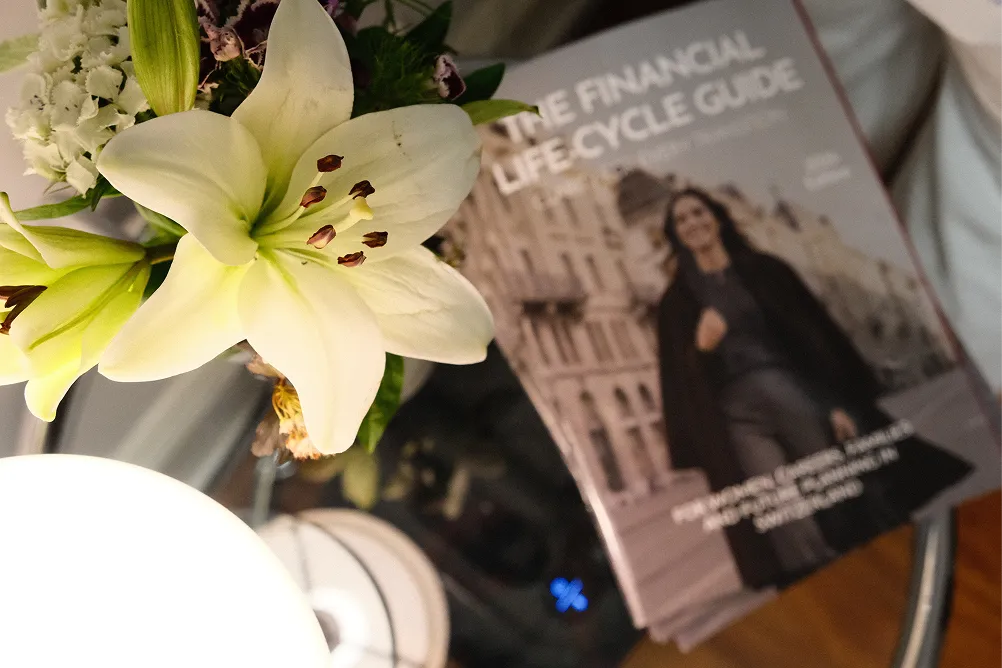
Protecting wealth in Verbier comes down to four things. Know what your chalet or apartment really costs to hold. Understand what Swiss banks do and do not guarantee. Know what Switzerland reports to your home tax authority. Make sure the rest of your money is not tied to the same place, currency or risk as your property. No country, bank or structure can guarantee safety, but a sound set-up reduces the damage when something goes wrong.
This guide is written for international investors, expatriates and families who own or are considering property in the Valais, and for those who hold the rest of their wealth in Switzerland.
Marmot Finance
Bring Your Investments Into Focus
Marmot Finance helps women and families in Switzerland build tailored investment strategies through personal consultations, digital tools and educational resources.
TL;DR
- A Verbier property is a tangible asset that can diversify a financial portfolio, but it carries fixed costs, maintenance, vacancy risk and changing rules, so it should not become the whole plan.
- Swiss cash deposits are protected up to CHF 100,000 per client and per legal entity through the banks' deposit scheme. Above that, the strength of the bank and the way assets are held matter.
- Swiss banks are no longer secret towards foreign tax authorities: account information is exchanged automatically with partner countries.
- Real diversification means spreading across assets, currencies and locations, not simply owning several funds.
- Review the plan whenever tax rules, your residence or your family situation change.
Why Verbier raises particular questions
Verbier is a concentrated market. Many owners hold a large share of their net worth in one alpine resort, often alongside a Swiss bank account, a business and a home elsewhere. That is a lot of value tied to one canton's tax rules, one tourism economy and one currency, the Swiss franc.
None of this is a reason to avoid Verbier. It is a reason to look at the whole picture. Wealth protection is less about a single clever product and more about avoiding a situation where one event, such as a tax change, a market fall, a divorce, a death or a move abroad, forces you to sell something at the wrong moment.
The sections below start with the property itself, then move to cash and investments, tax and reporting, and finally how to test whether your wealth is genuinely spread out.
Know what the property costs to hold
The first protection is a realistic cost picture. A property that looks like a stable asset can quietly drain returns if the running costs are underestimated.
According to a local agency's buyer information, purchase costs, including the notary, come to about 2.3% of the price, and annual property expenses, taxes and charges included, are in the region of CHF 70 per square metre. Another Verbier agency puts shared building charges at around CHF 50 per square metre, plus a contribution to the building's sinking fund, which pays for major repairs.
Then there is the local tourist tax. For owners it is a fixed annual sum, from CHF 320 for a studio to CHF 1,120 for a six-room property.
A simple example shows why this matters. Take a 100 m² apartment. At CHF 70 per square metre, annual expenses would be about CHF 7,000 before any renovation, insurance excess or periods without rental income. These figures come from agency sources and will vary by building, so ask the managing agent for the actual charge statements and the last three years of general assembly minutes before you buy or when you review an existing holding.

Who can buy
Foreign ownership of Swiss property is regulated. According to the Swiss SME portal, EU citizens living in Switzerland face the same purchase rules as Swiss citizens. EU entrepreneurs with a Swiss residence permit but a main residence abroad have the same rights only for business-use property, while holiday and second homes require authorisation. If you live outside Switzerland and Europe, the rules differ again, so confirm your situation with a notary before committing.
What happens when you sell
In the Canton of Valais, real estate capital gains tax is degressive: the rate falls the longer you have owned the property, as set out in the cantonal tax law. One local source describes the reduction as 4% per complete year from the sixth year of ownership. The cantonal law also allows deferral where the proceeds of a primary residence are reinvested in a new primary residence in Switzerland, subject to legal conditions. That deferral does not apply to a holiday home.
The practical lesson: the holding period is a protection in itself. Selling in a hurry within the first few years is the most expensive way to exit, so a property purchase should be funded with money you will not need at short notice.
Understand the tax changes around second homes
Swiss voters accepted on 28 September 2025 a reform that abolishes imputed rental value taxation. According to the Swiss Confederation, this is linked to a special property tax that cantons may introduce on second homes. Whether and how this affects you depends on how the canton of Valais and the commune implement it. A real estate guide from a Verbier agency states that the imputed rental value is scheduled to disappear from 1 January 2029.
For owners of a second home, this is a point to monitor rather than to panic about. Keep an eye on cantonal announcements, and when you model your returns, include a possible new annual tax as a sensitivity: what happens to your net yield if holding costs rise by a few hundred or a few thousand francs a year?
Swiss wealth tax is a separate matter. It is calculated on the taxable value of your assets, and mortgage debt can be deducted. The tax authority's guide for new taxpayers explains that cantons and communes tax residents on their movable assets, and on immovable assets where they are located, and that taxable wealth includes assets in Switzerland and abroad, such as real estate, securities, bank balances, cash and precious metals.
On succession, one local source notes that there is no tax on direct inheritance in the Canton of Valais. That applies to Swiss tax only. If you or your heirs live in another country, that country's inheritance rules may still apply, and this is where cross-border advice from a tax specialist pays for itself.
What protects your cash and investments in Switzerland
Many people assume that a Swiss account is safe by definition. It is better to know precisely what is and is not covered.
Cash deposits
Switzerland's deposit protection scheme is run by esisuisse, the self-regulatory body of Swiss banks. According to its website, protected deposits are covered up to CHF 100,000 per client and per legal entity if a bank fails. All banks with a branch in Switzerland must be members.
In practice, this means that large cash balances at a single bank are only partly covered. If you hold CHF 600,000 in cash at one institution, most of it sits outside the guarantee. Spreading cash across banks, or moving surplus cash into investments held as custody assets, is a basic protective step.
Securities held in custody
Shares, bonds and fund units held in a custody account are generally treated differently from cash. Under Swiss banking law, securities held for clients are segregated from the bank's own assets in the event of insolvency. The details, including the position of non-bank providers, can differ, so ask your provider to explain in writing how your assets are held and who the custodian is. Fund units in particular sit in a separate legal structure from the manager.
Two questions are worth asking any provider:
Who holds my assets, and is that institution supervised by FINMA? And are my securities separate from the provider's balance sheet?
What nobody guarantees
None of these protections cover investment losses. If markets fall, your portfolio falls with them. Protection against market risk comes from diversification, from an investment horizon that matches your needs and from avoiding forced selling. That brings us to the main point.
Are Swiss bank accounts still secret?
No, not towards your home tax authority. Under the automatic exchange of information, Swiss banks, collective investment vehicles and insurance companies collect account balances and investment income of foreign tax residents and pass them to the Federal Tax Administration. According to the Federal Tax Administration, it forwards the data to the relevant foreign tax authorities. Switzerland takes part in a standard that more than 100 countries have committed to adopting.
Bank secrecy still exists in a limited sense: Swiss banks do not freely disclose client information to private parties. But for tax purposes, transparency is the rule.
For international investors, the consequence is simple. Declare your Swiss accounts and your Verbier property where your home country requires it. Doing so is not just a legal obligation, it also removes the biggest long-term risk of all, which is an undeclared position that surfaces years later with penalties attached.
Avoiding double taxation on dividends
If you receive dividends or interest from abroad, withholding tax may be deducted at source. Switzerland offers a form, the DA-1, through which eligible taxpayers can request a credit for non-recoverable foreign withholding tax. The 2026 form applies to income due in 2026 and is subject to conditions, including a CHF 100 threshold. It is a small administrative step, but over the years it can recover real money. Check the current form each year.
Is your wealth really diversified?
Owning a chalet, a Swiss equity fund and a Swiss bank account may feel like three different assets. In a crisis they can behave alike: they all depend on Swiss economic conditions, Swiss tax policy and, for you, the Swiss franc.
Diversification can be tested on three levels.
By asset class
List everything you own and group it into property, shares, bonds, cash, business interests and other assets. Express each group as a percentage of your total net worth. If property exceeds roughly a third to a half of your total, or one business or employer makes up a large share of your income and your assets, you have a concentration. There is no universal threshold, and the right level depends on your needs, but seeing the numbers is usually a surprise.
A Verbier property can legitimately serve as a tangible asset that diversifies financial investments, may produce rental income and can support family succession. A Swiss wealth management firm notes the same dual use, pleasure and wealth planning, in an article on second homes, and also lists the downsides: fixed costs, maintenance, vacancy, and regulatory changes such as rules on short-term letting or second-home quotas.
By currency
Swiss residents often hold most of their wealth in francs, which makes sense for CHF expenses. But if your children study abroad, you plan to retire elsewhere, or your income is in euros or dollars, your future spending may not be in francs at all. Match the currency of your assets to the currency of your future costs. At Marmot, we manage accounts in CHF, EUR and USD, which covers the currencies most of our clients actually spend in.
By location and legal environment
Swiss pension funds and investors often remain heavily tilted towards domestic bonds, shares and real estate, a pattern that is the subject of ongoing commentary in the Swiss market. Private investors can fall into the same habit. Holding some assets in different countries, with different custodians, reduces exposure to a single legal or political decision. It also adds reporting obligations, which is why location and tax have to be planned together.
A short self-check
Before your next review, answer these questions on paper:
What share of my net worth is in one property? What share is in one currency? If I needed CHF 200,000 in cash within six months, what would I sell and what would it cost in tax and fees? Who would manage things if I were unable to, and do they have access? If you cannot answer the third and fourth questions quickly, that is where protection is thinnest.
Perspective: why a plan matters more than a product
In our work with women and families, we see the same pattern often. Wealth is built through a business, an inheritance, a property or a career, and it sits in a few places because that is how it arrived. The plan comes second, if at all.
We believe the order should be reversed. Start with what the money must do over the next five, ten and thirty years: fund a household, support children, provide independence in retirement, pass something on. Only then choose the assets. A Verbier chalet may well be part of that answer, as long as it is a deliberate share of the total and not an accident of history.
Women in particular tend to face longer retirements and, in many families, interruptions in earnings. That makes clear numbers more valuable, not less. Our approach combines personal consultations with digital tools, so that you can see your whole position clearly and make decisions with an adviser, not under pressure from a product salesperson.
How Marmot Finance can help
Marmot Finance is a FINMA accredited wealth manager dedicated to women and families in Switzerland and Europe. If your wealth is concentrated in property or in a single currency, we can build a diversified portfolio of ETFs and funds around your situation, in CHF, EUR or USD, with the option of sustainable, gender or other thematic strategies.
Our Marmot Easy, Premium and Select plans carry annual management fees of 0.65% for Easy, 1.0% to 0.8% for Premium and 0.8% to 0.4% for Select, per year. For personal guidance, you can read about our wealth management and financial coaching services, or start with the Money Makeover Quiz on our website to see where your finances stand.
Practical steps for the next twelve months
Protection is mostly routine. A sensible annual review includes the following.
First, update your net worth statement, including the current estimated value of the property and all debts. Second, check how much cash you hold at each bank against the CHF 100,000 deposit protection limit. Third, ask the managing agent about planned major works and the sinking fund balance, so that a special levy does not surprise you. Fourth, check for news on the cantonal second-home property tax and on short-term letting rules in your commune. Fifth, confirm that your declarations in your country of residence cover your Swiss accounts and property. Sixth, review your will, matrimonial property arrangements and powers of attorney with a notary, particularly after a marriage, divorce, birth or move across a border.
None of these steps is complicated. Together they remove most of the avoidable risks that hurt owners in a resort market.
FAQ
Is a Verbier property a good way to protect wealth?
It can be one part of the answer. It is a tangible asset that may diversify a financial portfolio and help with family succession. It also brings fixed costs, maintenance, vacancy risk and regulatory change, so it works best as a limited share of your total wealth.
Are Swiss bank accounts still secret?
Not for tax purposes. Switzerland exchanges account information of foreign tax residents automatically with partner countries, so your home tax authority may receive details of your balances and income. Banks still protect client confidentiality towards private third parties.
How much of my cash is protected in a Swiss bank?
Protected deposits are covered up to CHF 100,000 per client and per legal entity through the esisuisse scheme. Balances above that amount are not covered by the scheme, so consider spreading large cash holdings or investing the surplus according to your plan.
Do I pay inheritance tax on a Verbier property?
One local source states that the Canton of Valais does not levy tax on direct inheritance. Your own country of residence, or that of your heirs, may still tax the estate, so check both sides with a cross-border tax adviser.
Sources
- Buyers Information, Verbier.co
- Buying a Chalet or Apartment in Verbier, Michaud SA
- Investing in Swiss Real Estate: The Complete Guide, Schraner Verbier
- Loi fiscale du Valais (642.1)
- Federal Decree on Cantonal Property Taxes on Second Homes, admin.ch
- Nationals from EU/EFTA Member States, KMU Portal
- Leitfaden für zukünftige Steuerpflichtige, ESTV
- Automatic exchange of information AEOI, ESTV
- Formule DA-1 2026, ESTV
- esisuisse deposit protection