
Stock markets have suffered significant losses in recent days. The German stock index DAX and the Swiss stock index SMI lost 8%, while the technology-heavy NASDAQ index fell by 18%. The remaining indices lie somewhere in between.
Currently, five factors are coming together:
- The meeting of the US Federal Reserve on Wednesday. Many investors feared that the Fed could raise interest rates faster than previously expected.
- Careless remarks by US President Joe Biden regarding Ukraine, which effectively gave Russia permission for a partial invasion. This could trigger a spiral of violence that may become impossible to stop. Energy prices have risen sharply.
- Investor concerns about high inflation and fears that it may not decline.
- The first companies have presented their business results for the fourth quarter of 2021, and these were worse than expected.
- Uncertainty surrounding the Covid pandemic is not decreasing.
In such phases, it is first important to distinguish whether this is an orderly adjustment to new risks or whether a headless panic is taking place. In the case of irrational panic, investors should sell and wait with new purchases until the panic has subsided.
Here, the Fear and Greed Index provides useful guidance:
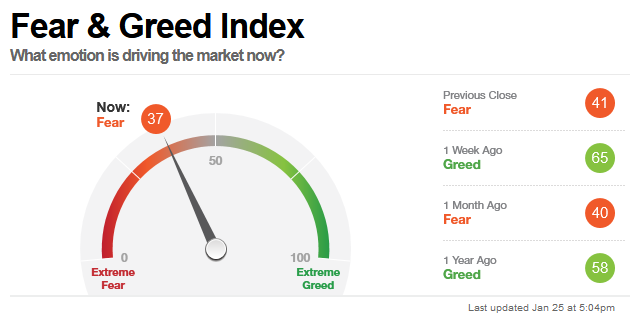
The index has fallen from 65 to 37. This signals fear, but not panic. In addition, the price of gold, a good indicator of panic, has hardly changed.
This therefore appears to be an adjustment to new risks rather than a full-scale panic.
Such a combination of negative factors is rare. We also consider some of them to be exaggerated. No one has an interest in a war with Russia, and expectations for profit growth of more than 22% compared to the previous year were unrealistically high. Furthermore, the Federal Reserve on Wednesday merely confirmed general expectations and did not become even more aggressive, as many had feared.
It is important not to be carried away by overly negative, or overly positive, market sentiment and to keep the long-term picture in mind.
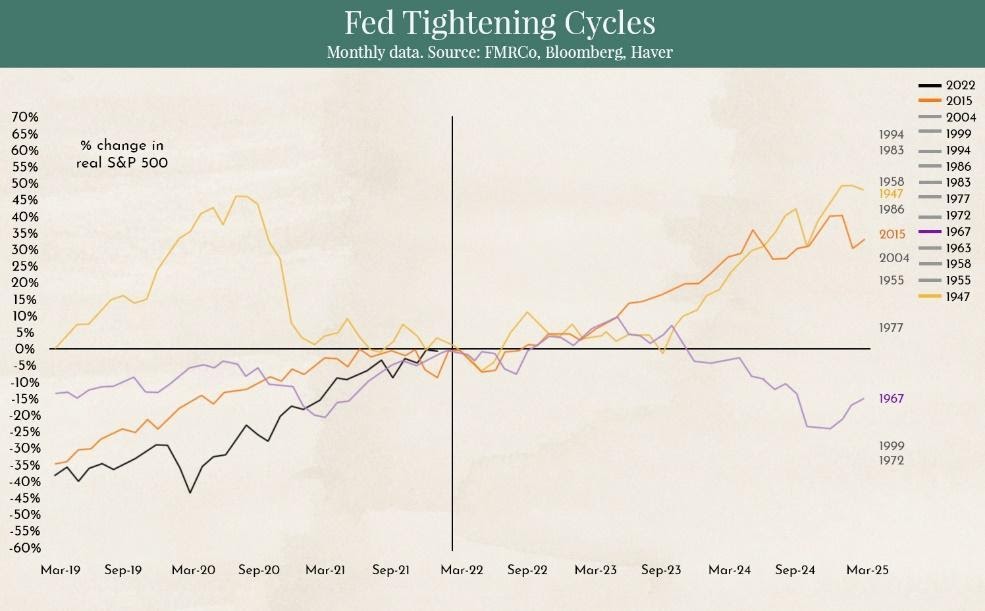
The chart shows 12 phases since 1947 in which the Federal Reserve changed its strategy. It illustrates stock market returns two years before and three years after the first interest rate hike. The broader market expects the Fed’s first rate increase in March 2022.
In 3 of the 12 periods, interest rates were raised too early or too aggressively, and the economy failed to recover. In the vast majority of cases, however, stock markets continued to rise. Nevertheless, during the first six months after the initial rate hike, markets relatively often moved sideways.
We expect markets to remain in a sideways trend until mid-year. We therefore use negative overreactions such as those seen this week as opportunities to buy at attractive prices.
At the same time, we are currently focusing more on value investing and high-quality companies. Many well-known internet companies that have never generated profits and finance their operations through short- and long-term borrowing are likely to face major difficulties in a rising interest rate environment.
Disclaimer:
The content in these blogs is intended solely for general informational purposes and to help potential clients gain an understanding of our approach and way of working. It does not constitute recommendations to buy or sell assets and should not be considered investment advice.
Marmot.Finance cannot assess whether or how the statements made align with your investment objectives or risk profile. If you make investment decisions based on this blog post, you do so entirely at your own risk and responsibility. Marmot.Finance cannot be held liable for any losses that may arise from the information contained in this blog post.
The products mentioned are not recommendations but are intended to illustrate how Marmot.Finance works and selects such products. In addition, Marmot.Finance is completely independent and does not earn compensation from product providers in any form.


.webp)





.jpeg)




.jpeg)

.svg)


