
Chart of the Week
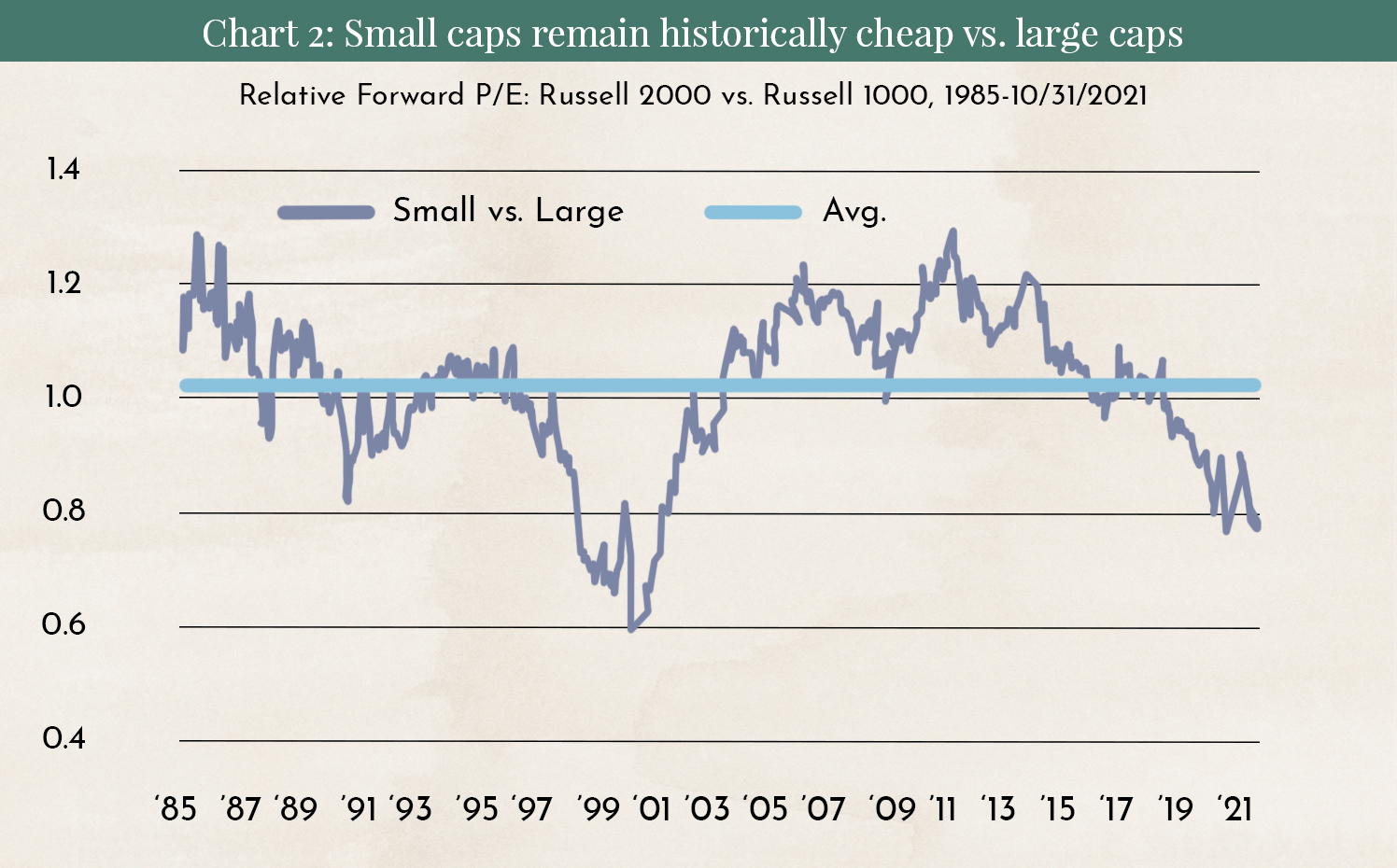
The chart shows the profits of large companies (represented by the Russell 1000 Index) relative to the profits of small companies (represented by the Russell 2000 Index). A value above 1 means that small companies are generating higher profits than large companies, while a value below 1 means that large companies are generating higher profits.
Why This Matters:
Since 2011, the profits of small companies have been declining relative to the profits of large companies, and since 2019, small companies have been undervalued compared to large companies.
In our view, this is due to two factors:
- Higher Leverage. Due to extremely low interest rates, many companies have taken on significant debt to grow more quickly. Large companies with substantial collateral have an easier time securing larger bank loans or issuing bonds.
- Share Buyback Programs. Large companies are far more likely than small companies to take on debt to buy back their own shares. This artificially drives up stock prices.
Due to still very low interest rates, large companies continue to have advantages in both areas. Only when interest rates are higher should a portfolio shift from large-company stocks to small-company stocks become worthwhile. Based on current forecasts, this is unlikely to happen until around the middle of next year.
How the Professionals Are Positioning Themselves in the Markets
Every quarter, Bank of America conducts a large survey of major investors (banks, asset managers, and wealth managers) to understand how they are positioning themselves in the stock market and what they expect for the coming quarters. In the past, taking a closer look at this data has been very helpful, as it has shown strong predictive value.
The Outlook for Inflation Has Deteriorated:

As many as 61% now believe that inflation figures are only temporarily high and will ease soon. The camp of optimists has grown, while the camp of pessimists is shrinking. Central banks have succeeded in convincing investors with their arguments.
This is further supported by the following chart:

Here, major investors were asked whether they expect inflation to be above or below the long-term trend. Almost 100% (both dark blue lines) expect inflation to remain above the long-term trend.
Accordingly, major investors are positioning their portfolios.

Over the past 20 years, major investors have never been this pessimistic about the future returns of bonds.
This view is also being consistently reflected in the equity market:

In the equity market, major investors are positioning themselves in sectors that benefit from a longer period of higher inflation. These include commodities, banks, and equities in general.
Investors were also asked which investment style they prefer for the next 12 months:
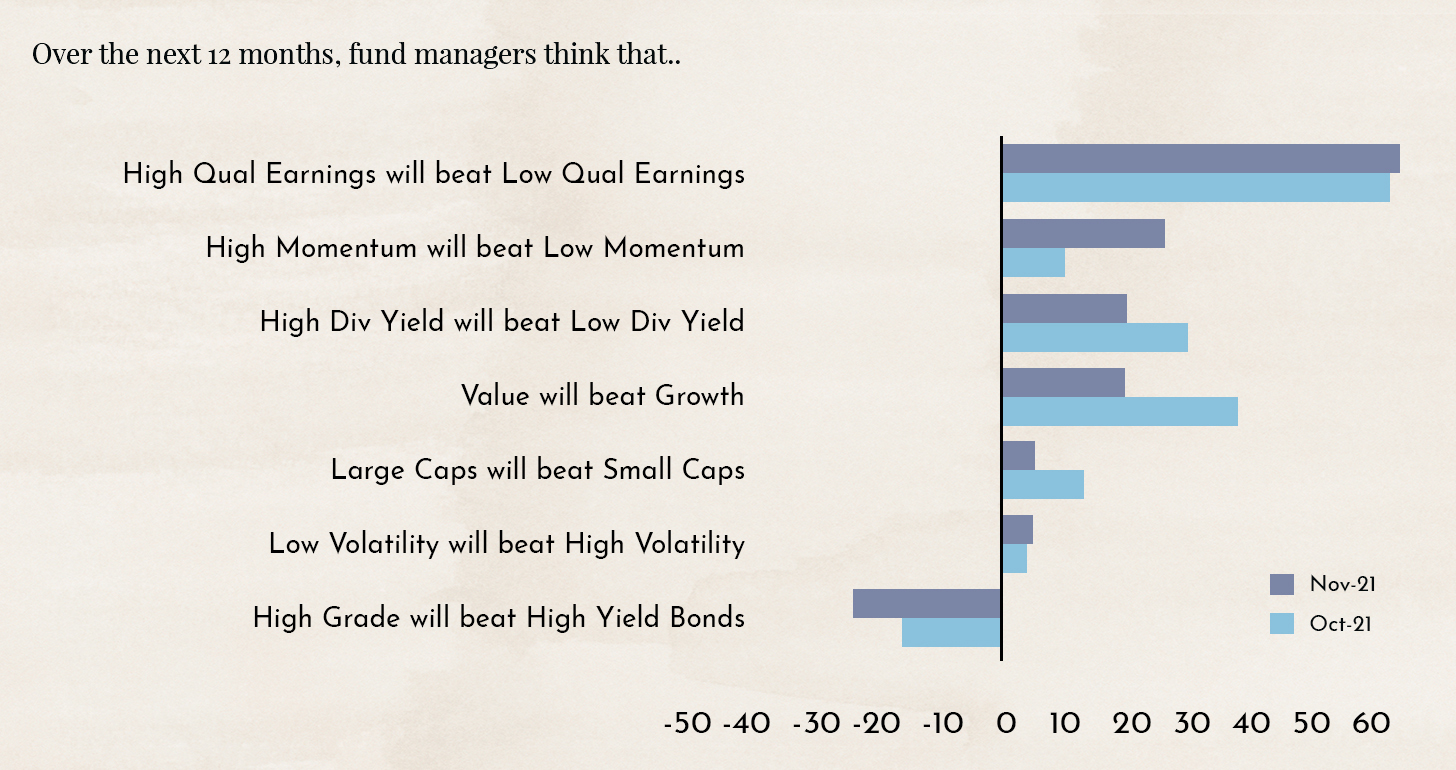
Investors continue to favor quality stocks, but what is interesting is how forecasts have shifted since last month. The rise of value stocks appears to have stalled. Many investors likely believe that growth stocks have corrected so sharply that they are attractive again. The camps favoring growth stocks and value stocks are now roughly equal in size.
The survey also supports our view in the Chart of the Week. Major investors still see higher return potential in large companies than in small companies. However, that conviction is steadily weakening.
Who is Satoshi Nakamoto?
Satoshi Nakamoto is the pseudonym of the creator of Bitcoin. It could be a single person or a group of people. For years, the crypto community has speculated about who is behind the name. In the coming weeks, the mystery may finally be revealed.
Like anyone else launching a new cryptocurrency today, he first accumulated coins for himself. Satoshi Nakamoto did the same and owns 1 million Bitcoins. At today’s value, these would be worth over USD 60 billion, making Satoshi Nakamoto the 20th richest person on Earth. If the price of Bitcoin rises above USD 150,000—which some banks still consider a conservative forecast—he would become the richest person in the world.
On October 31, 2008, a user named Satoshi Nakamoto published a white paper outlining the concept of Bitcoin. Over the next two years, the same person launched the protocol and maintained active communication with other developers through two email addresses. Then, the contact stopped.
In 2014, the newspaper Newsweek claimed that Satoshi Nakamoto was the Japanese IT developer Dorian Nakamoto. After a two-year silence, a message was sent through one of the two email addresses previously used by Satoshi Nakamoto stating, “I am not Dorian Nakamoto.” That was the last message received from Satoshi Nakamoto in the past seven years.
In May 2016, Craig Steven Wright claimed that he was Satoshi Nakamoto. However, the crypto community doubts this, mainly because he has not backed up the claim with a transaction. The 1 million Bitcoins have never been moved since 2008, nor has even a single Bitcoin been sold.
Craig Steven Wright is now being sued in Florida by the family of the late David Kleiman. The family claims that Wright and Kleiman co-wrote the Bitcoin white paper and were partners. Therefore, they argue that David Kleiman—and now his heirs—are entitled to half a million Bitcoins. The legal proceedings are likely to reveal many details from Bitcoin’s early founding period.
However, it is also possible that Wright and Kleiman are skilled impostors simply playing a high-stakes game. The real Satoshi Nakamoto may be enjoying the spectacle from afar. He can walk the world freely, free from paparazzi, knowing he is one of the richest people on Earth—yet no one knows it.
Disclaimer:
The content in these blogs is intended solely for general informational purposes and to help potential clients gain an understanding of our way of working. It does not constitute recommendations to buy or sell assets and should not be considered investment advice. Marmot.Finance cannot assess whether or how the statements made align with your investment objectives and risk profile. If you make investment decisions based on this blog post, you do so entirely at your own risk and responsibility. Marmot.Finance cannot be held liable for any losses you may incur as a result of the information contained in this blog post.
The products mentioned are not recommendations but are intended to demonstrate how Marmot.Finance works and selects such products. Marmot.Finance is also completely independent and does not earn any compensation in any form from product providers.


.webp)





.jpeg)




.jpeg)

.svg)


