A smart pension strategy in Zurich means using all three Swiss pension pillars deliberately: knowing what the state and your pension fund will actually pay, closing the gap with tax-deductible savings in pillar 3a and, where it fits, voluntary purchases into your pension fund, and deciding early how you will draw the money. None of this is exotic. Most of the gains come from doing the ordinary things in the right order, and from not leaving decisions until the year before retirement.
This guide covers the system as it stands in 2026, with a focus on Zurich residents, including expatriates and women whose careers include part-time work or breaks.
Marmot Finance
Make Your Pension Plan Work Harder
Marmot Finance helps women and families in Switzerland navigate investing with tailored strategies, personal consultations, digital tools and financial coaching.
TL;DR
- Start by measuring the gap: request your OASI pension forecast and your individual-account statement, then compare the result with the income you want in retirement.
- Pillar 3a is the simplest tax-efficient tool. In 2025/26 the limit is CHF 7,258 for employees with a pension fund and up to CHF 36,288 for self-employed people without one.
- Voluntary pension fund purchases are deductible, but a capital withdrawal within three years of a purchase can cancel the deduction.
- Annuity versus lump sum is a permanent decision with no universal answer, so model it years ahead and not at the last minute.
- Cash is safe in nominal terms but does little for a 20- or 30-year horizon, while investing brings fluctuations you must be able to sit through.
How the three pillars fit together
Switzerland's old-age system rests on three pillars: state provision, occupational pension insurance and private provision, each with its own purpose and its own rules. A sensible plan treats them as one household budget, because a weakness in one is usually compensated in another.
The first pillar, OASI (AHV in German), provides a basic pension intended to cover subsistence needs. It is financed by current salary contributions on a pay-as-you-go basis, and the reference age is currently 65. A full pension requires the same number of contribution years as people born in the same year. Gaps produce a partial pension, early withdrawal reduces the pension for life and deferral increases it for life.
The second pillar is your occupational pension fund, the Pensionskasse. Employees earning more than CHF 22,680 a year from one employer are subject to mandatory contributions, with age conditions. For most employees in Zurich, this is the largest asset after property, and often the least understood.
The third pillar is private. Pillar 3a is tied pension savings with a tax deduction, and pillar 3b is flexible savings without the same tax treatment. Alongside the pillars, you will probably hold free assets, and a good plan decides which money is for retirement income and which is for other goals.
Step one: find out what you will actually receive
The most common planning error is guessing. Before you choose any product, collect three numbers.
The first is your OASI forecast. You request it from your compensation office, and it estimates expected benefits using your current circumstances, legislation, salary assumptions and individual-account data, but it is non-binding until retirement. The second is your individual-account statement, which is free and records reported earnings, contribution periods and parenting or care credits. Request it to spot missing years or unreported salary before you rely on any estimate. This matters especially if you worked abroad, took a career break or changed employers often.
The third is the projection from your Pensionskasse, found on your annual statement. It shows the capital you have today, the projected capital at retirement and the pension it converts into.
Add the three together, compare the total with the yearly spending you expect, and you have your shortfall. Because forecasts are sensitive to marital status, family circumstances, future salary, contribution history and future residence, the OASI/DI Information Centre recommends refreshing them after major life changes: marriage, divorce, a child, a move abroad, a change of job.
Pillar 3a: the first tool to use
Contributions to pillar 3a are tax-deductible. For 2025/26, employees in a pension fund may pay in up to CHF 7,258 a year, while self-employed people without one may pay in 20% of annual income, up to CHF 36,288. Self-employed people can use pillar 3a if they pay OASI contributions, and for them it is often the main route to a private pension because pension fund cover is voluntary.
There is a newer feature worth knowing. According to the Canton of Zurich's tax return guide, from the 2026 tax year taxpayers can make additional pillar 3a purchases to cover contribution gaps arising since 1 January 2025, provided you have already paid the full ordinary maximum for that year. For anyone who skipped a year, for example during parental leave, this is a useful catch-up option.
Account or securities?
A 3a account is simple and capital is protected nominally, but interest has often been low. A 3a securities solution, usually funds, lets you take part in market returns. Swiss bank guidance describes the trade-off plainly: a higher expected return is compensation for the risk taken, and the equity share of the fund largely determines both.
A practical way to decide is to look at your horizon. Money you will need within five years belongs in a low-risk form. Money you will not touch for 20 years can usually carry a larger equity share, provided you will not sell in a panic after a bad year. Inflation also matters: a balance that never falls in francs can still lose purchasing power. Past returns do not guarantee future ones, and you should only invest what you can leave untouched through a downturn.
Voluntary purchases into your pension fund
If your pension fund rules allow it, you can buy into the second pillar to fill the gap between your insured benefits and the maximum the regulations permit. Gaps are common after part-time years, a late start in Switzerland or a salary increase. Voluntary purchases are tax-deductible, which makes them attractive for people with a high marginal tax rate.
There is one restriction that catches people out. If you withdraw capital within three years of a purchase, the purchased amount is generally not deductible, because of the rules against tax avoidance. So a purchase fits best when you will stay invested for longer than that, and when you have planned how you will withdraw later.
Two practical points. First, ask your fund for the exact purchase potential in writing before you transfer money. Second, if you also use pillar 3a, think about the order: the combination of a purchase and a later withdrawal needs to be spread sensibly, which leads to the next topic.
Annuity, lump sum or a mix
At retirement you choose between a lifelong pension and a capital withdrawal, or a combination. The choice is permanent and cannot be reversed, and it means balancing lifetime security and inflation-adjusted income against flexibility and inheritance goals. Even the Pensionskasse Stadt Zürich stresses that there is no universal recommendation and the answer depends on your financial, personal and family situation.
The questions that tend to decide it are these. How long might you live, and what would your partner live on if you died first? Do you have other secure income, such as a good OASI pension or rental income? Do you want to leave capital to children? How would you cope if markets fell by a third just after retirement?
Staggering is the middle path. Since 1 January 2024, partial withdrawals of second pillar capital are permitted in at most three stages in the Canton of Zurich. That allows a gradual transition, and it can help with tax planning because withdrawals can be spread over several years. Each case is different, so have a tax adviser confirm the effect for your situation before you commit.
Timing also needs attention. Retirement benefits are not paid automatically: you must submit requests to your pension institution and compensation fund several months before retirement.

When your situation is not standard
Self-employed and entrepreneurs
Without mandatory second-pillar cover, you build your own. The higher pillar 3a ceiling, a voluntary pension fund solution if you want one, and your business assets all need to be seen together, including what happens if you sell the company.
Part-time work and career breaks
Below the salary threshold, or with reduced hours, second-pillar savings can be thin. Women are often affected, since care work and part-time employment are more common. Check your individual-account statement for care credits, look for purchase potential and consider the 3a catch-up described above.
Expatriates
If you came to Zurich in mid-career, you will have fewer contribution years, and possibly pension entitlements elsewhere. Gaps lead to a partial OASI pension, and your forecast depends on future residence, so a possible move home belongs in the plan. We work with Swiss and European clients and manage accounts in CHF, EUR and USD, so cross-border questions are part of the conversation.
Couples and families
Marital status changes the forecast. Look at both partners' pension fund rules, survivor benefits and what each person would have if the relationship ended. Financial independence for each partner is a sound principle, not a statement of distrust.
Cash or investments for pension savings
Cash feels safe, and for short-term needs it is. Over decades, though, prices rise, and money kept in a low-interest account can lose value in real terms. Investing in diversified funds, for example broad ETF portfolios, has historically offered the chance of higher returns, with the cost of swings along the way.
A few rules keep this sensible. Keep an emergency reserve of several months of expenses outside any pension product, because 3a money is tied. Match the equity share to your horizon and to how you reacted in past downturns. Watch fees, since a difference of half a percentage point a year compounds over decades. And rebalance rather than react to headlines.
Our perspective
In our conversations with women and families in Switzerland, the same pattern appears again and again. People understand that a pension matters, but the system feels fragmented, so they postpone. The first step is rarely an investment decision. It is gathering the three documents described above and writing down one number: the yearly income you want at 65 or earlier.
Once that number exists, the choices become more straightforward. We tend to see pension planning as part of overall wealth planning: pillar 3a, purchases and free assets should be invested with a single strategy, not as separate products from separate providers. We also think the annuity-or-capital question deserves a conversation years before retirement, together with a partner where there is one.
Our approach combines personal consultation with digital tools. Our investment strategies are built on ETF and fund portfolios and can include sustainability, gender and talent themes, adapted to each client's profile. We are FINMA accredited and focus on women and families, because their financial paths, with career interruptions and longer life expectancy, often differ from the standard model that products are designed around.
How Marmot can help
If you want to see how your pension assets and free assets could work as one portfolio, our wealth management service covers personalised investment strategies, and financial coaching is available if you prefer to build the plan yourself with guidance. We offer three mandates: Marmot Easy at 0.65% per year, Marmot Premium at 1.0 to 0.8% per year and Marmot Select at 0.8 to 0.4% per year, with the fee scaled to the assets managed. You can read the details on our pricing page. Our educational webinars and community events, listed on our website, are open to anyone who wants to learn before deciding.
A simple order of action
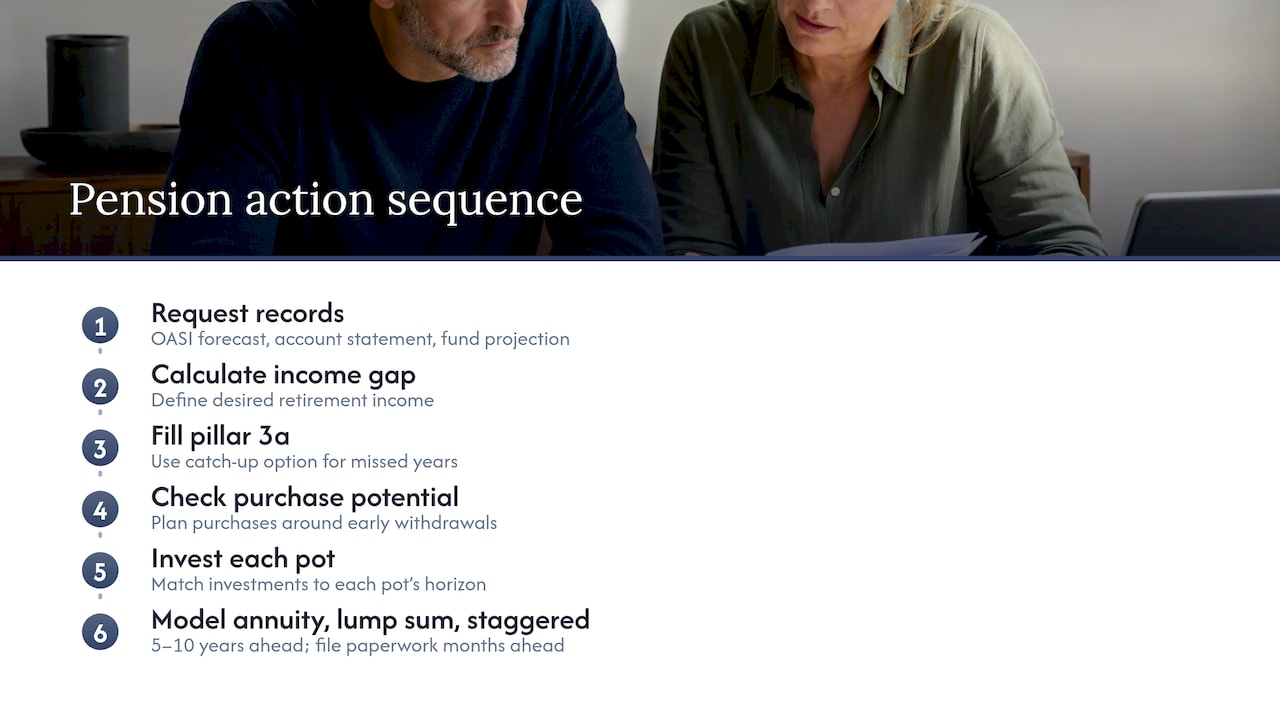
In practice, the sequence that works for most Zurich residents is as follows. Request your OASI forecast, your account statement and your pension fund projection. Define the retirement income you want and calculate the gap. Fill pillar 3a each year, using the catch-up option if you have missed one. Check the purchase potential in your pension fund and plan any purchase so that it is not undone by an early withdrawal. Decide how to invest each pot according to its horizon. Then, five to ten years before retirement, model annuity, lump sum and staggered options with a tax adviser, and file the paperwork months ahead.
This is general information and not personal advice. Tax treatment and limits change, so confirm figures with your pension fund, the Zurich tax office or a qualified adviser before acting.
FAQ
How much can I pay into pillar 3a in Zurich?
For 2025/26, employees with a pension fund can contribute up to CHF 7,258 a year. Self-employed people without a pension fund can contribute 20% of annual income, up to CHF 36,288, according to the Federal Social Insurance Office. Limits are adjusted over time, so check the current year.
Is a voluntary pension fund purchase worth it?
It can be, particularly if you have a high marginal tax rate and a real gap in your insured benefits. The purchase is deductible, but a capital withdrawal within three years generally removes the deduction. Ask your fund for the maximum purchase amount and discuss timing with a tax adviser.
Should I take my pension as an annuity or a lump sum?
There is no universal answer. An annuity gives lifelong income, while capital gives flexibility and can be inherited. The decision is permanent, so compare options several years before retirement and consider a partial withdrawal, which in Zurich is possible in up to three stages.
When should I apply for my retirement benefits?
Several months before you retire. Benefits are not paid automatically, and you must submit requests to your pension institution and compensation fund, as the Federal Social Insurance Office explains.
Sources
- Switzerland's old-age insurance system (FSIO, 2026)
- Pension forecasts (OASI/DI Information Centre)
- Social security in Switzerland (AHV/IV Information Centre)
- Old-age insurance system (FSIO)
- Which contributions can I pay into pillar 3a? (FSIO)
- Tax return guide Zurich 2026
- Pension bulletin, 16 December 2025 (FSIO)
- Capital withdrawals and partial retirement (Canton of Zurich)
- Retirement steps (FSIO)
- Capital or pension? (Pensionskasse Stadt Zürich)
- Säule 3a: Konto oder Wertschriften?