If you live in Zollikon, your tax bill is shaped by three layers (the Confederation, the canton of Zurich and the municipality), and the room you have to plan sits mostly in deductions, pension contributions and how you handle your wealth. You cannot negotiate the rates. You can, however, decide what ends up in your taxable income and when. This guide walks through the options that are available to private individuals, families, self-employed residents and internationals, using official 2026 figures.
Marmot Finance
Plan Your Wealth With Confidence
Marmot Finance helps women and families in Switzerland navigate investing and their financial journey with personal consultations and digital tools.
TL;DR
- Zollikon's municipal tax rate was 76% of the simple state tax in 2024, on top of the canton's 95% for 2026, so the local rate is part of the picture but not something you can change.
- Pillar 3a and voluntary 2nd pillar purchases reduce taxable income in the year you pay them, and the money must arrive by 31 December.
- Families have child, support and secondary earner deductions, and married couples have their own wealth tax scale.
- Wealth tax applies to your net assets worldwide, so expatriates should list foreign holdings as well as Swiss ones.
- Good planning is mostly a calendar habit: collect documents, pay contributions before year end, then file on time.
How tax is calculated for a Zollikon resident
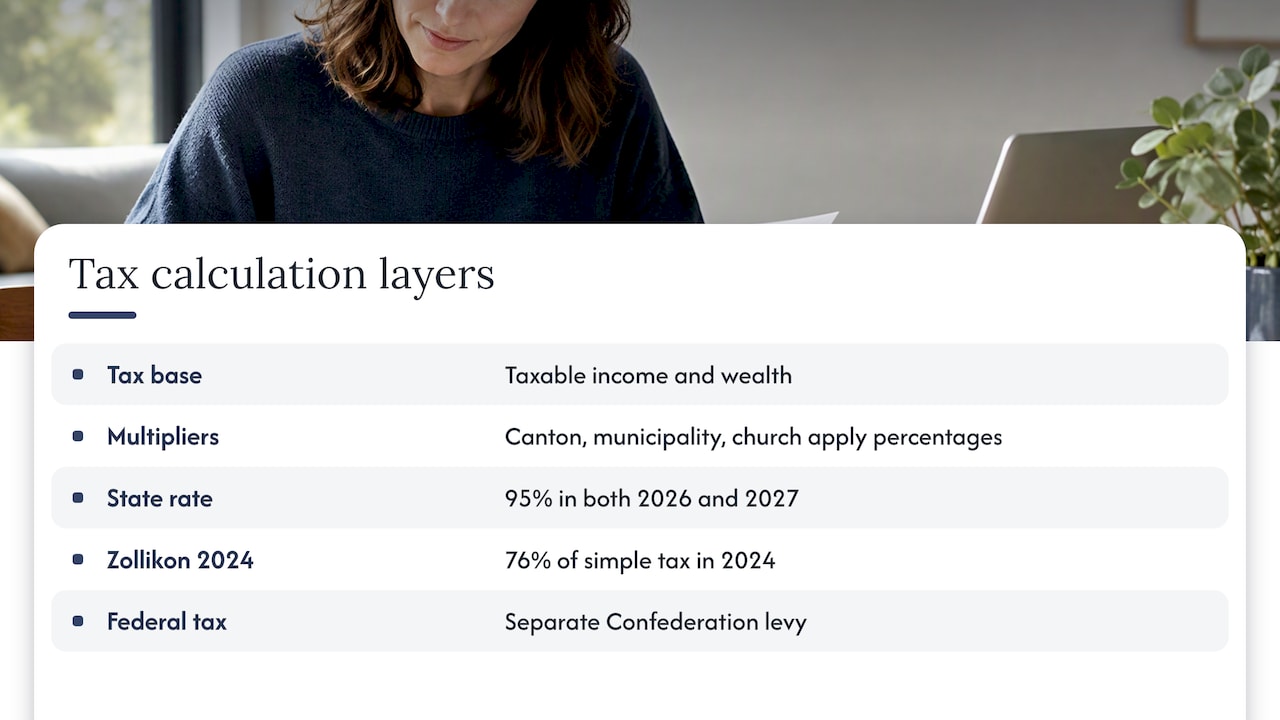
Swiss tax works in layers, and it helps to see them before talking about planning. The canton of Zurich calculates a "simple state tax" from your taxable income and wealth. The canton, the municipality and the church then each apply a percentage to that basic amount, and the Confederation levies its own direct federal tax separately. The municipal part is derived as a percentage of the simple state tax and collected with the same tax bill.
For 2026, the state tax rate is 95% of the simple state tax for all Zurich municipalities, and the canton lists 95% for both 2026 and 2027, while each municipality sets its own multiplier. Zollikon's municipal rate was 76% of the simple state tax in 2024. Check the canton's page on current municipal rates for the figure that applies to your tax year, because municipalities can change it.
Two things follow from this structure.
First, the progressive nature of income tax matters. The Zurich Cantonal Tax Office explains that personal income tax is progressive, meaning the rate rises with taxable income. Each franc you remove from taxable income through a deduction is therefore taxed at your top rate, not at your average rate. That is why deductions are worth more to higher earners, and why timing them well can be valuable.
Second, the multipliers are fixed from your point of view. Moving the needle on your bill means working on the base: taxable income and taxable wealth.
If you want to see the layers separately, the federal tax calculator reports the canton, municipality, church and Confederation individually, along with the multipliers used. Running it once with your real numbers gives you a baseline, and running it again after a planning step shows what the step is worth.
Deductions that reduce your taxable income
The most reliable planning option is simply to claim everything you are entitled to. The Zurich tax return guide for 2026 lists the main items. Residents can deduct professional expenses such as commuting and meals, debt interest, charitable donations, contributions to Pillar 3a and specific social deductions, such as child or support allowances. Costs for third-party childcare and vocational training can also be deducted, within set limits.

In practice, this breaks down into a few groups.
Work-related costs. If you commute or eat away from home because of your job, these are deductible within the rules of the guide. People often under-claim here simply because they never kept the receipts or season-ticket records.
Debt interest. Interest on mortgages and personal loans reduces taxable income. It also reduces taxable wealth, because debts that you can prove are subtracted from your assets.
Donations. Gifts to charitable organisations can be deducted. Keep the confirmation from the organisation, since the tax office may ask for it.
Education. Vocational training costs are deductible within limits. If you are retraining or building a second career, this is worth checking before you enrol, not after.
Social deductions. These depend on your personal situation and are covered in the family section below.
A practical habit: open a folder at the start of the year and drop every relevant document into it. When the tax return arrives, the work is already done, and you are less likely to forget an item that was worth several hundred francs.
Pillar 3a and 2nd pillar purchases
For many people in Zollikon, retirement savings are the largest single planning lever, because the contribution is deductible now and the money stays invested for later. Per the Zurich guide, contributions to Pillar 3a and voluntary 2nd pillar purchases directly reduce taxable income for the year in which they are made. They must be finalised by 31 December and backed by official bank or insurance documentation.
How much you can pay into Pillar 3a
For the 2026 tax year, the maximum deduction is CHF 7,258 for taxpayers affiliated with an occupational pension scheme. Those without a 2nd pillar can deduct up to 20% of net earned income, capped at CHF 36,288. That second group typically includes self-employed people without a pension fund, which makes Pillar 3a especially relevant for entrepreneurs.
The Federal Tax Administration stresses the same timing rule: contributions must reach an authorised institution by 31 December of the tax year. A transfer you start on 30 December that lands in January does not count for the year you intended. Do it in early December and the problem disappears.
A simple way to think about the saving
Take a person in an occupational scheme who pays in the full CHF 7,258. Their taxable income falls by that amount. The actual saving equals CHF 7,258 multiplied by their marginal tax rate across Confederation, canton and municipality, and that rate depends on income and civil status. Use the tax calculator mentioned above to find your own figure. The key point is that the deduction is real, but the money is not free: it is earmarked for retirement, so it belongs in the part of your plan that you will not need in the near term.
Voluntary 2nd pillar purchases
If your pension fund allows buy-ins, these are also deductible in the year you make them. They suit people with a gap in their pension record, for instance after years abroad, a career break or a change of employer. Before you pay anything, ask your pension fund for a statement of the permitted buy-in amount and keep the confirmation. The rules around withdrawals after a buy-in are strict, so it is worth speaking to your pension fund and a tax adviser about timing if you plan to take capital at retirement.
Wealth tax: what is taxed and how to plan around it
Switzerland taxes net wealth every year, and Zollikon residents are no exception. The Federal Tax Administration describes it as a periodic tax on net assets at a set date, 31 December, with assets generally valued at market value. Net means assets minus debts that you can document.
The 2026 Zurich scale for individuals starts at 0 ‰ on the first CHF 81,000 and rises to 3 ‰ for assets above CHF 3,304,000. Married couples have a separate scale: 0 ‰ on the first CHF 161,000, rising to 3 ‰ above CHF 3,385,000. These are basic rates, and the multipliers described earlier are applied on top of them, so the effective burden is higher than the printed per mille figures suggest.
What can you realistically do?
- Know your valuation date. Everything is measured on 31 December. Documents such as bank and custody statements for that date are what you will need.
- Deduct what you owe. Mortgage balances and other proven debts reduce the base.
- Separate short-term cash from long-term investments. Wealth tax is levied on what you hold, whether or not it earns anything. Large idle cash balances still count in full, so decide consciously how much liquidity you need.
- Let the plan follow your goals. Tax is one input. Choosing investments only to lower wealth tax rarely ends well, because returns, risk and timing matter more than a small annual per mille.
This is where an investment strategy and a tax picture meet. A portfolio built around your goals, with a clear view of how much you hold on 31 December, gives you both a better investment plan and a cleaner tax return.
Planning options for families
Families in Zollikon have more levers than single taxpayers. According to the Zurich cantonal gazette, families benefit from social deductions such as the child deduction for minors and support deductions, and dual-income households can claim a secondary earner deduction. Childcare costs paid to third parties are also deductible within limits, as noted in the tax return guide.
A few planning questions come up again and again:
Who pays into Pillar 3a? Each person with earned income has their own Pillar 3a limit. In a couple where both work, both can pay in, which doubles the deductible amount. In a couple where one partner has stopped working, the household may lose that second deduction, so it is worth reviewing how retirement savings are distributed.
Does the second income pay off? The secondary earner deduction exists precisely because a second salary is taxed on top of the first. Before changing working hours, look at the net effect after tax and childcare costs, not only the gross figure.
How do you hold assets? Married couples are assessed jointly and use the couples' wealth tax scale. If you are planning gifts to children, a property purchase or a change in civil status, speak to a tax adviser first, since each of these can change your taxable position.
For women in particular, retirement gaps from part-time work or career breaks are common. Pillar 3a and 2nd pillar buy-ins are two of the few tools that let you close those gaps, with a tax deduction as an incentive. If you are not sure where you stand, a structured look at your finances is a good first step, and our Money Makeover Quiz is built for that.
Entrepreneurs and self-employed residents
If you run your own business and live in Zollikon, two things are different from an employee's year. The first is the deadline. Self-employed residents of Zollikon must submit their completed and signed tax return by the end of September. The general rule in the Zurich guide is that the return is due within 30 days after the forms are delivered, subject to extensions. If you will need more time, apply for an extension before the deadline, not after.
The second difference is retirement provision. Without an occupational scheme, you can use the larger Pillar 3a limit of up to 20% of net earned income, capped at CHF 36,288 for 2026. For a founder with irregular income, this is a flexible tool: in a strong year you can pay in more, and in a lean year less.
A few habits help here:
- Keep business and private accounts separate, so your accounts are ready when the tax office asks.
- Set aside a tax reserve each month. Irregular income makes it easy to underestimate the bill.
- Decide in the autumn how much to put into Pillar 3a, once you can see the year's profit more clearly.
- Treat your private wealth as a plan of its own. Business assets are often concentrated in one company, so diversifying privately lowers your overall risk.
Corporate tax questions, such as the legal form of your company or salary versus dividends, go beyond a private return and should be handled by a qualified tax adviser.
Expatriates and cross-border situations
If you moved to Zollikon from abroad, or still have assets or income elsewhere, the principle to remember is that the wealth tax base is global. The Federal Tax Administration states that the entire wealth in Switzerland and abroad must be declared, and proven debts may be deducted.
That leads to a practical checklist:
- List every account and holding, including foreign bank accounts, pensions, shares, and property abroad.
- Gather year-end values for 31 December, in the original currency and converted to Swiss francs.
- Check how your home country treats you. Depending on your nationality and past residence, you may still have filing duties there. A tax adviser who knows both systems can confirm this.
- Review pensions from previous countries. Their treatment in Switzerland and abroad differs, and mistakes here can be expensive.
- Plan currency exposure. Many internationals hold assets in several currencies. We manage accounts in CHF, EUR and USD, which suits that situation.
International tax law is detailed, and two countries can both have a claim on the same income. This is exactly the point where individual advice from a tax specialist pays for itself.
A yearly rhythm for tax planning
Most people treat tax as an event in spring or autumn. It works better as a rhythm.
Self-employed residents should keep the end of September in mind. For everyone else, check the current filing date on the Zollikon municipality's tax return page, since dates are announced each year.
Our perspective
Tax planning in Switzerland rewards people who start early and keep it simple. In our conversations with women and families, we see the same pattern: the deductions are available to everyone, but few people use them in a coordinated way. Pillar 3a is paid in a rush in December, wealth is spread over several banks, and nobody has a single picture of what is held where.
We believe tax planning and investing belong in one conversation. A portfolio that matches your goals, your time horizon and your pension situation makes the tax return easier, and a clear tax picture makes better investment decisions possible. That is why we combine personal consultations with digital tools, so that you can see your whole financial situation and talk it through with a person.
We are FINMA accredited and work exclusively with women and families in Switzerland and Europe. Our approach is designed to build financial independence step by step, with education and a community alongside the portfolio. We do not replace a tax adviser for your tax return, but we can make sure your investments and your plan fit the choices you make there.
Where Marmot can help
If you want your investments to work alongside your tax planning, you can start with the Money Makeover Quiz to get a clear view of your current position. For ongoing management, our wealth management and coaching services combine personal advice with digital tools, and the pricing page shows the annual management fees: 0.65% per year for Marmot Easy, 1.0 to 0.8% per year for Marmot Premium and 0.8 to 0.4% per year for Marmot Select.
FAQ
Can I change the tax rate I pay in Zollikon?
Not directly. The state tax rate is set by the canton (95% for 2026) and the municipal rate by Zollikon, which was 76% of the simple state tax in 2024. What you control is the base: your taxable income and wealth, through deductions, pension contributions and how you document your assets.
What is the most effective deduction for most people?
For many employees, it is Pillar 3a, with a maximum deduction of CHF 7,258 for the 2026 tax year if you are in an occupational scheme. The saving depends on your marginal tax rate. Voluntary 2nd pillar purchases can be even larger, but you should first get your pension fund's statement and discuss withdrawal rules with an adviser.
When do I need to pay into Pillar 3a?
The payment must reach the authorised institution by 31 December of the tax year. Do not wait for the last days of the month, as a late transfer counts for the following year. Keep the official confirmation for your return.
Do I have to declare foreign assets?
Yes. The entire wealth, in Switzerland and abroad, must be declared, and proven debts can be deducted. If you have holdings in several countries, a tax adviser who knows the rules in each can help you avoid double taxation and missed filings.
Is tax planning different if I am self-employed?
Yes, in two ways. Your return is due by the end of September, and without a pension fund your Pillar 3a limit can reach 20% of net earned income, up to CHF 36,288 in 2026. Business and corporate tax questions should go to a qualified adviser.
Sources
- Kantonsblatt Zürich, tax rates and scales 2026 (ESTV)
- Vermögenssteuer natürlicher Personen (ESTV)
- Erläuterungen zu den Steuerberechnungen (ESTV)
- Steuerliche Behandlung von Vorsorgebeiträgen (ESTV)
- Steuern im Kanton Zürich, eine Kurzübersicht
- Wegleitung zur Steuererklärung 2026, Kanton Zürich
- Aktuelle Gemeindesteuerfüsse, Kanton Zürich
- Verfügung Ausgleichsfaktoren 2026, Anhang, Kanton Zürich
- Gemeinde Zollikon, Steuererklärung