
A money blueprint is the set of habits, numbers and beliefs that quietly decide what happens to every franc or euro that comes your way. You can start shaping it today with three moves: write a simple budget, build a small emergency buffer, and start a regular, tax-efficient retirement contribution. The rest of this guide shows you how each piece fits together.
TL;DR:
- Treat the 70/20/10 budget split as a starting point, then adjust it to your actual costs and goals rather than following it rigidly.
- Keep roughly three months of essential expenses in a separate, liquid savings account, and hold more if your income is irregular or you support a family.
- Avoid investing money needed within a year or two; match diversified investments to your time horizon and risk tolerance instead of chasing individual stocks.
- Swiss savers should coordinate regular pillar 3a contributions with pillar 2 purchase options and verify annual deduction rules and deadlines using current tax guidance.
- If you have multiple income sources, assets across borders, or a growing family, consult a professional adviser to review your full financial picture.
Marmot Finance
Build a clearer family money plan
Marmot Finance helps women and families in Switzerland navigate investing with tailored strategies, personal consultations and digital tools.
What a money blueprint actually covers
A money blueprint is the combination of your financial mindset (what you believe about money, risk and security) and the practical systems you use to manage it: budgeting, saving, investing and planning for retirement. It works because it pairs psychology with process. Good intentions fade, but a repeatable system keeps working even on the weeks when motivation does not show up.
The main components are:
- Budgeting: knowing what comes in and where it goes.
- Saving: a buffer that protects you from shocks.
- Investing: putting money to work over time.
- Pension and tax planning: making sure the structures around you (like the three-pillar system) are pulling in your favour.
- Mindset and review: the habits and checkpoints that keep the whole thing alive.
Each later section in this guide takes one of these and turns it into something you can actually do this month.
Budgeting: the first building block
A budget is simply a record of your income and spending, organised so that you can make decisions instead of guessing. Start by listing your income, then your fixed costs (rent, insurance, loan repayments), then what is left for discretionary spending.
- List every income source for a typical month, including irregular ones averaged out.
- Write down fixed costs such as rent, insurance, subscriptions and debt repayments.
- Estimate discretionary spending: food, leisure, shopping, the small stuff that adds up.
- Apply a rough split, such as 70% living costs, 20% savings and investing, 10% discretionary or giving, and adjust it to your own situation rather than following it rigidly.
- Track it using whatever you will actually keep using: a bank app, a simple spreadsheet, or an account that auto-splits incoming pay into separate pots.
The goal is not precision to the last cent. It is visibility, so that decisions about saving and investing are based on reality rather than a vague sense of how things usually go.
Saving and your emergency buffer: what to hold and why
An emergency buffer is money you can reach within days, kept aside specifically so that a broken boiler or a lost contract does not force you to sell investments at a bad moment or reach for a loan.
- Size it around three months of essential expenses as a practical starting point, more if your income is irregular or you are the main earner for a family.
- Keep it liquid and low-risk: a savings account, not an investment account, because you need access, not growth.
- Separate it from spending money so it is not quietly absorbed into everyday life.
- Automate the build: a standing order the day after payday removes the temptation to skip a month.
Pro Tip: Open a separate account purely for the buffer, even if the interest rate is unremarkable. Friction (having to actively move the money) is what keeps it from disappearing.
Investing basics for your blueprint
Once a buffer is in place, investing is how your money starts working instead of sitting still. Four principles matter more than any specific product: your time horizon, how much you pay in costs, how diversified you are, and how much risk you can genuinely tolerate without panicking at the first downturn.
- Time horizon: money you need within a year or two has no business being in volatile assets.
- Cost control: fees compound against you the same way returns compound for you, so low-cost, broad instruments usually beat expensive, narrow ones over time.
- Diversification: spreading across regions, sectors and asset types rather than betting on a handful of favourites.
- Risk tolerance: honest self-assessment, not the risk level you wish you had.
For most people starting out, broad index-tracking funds or regular savings plans into diversified portfolios are a sensible category to look at, rather than chasing individual stocks or trends. Size your contributions against your goals: smaller, steady amounts towards a house deposit in five years; larger, more consistent amounts towards retirement, where time does most of the work for you.
Pensions, tax and tax-efficient steps to include
For anyone saving within the Swiss system, a money blueprint that ignores pensions is missing its most powerful lever. The three-pillar system (state pension, occupational pension, and private pillar 3a) works best when the pieces are planned together rather than left to run separately. Many people treat pillar 3a as a last-minute top-up rather than coordinating it with pillar 2 purchases and personal investments, which quietly erodes the tax efficiency available to them, as guidance for self-employed savers points out.
- Contribute to pillar 3a regularly, ideally through a standing order rather than a single payment late in the year.
- Review your pillar 2 (BVG) options, particularly voluntary purchases, when your income rises.
- Check documentation timing, since deductions and contribution deadlines affect what you can claim.
The annual Swiss tax return lists pillar 3a contributions as a deductible item, and the official tax form guidance is the place to verify current allowance amounts and where to report them, since these details change and are worth confirming each year rather than assumed from memory.
A simple 6-step money blueprint you can implement this quarter
A blueprint only earns its name once it moves from idea to action. Here is a six-step version you can realistically complete within one quarter.
- Set one concrete goal (week 1): a number and a date, not a vague ambition.
- Build your budget (weeks 1 to 2): income, fixed costs, discretionary spending, mapped out properly for the first time.
- Establish your buffer (weeks 2 to 6): automate transfers until you reach roughly three months of essentials.
- Begin or review investing (month 2): choose a diversified, low-cost starting point matched to your time horizon.
- Make one pension or tax move (month 2 to 3): set up or increase a pillar 3a contribution, or review pillar 2 purchase options.
- Schedule a review (end of quarter): a fixed date to check progress, not an open-ended "someday".
StepTimeframeQuick winSet a goalWeek 1A clear target numberBuild a budgetWeeks 1 to 2Visibility on spendingBuild a bufferWeeks 2 to 6First automated transferStart investingMonth 2First contribution madePension or tax moveMonths 2 to 33a contribution set upReviewEnd of quarterProgress checkpoint
Measure progress with simple markers: buffer size reached, contributions made on schedule, and whether the quarterly review actually happened. If your situation involves multiple income sources, cross-border assets or a growing family, that is usually the point where a conversation with a professional adviser saves more than it costs.
How Marmot Finance helps you build a money blueprint
We built Marmot Finance as a wealth manager focused on women and families, because we believe financial planning works better when it is built around the person, not a generic template. Our approach pairs personal consultations with digital tools, so you get a plan tailored to your actual numbers rather than a one-size approach.
- Financial coaching: structured support for the mindset and habit side of your blueprint, not just the spreadsheet side.
- Personalised portfolio management: strategies matched to your goals, time horizon and risk tolerance, with annual fees from 0.65% depending on the plan.
- Educational webinars and community events: ongoing learning so your blueprint keeps evolving as your life does.
If your finances have grown more complex, blended income, cross-border considerations, a family to plan for, it is worth having someone review the whole picture with you rather than patching pieces on your own.
How family background shapes your money blueprint
Most people's first beliefs about money were never taught directly. They were absorbed from watching parents argue about bills, celebrate a bonus, or go quiet whenever the subject came up. If you grew up in a household where money was scarce or unpredictable, you may carry a tendency towards either tight control or sudden splurges, both reactions to the same underlying unease. If money was abundant but never discussed openly, you might reach adulthood confident with spending but surprisingly uncertain about budgeting or investing basics, simply because no one modelled the process for you.
Cultural and family attitudes towards saving, debt, and even talking about money out loud all shape the blueprint you carry without realising it. Someone raised to see debt as shameful might avoid even sensible borrowing, such as a mortgage. Someone raised to see saving as something "other people" do might struggle to build a buffer, not from lack of ability but from lack of a template.
Recognising where your instincts came from does not mean blaming your upbringing. It means noticing which habits serve you and which ones you inherited without ever actually choosing. That distinction is often the first real step towards rewriting the parts that are not working, rather than fighting them quietly for years.

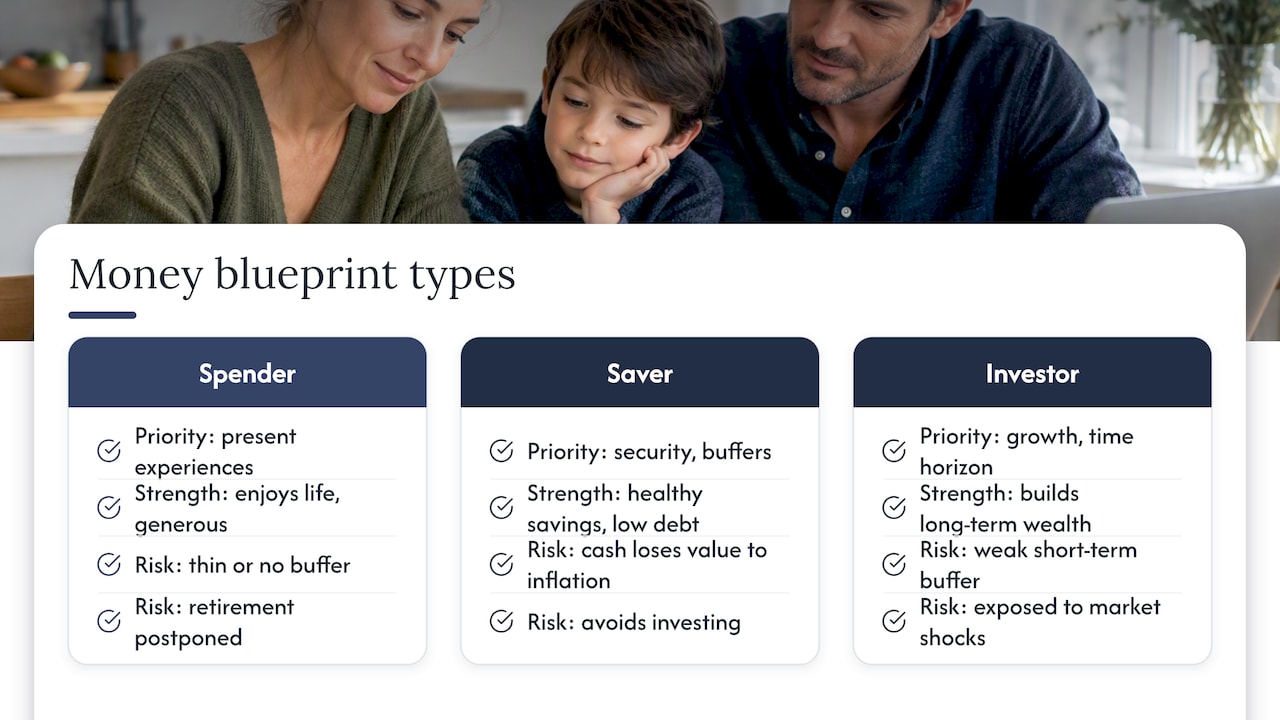
Spender, saver, investor: common money blueprint types
People tend to default into recognisable patterns, and naming yours is often the fastest way to spot where your blueprint needs attention.
The spender prioritises the present. Money flows out roughly as fast as it comes in, often towards experiences or visible comforts rather than things. The strength here is enjoying life and generosity. The risk is a thin or non-existent buffer and a retirement plan left for "later".
The saver prioritises security above almost everything else. Buffers are healthy, debt is minimal, and spending is deliberate. The risk runs the other way: money sitting in low-yield accounts for years, quietly losing value to inflation because the step into investing feels too uncertain to take.
The investor is comfortable putting money to work and thinks in terms of growth and time horizon. This blueprint often builds wealth effectively over the long run, but can neglect the short-term buffer, leaving the plan exposed if a shock arrives before investments have time to recover.
Most people are a blend, leaning one way under pressure and another when things feel calm. The useful exercise is not picking a label, but noticing which type you default to when money feels tight, and building the discipline to counterbalance it rather than letting the default run unchecked.
Author perspective: the mindset that makes a blueprint last
The technical side of a money blueprint, budgets, buffers, pension contributions, is the easy part to explain and the hard part to sustain. What actually determines whether a plan survives contact with real life is smaller than people expect: automating the boring decisions, reviewing progress on a fixed date rather than when motivation strikes, and treating setbacks as data rather than failure. Financial education is not a one-off task either. The habits that compound are modest ones, revisited often, not grand resolutions made once a year.
This article is general information, not a substitute for advice from a qualified financial advisor. Consult a qualified financial professional about your own circumstances before acting on anything here.
FAQ
What is a money blueprint?
A money blueprint is the combination of your financial habits, beliefs and systems, covering budgeting, saving, investing and pension planning, that determines how you manage money day to day. It blends mindset with practical process, which is why two people with similar incomes can end up in very different financial positions.
How much money do I need to invest to make $1,000 a month?
The amount depends entirely on the expected return and your currency, and no fixed figure applies universally, so it is worth working through your own numbers with a financial planner rather than relying on a generic rule. What matters more immediately is building consistent contributions and a diversified approach, rather than fixating on a single target income figure.
What is the 70/20/10 rule for money?
It works as a starting point rather than a strict rule, and most people adjust the split to fit their own costs and goals.
What is a blueprint in finance?
In a financial context, a blueprint refers to the structured plan and underlying mindset someone uses to manage money, covering budgeting, saving, investing and retirement planning as connected parts rather than separate tasks. The term emphasises that a workable financial plan needs both a practical system and the habits to keep using it.
Sources