
Compounding is the process by which interest or investment returns generate their own additional earnings over time, because each period's gains are added to the original amount before the next period's growth is calculated. We see this as the single most reliable force behind long-term wealth building: a mathematical overview of compound interest shows how a steady 10% annual rate turns an initial $1,000 into roughly $117,391 after 50 years, purely through reinvestment.
TL;DR:
- At 5% over 20 years, £5,000 grows to about £13,266 with annual compounding, versus £10,000 with simple interest on the same principal.
- Two investors contributing £300 monthly at 6% contribute equal totals, but starting at 25 gives the balance ten extra years to compound before age 65.
- Use conservative return assumptions in a calculator, and check whether its rate excludes inflation and fees, because projected balances otherwise overstate spendable growth.
- Tax treatment varies by country and account type, so check local rules with a qualified tax adviser before estimating the compounded growth you will keep.
Marmot Finance
Make Long-Term Investing Personal
Marmot Finance combines personal consultations and digital tools to help women and families in Switzerland manage investments around their financial profiles.
Definition and core terms: principal, interest and reinvestment
Once you understand compounding at its simplest, the jargon around it becomes much easier to decode. Here is the plain version: you put money aside, it earns a return, and instead of taking that return out, you leave it in. The next period, you earn a return on the original amount plus the return you just added. Do that enough times and the growth stops looking like a straight line and starts to curve upward.
A few terms show up constantly in this context, and getting comfortable with them makes every calculator, statement and advisory conversation far less intimidating.
- Principal: the original sum you invest or deposit, before any interest or returns are added.
- Nominal rate: the stated annual interest rate, before accounting for how often it compounds.
- Compounding period: the interval at which interest is calculated and added, such as daily, monthly, quarterly or annually.
- Effective annual rate: the real annual return once compounding frequency is factored in, which is always equal to or higher than the nominal rate.
- Reinvestment: the act of leaving earned interest, dividends or coupons in the account rather than withdrawing them, which is what actually makes compounding happen.
You will meet these terms in savings accounts, bonds, pension funds, dividend-paying shares and almost any product where returns can be left to grow rather than spent. The mechanics are identical everywhere: time plus reinvestment plus a positive rate equals accelerating growth. The only variables are how quickly that growth shows up and how much friction, in the form of fees or withdrawals, slows it down.
Compound interest formulas and worked numerical examples
The formulas behind compounding look more intimidating than they are. Once you know what each letter stands for, you can run these calculations yourself with nothing more than a basic calculator.
The standard discrete compounding formula is:
A = P(1 + r/n)^(n·t)
Here, A is the final amount, P is the principal, r is the nominal annual interest rate (written as a decimal), n is the number of compounding periods per year, and t is the number of years the money stays invested.
When compounding happens continuously rather than at fixed intervals, the formula simplifies to:
A = Pe^(r·t)
where e is Euler's number, roughly 2.71828. Continuous compounding is mostly a theoretical tool used in academic finance and certain pricing models rather than something you will encounter on a typical bank statement, but it represents the mathematical limit of compounding frequency, where periods become infinitely short.
Let's walk through two examples to see how this plays out in practice.
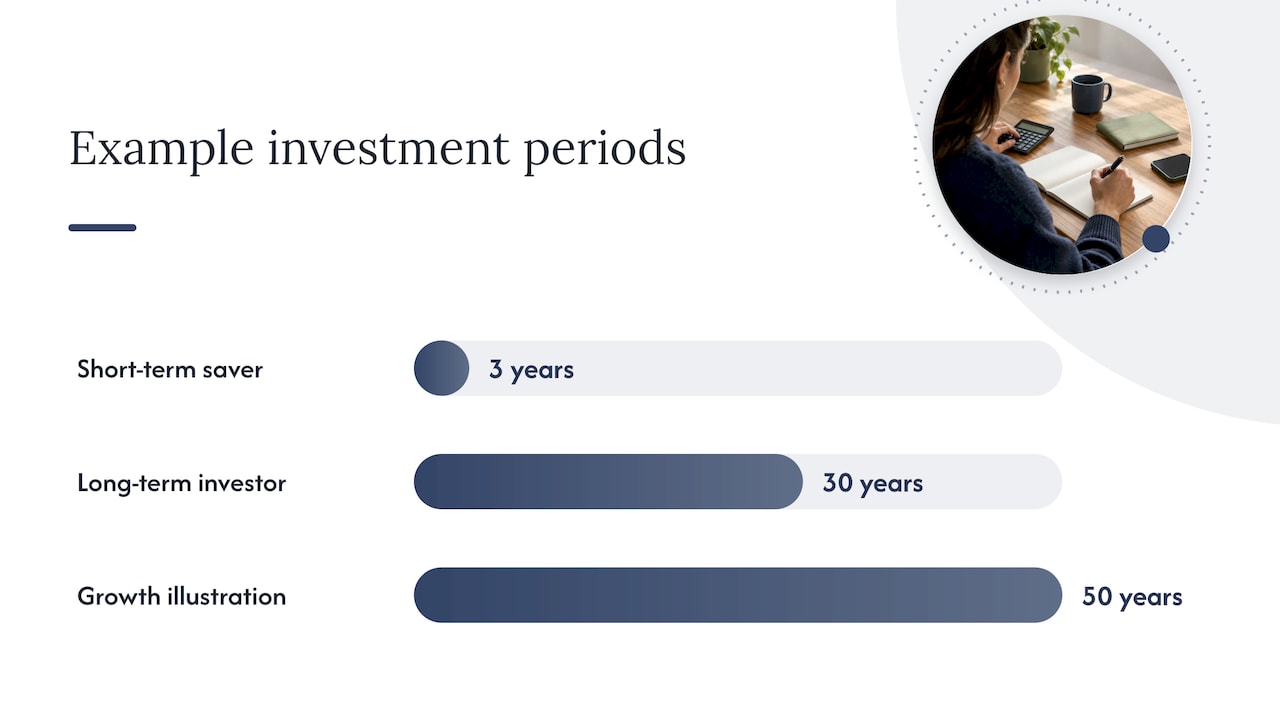
- Short-term saver: say you deposit £2,000 into an account paying a 4% nominal annual rate, compounded monthly, for three years. Here, P = £2,000, r = 0.04, n = 12, and t = 3. Plugging in: A = 2,000 × (1 + 0.04/12)^(12×3) = 2,000 × (1.003333)^36, which works out to approximately £2,254. You have earned about £254 in interest, a modest but real reward for leaving the money untouched.
- Long-term investor: now imagine a £10,000 investment earning a steady 7% annual return, compounded annually, held for 30 years. Here, P = £10,000, r = 0.07, n = 1, and t = 30. That gives A = 10,000 × (1.07)^30, or roughly £76,123. The principal grew more than sevenfold, and most of that growth happened in the later years, once the base of accumulated interest became large enough to generate serious returns on its own.
Even modest rates produce dramatic results given enough time. A separate mathematical illustration of compound growth shows that $1,000 compounding annually at 10% becomes approximately $117,391 after 50 years, which is over 117 times the original sum. The lesson from both examples is the same: the formula does the heavy lifting, but time is what makes the output worth paying attention to.
Compound interest versus simple interest
Simple interest is calculated only on the original principal, every single period, with no allowance for previously earned interest to grow further. The formula is A = P(1 + r·t), where the variables mean the same thing as above but the growth stays flat rather than curving upward.
To see the gap this creates, take £5,000 invested at 5% for 20 years under both methods.
- Simple interest: A = 5,000 × (1 + 0.05 × 20) = 5,000 × 2 = £10,000.
- Compound interest (annual): A = 5,000 × (1.05)^20 = approximately £13,266.
That is a difference of over £3,000 on the exact same rate and time horizon, purely because compounding lets earlier interest start earning its own interest.
In practice, simple interest tends to show up in short-term lending products, such as certain personal loans or car financing, where the lender calculates interest on the outstanding balance without factoring in prior interest. Compound interest dominates savings accounts, most investment products, mortgages and nearly anything held over a longer horizon, because lenders and investment providers both recognise how much more value accrues when interest is allowed to build on itself.
Why time matters: starting early and the exponential curve
Time is the multiplier that makes compounding worth discussing at all. The same rate and the same contribution produce wildly different outcomes depending on how many years they are given to work.
Consider two people who each invest £300 a month at a 6% average annual return, compounded monthly. One starts at age 25 and stops contributing at 55, leaving the balance to keep growing untouched until age 65. The other starts at 35 and contributes continuously until 65. Despite contributing for a shorter period, the early starter's money has roughly a decade longer to compound before retirement, and in most realistic scenarios this produces a noticeably larger final balance, even though both contributed similar total amounts over their working lives.
A modest rate compounded consistently over decades can multiply an initial sum many times over. The example of $1,000 growing to about $117,391 after 50 years at 10% annual compounding demonstrates this precisely: the growth is slow and almost unnoticeable in the first decade, then accelerates sharply in the final years as the base balance becomes large enough for its own interest to matter.
This is also where compounding frequency comes in. More frequent compounding, daily or monthly rather than annually, produces a higher effective annual rate for the same nominal rate, though the difference becomes meaningful mainly on larger balances or over longer periods.
A few practical takeaways follow from this:
- Start as early as your circumstances allow, since the extra years at the beginning tend to matter more than larger contributions added later.
- Prioritise consistency over size, because regular, smaller contributions often outperform sporadic larger ones held for a shorter time.
- Use tax-advantaged accounts where appropriate, since reduced tax drag on reinvested returns lets more of the gain stay in the compounding cycle.
Where compounding shows up in everyday finance
Compounding is not an abstract concept reserved for spreadsheets. It quietly operates across most of the financial products you already use or will use at some point.
- Savings accounts and time deposits: banks typically compound interest daily, monthly or annually, and the stated annual percentage yield already reflects that frequency.
- Bonds and coupons: when coupon payments are reinvested into additional bonds or funds rather than spent, the holder benefits from compounding on top of the bond's own yield.
- Dividend reinvestment plans and ETFs: many funds offer automatic reinvestment of dividends, which buys additional shares and lets future dividends compound on a growing share count rather than a fixed one.
- Pension and retirement accounts: these are often the clearest real-world example, since returns typically stay invested for decades without withdrawal, giving compounding the long runway it needs to produce its largest effects.
The common thread across all four is reinvestment. Interest, coupons or dividends that are paid out and spent stop contributing to growth the moment they leave the account. Left in place, they become part of the base that the next period's return is calculated on.
How to use compound-growth calculators and what inputs matter
A good compound-growth calculator turns the formulas above into something you can test in seconds rather than calculate by hand. The inputs that actually drive the output are always the same five.
- Initial amount: the lump sum you are starting with, if any.
- Periodic contribution: how much you plan to add regularly, and how often.
- Interest rate or expected return: your realistic annual rate, as a percentage.
- Compounding frequency: whether growth is calculated daily, monthly, quarterly or annually.
- Time horizon: the number of years you intend to leave the money invested.
Enter conservative, realistic figures rather than best-case assumptions, since calculators only output what you put in. A tool such as the Compound Growth Calculator from MarketCapLens lets you adjust each of these variables and see how sensitive your final balance is to changes in rate or frequency, which is a useful way to understand your own plan before committing to it.
Pro Tip: Always check whether a calculator's projected rate is before or after inflation and fees, since the gap between nominal and real growth can be larger than it first appears.
How Marmot Finance helps clients make compounding work for them
Understanding the mathematics of compounding is one thing. Applying it consistently, inside a strategy that matches your own tax situation, risk tolerance and goals, is where most people need support. We offer wealth management services focused on disciplined reinvestment, which sits at the core of how we build portfolios.
We combine personal consultations with digital tools to support informed reinvestment decisions. Strategies are tailored to individual financial profiles, aiming to keep returns working inside the portfolio by minimizing fees and premature withdrawals, which can interrupt the compounding process.
For readers who want to see where they currently stand, our Money Makeover Quiz is a useful first step, and our educational webinars and community events offer a way to keep learning without any obligation. Clients who want ongoing, personalised support can explore our wealth management and financial coaching services, with management fees detailed on our pricing page depending on the plan and portfolio size.
Inflation and the difference between real and nominal returns
A rate of return only tells half the story until you factor in inflation. Your nominal return is the headline percentage your account or investment earns before any adjustment, while your real return is what remains after subtracting the rate at which prices are rising.
Inflation matters enormously for long-term planning, because a strategy that looks impressive on paper can still fail to meaningfully grow your wealth once inflation is accounted for.
This is one reason we encourage clients to think in terms of real returns when setting long-term goals, rather than focusing solely on the nominal percentage a product advertises. Compounding still works in your favour either way, but the end result in actual spending power depends on the gap between your return and the inflation rate over the same stretch of time.
Tax implications on compounded returns in Switzerland and Europe
Tax treatment can meaningfully change how much of your compounded growth you actually keep, and the rules differ depending on where you live and what type of account you use. In Switzerland, the Federal Tax Administration publishes recognised interest rates for tax purposes, which are used in specific administrative and intra-group lending contexts rather than as a general tax on investment returns.
Pension assets held within Switzerland's occupational pension system follow their own rules, including the option in certain circumstances to use pension capital toward owner-occupied housing, through either a withdrawal or a pledge, both of which carry specific conditions and tax consequences. Across Europe more broadly, tax treatment of interest, dividends and capital gains varies by country and by account type, so the portion of compounded growth you keep after tax depends heavily on your own residency and account structure. We always recommend checking your specific situation with a qualified tax adviser before assuming how a given account will be taxed.
Behavioural factors that make or break compounding
The mathematics of compounding is fixed, but the behaviour around it is not, and behaviour is usually what determines whether someone actually benefits from the effect. Consistency in contributions matters more than most people expect: an investor who contributes steadily through market ups and downs tends to accumulate a larger base than one who stops and starts depending on sentiment.
Withdrawals are the other side of this. Taking money out, even occasionally, interrupts the compounding cycle at exactly the point where the balance is becoming large enough to matter. The further into a compounding timeline a withdrawal happens, the more growth it removes, because it is not just the withdrawn amount that is lost but all the future growth that amount would have generated.
We find that clients who treat their contributions as non-negotiable, much like a recurring bill, tend to build far stronger long-term outcomes than those who treat saving as whatever is left over at the end of the month.
A personal note on compounding and long-term thinking
Compounding rewards patience more than talent, which is part of why it resonates with so many of the women and families we work with. You do not need to predict markets or pick winning shares to benefit from it. You need a sound strategy, consistent contributions and the discipline to leave your returns alone long enough for the curve to bend upward.
What we find most underappreciated is how emotionally difficult that patience can be, particularly in the early years when growth looks painfully slow. If you want to see how your own numbers might play out, try running a few scenarios through a calculator, or join one of our educational webinars to work through the maths with others asking the same questions.
This article is general information, not a substitute for advice from a qualified financial advisor. Consult a qualified financial professional about your own circumstances before acting on anything here.
FAQ
What is compounding with an example?
Compounding is earning returns on both your original investment and on previously earned returns, rather than on the principal alone. For example, a $1,000 investment compounding annually at 10% grows to roughly $117,391 after 50 years, far more than simple interest would produce over the same period.
How much will $5,000 be worth in 10 years at 6% compounded continuously?
Using the continuous compounding formula A = Pe^(r·t), continuous compounding gives a result slightly higher than annual compounding at the same rate, since continuous compounding represents the fastest possible compounding frequency.
How do you calculate compound interest on a sum at a given annual rate?
You apply the formula A = P(1 + r/n)^(n·t), then subtract the original principal to find the interest earned. For example, £30,000 at 7% compounded annually for one year grows to £32,100, meaning £2,100 in interest for that single year.
Which statement best describes compound interest?
Compound interest is interest calculated on both the original principal and on any interest already added to it, which causes growth to accelerate over time rather than stay flat. This distinguishes it from simple interest, which is always calculated only on the original principal.
Does compounding frequency actually make a noticeable difference?
Yes, more frequent compounding, such as daily or monthly rather than annually, produces a slightly higher effective return on the same nominal rate, though the difference is usually small unless the balance or time horizon is large. It becomes more meaningful over long periods or with substantial principal amounts.
Sources
- Compound Interest - an overview
- Wohneigentumsförderung mit Mitteln der beruflichen Vorsorge
- Steuerlich anerkannte Zinssätze 2025 für Vorschüsse oder Darlehen in Schweizer Franken