

Yes. If what you actually want is personalised investment management paired with financial coaching, rather than a full administrative family office running trusts and estate structures, that service exists and it suits many women and families well. Marmot Finance is one example: a FINMA-accredited, hybrid wealth manager serving women and families across Switzerland and Europe, managing CHF, EUR and USD accounts.
This article does not cover full single or multi-family office administration, meaning trust structures, succession law, or dedicated concierge staff. That is a different service, for a different kind of client.
- The verdict: Coaching-led investment management is available and often the better fit than a full family office.
- Who it’s for: Women and families who want a tailored plan, not a bureaucracy.
- What it excludes: Estate administration, trust structuring, multi-generational concierge services.
Key Takeaways
Coaching-led wealth management works best when it combines a written investment policy with regular pension review and consistent human follow-up.
What does ‘family office services’ mean in this context?
Used loosely online, “family office” can mean anything from a single assistant managing one wealthy household’s affairs to a multi-disciplinary team handling tax, trusts and property across three countries. That’s not what this article is about.
Here, family office services mean something narrower and more useful to most readers: personalised investment management, financial planning, coaching, digital tools and ongoing education. No trust administration. No fiduciary paperwork for a family foundation. No concierge staff booking your holidays.
In practice, that translates into a specific set of services:
- Portfolio construction built around your goals, time horizon and risk appetite, not a generic model portfolio.
- Pension review, looking at your three-pillar position (AHV, occupational pension, and private Säule 3a) to spot gaps early.
- Säule 3a planning, including how much to contribute and which structure suits your tax situation.
- Coaching sessions, where you learn what your money is doing and why, not just receive a quarterly statement.
- Consolidated reporting, so multiple accounts or currencies show up in one clear view.
- Multi-currency handling, useful if you hold assets or income in CHF, EUR and USD.
What’s deliberately left out: estate and trust administration, tax filing on your behalf, and the kind of full concierge or fiduciary services a large single-family office would run. If you need someone to manage a family trust across jurisdictions, full family office services are a different conversation entirely.
Pro Tip: Ask any provider to define, in writing, exactly which of these six services they include as standard and which cost extra. Vague answers here are the clearest early warning sign.
Who actually benefits from this kind of service?
Three groups tend to get the most out of coaching-led wealth management.
Women rebuilding financial independence after a career break, divorce, or a period of part-time work benefit particularly, because Swiss pension data shows that part-time work and career breaks are the main drivers of the gender pension gap. A pension review that catches this early is worth far more than one that catches it at 60.
Families juggling multiple accounts, currencies, or countries also do well here, particularly when they want one coordinated plan rather than three separate advisers who don’t talk to each other.

And individuals with investable assets who actually want to understand their money, not just outsource it and forget it, are the third group. Coaching only works if you show up for it.
That said, a few conditions matter:
- You should have investable assets beyond an emergency fund, since portfolio construction needs something to construct.
- Your situation should be complex enough to need a plan (multiple pensions, income in different currencies, a career break to correct for) but not so complex it needs trustees.
- If your needs run to succession planning across a family business, multi-jurisdiction trusts, or coordinating lawyers and tax specialists in several countries, a full family office is genuinely the better fit. Coaching won’t fix that. Structure will.
How do you choose a provider without getting burned?
Fee structures in wealth management are not always straightforward, so start there.
- Ask whether fees are charged on assets under management (AUM), hourly, or as a flat coaching fee, and get the actual percentage or number in writing.
- Confirm the firm holds FINMA accreditation or equivalent regulatory oversight, and ask what that covers in practice.
- Ask for evidence they’ve worked with women and families specifically, not just wealthy individuals in general. The advice differs.
- Check whether accounts can genuinely handle CHF, EUR and USD if you need that, and who holds custody of your assets.
- Request a sample investment policy statement before you sign anything, so you know what you’re actually agreeing to.
When you sit down with a potential adviser, ask directly about your AHV statement, your second pillar (Pensionskasse) position, and your Säule 3a options. Ask how coaching sessions are structured and how often you’ll get reporting. Ask, plainly, whether they earn commission from any product they recommend.
Pro Tip: If a provider promises guaranteed returns, walk away. No legitimate wealth manager guarantees market performance, and anyone who does is either misunderstanding risk or hiding something.
Red flags worth remembering: fee structures nobody will explain clearly, no written investment policy, and unclear custody arrangements for your assets.
What happens after you sign up, and what does it cost?
Onboarding with most providers in this space follows a similar shape.
- A discovery meeting, or “fact find,” where you talk through your goals, family situation and current accounts.
- Collection of pension and account statements, including AHV, Pensionskasse and any Säule 3a policies.
- A risk profile and written investment policy, agreed before any money moves.
- Account setup and transfers, which can take a few weeks depending on your existing providers.
- Initial coaching sessions to walk through the plan and answer questions.
After that, expect quarterly reporting as standard, an annual review focused specifically on pension optimisation, and coaching follow-ups on a schedule that suits you. Targeted financial education for women tends to work best when it’s paired with concrete, scheduled check-ins rather than a one-off session.
On cost, most providers in this narrower category charge a management fee based on assets under management, plus a separate coaching or advisory fee. What moves the number: portfolio complexity, how bespoke the strategy is, and how much coaching you actually use. A simple, single-currency portfolio with light coaching costs less than a multi-currency setup with pension restructuring and monthly sessions.
How does Marmot Finance actually deliver this?
Marmot Finance runs on a hybrid model: personal consultations combined with digital tools, built specifically for women and families rather than adapted from a general wealth-management template.
- FINMA-accredited, serving Swiss and European clients.
- Accounts held in CHF, EUR and USD.
- A Money Makeover Quiz that gives you a starting picture of your financial position before your first meeting.
- A digital financial planner that sits alongside human coaching, not instead of it.
- Educational resources and community support for clients working through similar life stages.
- Over 350 women have used Marmot’s services to date, including regional coverage such as its Küsnacht service page.
The gap between having a financial plan and actually following it is where most people lose ground. Pairing a written investment policy with a short quiz and a coach who checks in regularly closes that gap far more reliably than a PDF report nobody reads twice.
Marmot’s approach reflects a broader pattern in family office reporting standards: consolidated reporting and clear wealth oversight matter, even when the full administrative apparatus of a traditional family office isn’t needed.
A note on coaching and pension gaps
Coaching only earns its fee if it changes behaviour. What tends to work, in my view, is treating pension conversations as something you’re building toward, not a problem to be managed quietly. A woman who’s taken a career break isn’t behind through any fault of hers; she’s behind because the three-pillar system wasn’t built with breaks in mind. A costed, written plan to close that gap, reviewed yearly, does more good than a single alarming conversation ever could.
Ready to see where you stand?
If Küsnacht is home, or you’re weighing up hybrid wealth management more broadly, the practical next step is small. Take Marmot Finance’s Money Makeover Quiz to get a starting picture of your finances. Then pull together your AHV statement, your latest Pensionskasse certificate, and details of any Säule 3a policies before booking an introductory consultation.
Marmot Finance’s wealth management service covers exactly the personalised investment and coaching model this article describes, and the Küsnacht page gives a clearer sense of what a first meeting looks like locally. Bring your pension statements, a rough sense of your goals, and questions. That’s genuinely enough to start.
Frequently asked questions
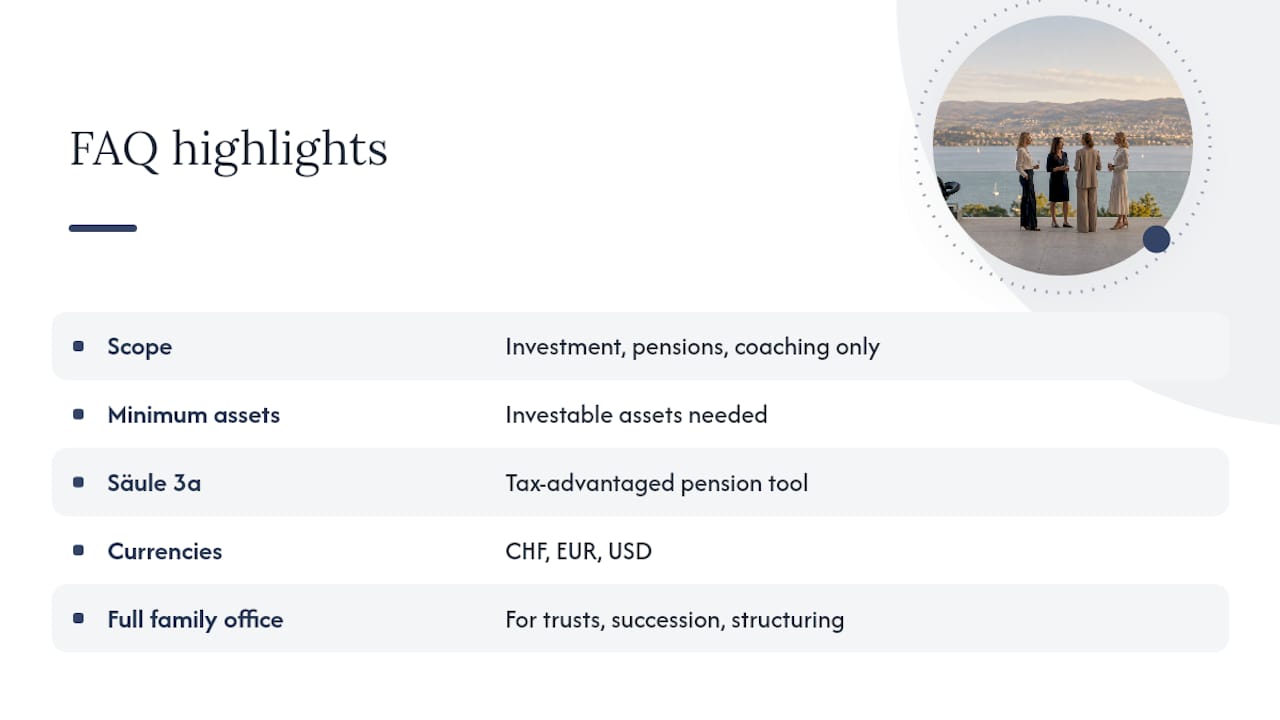
Is this the same as a traditional family office? No. This service focuses on investment management, pension planning and coaching. A traditional family office also handles trust administration, estate structuring and concierge functions, which sit outside this article’s scope entirely.
Do I need a minimum amount of assets to use this kind of service? There’s no universal threshold, but you should have investable assets beyond day-to-day savings for portfolio construction to make sense. Your adviser should be able to explain what fits your situation during an initial consultation.
How does Säule 3a fit into a personalised investment plan? Säule 3a offers tax advantages and is one of the practical tools recommended for closing pension gaps, particularly for women who’ve had career breaks. A good adviser reviews it alongside your AHV and Pensionskasse position, not in isolation.
Can Marmot Finance manage accounts in different currencies? Yes. Marmot Finance manages CHF, EUR and USD accounts, which suits clients with income, assets or family ties across Switzerland and Europe.
What if my situation turns out to need a full family office? Some cases do, particularly where succession planning, multi-jurisdiction trusts or business structuring are involved. In that case, full family office services are worth exploring separately from the coaching-led model this article describes.
This article is general information, not a substitute for advice from a qualified financial advisor. Consult a qualified financial professional about your own circumstances before acting on anything here.
Sources
- Vorsorge in der Schweiz: Was Frauen jetzt über AHV, Pensionskasse & Säule 3a wissen müssen — womenmatter/s
- Finanzberatung für Frauen: Ihr Weg zur finanziellen Unabhängigkeit - Everon AG
- Female Finance: Tipps für Frauen zum Thema Finanzen — ZKB
Recommended
- Family Office Dienstleistungen in St. Moritz: Verwaltung komplexer Vermögen | Marmot Finance
- Anlageberatung für Frauen erklärt: Ihr Schweizer Leitfaden | Marmot Finance


.webp)





.jpeg)




.png)

.svg)


