Use this checklist now: pick the one item with the biggest gap, whether that’s an undersized emergency fund, an unreviewed insurance policy or an unused Pillar 3a allowance, and act on it this week. A proper financial checklist walks through liquidity, pensions, tax, insurance, investments and your key documents, so your whole financial picture gets organised, reviewed and improved rather than left to chance.
TL;DR:
- Keep three to six months of essential expenses in an accessible savings or call account, rather than a fixed term deposit.
- Use twelve months of statements to establish your spending baseline, then automate savings transfers before discretionary spending.
- Check your Pillar 3a allowance before year end, since contributions must arrive by the deadline to qualify for that year’s tax deduction.
- Quarterly, compare your investment allocation with its target and check fund expense ratios, since ongoing charges can erode returns more than transaction fees.
- A will does not cover incapacity; review your power of attorney and healthcare directive yearly, including who can make financial or medical decisions.
Marmot Finance
Bring Your Financial Picture Together
Marmot Finance combines personal consultations and digital tools to help women and families in Switzerland navigate their financial journey.
A practical, category-by-category checklist you can tick off
A financial checklist only works if you can tick things off, so here is what “done” looks like in each area.
Emergency fund. Most guidance points to a few months of essential expenses, held somewhere you can reach without penalties or notice periods. A practical Swiss guide on the emergency fund recommends exactly this range and warns against parking the money in products with withdrawal restrictions, since the whole point of this money is that it’s there the moment you need it. A savings account or call account usually beats a fixed-term deposit for this purpose, even if the return is lower.
Budget and cashflow. Pull your last twelve months of statements and see where the money actually went, not where you think it went. It won’t fit everyone’s situation perfectly, but it gives you a baseline to adjust from. Once you’ve set your split, automate the transfers so saving happens before you get the chance to spend it.
Debt. List every debt you’re carrying with its interest rate, and deal with the expensive ones first, credit cards and consumer loans typically cost far more than a mortgage. If you have a mortgage, check whether your amortisation schedule still suits you or whether an accelerated repayment plan would save meaningful interest over time.
Insurance. Go through your health, liability, home and life policies and confirm the cover still matches your life, not the life you had when you signed up. Update beneficiaries if your family situation has changed, and keep policy numbers and renewal dates in one place so you’re never scrambling before a deadline.
Retirement and pensions. Gather your latest Pillar 2 (occupational pension) and Pillar 3a statements and see where you stand. If you haven’t used your Pillar 3a allowance for the year, a top-up before year-end is one of the few moves that reduces your taxable income immediately while also building retirement savings.
Taxes. Collect receipts for deductible expenses, professional costs, pension contributions, and check what else you can still do before the tax year closes. An end-of-year financial checklist specifically flags Pillar 3a top-ups and an insurance review as two of the highest-value moves to make before year-end.
Investments. Check your allocation against your actual goals and risk tolerance, not against what felt right when markets were doing something different. Pay close attention to the ongoing charges inside your funds: a fund-cost analysis from NZZ found that indirect costs such as the total expense ratio (TER) can erode long-term returns more than the transaction fees investors tend to notice. Rebalance if your allocation has drifted meaningfully from your target.
Documents and admin. Round up your key statements, pension records, insurance policies and your will, and check they’re current. Review recurring subscriptions you’ve forgotten about and update any passwords tied to financial accounts.
- Emergency fund: three to six months of expenses, held in an accessible account.
- Budget: apply a simple split (such as 70/20/10) and automate transfers.
- Debt: list rates, attack the expensive debt first, review mortgage amortisation.
- Insurance: confirm cover matches your life, update beneficiaries.
- Pensions: gather Pillar 2 and Pillar 3a statements, consider a top-up.
- Tax: collect receipts, check deductions, act before the deadline.
- Investments: review allocation, watch ongoing charges, rebalance if drifted.
- Documents: gather statements and wills, tidy subscriptions and passwords.
Pro Tip: Do the emergency fund and insurance checks first. They take the least time and remove the biggest risks if something goes wrong this year.
Ongoing fund charges often cost investors more over the long run than the transaction fees they actually notice, which is why checking the TER on your funds deserves a spot on this list even though it feels like a minor detail.
How to use the checklist: timing, prioritisation and a simple timetable
A checklist you never open is worthless, so here’s how to actually work through it.
- Start with a one-hour triage. Check your liquidity (do you have an accessible emergency fund?), confirm your insurance policy numbers and renewal dates are findable, and locate this year’s tax documents. These three alone remove most of the risk of a nasty surprise.
- Run quarterly checks. Every three months, glance at your budget against actual spending and check whether your investment allocation has drifted from target. Ten minutes, done consistently, beats an annual scramble.
- Save the bigger moves for year-end. A Pillar 3a top-up and any tax-sensitive decisions belong in the final quarter, when you know your full-year income and can plan deductions properly.
- Prioritise by urgency times impact. An uninsured gap or an empty emergency fund is both urgent and high-impact, do that first. A minor subscription clean-up is neither, it can wait.
- Follow a simple timetable. In December, handle your Pillar 3a top-up and any last tax actions. In January, review how the year went and reset your budget and savings targets for the one ahead.
What to emphasise in your 20s, 30s, 40s and 50s+
The checklist stays the same, but what matters most shifts as your life does.
- In your 20s: build your emergency fund from scratch, start pension contributions even if they’re small, and get basic liability and health cover sorted. Building a credit history now pays off later when you need a mortgage.
- In your 30s: this is often when mortgages, growing families and life insurance needs collide. Increasing your Pillar 3a contributions becomes more valuable as your income rises and your tax bracket with it.
- In your 40s: check for gaps in your pension projections and close them while you still have time for compounding to help. Estate planning stops being optional once you have dependants and meaningful assets.
- In your 50s and beyond: test different retirement scenarios against your actual pension statements, look at ways to optimise your Pillar 2 and Pillar 3a withdrawals, and make sure succession documents are in order well before you need them.
Swiss-focused checks and practical insights
A few checks matter specifically if your finances touch Switzerland, and they’re easy to overlook if you’re following a generic checklist.
- Pillar 3a contribution limits for the 2026 tax year stay at the levels set by the Federal Tax Administration, and contributing before the deadline is the only way to claim the deduction for that year, so check the current limits before year-end.
- Watch the ongoing charges inside any funds you hold. As the NZZ analysis points out, a high TER quietly compounds against you every year, even when the fund’s headline performance looks fine.
- Before any advisory conversation, gather your BVG pension fund statement, your AHV records and your last tax return. Having these ready turns a vague conversation into a concrete one.
- We built a Money Makeover Quiz specifically because many women don’t know where to start, and numerous women have already used similar guidance to reorganise their finances.
Pro Tip: Keep your Pillar 2 and Pillar 3a statements in the same folder as your tax return. When year-end arrives, you’ll have everything in one place instead of chasing documents under deadline pressure.
Credit score and report review
Outside Switzerland, many readers will also want to check their credit report at least once a year, since errors on these reports are common and can affect your ability to borrow. Review the report for accounts you don’t recognise, outdated balances, or late payments that were actually made on time.
If you’re applying for a mortgage, a car loan, or even a new insurance policy, a clean and accurate credit history makes the process faster and often cheaper. Dispute anything incorrect as soon as you spot it rather than waiting until you need the credit, since corrections can take time to process.
This check matters more the closer you are to a major purchase, but it costs almost nothing to do annually regardless. Treat it the same way you treat your insurance review: a quick look that occasionally catches something worth fixing before it becomes expensive.
Estate planning basics beyond wills
A will covers who inherits what, but it doesn’t cover what happens if you’re alive but unable to make decisions. That’s where a power of attorney comes in: a document naming someone to handle your financial or legal affairs if you can’t do it yourself, whether due to illness, injury or absence.
A healthcare directive, sometimes called an advance directive, does something similar for medical decisions. It states your wishes about treatment if you’re unable to communicate them, and names someone to make those calls on your behalf.
Neither document is complicated to set up, but both are easy to postpone indefinitely because they involve thinking about scenarios nobody wants to imagine. Reviewing them once a year, alongside your will, means they actually reflect your current wishes and your current choice of representative, rather than a decision made a decade ago under different circumstances.
Review of major financial goals and progress tracking
A checklist without goals attached is just admin. Once a year, write down what you’re actually working towards: a house deposit, your children’s education, an earlier retirement, financial independence, whatever it is for you.
For each goal, check three things: how much you’ve saved towards it, whether your current savings rate gets you there on time, and whether the goal itself still makes sense given how your life has changed. A goal set five years ago might need an update, not because you failed, but because your circumstances moved on.
This is also the moment to notice goals that have quietly stalled. If a target has had no progress for two years running, either recommit to it properly with a concrete monthly contribution, or consciously drop it and redirect that mental energy and money somewhere that matters more to you now.
Planning for education expenses
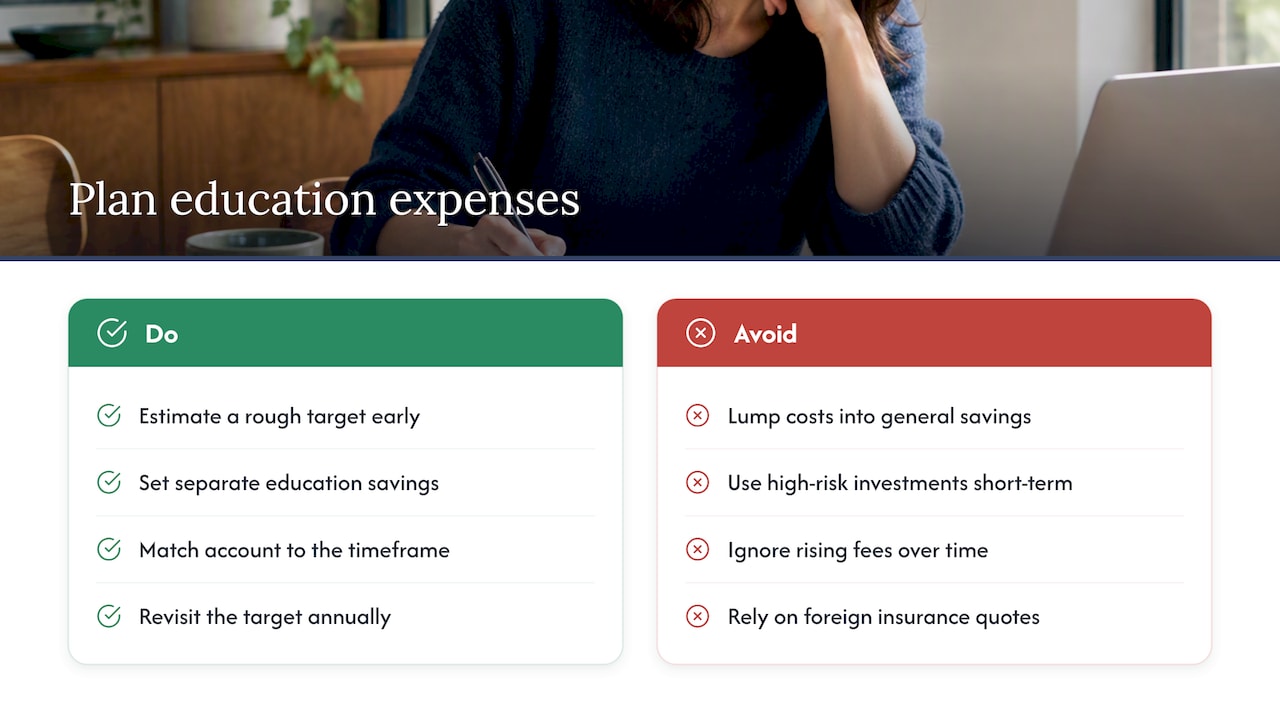
If you have children, or you’re planning to, education costs deserve their own line in the annual review rather than getting lumped into general savings. Costs vary enormously depending on whether you’re thinking about private schooling, university abroad, or further education later in life, so the sooner you estimate a rough target, the more realistic your saving plan can be.
Dedicated education savings, kept separate from your general investment portfolio, make it easier to track progress and avoid accidentally spending the money on something else. Depending on the timeframe, this might sit in a lower-risk account if the expense is a few years away, or in a longer-term investment if you’re planning a decade or more ahead.
Revisit the target annually. School and university fees tend to rise, and a plan that looked sufficient three years ago might now fall short. If you’re estimating life insurance cover to protect this plan in case something happens to you, a tool like the Final Expense Premium Estimator can give you a rough sense of typical premium costs, though Swiss readers should check cover and pricing with a provider operating in their own market.
Why a short annual review beats ad hoc fixing
A short, structured review once a year consistently beats the habit of fixing things only when they break. Most financial damage doesn’t come from one bad decision, it comes from small gaps left unattended for years: an emergency fund never quite topped up, a Pillar 3a allowance left unused, a will that still names an ex-partner.

If I had to pick one behavioural tip, it’s this: automate what you can, and put a date in your calendar for what you can’t. Automation removes the need for willpower, and a fixed annual date removes the need to remember.
If you want a more guided version of this review, our educational resources and community events cover these topics in more depth throughout the year.
This article is general information, not a substitute for advice from a qualified financial advisor. Consult a qualified financial professional about your own circumstances before acting on anything here.
FAQ
What is the 7 7 7 rule for money?
The 7 rule isn’t a standard, widely recognised financial framework, definitions vary depending on where you encounter it. If you’ve seen it referenced somewhere specific, treat it as one person’s shorthand rather than an established rule, and focus instead on the core checklist categories covered above.
What is the 70/20/10 rule for money?
It’s a starting point rather than a strict formula, and many people adjust the percentages once they understand their actual spending patterns.
What is the 4-3-2-1 rule in finance?
Like the 7 rule, the 4-3-2-1 rule isn’t a single, consistently defined standard across financial sources, so treat any version you encounter with some caution. Rather than chasing a memorable formula, it’s usually more useful to build a budget and savings plan around your own numbers and goals.
What are the seven components of a financial plan?
A financial plan commonly covers cashflow and budgeting, an emergency fund, debt management, insurance cover, retirement and pension planning, investment strategy, and estate planning documents. These map closely onto the checklist categories above, which is why reviewing them together once a year makes sense rather than treating each as a separate task.
How much does financial coaching or wealth management cost?
Costs vary by provider and the scope of service involved. Our own annual management fee runs from 0.65% per year on the Marmot Easy plan, with Premium and Select plans priced differently depending on the level of service and assets involved.
Sources