
Chart of the Week
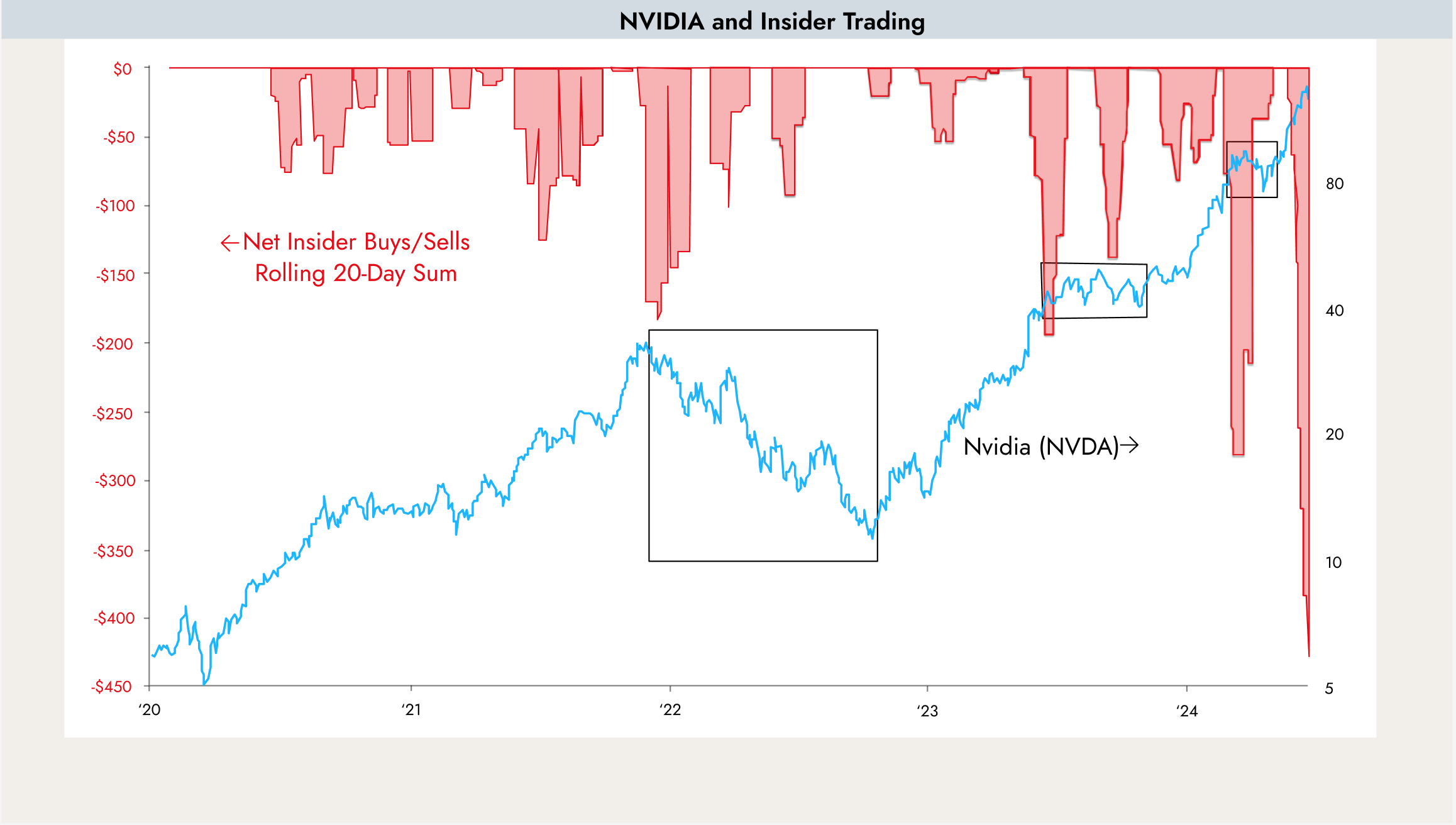
The chart shows the price performance of NVIDIA (black line) and, in red bars from top to bottom, the volume of insider sales. Directors, executives, or other individuals who possess material information or hold more than 10% of a company’s class of securities are considered insiders by the SEC. These individuals are required to report purchases and sales of shares in their own company to the SEC, and these disclosures are made public.
There is also a so-called “buyback blackout period.” A blackout period in financial markets is a timeframe during which insiders are prohibited from buying or selling shares of their company or making changes to their pension plan investments. For company shares, a blackout period is generally imposed before earnings announcements. For pension plans, it occurs during periods when significant changes are being made.

As we are approaching the end of the second quarter, the blackout period is now beginning for many stocks, including NVIDIA. The peak will be reached on July 12 (black bars), when nearly 80% of all companies will be in this blackout period. That is why NVIDIA insiders had to sell last week or otherwise would have been blocked from selling for almost a month.
Why This Matters
NVIDIA has fallen by nearly 20% since its peak last Friday. Is this the trend reversal? NVIDIA’s June stock options expired on Friday. The data shows that most investors did not roll over these positions, meaning they unwound their aggressive bets on NVIDIA and no longer believe in further upside.
In addition, as described above, record-high sales by NVIDIA insiders are raising concerns.
There is a fairly high probability that NVIDIA’s rally has been temporarily slowed and that a consolidation phase lasting 1–2 months could now follow.
Positioning and Expectations of Institutional Investors
Bank of America conducts a survey every month among the largest institutional investors. Institutional investors are responsible for more than 50% of trading volume in the U.S. stock market. That is why it is very interesting to see how they are positioned and what plans they have. This will influence the market in the coming weeks.

Here, large institutional investors were asked where they see the biggest risks (tail risks) over the coming months. Concerns about rising inflation have declined, but it remains the biggest worry.
Geopolitical risks and the U.S. elections have increased in importance.

The chart shows inflation trends from 1966 to 1982 (black line) and since 2014 (blue line). The two periods share many similarities, which is why they are being compared. So far, inflation developments in the U.S. have been very comparable. If this pattern continues, inflation could rise sharply again starting in 2025. At the moment, however, this is not yet being observed, and it is not entirely clear where such strong inflation would come from. Possible drivers could include geopolitical conflicts affecting oil prices or an imbalance between supply and demand for commodities.
At present, inflation is declining in the U.S. and Europe, but the risk of inflation accelerating again remains and should be closely monitored.
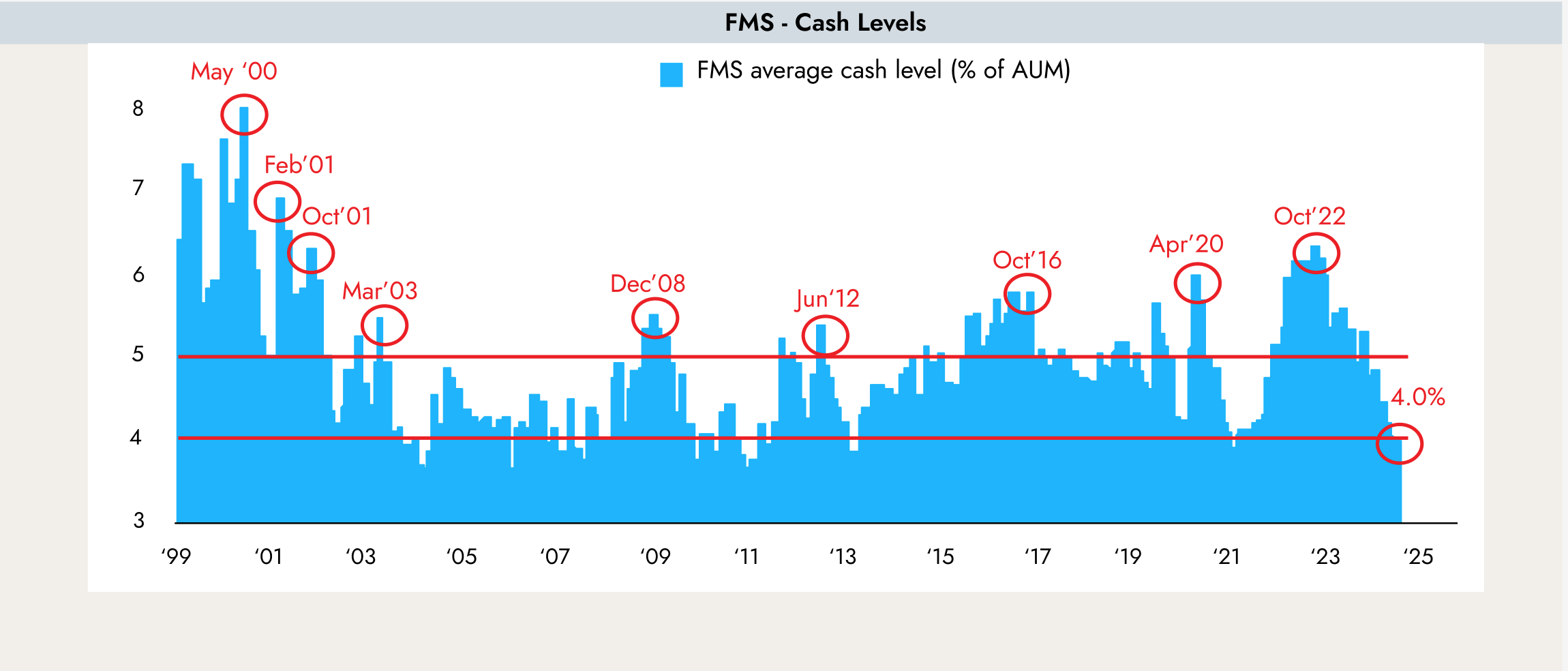
For the creation of this chart, institutional investors were surveyed about the percentage of cash held in their portfolios. At 4%, cash levels are close to historical lows. This means that even if positive economic news is published, large investors no longer have much buying power left. Positive news is therefore likely to have a smaller impact on the markets than negative news. These are often situations in which a trend reversal or consolidation may be approaching.

The chart comes from a survey conducted by J.P. Morgan, one of the largest banks in the U.S., among its clients. Clients were asked whether they plan to increase their equity exposure in the coming weeks. At 17%, the figure is as low as it was in August 2023. This was followed by a market correction of 10–15%. A similar development could be ahead of us in the coming weeks.
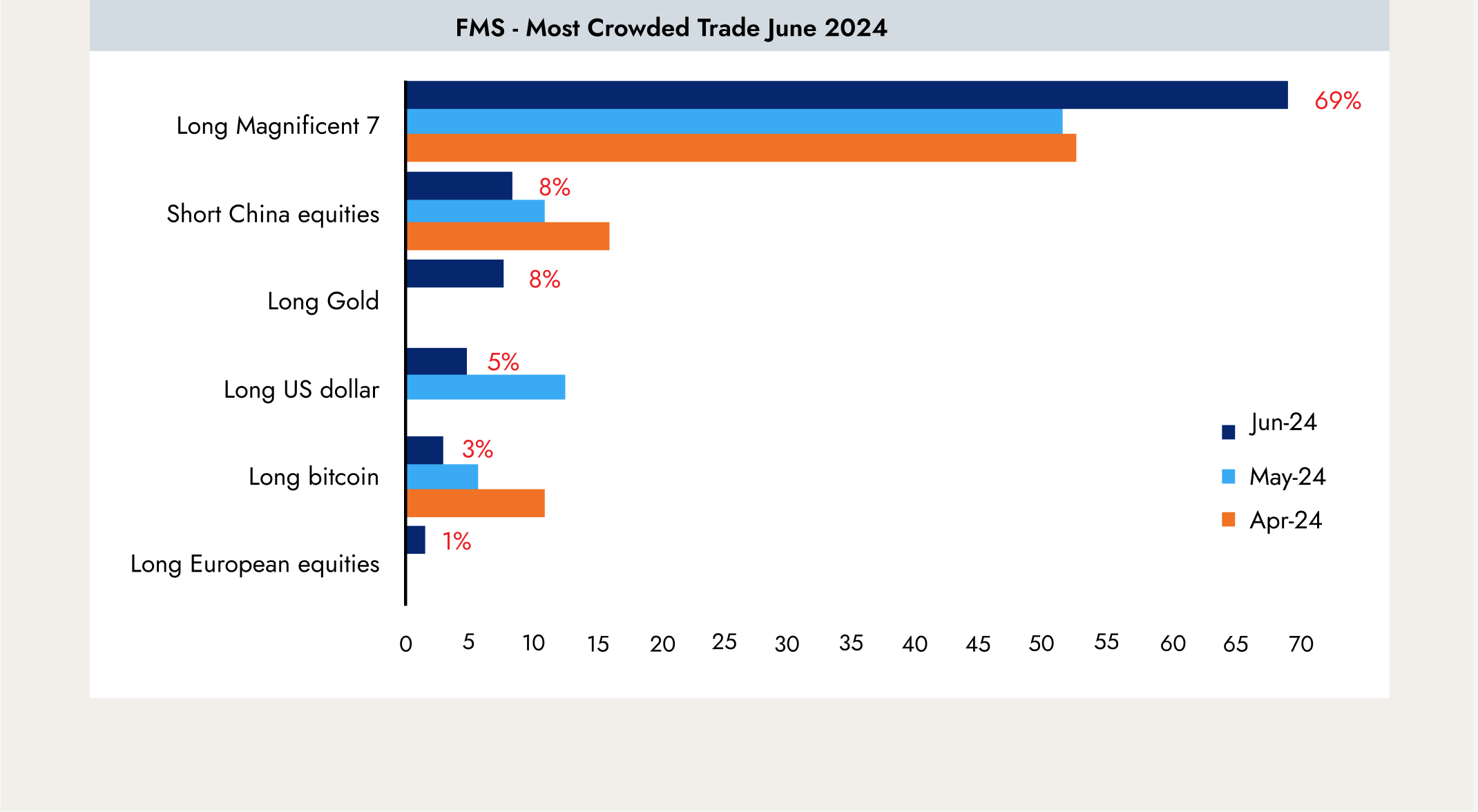
Finally, one more question from the Bank of America survey of the largest institutional investors. They were asked where they see the biggest “crowded trade” — meaning the asset classes in which too many investors are positioned, making valuations no longer attractive.
Even in June, the most frequently mentioned asset class or investment theme remains the Magnificent 7 stocks (Apple, Microsoft, Google, Facebook, Amazon, Tesla, and NVIDIA). It is therefore unlikely that large institutional investors will allocate significantly more capital to these stocks. This brings us full circle to the first topic. A consolidation in NVIDIA appears more likely than new all-time highs.


.webp)





.jpeg)




.jpeg)

.svg)


