Succession planning in Basel comes down to four decisions, taken in this order: who takes over (family, employees or an outside buyer), how the handover is financed, how it is taxed, and how your own and your family's finances look once the company is no longer your main asset. Most of the damage in Swiss successions comes from starting late, not from choosing the wrong route. This guide walks through each decision, using Swiss federal sources, and explains where the private side of the plan, your wealth after the handover, fits in.
Marmot Finance
Plan Your Wealth Beyond the Business
Marmot Finance helps women and families in Switzerland navigate investment decisions with tailored strategies, personal consultations and digital tools.
TL;DR
- Choose the route first: family handover, management buy-out or sale to a third party. Each one needs a different timeline and a different financing plan.
- Since 1 January 2023 the Swiss inheritance rules give owners more freedom to pass a company to one chosen heir, and allow equalisation payments to other heirs to be deferred.
- Restructuring a sole proprietorship into an AG or GmbH shortly before a sale can trigger tax. A five-year holding period (Sperrfrist) applies for tax-neutral treatment.
- A company is usually the largest single asset an owner has. Plan what happens to the proceeds, your pension and your family's security at the same time as the handover.
- Get a lawyer and a tax specialist involved early. This article is general information, not advice on your case.
Why succession needs more lead time than most owners expect
Many owners in Basel and the surrounding region assume the question will answer itself: a child will take over, a senior employee will step up, or a buyer will appear when the time comes. In practice, succession is a process rather than a date. It involves valuation, legal documents, financing, tax and, often the hardest part, conversations inside the family and the team.
The pressure is real in the north-west of Switzerland. A study by Basler Kantonalbank on SME succession in the north-west of Switzerland, published in October 2025, describes an unresolved succession as the largest economic challenge for many small and medium-sized companies in the coming years, with many owners belonging to the baby-boomer generation. It also points out that clear legal arrangements, open communication and professional support over several years raise the chances of a good outcome.
A sensible planning horizon is several years, not months. If you are in your fifties and own a company that depends heavily on you personally, now is a reasonable moment to start, even if retirement still feels distant.
Step 1: Choose the route
There are three classic ways to hand over a Swiss company. None is better in general. The right one depends on your family, your team, your company's profitability and what you need financially from the exit.
Family handover
The federal SME portal describes the family succession (family buy-out) as the case where one or more heirs take over operational management and/or financial control of the company. It sounds simple, but it rests on conditions: the heir must actually want the role and be capable of it, the other family members must accept the arrangement, and the finances must work.
The finance question is the one owners underestimate. If one child receives the company and the others are entitled to a fair share of the estate, someone has to pay that equalisation. A company's value is tied up in machines, stock, premises and goodwill, not in cash. Without planning, the successor may have to borrow heavily, or the business is pulled apart to raise the money.
Sale to employees or management
A management buy-out suits companies with a strong second tier and a good relationship between the owner and the team. The challenge is again financing: the buyers rarely have the capital, so the purchase price is often partly funded by a bank loan and partly by a seller loan from you. That keeps you exposed to the company's performance after you have formally left, which should be part of your risk thinking.
Sale to a third party
Selling to an outside buyer, whether a competitor, a financial investor or an individual entrepreneur, usually gives the cleanest financial break. It also demands the most preparation: clean accounts, documented processes, a company that does not collapse when you step back, and a realistic valuation. Regional advisers in Basel offer matchmaking for this route, so it is worth asking what a mandate would actually involve before you sign.
Step 2: Use the new inheritance rules
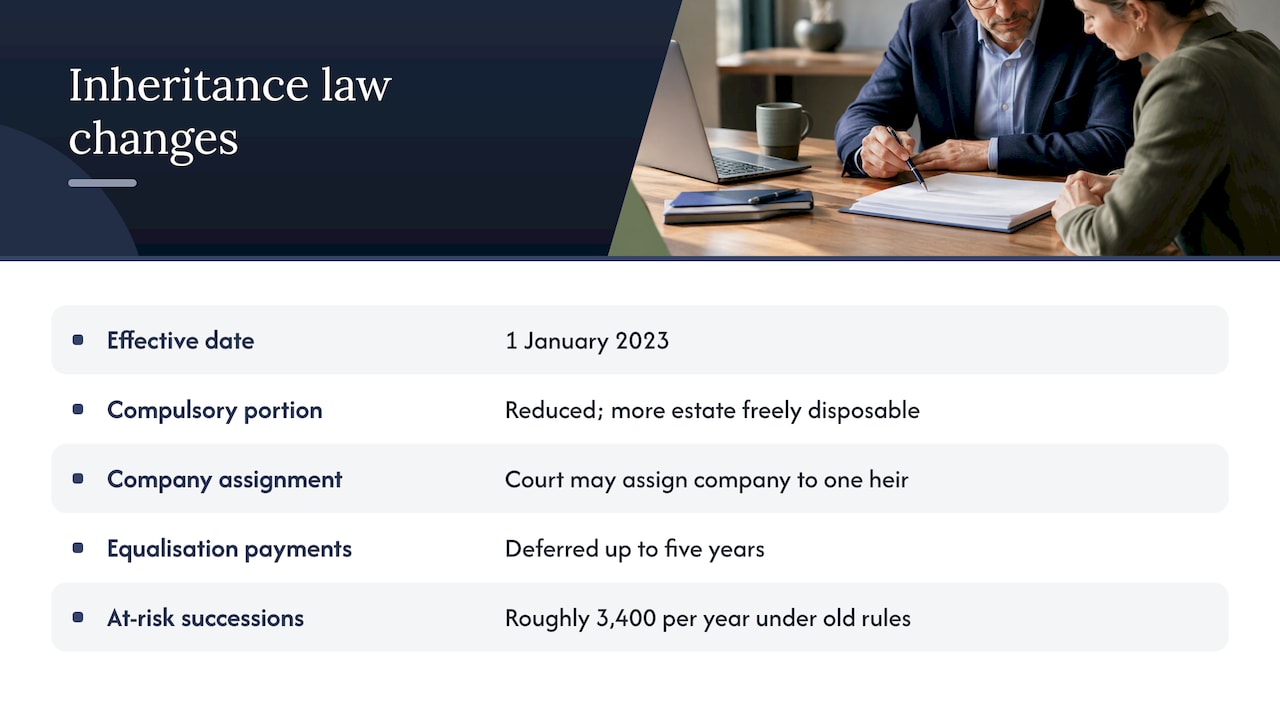
If the company stays in the family, Swiss law is now friendlier than it was a few years ago. According to the Federal Council's message on business succession in inheritance law, amendments came into force on 1 January 2023. Testators can now dispose freely of a larger part of their estate, because the compulsory portion (Pflichtteil) was reduced. This gives more flexibility for succession.
The same reform introduced tools aimed specifically at companies. Under defined conditions, a court can assign the company to a single heir so that it does not have to be liquidated. The equalisation payments owed to the other heirs can be deferred for up to five years, which eases the liquidity problem described above. The federal administration had also identified roughly 3,400 company successions a year that could run into financing problems under the previous rules.
The legislative text is public. The definition of what counts as a company for these purposes (economically active partnerships, sole proprietorships and commercial companies whose shares are not listed on a stock exchange) is in the draft of the Civil Code amendment on Fedlex. The Federal Office of Justice also keeps an overview page on inheritance law with the background to the reform.
Put it in writing with an inheritance contract
A reform on paper does nothing for your family unless your own documents reflect it. Practitioners generally recommend an Erbvertrag (inheritance contract) because it binds all parties to agreed values early, before emotions rise. The federal SME portal makes the point that such instruments are meant to give a fair, clear framework rather than to exclude family members. Many families fear that succession will divide them. Talking openly, with a neutral professional in the room, is often what prevents it.
A notary or a lawyer specialised in inheritance law drafts an Erbvertrag. If you live in Basel-Stadt or Basel-Landschaft, choose someone who knows cantonal practice. Cross-border families, for example owners with a German or French spouse or children living abroad, should ask explicitly how foreign inheritance law interacts with the Swiss documents.
Step 3: Understand the tax side before you restructure
Tax is where well-meant preparation goes wrong. The details depend on your legal form, your canton and the structure of the deal, so what follows is a map of the main issues, not a calculation.
A tax guide from the SGNAFO practice documents on succession and taxes stresses that taxes play a considerable role in every succession, and that owners hope to realise the gains from a handover with little or no tax. That hope is often realistic, but only if the steps are taken in the right order.
Sole proprietorship or partnership versus company
A sole proprietor who sells the business realises hidden reserves, and the profit is generally treated as income, with some relief mechanisms available. Many owners therefore consider converting to an AG or GmbH ahead of the sale. This can work, but the conversion must respect a five-year holding period (Sperrfrist) to remain tax-neutral, according to the same source. If you convert and sell too soon, you may trigger a tax bill that nobody planned for.
The practical consequence is simple: if a sale is possible within the next five to ten years and your business is still unincorporated, ask a tax adviser now whether a conversion makes sense and when it would have to happen.
Shares held privately
For owners of an AG or GmbH who hold their shares as private assets, capital gains from selling shares are generally tax-free in Switzerland. There are exceptions, including cases of indirect partial liquidation and transposition, which is why a pre-sale review matters. Do not assume the exception does not apply to you because the principle is generous.
Pension and salary decisions
Your own pension plan is part of the picture. Voluntary contributions, the timing of a capital withdrawal and the choice between capital and annuity all affect how much of the proceeds you keep. Withdrawal rules and tax rates differ by canton, and people moving abroad after the sale face further questions. This is a point where owners with international ties, such as expatriates running a company in Basel, need advice from a specialist in cross-border tax before they commit.
Step 4: Prepare the company to be handed over
Legal and tax structure are only half of it. A company that depends on its owner for every key decision is hard to hand over and hard to value. Practical preparation usually covers the following areas, which you can work through over a couple of years.
First, make yourself less essential. Delegate client relationships, document processes and give your successor real responsibility well before the transfer date. Second, clean up the numbers. Buyers, banks and heirs will look at several years of accounts, and unclear private expenses or related-party transactions create friction. Third, look at the premises. If you own the building personally and the company rents it, decide whether the property goes with the business, is sold separately or stays as a source of retirement income. Fourth, plan the communication: employees, key customers and suppliers should hear about a handover from you, not from rumours.
Step 5: Plan your wealth after the handover
This is the part many succession guides skip. Once the company is handed over, your financial life changes in one step. The business that provided salary, dividends and most of your net worth is replaced by a lump sum, instalments, a seller loan or a mix of these. For many owners and their families, that is the first time in decades that they hold a large liquid portfolio.
The questions that follow are practical:
- How much do you need each year to live on, and for how many years?
- How do your pension capital, the sale proceeds and any property fit together?
- What do you want to pass on to children, and when?
- How much risk is sensible for money that now has to last for the rest of your life, in which currency, and over what horizon?
If a spouse or partner has never been closely involved in the finances, now is the time to include them. For women who co-own a company or who will inherit one, understanding the numbers before the transition is not a luxury. It gives you a seat at the table when the decisions are taken.
Our perspective: succession is a financial plan, not only a legal one
We are a wealth manager, not a law firm or a tax adviser, and we say so openly: the Erbvertrag, the corporate structure and the tax ruling belong to specialists in those fields. What we see from the side of the family's finances is that the handover is treated as a single event, when it is the start of a new phase.

Our work with women and families in Switzerland and Europe shows us the same pattern. The documents are prepared with care, but the question "what will our money do for us afterwards?" is left until after the signing. At that point, decisions about investing are made under time pressure, sometimes with a large sum sitting on a current account. We think the better order is to sketch the post-handover plan, including income needs, risk tolerance and family goals, while the sale or transfer is still being negotiated.
We also believe that women in family businesses, as successors, co-owners or spouses, deserve to be part of this conversation from the start. A good plan is one that every person affected by it can read and understand, not only the person who negotiated it.
How Marmot Finance can support the next chapter
Once the legal and tax work is done, we help with the part that comes after: investing proceeds and building a long-term plan. Marmot Finance is accredited by FINMA and works exclusively with women and families in Switzerland and Europe. We manage accounts in CHF, EUR and USD, combining personal consultations with digital tools.
Our wealth management and financial coaching services cover investment portfolios built on ETFs and funds, as well as thematic strategies such as sustainability. The annual management fee depends on the plan and is tiered by assets: Marmot Easy is 0.65% per year, Marmot Premium ranges from 1.0% to 0.8% per year and Marmot Select from 0.8% to 0.4% per year. You can see the plans on our pricing page. If you are earlier in the process and want to learn first, our educational webinars and community events are open to anyone who wants to understand investing and planning before taking decisions.
A realistic timeline for owners in Basel
The following timeline is an orientation, not a rule, and your own situation may need more time.
Frequently asked questions
What does succession planning mean for a business owner?
It is the structured process of deciding who will own and run your company after you, and arranging the legal, tax and financial steps so that the transfer works. It covers the company, but also your personal assets and your family. In Switzerland it touches company law, inheritance law and tax law at the same time.
How early should I start in Basel?
Most specialists suggest several years, and the tax holding periods point the same way. A conversion from sole proprietorship to a corporation, for example, needs a five-year holding period to stay tax-neutral. Starting early gives you room to correct course if the preferred successor changes their mind.
Did the 2023 reform change anything for family companies?
Yes. The Federal Council reduced compulsory portions, allowed courts under certain conditions to assign a company to one heir, and made it possible to defer equalisation payments for up to five years. It does not replace the need for your own documents, so check them against the new rules with a lawyer.
What are the downsides of succession planning?
It takes time, it can bring family tensions into the open, and it often involves costs for advisers, valuation and legal drafting. Those costs are usually small compared with the cost of a rushed or failed handover. A neutral third party can help keep the conversations productive.
Can Marmot Finance handle the legal and tax side?
No. We are a wealth manager and do not provide legal or tax advice. We work alongside your lawyer and tax adviser and help you invest and plan your finances after the handover.
Sources
- Federal Council message on business succession in inheritance law (admin.ch)
- Die familieninterne Nachfolge (kmu.admin.ch)
- KMU Nachfolge und Steuern (SGNAFO)
- Civil Code draft on business succession (Fedlex)
- Erbrecht overview (Federal Office of Justice)
- BKB study on SME succession in north-west Switzerland