Entrepreneurs in Nidwalden protect their wealth by doing four things in a deliberate order: keeping business and private assets legally apart, using the canton's tax rules and the pension system, insuring the risks that could hurt the business, and investing private money so that it does not depend on the company's fortunes. Nidwalden helps with the tax side, but tax is only one part of the picture. This article explains each step in plain terms, with the figures that apply in 2026.
Marmot Finance
Build Wealth Beyond Your Business
Marmot Finance helps women and families in Switzerland invest with tailored strategies, personal consultations and user-friendly digital tools.
TL;DR
- Your legal form decides how much of your private wealth is exposed: a sole proprietor is liable with everything, while an AG or GmbH generally limits the risk to the company's assets.
- Nidwalden's simple wealth tax rate is 0.25‰, with a reduced 0.2‰ for qualifying participations of at least 10% of capital.
- Pillar 3a lets self-employed people deduct up to 20% of earned income, capped at CHF 36,288, and the assets are exempt from wealth tax while locked in the pension plan.
- Build private wealth outside the company, diversified away from your own business, and plan succession before you need it.
Why protection starts with the legal form
Most wealth problems for founders begin with a simple fact: the business and the owner are, legally, the same person or they are not. That choice is made at incorporation and is hard to undo later.
In a sole proprietorship there is no legal separation between personal and business assets. SECO states that the owner may have to cover business debts with personal assets. The same applies to the tax side: sole proprietorships and partnerships are not taxed as separate legal entities, so business and private income and assets are taxed together in the owner's hands.
An AG or a GmbH changes this. Private assets are clearly separate from business assets, and the company's fixed assets belong to the company, as the federal SME portal explains. The canton of Zurich's business portal gives the entry thresholds: a GmbH needs CHF 20,000 of fully paid-in capital, an AG CHF 100,000 of share capital, of which at least CHF 50,000 must be paid in at incorporation. Both forms generally shield personal assets from company obligations.
The limits of limited liability
Limited liability is not absolute, and this is where founders are sometimes surprised. In a GmbH, debts are guaranteed by company assets only, but the articles of association may require additional payments to cover balance-sheet losses or keep the company going, capped at twice the nominal value of a share. In an AG, shareholders generally lose at most their invested share capital in a bankruptcy, but they must pay in the full capital their shares represent.
In practice, banks and landlords often ask founders for personal guarantees on loans and leases. A personal guarantee sits outside the company's liability shield. Before you sign one, ask what it covers, for how long, and whether it can be capped or released once the company has a track record.
Keeping business and private money apart
The legal form only works if the books follow it. For sole proprietors, SECO advises separating business and private expenses, allocating mixed-use assets proportionally, and using private and equity accounts, as set out in its guidance on closing the accounts. Company owners should go further and keep habits clean:
Pay yourself a documented salary and, where appropriate, dividends, rather than drawing cash when you need it. Keep a separate private account for household spending. Do not let the company pay private costs informally, because this blurs the line that protects you and can attract questions from the tax authorities. Where you lend money to your own company, put the loan in writing.
This is dull work, but it is the cheapest form of wealth protection there is.
What Nidwalden's tax rules mean for your private assets
Nidwalden is well known for being tax-friendly, and for entrepreneurs the wealth tax is the relevant part. The canton's official tariff lists a simple wealth tax of 0.25‰, reduced to 0.2‰ for qualifying participations of at least 10% of capital. These are the base rates: the amount you actually pay also depends on the municipal and cantonal multipliers, so use the canton's tariff page for your municipality.
Two details matter for owners. First, taxable wealth includes all assets and rights, and that explicitly covers assets invested in a business or agricultural enterprise. Your shares in your own company are therefore part of your taxable wealth, even though you cannot easily sell them. Second, the canton allows a deduction from net wealth: CHF 70,000 for spouses living in an unseparated marriage and CHF 35,000 for other taxpayers.
For newly established companies of economic interest to the canton, Nidwalden also grants tax relief typically between 10% and 30% for the year of founding and the nine years that follow. This applies to the company, not to you personally, and it is granted case by case, so speak to the cantonal tax authority or the economic development agency before you assume it applies to your plan.
A low tax rate is a benefit, not a protection. It leaves you with more money each year, but it does nothing if a single guarantee or a lawsuit takes the business and your savings together.

Pillar 3a: a pension tool that also shields wealth
For self-employed people, the third pillar is one of the few deductions that is large, simple and legally secure. Self-employed people with AHV-liable income can deduct contributions of up to 20% of earned income, capped at CHF 36,288 from 2025, if they have no Pillar 2 coverage. The Federal Social Insurance Office also notes that, for the self-employed, Pillar 3a can serve as a replacement for the optional occupational pension scheme.
There is a second benefit that is easy to overlook. According to the Federal Tax Administration's circular on the tax treatment of pension contributions, Pillar 3a assets are exempt from wealth tax while they remain in the locked pension plan. Money in Pillar 3a is also separate from your business assets, which is useful for a founder whose company may one day struggle.
The trade-off is access. The funds are locked until the conditions for withdrawal are met, so do not put in money you may need for the business. Many entrepreneurs treat Pillar 3a as the floor of their private plan and keep a separate, freely accessible portfolio on top of it. If you have no Pillar 2 cover, check how the 20% rule applies to your income with your pension provider or tax adviser before you plan the year's contribution.
Insurance and cash reserves for business risks
The second layer is insurance. SECO lists property insurance for buildings and personal property such as goods, machines, tools, computers and vehicles, and operating-loss insurance, which covers interruption costs and lost profit. The cover you need depends largely on your sector: a workshop in Stans faces different risks from a consultancy working from a home office in Hergiswil.
Beyond the company's own policies, think about what happens if you cannot work. A founder who is the main earner and the main asset of the business is a concentrated risk. Loss-of-income cover, life insurance linked to a buy-sell agreement with business partners, and a sensible liquidity reserve all belong in the plan.
A useful rule of thumb is to hold two separate cash reserves: one in the company to cover a few months of fixed costs, and one in your private name to cover household costs. If the company needs rescuing, you then have a choice rather than an obligation. How many months is right depends on how volatile your revenue is, so it is a decision for your own numbers, not a standard figure.
Diversifying beyond your own company
Many entrepreneurs have 70% or more of their net worth in one company, in one sector, in one region. That is concentration risk, and it is the part of wealth protection that insurance and legal forms cannot fix.
The practical answer is to build a private portfolio that has little in common with your business. If your company depends on the Swiss industrial cycle, a portfolio of globally spread equity ETFs, bonds and some real assets gives you exposure to different drivers. Three questions shape the mix. How much of your wealth is already tied up in the business? When might you need to draw on private money, for example for a sale, a family purchase or retirement? And how much of a loss could you accept in a bad year without changing your life?
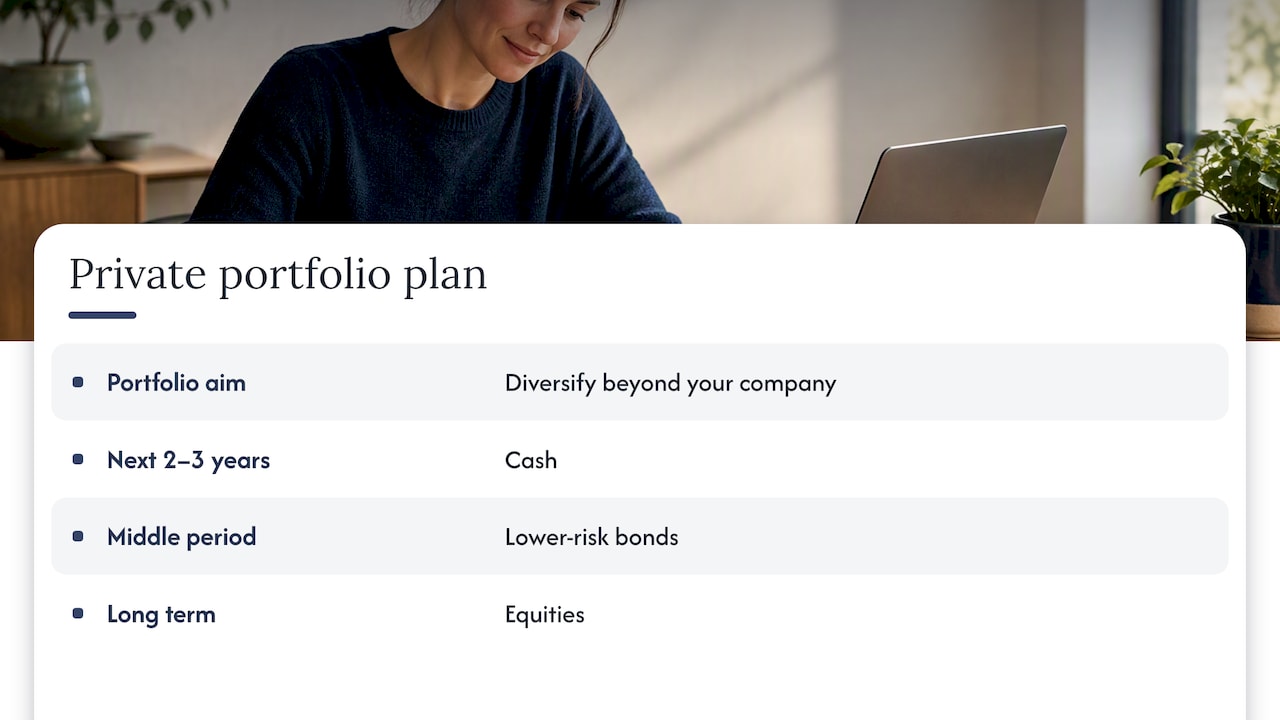
When you set the time horizon, split your money into buckets: cash for the next two or three years, a middle part in lower-risk bonds, and a long-term part in equities. For a broader view of how mixing asset types lowers risk in the long run, this explanation of retirement portfolio diversification is a helpful overview.
Liquidity matters as much as return. Shares in your own company are hard to sell quickly, so the private portfolio should be easy to turn into cash.
Planning succession and the transfer to family
Wealth protection includes protecting your family from disorder when you step back or when something happens to you. Swiss inheritance law changed at the start of 2023: the revised law entered into force on 1 January 2023 and reduced the statutory compulsory portions, which gives owners more freedom to assign the larger free portion to the person who will run the business. The same source notes that the company is now valued at the time of the handover, and that the successor can request that compensation payments to other heirs be deferred. Both changes make a family succession easier to finance.
For a founder with several children, only some of whom will work in the business, this matters. You can give the business to the child who will run it and balance the others with private assets, which is easier if you have built a private portfolio outside the company. Without that portfolio, the only asset to divide is the business itself.
A sound succession plan generally includes a will or inheritance contract, a marital property agreement where relevant, a power of attorney in case you lose capacity, and a clear plan for who takes operational decisions in the meantime. For cross-border families, for example founders with a spouse or children living in Germany, Italy or the United States, the rules of more than one country may apply, so involve a lawyer who handles cross-border estates.
Our perspective
We work with women entrepreneurs and families, and one pattern comes up again and again: the company gets all the attention, and the private side is left to chance. A founder may have excellent insurance for the workshop and nothing set aside for her own family if the business stalls. Women entrepreneurs are also often the person holding the family together financially, which makes the private plan more important, not less.
Our view is that the business is one asset, and an important one, but it should never be the only plan. We would begin with a clear picture of what you own, in the company and outside it, and how quickly each part could be turned into cash. Next, we would set a private reserve, use Pillar 3a as it fits, and build a diversified portfolio that does not rely on the same drivers as your company. The investing should be explained in plain words, because a plan you understand is a plan you will keep through a bad year.
We also think tax should follow the plan and not lead it. Nidwalden's rates are attractive, but a low rate on a concentrated, illiquid balance sheet is still a concentrated, illiquid balance sheet.
How Marmot can help
Marmot Finance is a FINMA accredited wealth manager that works exclusively with women and families in Switzerland and Europe, combining personal consultations with digital tools. If you want to build the private side of your wealth, our wealth management service covers personalised portfolios and financial coaching. The annual management fee is published on our pricing page: 0.65% per year for Marmot Easy, 1.0-0.8% per year for Marmot Premium and 0.8-0.4% per year for Marmot Select. We manage accounts in CHF, EUR and USD. If you would first like to learn, our webinars and community events are a good starting point, and you can read more about our work in the canton on our Nidwalden page.
FAQ
Does an AG or GmbH fully protect my personal assets?
Generally yes, because the company's obligations are secured by company assets. There are exceptions: shareholders must pay in the full capital their shares represent, a GmbH's articles may require additional payments of up to twice the nominal value of a share, and personal guarantees you sign for loans or leases remain your own liability.
Is my company taxed as part of my wealth in Nidwalden?
Yes. Taxable wealth includes assets invested in a business, and your shares in your own company count as wealth. Qualifying participations of at least 10% of capital are taxed at the reduced simple rate of 0.2‰ instead of 0.25‰.
How much can a self-employed person pay into Pillar 3a?
Self-employed people with AHV-liable income and no Pillar 2 coverage can deduct up to 20% of earned income, capped at CHF 36,288 from 2025. Check the current annual maximum on the Federal Social Insurance Office page before you pay in, as it can be adjusted.
When should I start planning my succession?
Earlier than feels necessary. Since the inheritance law revision of 1 January 2023, owners have more room to assign the business to one heir, but the plan still needs a valuation, financing and often a private portfolio to balance the other heirs. A lawyer and a tax adviser should look at it together.
Sources
- Steuertarife & Steuerfüsse, Steuern Nidwalden
- Kantonsblatt Nidwalden, Steuerdokumentation ESTV
- Closing the accounts of a sole proprietorship, SECO
- Case study on a service provider, SECO
- Certain companies are tax-exempt, SECO
- Legal form: Limited liability company, SECO
- Rechtsform: Aktiengesellschaft AG, SECO
- Select legal form, Canton of Zurich
- Insurance: social security schemes and business insurance, SECO
- Die dritte Säule, BSV
- Tax treatment of pension contributions, Federal Tax Administration
- Erbrechtsrevision 2023: Vorteile für die Unternehmensnachfolge