A family in Zumikon plans retirement by working out three things in order: what the state and the pension fund will pay, what gap remains between that income and your real spending, and how to close the gap with savings, investments and sensible timing of withdrawals. The rules come from federal law, the tax treatment from the Canton of Zurich, and the decisions from your own household. This guide walks through each step in plain language.
Marmot Finance
Plan Your Family’s Financial Future
Marmot Finance supports women and families in Switzerland with tailored investment management, personal consultations and user-friendly digital tools.
TL;DR
- Two public pillars form the base: the AHV (first pillar) and the pension fund (second pillar). For a married couple, the combined AHV pension is capped, so the household usually needs more than the state provides.
- Your pension fund certificate (Pensionskassenausweis) is the most useful document you own. It shows your capital, your conversion rate and your lump-sum options.
- In the Canton of Zurich, a pension fund capital withdrawal is taxed separately from income, and spreading withdrawals across several tax years can lower the bill.
- Private investing, held in a structure that suits your family, fills the gap. Start early, write the plan down and review it every year.
Why retirement planning in Zumikon deserves its own look
Zumikon sits on the Pfannenstiel above Lake Zurich, and many households here have higher incomes, property and more than one source of wealth. That tends to make the plan more complex than a simple AHV and pension fund calculation. Home ownership, a business, children's education and sometimes foreign assets all play a part.
The tax picture is also local. For 2026, the municipality of Zumikon sets its tax multiplier at 71%, with the cantonal multiplier at 95%, both lower than the year before. Multipliers change, so it is worth checking the current figure each year when you model your future net income.
None of this changes the basic architecture. Swiss retirement provision rests on three pillars, and the first job is to understand what the first two will deliver.
Pillar one: what the AHV will pay your household
The AHV is the state old-age and survivors' insurance. According to the Federal Social Insurance Office (BSV), the maximum monthly old-age pension for a single person in 2026 is CHF 2,520, and you only receive it with a full contribution history. Gaps in contribution years reduce the pension, which is a particular concern for people who spent years abroad or stepped back from paid work to raise children.
For couples, the picture is less generous than doubling the single figure. The same BSV page explains that married couples face a cap on their combined pensions at 150% of the maximum individual pension, which comes to CHF 3,780 per month. Over a year, with the pension paid 13 times, that is CHF 49,140 for the household at the very most.
For a Zumikon family used to a comfortable lifestyle, that is a floor, not a plan. It is helpful to see it as the part of your income that is secure, rather than the part that is sufficient.
Survivors' pensions
It is worth knowing what happens if one partner dies. The widow's or widower's pension is set at 80% of the deceased person's pension, ranging from CHF 1,008 to CHF 2,016 per month in 2026. For a household that relies on two incomes or two pensions, the drop can be considerable, so your plan should show what the surviving partner would live on.
Check your contribution record
You can request an extract from your individual account (Kontoauszug) from your AHV compensation office. If you find a gap, ask early how it can be handled. This is a ten-minute task that can affect your pension for life, and it is easiest to fix while the years in question are still recent.
Pillar two: the pension fund and the choices it gives you
The second pillar is meant to let you continue your previous standard of living in an appropriate way. Employees earning over CHF 22,680 per year are covered by the mandatory scheme in 2026, and saving starts at age 25. The conversion rate (Umwandlungssatz) for the mandatory part is 6.8%, as the BSV states on the same page. This is the percentage used to turn your saved capital into an annual pension.
A simple example shows what that means. If the mandatory part of your capital were CHF 500,000, a 6.8% conversion rate would give an annual pension of CHF 34,000, or about CHF 2,833 per month. Most pension funds with over-mandatory coverage use lower rates on the extra part, so your actual figure may differ. The example is only meant to show how the mechanics work.
Mandatory or over-mandatory?
The BSV points out that over two-thirds of employees in Switzerland have over-mandatory coverage, meaning their fund offers more than the legal minimum. Which group you belong to affects how reforms and market returns reach your pension. Your Pensionskassenausweis will show it. If you cannot find the answer on the certificate, ask your fund directly.
The conversion rate keeps moving
Life expectancy has risen, and many funds respond by lowering their rates. FUTURA is one example: it publishes its conversion rates and key figures openly, and says it adjusts them over time. The lesson for your plan is simple. Do not use an old statement or a rate you remember from five years ago. Take the current and projected rate from your latest certificate.
Reform and access
The BVG reform is also changing who can join the second pillar. According to the BSV, the reform lowers the income threshold for being insured in a pension fund. This matters particularly for people with several part-time jobs, which is more common among women. If one partner has worked part-time, check whether their second-pillar coverage has been thin.
Pension or lump sum: the decision with the largest tax effect
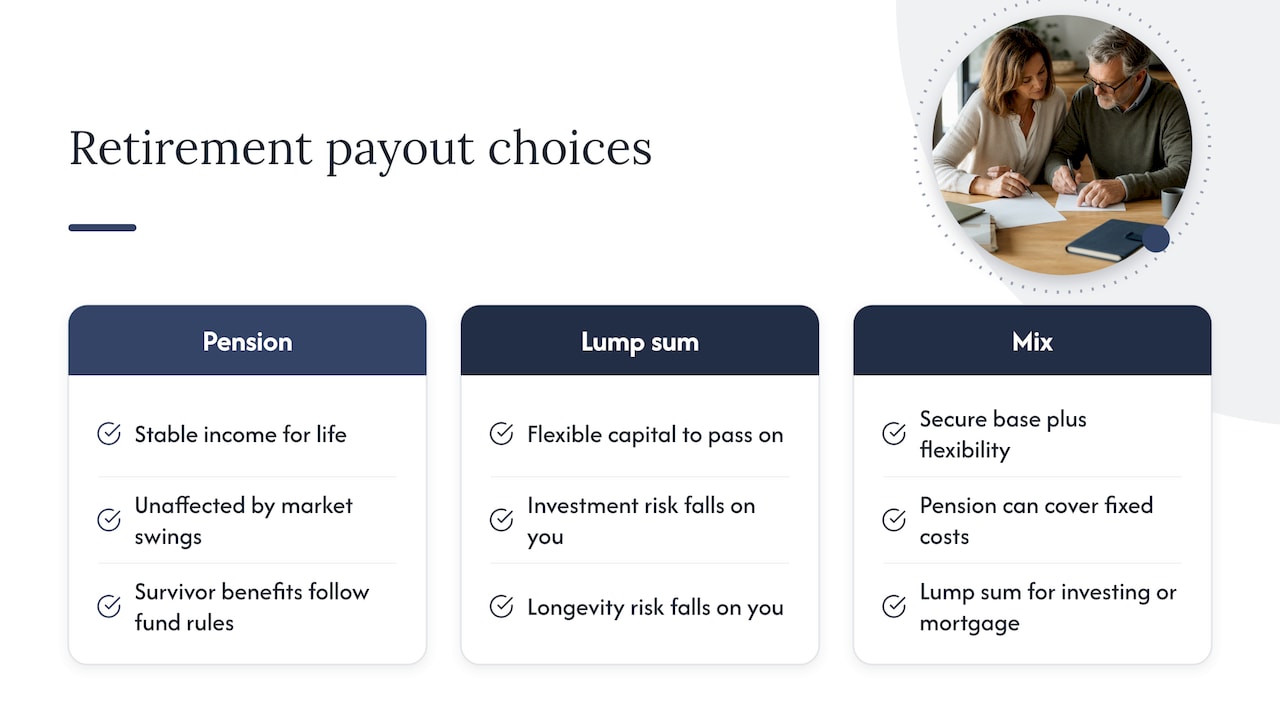
At retirement, you can usually choose between a monthly pension, a lump sum, or a mix. By law, you may withdraw at least one quarter of your pension capital as a lump sum. Many funds allow more, but regulations differ, so you need to read your fund's rules.
There is no universally right answer. Here is how to think about it.
The pension gives you a stable income for life, and it is not affected by market swings. It also stops being yours to pass on in the same way as capital: the survivors' benefits depend on your fund's rules.
The lump sum gives you flexibility and the ability to leave capital to your children. It also puts the investment risk and the longevity risk on you. You need a plan for making the money last.
A mix is common among families who want a secure base and some flexibility. For example, a couple might take the pension as the basis for their fixed costs and take a lump sum to invest for the long term, or to pay down a mortgage.
If you are comparing the two, run the numbers on your fund's online portal first. Many funds, such as FUTURA with its myFUTURA portal, offer simulations that show how different choices affect your income and liquidity.
How Zurich taxes a capital withdrawal
In the Canton of Zurich, pension capital withdrawals are taxed separately from your ordinary income, at a privileged rate. The rate is derived from one-twentieth of the withdrawal, and a minimum cantonal tax of 2% applies. The detailed rules are set out in the cantonal tax office's guidance on taxing capital benefits.
The key practical point is aggregation. If several withdrawals fall into the same tax year, they are added together, which can push the effective rate up. If you have a pension fund capital, a third-pillar account and perhaps a vested benefits account, think about whether you can take them in different years. Whether that is possible depends on your age, your accounts and the rules of each provider, so ask your tax adviser or the cantonal tax office before you commit.
If you are a couple, remember that you each have your own withdrawals. Planning both partners' timing together is often where the biggest savings are found.
The gap: what your family will actually spend
Once you know the AHV and pension fund income, compare it with your expected spending. The gap is what private savings and investments need to cover. A practical way to do this:
- List your fixed costs in retirement: housing, health insurance premiums, taxes, insurance.
- Add the flexible costs: travel, hobbies, helping children or grandchildren.
- Subtract the expected AHV and pension income, after tax.
- Divide the remaining annual gap by a cautious withdrawal rate to see how much capital you need.
Take the example of a couple who want CHF 120,000 per year after tax. If the AHV pays them at most CHF 49,140 and the pension funds together pay CHF 60,000, the gap is roughly CHF 10,860 per year before tax effects. That is manageable. If the pension funds pay only CHF 30,000, the gap is CHF 40,860 per year, and the savings needed are much larger. These numbers are illustrations, not forecasts, but they show why the certificate matters.
Do not forget the survivors' scenario from earlier. Run the same calculation for one person living in the house alone.
Pillar three and private wealth: filling the gap
The third pillar covers both the tied pension account (3a) and free private investments. A tied account gives tax relief on contributions, but the money is blocked until retirement, with some exceptions. Free assets are flexible but do not carry the same tax advantages.
For families with substantial wealth, the question quickly moves beyond the 3a account. Typical questions include how to invest for a 25 or 30 year horizon, how much to hold in property, how to keep currency risk in check, and how to pass wealth on. A well-built portfolio of diversified ETFs and funds, matched to your goals and risk tolerance, is the usual basis. Costs matter because they compound over decades, so compare fees on the same basis before you choose.
Families with business assets or several generations involved may also ask whether a family office structure would make sense. This is a bigger step, and when a family office structure makes sense depends on the size of assets and the complexity of the family situation. For most households, a clear plan and a well-managed portfolio come first.

Special points for women and international families
Women in Switzerland often retire with lower pension capital, because part-time work and career breaks reduce both AHV contributions and second-pillar savings. If this applies to you, look at the whole household. Voluntary buy-ins to the pension fund, a fair split of savings between partners and your own investment account can make a real difference. Our colleagues often see couples where one partner manages the money and the other does not know the figures. It is a good idea for both of you to understand the plan.
If you moved to Zumikon from abroad, your first-pillar and second-pillar history may be incomplete, and you may have pensions in other countries. Cross-border tax treatment can be intricate, so it is sensible to get advice from a Swiss tax specialist who knows both countries before you withdraw anything.
Our perspective: start with the household, not the product
We meet many families who have arrived at retirement planning through a product: a 3a account, a policy, a fund recommended by a friend. The better path is to start with the household. What do you want your life to look like at 65 or 70? Who depends on whom? Which assets sit where?
Once those answers exist on paper, the product choices become simpler, and often fewer. We find that clarity about the pension fund certificate, the AHV record and the tax timing of withdrawals does more for a family's outcome than any single investment decision.
At Marmot Finance, we focus on women and families in Switzerland and Europe, and we combine personal conversations with digital tools so that you can see your plan and keep it up to date. We believe that women in particular benefit from understanding the numbers themselves, which is why education is part of what we offer. We do not replace your tax adviser or your pension fund, but we help you see how everything fits together and invest the part that is yours to manage.
How Marmot can help
If you would like help turning the pension numbers into an investment plan, we offer wealth management in three tiers. Our annual management fee is 0.65% per year for Marmot Easy, 1.0 to 0.8% per year for Marmot Premium and 0.8 to 0.4% per year for Marmot Select, and you can see the details on our pricing page. We also offer wealth management and financial coaching for those who want to talk through the plan with a person first. Marmot Finance is FINMA accredited and manages accounts in CHF, EUR and USD.
A yearly routine that keeps the plan alive
A retirement plan is not a one-off document. A short annual review is enough for most families.
- Read your new pension fund certificate and note the capital, the projected pension and the conversion rate.
- Check your 3a contributions and your investment portfolio against your target.
- Update your spending estimate, especially if children have left home or you have bought or sold property.
- Look at the tax rules and the Zumikon multiplier for the year ahead.
- Review beneficiary clauses and your will after any change in family circumstances.
Five to ten years before retirement, make the review more detailed. This is when decisions about buy-ins, lump sums and the timing of withdrawals have the most effect.
FAQ
How much AHV pension will a married couple receive?
In 2026, the combined AHV pension of a married couple is capped at CHF 3,780 per month, which is 150% of the maximum single pension of CHF 2,520, according to the BSV. Your actual amount depends on your contribution years and average income. An extract from your individual account shows where you stand.
What is the widow's pension in Switzerland?
The widow's or widower's pension is 80% of the deceased person's old-age pension. In 2026 it ranges from CHF 1,008 to CHF 2,016 per month, as the BSV lists. Your pension fund may add its own survivors' benefits, so check its rules.
What is the second pillar of the Swiss pension system?
It is the occupational pension (Pensionskasse), meant to maintain your previous standard of living alongside the AHV. It is mandatory for employees above the income threshold, which is CHF 22,680 per year in 2026. You save from age 25, and at retirement you can take a pension, a lump sum or both, within your fund's rules.
Is it better to take the pension or the lump sum?
It depends on your health, your other assets, your tax situation and how much flexibility you want. A pension gives security, while a lump sum gives control and the ability to leave capital behind. A tax adviser and your fund's simulation tool can help you compare the options for your own case.
Sources
- Steuerfuss, Gemeinde Zumikon
- Leistungen der AHV, BSV
- Die Altersvorsorge in der beruflichen Vorsorge, BSV
- BVG-Reform, BSV
- Reform und Zugang zur zweiten Säule, BSV FAQ
- Kennzahlen, FUTURA Pensionskasse
- Steuerwissen für Privatpersonen, Kanton Zürich
- Weisung zur Besteuerung von Kapitalleistungen, Kanton Zürich