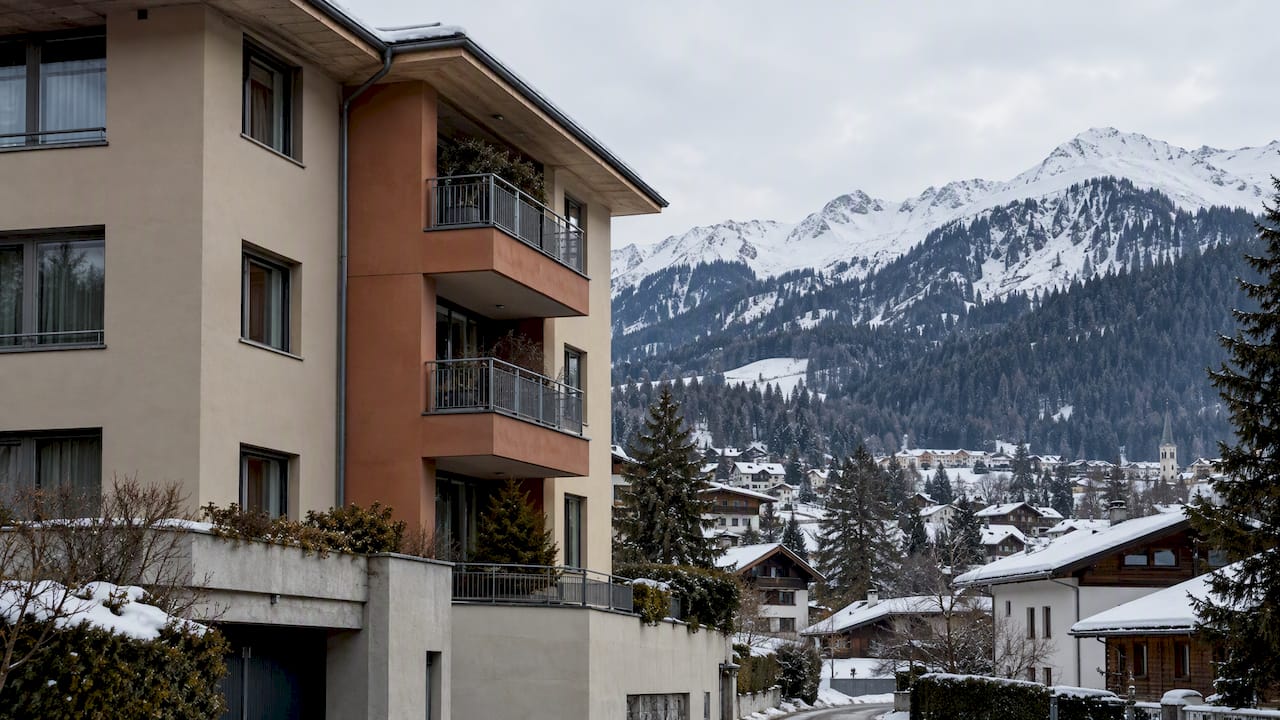
Diversifying from Klosters starts with an honest look at what you already own. For many people here, most of their wealth sits in one valley: a home or holiday flat, a local business, perhaps shares in the employer that pays the salary. Spreading that across asset classes, regions, currencies and issuers, with a plan you can explain in one page, is what turns a collection of holdings into a portfolio.
This guide is written for women, families and international residents who hold Swiss assets and want clarity rather than jargon. It covers where concentration hides, what Swiss rules say about it, and a step-by-step way to build something more balanced.
Marmot Finance
marmot.finance
Build a Portfolio Beyond Klosters
Marmot Finance helps women and families in Switzerland shape investment strategies around their financial profiles, with personal consultations and digital tools.
TL;DR
- Start with the whole balance sheet: property, pension, employer shares and cash all count, not only the securities account.
- In a resort like Klosters, a flat is a bet on one restricted local market, not a diversified property position.
- Swiss rules treat single positions of 10% or more in one equity, or 20% or more with one issuer, as a concentration that your provider must flag.
- Diversifying the contents of a product does not diversify the institution behind it.
- A written plan, a rebalancing rule and an honest look at costs matter more than finding the perfect fund.
Why a Klosters-based investor needs to look beyond the valley
People who live in or near Klosters often have a clear emotional and financial link to the region. That is understandable. The risk is that income, home, savings and sometimes pension all depend, directly or indirectly, on the same Swiss economy, the same franc and, in a tourism region, the same visitor cycle.
Experts call the tendency to favour what is familiar home bias. BDO's analysis of the FINMA circular on conduct rules points to the same pattern from the regulatory side: investors can end up with unintended exposure, for example by holding a high share of their own bank's products, which sits badly with the risk profile they believe they have chosen.
Diversification does not mean owning many things. It means owning things that do not all fall for the same reason. A useful test is to ask: what single event would hurt most of what I own at the same time? If the answer is a downturn in Swiss alpine property, a strong franc or the failure of one institution, there is work to do.
Step 1: Map everything you own, not just your securities account
Before choosing any fund, write down your full position. Include:
- Your main home and any holiday property, at a realistic market value.
- Pillar 2 and Pillar 3a balances, and any vested benefits accounts.
- Shares or options in your employer or your own company.
- Cash, deposits and savings across all banks.
- Securities, funds and any structured products.
- Debts, mainly the mortgage, and the interest rate it runs at.
Most people find that their liquid investments are a small slice of the picture and that property dominates. That is not a problem in itself, but it changes what the rest of the portfolio should do. If a flat is already 60% of your wealth, the securities account should probably not add more Swiss real estate exposure through property funds.
For tax purposes, Swiss rules also differ by canton and by the type of income, so it is worth reading the federal overview of the Swiss tax system and checking with a tax adviser before moving large positions. This matters even more if you are an expatriate or hold assets in more than one country.
Step 2: Understand what property in Klosters really is
Property is the most common concentration in the region, so it deserves its own section. A mountain flat is often described as a diversifier because it is a real asset. In practice, it is one asset in one place, with a legal status that changes its value.
A Blick report from April 2025 gives a striking example from the Swiss mountains: a 3.5-room flat of 87 square metres on the first floor was offered at 860,000 francs, while the same layout one floor up, without the residency restriction, cost 1.85 million francs. The difference came from the legal status, not the building.
Klosters has its own history here. A local notary's overview of first and second homes explains that, since the 2012 federal initiative, Klosters and Davos may in principle not approve new second homes, and that the municipality voted in November 2018 on a local second-home law and on lifting local restrictions on sales to people abroad. Rules like these can change, and they differ from building to building, so any purchase or sale needs a local legal check.
A study of second-home price developments in Graubünden between 2010 and 2023, prepared at the University of Applied Sciences of the Grisons, uses actual transaction prices. Its framing is worth keeping in mind: top destinations have behaved quite differently from the wider market. That is the point. Alpine property is a segment, and its returns depend on demand from a particular group of buyers.
In practical terms, treat the Klosters flat as one large position, and diversify the rest of your wealth away from it. That usually means global equities, bonds from several issuers and currencies, and possibly property exposure outside the Alps.

Step 3: Spread across asset classes, regions and currencies
Once the whole picture is clear, the investment side can be organised around four questions.
Asset classes
The classic building blocks are equities, bonds, cash and real assets. They behave differently, but not always as hoped. In periods of inflation stress, equities and bonds can fall together, which is why many investors add a smaller allocation to real assets or other diversifiers instead of relying on a simple two-asset mix.
Regions and sectors
Switzerland is a small share of global markets, and its stock market leans on a handful of large companies in a few sectors. A global equity allocation brings in other regions, other currencies and sectors that are thin or missing at home. Broad, low-cost index funds and ETFs are the usual tools, because they hold hundreds or thousands of companies in one wrapper.
Currencies
If your costs are in Swiss francs, holding everything in francs is a sensible anchor. But if you are an international resident, or your children will study abroad, some exposure to euros or US dollars may match your real future spending. Think about where the money will be spent, not about guessing exchange rates.
Time horizon
Money needed within a few years belongs in stable, liquid assets. Money for retirement in twenty years can carry more equity risk. Splitting your wealth into buckets by purpose makes it easier to stay calm when markets fall.
Step 4: Watch for concentrations that look like diversification
Some of the most common mistakes involve holdings that appear diversified but are not.
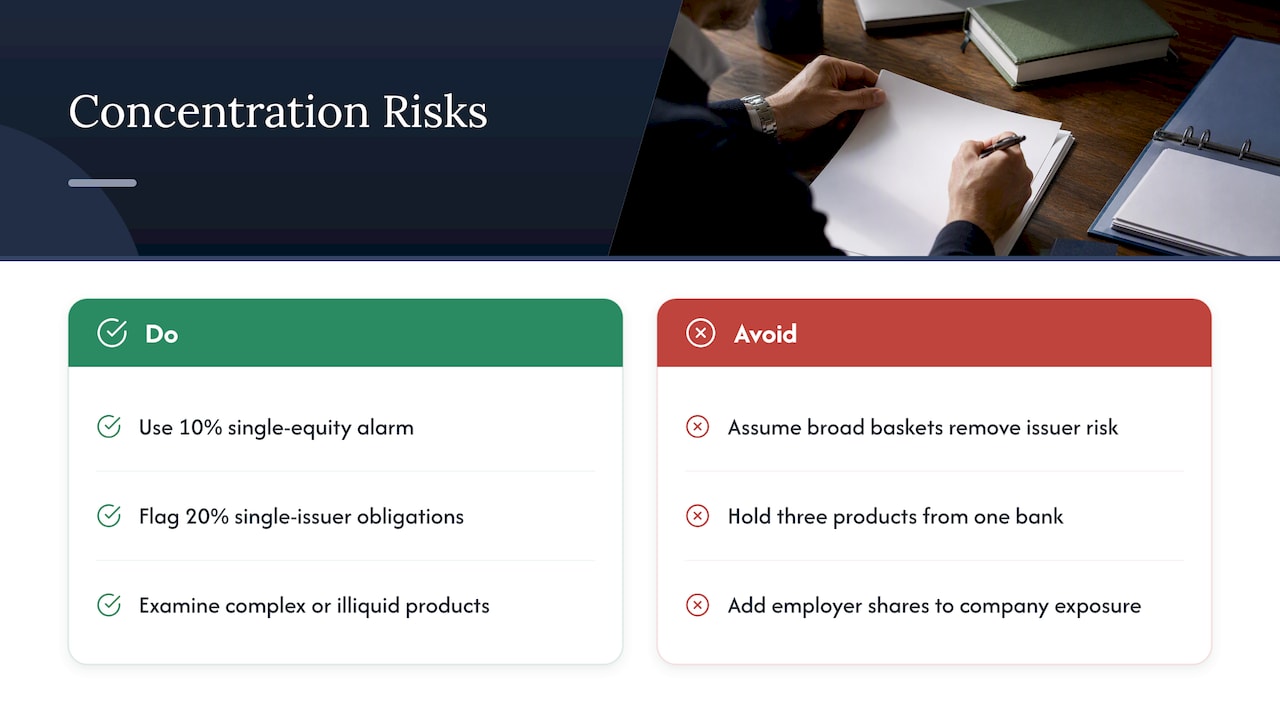
One institution behind many holdings. PeakCompliance explains that concentration can arise at the level of the security, the issuer or the product structure. In a structured product such as an actively managed certificate, the basket inside can be broad, yet you still carry the full credit risk of the issuer. If three of your products come from the same bank, you hold one counterparty three times.
Large single positions. Swiss rules for financial service providers under FIDLEG and FIDLEV give a useful rule of thumb. According to BDO's summary, an unusual concentration is generally assumed from 10% in a single equity or 20% in the obligations of a single issuer, and providers have to warn clients about it. You do not need to be a client of a regulated provider to use these numbers as a personal alarm.
Employer shares. Your salary, bonus and pension already depend on one company. Adding a large block of its shares doubles the exposure.
Complex or illiquid products. These can be appropriate, but they deserve scrutiny. The law firm GWP notes in its 2026 investor protection newsletter that FINMA expects careful examination and solid documentation for complex, illiquid or particularly risky investments.
What good practice looks like at the Swiss National Bank
It may sound odd to learn from a central bank, but the principles scale down well. The Swiss National Bank describes its investment and risk control process as relying on broad diversification to manage absolute risk, supported by benchmarks, limits and regular stress tests.
A private investor can copy that in a simple form. Choose a target mix (your benchmark). Set limits on single positions and single issuers. Run a basic stress test once a year: if equities fell by a third and the franc rose sharply, what would happen to your plan, and could you still pay for what matters? None of this needs software, only an honest page of numbers.
Step 5: Write the plan down and rebalance with a rule
A portfolio drifts. After a strong year for equities, you hold more risk than you intended. A rebalancing rule solves this without forecasting: for example, review once or twice a year, and bring each part back to target if it has moved more than a set margin, say five percentage points.
Write down:
- Your goal and time horizon for each bucket.
- The target split between equities, bonds, cash and real assets.
- The limits for any single stock, issuer or product.
- Your rebalancing rule and review dates.
- Who decides, if you invest as a couple or a family.
This document is also what a professional would need to give advice that suits you. GWP notes that portfolio-based advice requires a full suitability assessment, covering financial circumstances, objectives, and knowledge and experience, and the velaw summary of the FINMA circular lists the same elements. A label such as "balanced" or "growth" is not enough on its own, so be wary of any provider who does not ask detailed questions first.
A worked example
Take a fictional household, not a real client. A couple in Klosters own a home worth 2 million francs with a 700,000 franc mortgage, have 400,000 francs in pension assets and hold 300,000 francs in a securities account, of which 120,000 is shares in the husband's employer.
Their net wealth is around 2 million francs, and the employer shares are 40% of their liquid investments, far over the 10% single-equity alarm level. Their home accounts for the bulk of their wealth. A sensible first move would be to reduce the employer position gradually, mindful of tax and any blocking periods, and to reinvest into a globally diversified mix of equity and bond funds across several issuers. They would also decide deliberately whether they want any further Swiss property exposure, and the answer is probably no.
The figures are illustrative only. Your numbers, tax situation and goals will differ.
Where our own point of view comes in
Perspective: diversification is a plan, not a product
In our work with women and families in Switzerland, we see the same pattern again and again. The portfolio itself is rarely the first problem. The first problem is that nobody has looked at the whole picture: the property, the pension, the partner's assets, the business, the cash left idle in an account. Diversification only makes sense once that picture exists.
We also believe that many women have been advised in a way that fits an average client rather than their real life, with career breaks, longer life expectancy, and often a larger share of family responsibility. That is why we start with the financial profile and goals, and then build the strategy, through a mix of personal conversations and digital tools. Broad ETF and fund portfolios are the core, and some clients add thematic strategies such as sustainability, gender or best talents, as a complement and not as a replacement for broad diversification.
Finally, we think a good portfolio is one you understand well enough to stick with when markets are rough. If you cannot explain why you own something, it probably should not be there.
How Marmot can help
If you would rather not do this alone, Marmot Finance is a FINMA-accredited wealth manager dedicated to women and families in Switzerland and Europe. We manage accounts in CHF, EUR and USD and offer three levels of service. The annual management fee is 0.65% per year for Marmot Easy, 1.0-0.8% per year for Marmot Premium and 0.8-0.4% per year for Marmot Select, as published on our pricing page. Fees are tiered, so please check the page for the details that apply to you.
You can read more about our wealth management and financial coaching, or start with our educational webinars and community events if you simply want to learn first.
Mistakes to avoid
A few habits cause most of the damage. Buying many funds that hold the same top companies gives a long list of holdings and little real spread. Chasing last year's best theme adds concentration after the gains have already happened. Ignoring costs is another: a fee of one percent a year compounds against you over decades, so compare what you pay with what you receive. And selling everything in a panic turns a temporary loss into a permanent one.
This article is general information, not personal advice. For decisions about your own assets, speak to a licensed financial adviser and, for tax questions, a tax adviser registered in your canton of residence.
FAQ
Is a holiday flat in Klosters a good way to diversify?
It adds a real asset, but it also adds a large position in one place with a specific legal status. As the Blick example shows, the same flat can have very different values depending on whether it is restricted or not. Treat it as a concentration and diversify the rest of your wealth around it.
How many investments do I need to be diversified?
There is no magic number, because what matters is how different the holdings are. One global equity ETF can hold thousands of companies, while ten funds from one provider tracking the same index add little. Focus on asset classes, regions, currencies and issuers.
What is a cluster risk in Switzerland?
It is an unusual concentration in a portfolio. According to BDO, it is generally assumed at 10% or more in one equity or 20% or more in the obligations of one issuer, and providers must point it out to their clients. Investors can use the same thresholds as a personal warning level.
Should I hold euros or dollars as a Swiss resident?
It depends on where your future spending will be. If you will spend in francs, francs are a natural anchor. If you expect costs in euros or dollars, such as a property abroad or study fees, holding part of your assets in those currencies can reduce surprises.
Do I need a professional to diversify?
Not necessarily. Many people manage a simple, broad portfolio themselves. A professional becomes useful when your situation is complex, for example with several countries, a business, a family office structure or a large property holding, or when you want someone to keep you disciplined.
Sources
- BDO: FINMA-Rundschreiben 2025/2
- GWP: Anlegerschutz newsletter, June 2026
- velaw: FINMA-Rundschreiben 2025/2
- PeakCompliance: FINMA risk concentrations
- Swiss National Bank: investment and risk control process
- Blick: holiday flat prices in the mountains
- Second-home price developments in Graubünden 2010 to 2023
- Schawalder Kocher: first and second homes
- Swiss Federal Tax Administration: Swiss tax system