Financial security for a woman living in Horgen rests on three things: understanding what the Swiss pension system will and will not pay you, building savings and investments in your own name, and reviewing the whole picture whenever your life changes. None of this requires a large income or a finance degree. It does require starting earlier than feels necessary, because the gaps that affect women in Switzerland build up quietly over decades.
This guide walks through the numbers, the three pension pillars, practical steps for different life situations, and the point at which professional advice starts to pay for itself.
Marmot Finance
Build a plan for your financial future
Marmot Finance supports women and families in Switzerland with tailored investment management, personal consultations and digital tools.
TL;DR
- Women in Switzerland receive a pension roughly 30% lower than men's, mainly because of the second pillar, so your own planning matters more than the national average suggests.
- Check your pension fund statement each year, and use Pillar 3a as a tax-efficient way to close the gap, especially if you work part-time.
- Keep an emergency reserve, review insurance cover for disability and death, and invest long term in your own name.
- Life events such as having children, divorce, or a career break are the moments when a plan needs to be reviewed, not postponed.
- Independent advice is worth considering once your assets, tax position or family situation become complex.
Why the numbers matter before you start
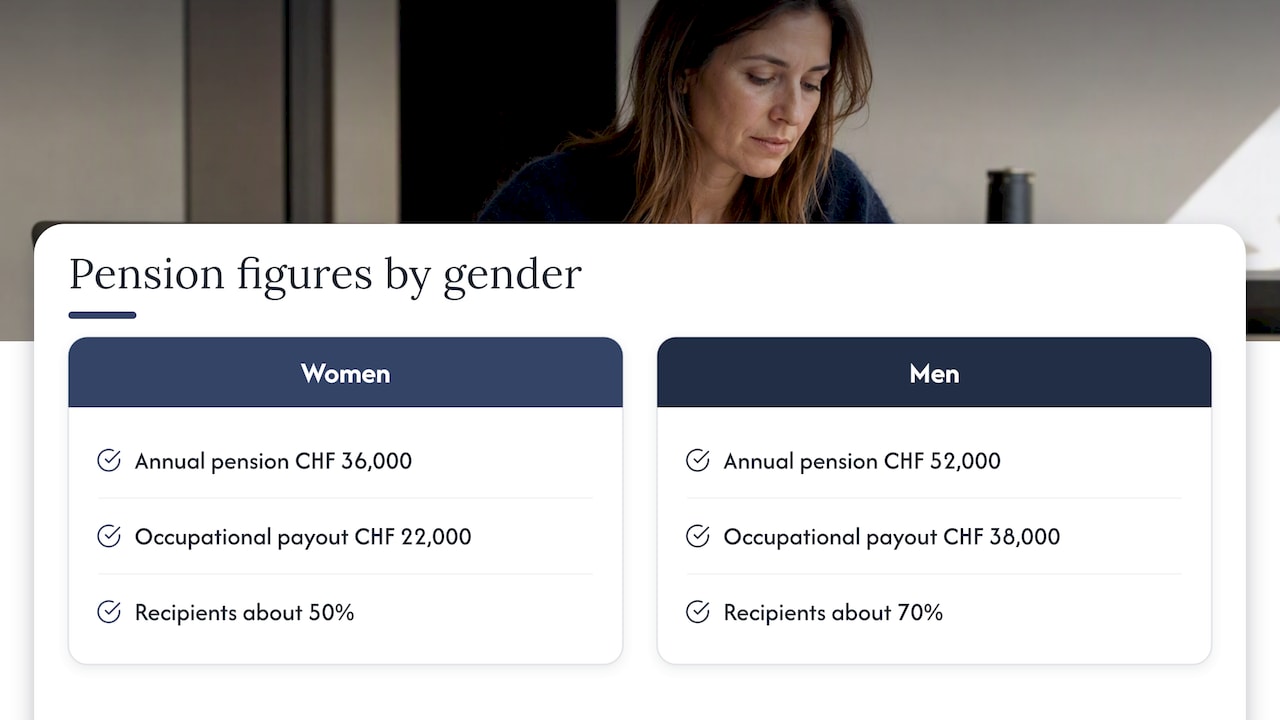
The starting point is not pleasant, but it is useful. According to the Federal Statistical Office, the average annual pension from old-age provision in 2023 was CHF 36,000 for women and CHF 52,000 for men, a gender pension gap of about 30%. The difference comes largely from the second pillar: only about half of women receive an occupational pension, compared with around 70% of men, and the average annual payout is roughly CHF 22,000 for women against CHF 38,000 for men.
The causes are well known. The Federal Office for Gender Equality reports that women earn on average 15.7% less than men (as of 2024), and lower pay means lower contributions every single year. Part-time work, which is common among women with young children, reduces the insured salary in many pension funds. Career breaks reduce it further.
The point is not that you are doing something wrong. The system was built around a continuous full-time career, and many women's lives do not look like that. Knowing this lets you compensate on purpose rather than discover the shortfall at 60.
Understand the three pillars as they apply to you
Swiss retirement provision is built on three pillars: the state pension (AHV), the occupational pension (pension fund, or BVG) and private provision, which includes Pillar 3a. Each one has a different weak point for women.
First pillar: AHV and the changing retirement age
The AHV is the most stable part of the system, and it is less dependent on your employment history than the other two. What has changed is the timing. Under the AHV 21 reform, the reference age for women rises from 64 to 65 in steps of three months per year from 2025, reaching 65 for everyone by 2028. For a woman born in 1962, the reference age in 2026 is 64 years and 6 months.
Women of the so-called transition generation, born between 1961 and 1969, can receive compensation measures such as a lifelong pension supplement, but according to the same source only if the pension is drawn at the reference age or later, not with early withdrawal. If you belong to this group, check this before deciding to retire early.
The AHV also protects families. Survivors' pensions exist to prevent a spouse or children from falling into financial hardship after a death. They are a safety net, not a replacement for the income of a partner, which is why life and disability cover remains relevant for households with children.

Second pillar: the pension fund
This is where most of the gap arises, so it deserves the most attention. Once a year, your pension fund sends a certificate. Many people file it without reading it. Read it, and look at four things: the insured salary, the current retirement assets, the projected pension at the reference age, and the amount you could buy into the fund voluntarily.
If you work part-time, ask HR how your insured salary is calculated. Some funds apply a fixed deduction that hurts part-time employees disproportionately, while others adjust it to your working rate. The rules differ from fund to fund, so the answer is specific to your employer and worth knowing before you decide how much to save elsewhere.
If you are married or in a registered partnership, it is also worth understanding what happens to the pension fund assets in case of divorce. We come back to this below.
Third pillar: Pillar 3a and beyond
Pillar 3a is the pillar you control completely. Anyone with AHV-taxable income can contribute, and the annual payments, up to a legal limit that is adjusted regularly and published by the federal authorities, can be deducted from taxable income. Employees with a pension fund have a lower limit than self-employed people without one, so check the current figure for your situation before you pay in.
Two practical points. First, a 3a account is not the same as a savings account. Many providers let you invest the money in funds, which matters over a horizon of twenty years or more, because interest on a plain account may not keep up with inflation. Second, think about how you will withdraw it. Withdrawals are taxed, so spreading them across several accounts and several years can reduce the tax burden. If you live in Horgen now but may move abroad later, ask a tax adviser how that affects the payout.
The tax side of couples' finances is also in motion. If you are married, the planned switch to individual taxation changes how two incomes are assessed, and this overview of the reform for couples is a good place to understand the direction of travel before you plan joint savings.
What financial security means in practice
Pension planning is only one part. Security, as most people describe it, is the ability to absorb a bad year without panic. A sensible order of priorities looks like this.
An emergency reserve in your own name
Before investing, hold a cash reserve that covers several months of fixed costs: rent or mortgage interest, health insurance premiums, taxes, and childcare. A common guideline is three to six months, but a single parent or a self-employed woman should lean towards the upper end, because income interruptions hit harder. Keep it in an account that is in your name, not only in a joint account, so that you retain access whatever happens in the relationship.
Insurance that matches your actual risks
The two risks that damage a household most are long-term illness and the death of the main earner. Check what your pension fund pays on disability and death, because the benefits vary by fund, and then decide whether a gap needs private cover. This is particularly relevant if you work part-time or are self-employed, where cover is often thinner than people assume.
Investing for the long term
Once the reserve is in place, long-term investing is the main tool for growing wealth beyond what savings accounts offer. Surveys among Swiss women regularly find that they prefer security over returns and want investments that reflect their values. These are sound instincts, and they are compatible with investing. The usual mistake is not too much caution in choosing investments, but holding almost everything in cash for years.
A reasonable approach for most people is broad diversification, low costs, a time horizon matched to the goal, and regular contributions rather than trying to pick the right moment. Sustainable strategies, which many women prefer, can be built the same way.
Life events that change the plan
The most important financial decisions in a woman's life rarely look like financial decisions at the time. They look like family decisions.
Having children and reducing your working hours
When working hours fall, pension contributions fall with them. Before you reduce your rate, calculate what the change means for your pension fund and for your Pillar 3a capacity, and decide with your partner how the difference will be compensated, for example through higher 3a payments from the household budget or voluntary buy-ins. A decision made jointly and in writing is far less likely to cause conflict later.
Marriage, separation and divorce
Married or not, each of you should know what the other earns, what is held where and who is the beneficiary of which policy. In a divorce, the pension fund assets accumulated during the marriage are generally divided, but unmarried couples have no such mechanism, so a woman who has reduced her own work for the family without being married carries a larger risk. A lawyer specialising in family law can explain how this applies to your case, and it is worth doing this before it becomes urgent.
Widowhood
Women live longer on average, and many will manage household finances alone at some point. Knowing the accounts, the insurance and the pension arrangements while your partner is alive is a form of protection. Make sure both partners can access the documents and understand the main decisions.
Moving to Switzerland or leaving it
Horgen has a large international community, and expatriates often have pension rights in several countries. These do not automatically add up in a useful way. If you have worked abroad, ask what you are entitled to under each system and how cross-border tax rules apply to your situation. This is a typical case where a specialist saves more than they cost.
Horgen: local context
Horgen sits on the western shore of Lake Zurich, within commuting distance of the city, and many residents work in Zurich. This affects your planning mainly through tax. The municipality's council has proposed keeping the tax rate at 90% for 2026, subject to the municipal assembly's approval, which is one reason why the Canton of Zurich's overall tax picture, and the deduction value of Pillar 3a payments, should be calculated for your own income rather than assumed. Check the current rate on the municipality's website when you plan, because it is decided annually.
A yearly routine that takes one afternoon
Security comes less from a single smart decision than from a habit. Once a year, ideally in autumn before the 3a deadline of 31 December, go through the same questions. What does the pension fund certificate say, and has it changed? Have you used your 3a allowance, and where is the money invested? Is the emergency reserve still adequate for your current costs? Are insurance and beneficiaries up to date? Has anything happened in your family or career that changes the plan?
Write down the answers. After three years you have a record that shows whether you are moving in the right direction.
Our perspective
We work with women and families in Switzerland and Europe, and one pattern is consistent: the women who feel most insecure about money are rarely the ones with the least. They are often well-educated, earn a good income, and still defer financial decisions to a partner, to a bank adviser they do not quite trust, or to a future date. The cost of that deferral is real, because compounding rewards early starts, and the pension gap is built in the years when nobody is looking.
Our view is that financial literacy should come before product selection. A woman who understands her pension fund certificate, her tax position and the difference between a savings account and an investment can judge any advice she receives, including ours. That is why we combine personal consultations with digital tools and education, such as our Money Makeover Quiz, webinars and community events, rather than leaving clients alone with a portfolio they cannot interpret.
We also think investing should reflect values. Sustainability, gender equality and long-term thinking are not decorations on a portfolio, they are criteria many of our clients use from the start, and a good strategy can accommodate them.
How Marmot Finance can help
If you want a second pair of eyes on your situation, Marmot Finance is a FINMA-accredited wealth manager focused on women and families in Switzerland and Europe. Our approach is hybrid: personal consultations together with digital tools. We manage accounts in CHF, EUR and USD.
The management fee is published and depends on the plan: Marmot Easy is 0.65% per year, Marmot Premium is 1.0 to 0.8% per year, and Marmot Select is 0.8 to 0.4% per year, with the fee reducing as the managed assets grow. You can compare the plans on our pricing page, and read about our wealth management and financial coaching services. If you are not ready for a mandate, our webinars and community events are a low-pressure way to learn.
FAQ
How much should a woman in Switzerland save each month?
There is no universal figure, because it depends on income, pension fund cover and goals. A practical starting point is to use your full Pillar 3a allowance if you can, and to pay at least something regularly into investments in addition to your emergency reserve. Review the amount each year as your income changes.
Is Pillar 3a worth it for part-time workers?
In most cases, yes, because part-time work often means lower pension fund contributions, and 3a is one of the few tools that lets you compensate on your own terms. You need AHV-taxable income to contribute, and the tax benefit depends on your marginal tax rate, so a quick calculation for your income in Horgen is worthwhile.
When should I get professional advice?
Consider it when your situation becomes more complex: a divorce, an inheritance, a business, assets in several countries, or a pension fund decision such as a buy-in or capital withdrawal. Choose someone who explains their fees clearly and who is willing to teach you the reasoning, not only to recommend products.
Does the higher retirement age for women affect my planning?
It does if you were born between 1961 and 1969 or are planning an early retirement. The reference age rises in stages to 65 by 2028, and compensation measures for the transition generation apply only if you draw the pension at the reference age or later. Check your exact figures with your AHV compensation office before deciding.
Sources
- Federal Statistical Office: gender equality indicators 2/2025
- Federal Office for Gender Equality: equal pay
- Federal Social Insurance Office: AHV 21
- Federal Social Insurance Office: old-age provision
- AHV/IV information centre: survivors' pensions
- Municipality of Horgen: tax rate 2026