

The priority for any investor building or reviewing a portfolio is simple: set clear objectives before choosing products, and only work with a manager you have actually checked. Confirm the firm holds a FINMA licence or falls under a recognised supervisory organisation, ask for fee transparency in writing, and request sample reporting before signing anything. Those three steps prevent more damage than any clever asset allocation ever will.
TL;DR:
- Investors should verify their wealth manager’s license, request a sample net-of-fees report, and understand their retrocession policies before signing any agreement.
- Rebalancing rules must be set in advance and monitored with calendar reminders to preserve strategy discipline during market volatility.
- Combining broad-based ETFs for equities and bonds with a modest allocation to alternatives can optimize diversification aligned with the investor’s risk profile.
- Fees and hidden costs, such as management, custody, transaction, and retrocession expenses, can significantly erode long-term returns if not transparently managed.
- The Swiss market’s local opportunities demand thorough fee, governance, and regulatory checks, especially for cross-border investors and currency exposure management.
What should investors know about portfolio management in Zurich?
Portfolio management is not a product you buy once. It is a process you repeat, and the process matters more than any single fund pick. Here is the sequence that actually works, in the order it should happen.
- Define your goals and time horizon. Are you investing for retirement in twenty years, a house deposit in five, or your children’s education in ten? Each answer points to a different mix of risk and liquidity.
- Quantify what you actually have to invest. Add up liquid assets, then set aside an emergency buffer, typically three to six months of living costs, before a single franc goes into markets.
- Assess your real risk tolerance, not the one you’d like to have. This becomes your strategic asset allocation: the split between equities, bonds, cash and alternatives that you can live with through a bad year, not just a good one.
- Set rebalancing rules in advance. Decide whether you’ll rebalance on a calendar basis (say, every six months) or when an asset class drifts more than five percentage points from its target. Write it down while you’re calm, not when markets are falling.
- Agree reporting cadence and decision governance. Who reviews performance, how often, and who has authority to change the strategy? For a couple or family, this avoids arguments later.
- Gather your documents and book the right meetings. Pull together recent statements, pension certificates, and a rough budget before your first advisory conversation, so the discussion is about strategy, not admin.
Swiss Life’s own guidance for individual investors backs up this order: define goals, understand your risk profile, then choose products that match, reviewing the plan regularly rather than leaving it untouched for years. That last point trips up more portfolios than any bad investment choice. A strategy set in 2020 rarely still fits a life in 2026.
Pro Tip: Put your rebalancing rule on a calendar reminder now, before you need it. Deciding to sell winners and buy laggards is far easier in January than in the middle of a market slide, when emotion tends to override the plan.

Which asset classes and instruments should you actually use?
Every portfolio is built from the same basic ingredients. What separates a good one from a mediocre one is how those ingredients are weighted and combined.
Equities drive long-term growth but come with volatility you have to be able to sit through. Bonds provide income and act as a shock absorber when equity markets fall, though yields vary sharply by issuer and duration. Cash buys you liquidity and optionality, at the cost of near-zero real return once inflation is factored in.
For most private investors, funds or exchange-traded funds (ETFs) make more sense than picking individual shares. A single global equity ETF can hold thousands of underlying companies for a fraction of the cost of building that spread yourself. Direct holdings only start to make sense once a portfolio is large enough to diversify properly across single stocks, or when a client has a specific reason (concentrated employer stock, a family business) to hold something directly.
On the active versus passive question: passive index funds tend to win on cost and consistency over long periods, though active management can add value in less efficient corners of the market, such as smaller companies or specific credit segments. Zurich Insurance’s own investor guidance reflects this same basic split of product categories matched to investor goals, which tells you something useful: mainstream providers and boutique managers alike are working from the same toolbox. The real differentiator is how the tools get used.
Alternatives (private equity, structured products, gold, real assets) can add genuine diversification, but they usually come with minimum tickets, longer lock-up periods, or lower liquidity, so suitability matters more here than anywhere else in the portfolio.
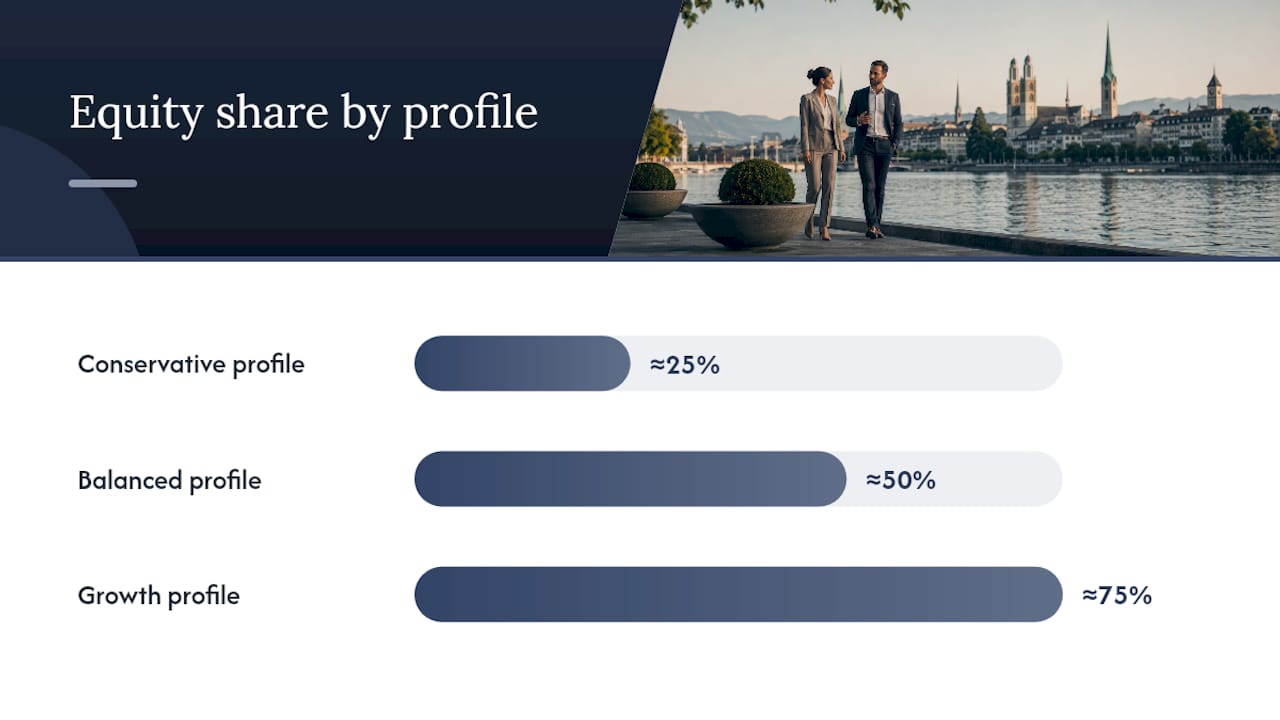
Three rough templates illustrate how this comes together:
- Conservative profile: roughly 70 to 80% bonds and cash, 20 to 30% equities, minimal alternatives.
- Balanced profile: close to an even split between equities and bonds, with a modest 5 to 10% allocation to alternatives or real assets.
- Growth profile: 70% or more in equities, a smaller bond allocation for ballast, and room for a satellite allocation to higher conviction or thematic positions.
None of these are prescriptions. They are starting points to discuss with whoever is managing your money.
What fees and hidden costs should you watch for?
Fees are where portfolios quietly lose the most money, and they are the easiest thing to overlook because they rarely show up as a single number.
You’ll typically encounter four layers: a management fee charged by your advisor or manager, custody fees charged by the bank holding your assets, transaction costs each time something is bought or sold, and the total expense ratio (TER) baked into any fund or ETF you hold. On top of that sits a fifth, less visible cost: retrocessions, which are payments some fund providers make back to the distributor for selling their products.
Here’s why this matters more than most investors realise. An extra 0.5 to 1% in annual fees, compounded over twenty or thirty years, can quietly erode a meaningful share of your total return, simply through the effect of compounding working against you instead of for you. Independent Swiss wealth managers often charge 0.8 to 1.2% versus 1.5 to 2.5% for typical private bank mandates, largely because they refuse or reverse retrocessions rather than pocketing them.
Watch for these warning signs before you sign anything:
- A manager who won’t put their retrocession policy in writing.
- A portfolio stuffed with the firm’s own proprietary funds rather than a genuinely open selection.
- Custody fees that appear on statements without a clear explanation of what they cover.
- Reporting that shows gross performance only, never net of all fees.
In your first meeting, ask directly: what is your total all-in cost as a percentage, do you receive retrocessions and do you pass them back to me, and can I see a sample net-of-fees report from an existing client relationship. A manager with nothing to hide will answer all three without hesitation.
How do you choose the right wealth manager or advisory model?
Picking a wealth manager is less about finding the smartest person in the room and more about finding someone whose incentives line up with yours. A handful of criteria separate the serious operators from the rest.
- Independence. Is the firm tied to a specific bank or product range, or free to select across the market? Independent Swiss wealth managers typically separate custody from advisory, which reduces the temptation to push proprietary products.
- Regulatory status. Confirm the firm’s FINMA licence or supervisory organisation membership directly on the public registry, not from a claim on their website.
- Fee model. Ask for the full cost breakdown in percentage terms, including any retrocessions, before comparing quotes across providers.
- Custody arrangement. Where exactly will your assets sit, and is that custodian separate from the advisory firm managing your strategy?
- Reporting transparency. Request a sample report before you sign. It should show net-of-fees performance, current allocation, and a clear benchmark comparison.
- Alignment of interests. Does the firm’s revenue depend on your portfolio’s growth, or on selling you specific products regardless of fit?
The right model also depends on how much you’re investing. Smaller portfolios are often better served by advisory or robo-advice models with lower minimums, while discretionary mandates, where the manager makes day-to-day decisions on your behalf, tend to suit larger portfolios where ongoing hands-on management justifies the higher fee. Local Swiss wealth managers who emphasise sample reporting and clear retrocession policy as standard practice are usually a safer starting point than those who treat these as special requests.
Pro Tip: Ask for the firm’s investment policy statement template before your first proper meeting. A serious manager will have one ready. A firm that has to draft one from scratch for you is telling you something about how many other clients get this level of documentation.
What tax and regulatory points should investors keep in mind?
FINMA supervises banks, asset managers and securities firms operating in Switzerland, and its public registry is the fastest way to verify that a firm is genuinely licensed rather than simply claiming to be. This single check takes minutes and rules out a large share of dubious operators before you’ve spent a franc.
Tax is where things get genuinely personal, and no generic article can replace advice tailored to your situation. A few points apply broadly, though:
- Cross-border investors are often subject to reporting frameworks such as FATCA and CRS, which share account information between tax authorities.
- Withholding tax treatment on dividends and interest can vary significantly depending on where your custody account is held and your country of residency.
- Where you are tax resident, rather than where your assets are custodied, usually determines your primary reporting obligation.
- Custody location and residency together shape both your reporting duties and your withholding exposure, so the two need to be reviewed together, not separately.
If you split your life across two countries, or hold assets in more than one currency and jurisdiction, involve a tax specialist before restructuring anything. A tax-efficient wealth structuring approach that ignores your specific residency status can create more problems than it solves.
How should investors manage risk and diversify a portfolio?
Diversification only works if it’s genuine. Holding ten Swiss bank shares instead of one is not diversification, it’s concentration with extra steps.
- Spread exposure across asset classes, geographic regions and currencies, and be honest with yourself about home bias, the well-documented tendency to overweight familiar domestic companies simply because you know their names.
- Set position sizing limits so no single holding can sink the portfolio, and keep a cash buffer that lets you avoid selling into a falling market out of necessity.
- Use rebalancing rules, duration management on bond holdings, and modest currency hedging where foreign exposure is large, to keep risk within the boundaries you set at the start.
- A small, disciplined allocation to alternatives can smooth returns further, but should never replace the core diversification job done by equities and bonds.
Rebalancing itself does real work over time. An investor who mechanically trims winners and tops up laggards each year tends to end up buying more of what’s currently cheap and less of what’s currently expensive, without needing to predict anything. It’s a mechanical discipline, not a forecasting skill, and that’s precisely why it holds up when your judgement might not. For a deeper look at applying this in practice, Marmot Finance’s diversification guidance walks through specific techniques for reducing concentration risk.
Why Marmot Finance: verifiable credentials and how we support investors
Marmot Finance is a FINMA-accredited wealth manager focused exclusively on women and families across Switzerland and Europe, managing accounts in CHF, EUR and USD. The approach combines personal consultation with practical digital tools, including the Money Makeover Quiz, personalised investment mandates, and ongoing financial coaching.
Clients get a strategy built around their actual financial profile rather than a standard template, alongside the community and education that many traditional wealth managers skip entirely. If you’re evaluating any manager, including Marmot Finance, ask for the same things: proof of licence, a sample net-of-fees report, and a clear written fee and retrocession policy. A manager confident in their service will hand these over without hesitation.
What performance benchmarks should you use to judge a Swiss portfolio?
Raw returns tell you almost nothing on their own. A portfolio that returned 6% last year looks strong until you learn a comparable benchmark returned 9%, or weak until you learn the benchmark fell 2%.
The right benchmark depends entirely on your allocation. A balanced portfolio split roughly between global equities and bonds should be measured against a blended index reflecting that same split, not against a pure equity index that will make a balanced portfolio look like it’s underperforming in strong bull years. Currency matters here too. A Swiss franc based investor holding significant US dollar or euro exposure needs to look at both hedged and unhedged benchmark comparisons, since currency swings can distort performance figures without any change in the underlying investments.
Ask any manager reporting your performance to show it net of all fees, against an appropriate benchmark, over a period of at least three to five years. One good year proves very little. Consistency across a full market cycle, including at least one meaningful downturn, tells you far more about whether a strategy actually works than any single twelve-month snapshot.
Be wary of managers who only show gross performance or who benchmark against an index that doesn’t match your actual risk profile. That mismatch, intentional or not, is one of the easiest ways for underperformance to hide in plain sight.
What legal protections do investors have in Zurich and Switzerland?
Switzerland’s regulatory framework gives investors several concrete layers of protection, though it’s worth understanding what they cover and what they don’t.
FINMA supervises banks, securities firms and licensed asset managers, and firms that manage client assets on a discretionary basis generally require either direct FINMA authorisation or membership of a FINMA-approved supervisory organisation. Checking a firm’s status on the public registry before signing any mandate is the single most useful protective step available to any investor.
Client assets held in custody at a licensed bank are legally segregated from the bank’s own balance sheet, meaning they don’t form part of the bank’s assets if the institution fails. This segregation is a structural protection built into how Swiss custody works, not a discretionary courtesy from any individual firm.
Beyond regulatory supervision, investors retain ordinary contractual rights: the right to a clear mandate agreement, the right to request full disclosure of fees and conflicts of interest, and the right to terminate an advisory or discretionary relationship according to the terms set out in that agreement. None of this replaces independent legal advice for complex situations, particularly cross-border ones, but it does mean the basic architecture protecting Swiss investors is genuinely robust, provided you’re dealing with a properly licensed counterparty in the first place.
What makes the Zurich financial market distinctive for investors?
Zurich sits among the world’s established financial centres, home to major banks, insurers and a dense cluster of independent wealth managers, which gives local investors genuine choice rather than a handful of default options.
That density cuts both ways. More choice means more competition on fees and service quality, which tends to benefit clients willing to shop around and ask hard questions. It also means more marketing noise to filter through, which is exactly why licence verification and fee transparency matter as much as they do everywhere in this guide.
Local opportunities worth understanding include Swiss-domiciled equities and bonds, which come with familiar reporting standards and, for many investors, simpler tax treatment than holding everything offshore. The Swiss franc’s long-standing reputation as a relatively stable currency also shapes how many local investors think about currency exposure within a broader portfolio, often favouring a meaningful home-currency allocation for spending needs even within an internationally diversified strategy.
For an investor building a portfolio from or for Zurich, the practical takeaway isn’t that local products are inherently better. It’s that the depth of choice available locally makes the fee and governance checks covered earlier in this guide even more worth doing properly, since a mediocre option is rarely your only option here.
How does Swiss monetary policy affect your portfolio?
Decisions made by the Swiss National Bank ripple through portfolios in ways that are easy to underestimate, particularly for bond holdings and currency exposure.
When the SNB adjusts its policy rate, bond prices move in the opposite direction almost immediately, existing bonds with lower coupons become less attractive when new bonds offer higher yields, and vice versa when rates fall. This is one of the reasons duration management, essentially controlling how sensitive your bond holdings are to rate changes, sits on the list of tactical risk tools covered earlier in this guide.
Currency policy matters just as much. The Swiss franc’s tendency to strengthen during periods of global uncertainty means investors holding significant foreign currency assets can see returns swing simply from currency movement, independent of how the underlying investments actually performed. This is precisely why currency hedging decisions deserve real thought rather than being left as an afterthought.
Inflation figures and growth data also feed into these decisions, and both shift the relative appeal of equities versus bonds within a strategic allocation. None of this means trying to predict the SNB’s next move, that’s a losing game for almost everyone who tries it. It means building a portfolio robust enough to handle rate and currency shifts without requiring you to guess correctly which way they’ll go next.
What most guides get wrong about managing money in Zurich
Most guidance on this topic focuses heavily on asset allocation models, as though picking the right split between equities and bonds is the hard part. It isn’t. The research behind this guide points somewhere less glamorous: fee transparency and licence verification do more to protect long-term returns than any allocation tweak, because a hidden 1% annual fee compounds against you every single year, while a slightly suboptimal allocation might cost you far less over the same period.
The conventional advice to “diversify and rebalance” is correct but incomplete. It skips the harder question of who you’re trusting to execute that strategy, and whether their incentives actually match yours. An investor who asks for a written retrocession policy and a sample net-of-fees report before signing anything has done more real due diligence than one who has memorised the difference between growth and value investing.
If there’s one thing to prioritise first, it’s this: verify the licence, demand the fee breakdown in writing, then talk about allocation. Get that order backwards and even a well-built portfolio can quietly underperform for reasons that have nothing to do with markets.
Ready to put this into practice?
Everything above works better with someone in your corner who actually applies it. Some wealth managers focus on women and families who want portfolio strategies that fit their financial situation, and offer management for CHF, EUR and USD accounts for clients living or investing in Switzerland and Europe.
Getting started is straightforward. Before a first conversation, gather recent account statements, a rough picture of your monthly budget, and any pension or existing investment documents you have to hand. From there, Marmot Finance’s wealth management service walks through your goals, risk tolerance and time horizon, then builds a personalised mandate around them, backed by fee transparency and regular net-of-fees reporting from day one. If you’re in Zurich specifically, the local wealth management team can talk through what a mandate would look like for your situation. Many clients start with the Money Makeover Quiz simply to get a clear picture of where they stand before committing to anything further.
This article is general information, not a substitute for advice from a qualified financial advisor. Consult a qualified financial professional about your own circumstances before acting on anything here.
Sources
- Investing and growing your money — Zurich Switzerland
- Wealth management Switzerland — Fortune Swiss (market overview)
- Let your money work for you: 10 investment tips — Swiss Life
Recommended

.webp)





.jpeg)




.png)

.svg)


