

Sustainable investing is an investment approach that intentionally aligns your financial resources with your personal and family values for the long term. Known formally as values-based or responsible investing, it goes beyond simply avoiding harmful companies. The Principles for Responsible Investment defines responsible investment as a risk management discipline, one that considers environmental, social, and governance factors to make better-informed decisions. For individuals and families in Herrliberg, sustainable investing in Herrliberg means aligning wealth with long-term values through four clear steps: defining your values, codifying them in an investment policy statement (IPS), selecting the right investment vehicles, and monitoring your portfolio over time.
How to identify and prioritise your core values for sustainable investing
The first step in aligning investments with values is deciding what actually matters to you. This sounds simple, but families often struggle here. When everything feels important, nothing gets prioritised, and your portfolio ends up scattered and difficult to manage.
Industry best practice recommends limiting your values-based filters to 5–6 core priorities. That boundary keeps your portfolio diversified and your decision-making clear. Trying to screen out every issue at once creates an over-constrained portfolio with too few investment options and weaker long-term returns.
For Swiss families, common value categories include environmental stewardship, social responsibility, and good corporate governance. Environmental stewardship covers areas like climate change, clean water, and biodiversity. Social responsibility includes fair labour practices, gender equality, and community impact. Governance focuses on board transparency, executive accountability, and anti-corruption standards.
Within those broad categories, your personal choices will be specific. A family in Herrliberg might prioritise clean energy and gender diversity on corporate boards. Another might focus on avoiding fossil fuels and weapons manufacturing. The key is that your choices reflect your actual convictions, not a generic list borrowed from a fund prospectus.

Pro Tip: Start by listing your top ten concerns, then cut the list in half. The five or six that survive the cut are your genuine priorities. These are the ones worth building a portfolio around.
Families also benefit from thinking about values-based spending as a companion discipline. How you spend and how you invest should tell the same story about what you believe.
Why an investment policy statement is essential
An investment policy statement is a written document that records your financial goals, your values-based exclusions, and the standards you will use to judge success. Think of it as the rulebook for your portfolio. Without it, every market dip becomes a test of willpower rather than a moment to consult your plan.
Research confirms that without an IPS, emotional responses cause investors to abandon their sustainable plan at exactly the wrong moment. Markets fall, headlines turn negative, and the temptation to sell or pivot is strong. A written IPS removes that temptation by reminding you why you invested the way you did.
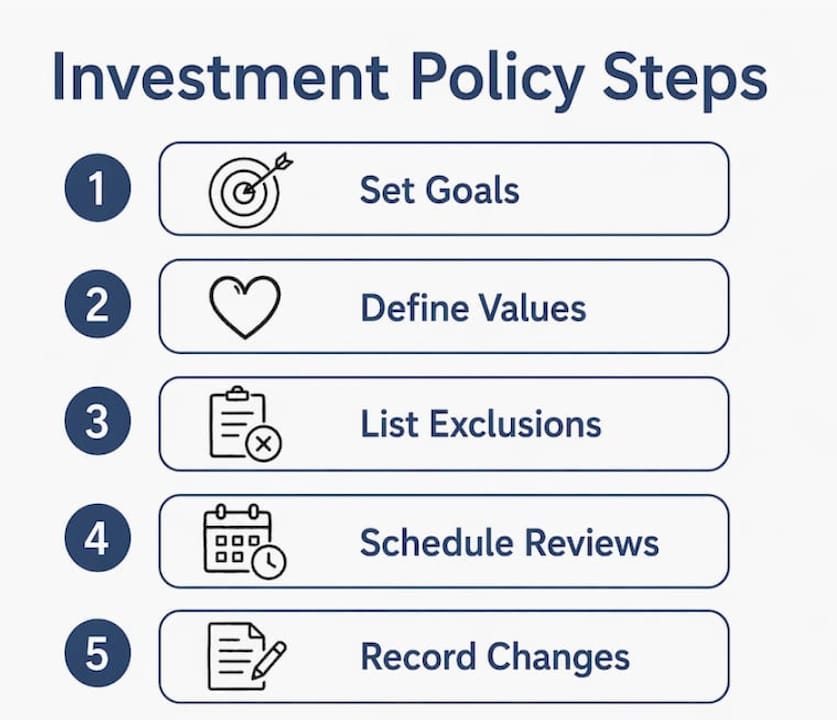
A well-constructed IPS for sustainable investing covers four areas. First, it states your financial goals clearly, whether that is retirement at a specific age, funding children’s education, or building intergenerational wealth. Second, it lists your exclusions, such as fossil fuels, tobacco, or arms. Third, it sets measurable targets, for example a minimum percentage of holdings in companies with verified net-zero commitments. Fourth, it defines a review schedule, typically once or twice a year.
The review schedule matters as much as the document itself. Your values will evolve as your family grows and as the world changes. A daughter entering the workforce may shift your thinking on gender equality metrics. A new climate report may sharpen your views on energy holdings. Your IPS should be a living document, not a filing cabinet relic.
Pro Tip: Keep a brief record of every portfolio change you make and the reason for it. When you review your IPS annually, that log tells you whether your decisions have stayed true to your stated values or drifted under market pressure.
For families managing wealth across CHF, EUR, and USD accounts, an IPS also helps coordinate decisions across currencies and asset classes without losing sight of the underlying values.
What investment vehicles suit a sustainable strategy?
Once your values are clear and your IPS is written, you choose the investment vehicles that carry those values into practice. The main options are funds, direct equity ownership, and thematic allocations.
Funds are the most accessible starting point. ESG-screened funds apply environmental, social, and governance criteria to filter holdings. Thematic funds go further, concentrating on specific areas like clean technology, sustainable agriculture, or social housing. Direct equity ownership gives you more control but requires deeper research and a larger portfolio to maintain diversification.
Thematic allocations are particularly relevant for eco-friendly investments in Herrliberg, where families often have strong views on specific issues. A clean technology allocation, for example, might include solar energy producers, battery storage companies, and energy-efficient building firms. This approach lets you direct capital toward solutions you believe in, not just away from industries you want to avoid.
ESG integration means using environmental, social, and governance data as part of standard financial analysis. It does not replace financial metrics. It adds a layer of risk assessment that traditional analysis misses, such as regulatory exposure from carbon-heavy operations or reputational risk from poor labour practices.
One risk to watch is impact leakage. Impact leakage occurs when a portfolio unintentionally holds assets that contradict your sustainability intentions. A fund labelled “sustainable” may still hold companies with poor supply chain practices buried in its underlying holdings. Regular audits of actual holdings, not just fund names, are the only way to catch this.
Balancing values alignment with financial returns is not a compromise you have to accept. Industry experts recommend identifying your non-negotiables first, then checking performance data to confirm the strategy is both emotionally and financially sustainable. The misconception that responsible investing sacrifices returns has been repeatedly challenged by long-term performance data across European markets.
For guidance on building a diversified sustainable portfolio within Swiss regulations, the principles of concentration risk and asset class spread apply just as firmly to values-based portfolios as to conventional ones.
How to monitor and adjust your portfolio over time
A sustainable portfolio is not a set-and-forget arrangement. Regular oversight keeps your holdings aligned with your values and your financial goals as both evolve.
Portfolio audits should happen at least once a year. During an audit, you check whether each holding still meets your IPS criteria, whether any fund has drifted in its underlying composition, and whether new investment options better serve your priorities. This is also when you catch impact leakage before it becomes a pattern.
Key performance indicators for sustainable investing go beyond financial returns. Measurable sustainability metrics, such as clean energy megawatts generated by companies in your portfolio or the percentage of holdings with verified gender diversity policies, give you a concrete picture of the impact your capital is creating. These KPIs sit alongside standard financial metrics like return on equity and volatility.
Rebalancing a values-based portfolio requires care. Tax-efficient transitions matter, particularly for Swiss residents managing assets across multiple currencies. Selling holdings to realign with your values can trigger capital gains. Working with an adviser who understands both Swiss tax rules and sustainable finance options helps you rebalance without unnecessary costs.
Pro Tip: When updating your IPS after a life change, such as a career shift, inheritance, or a child leaving home, revisit your values list first. Life changes often reveal new priorities that your original IPS did not anticipate.
Investor stewardship is another monitoring tool. As a shareholder, you hold rights to vote on company resolutions and engage with management on sustainability issues. Exercising those rights across asset classes protects the long-term value of your investments and reinforces the values you have codified in your IPS. Responsible investing is increasingly mainstream, with sustainability risks now recognised as central to long-term value creation rather than a niche concern.
For a broader view of how wealth management frameworks integrate sustainability principles into personal financial planning, the connection between values and long-term asset growth is well established.
Key takeaways
Sustainable investing works best when values are clearly defined, formally documented, and actively monitored through a structured investment policy statement and regular portfolio audits.
What I have learned about sustainable investing for Swiss families
The biggest misconception I encounter is that values-aligned investing means accepting lower returns. That belief stops many families from starting at all. The evidence from European markets over the past decade does not support it. Well-constructed ESG portfolios have performed competitively with conventional ones, and in some periods, better, because they screen out companies carrying hidden regulatory and reputational risks.
What I have found genuinely matters is the quality of the values conversation at the start. Families who rush past that step and go straight to fund selection often end up with a portfolio that looks sustainable on paper but feels disconnected from what they actually care about. The IPS is not bureaucracy. It is the document that makes the whole strategy hold together when markets get uncomfortable.
The other thing worth saying plainly: sustainable investing is not passive. Stewardship, voting rights, and engagement with companies are real tools. Families who use them are not just avoiding harm. They are actively shaping the direction of the companies they own. That is a meaningful shift in how you think about wealth, from something you protect to something you direct.
For families navigating this across different financial backgrounds and life stages, the role of women in wealth management is also worth understanding. Women consistently prioritise sustainability and long-term impact in investment decisions, and that perspective strengthens family portfolios.
— Sophie Steinmann
How Marmot supports your sustainable wealth strategy
Marmot is a FINMA-accredited wealth manager dedicated to helping women and families in Switzerland build investment strategies that reflect their values and long-term goals.

Marmot combines personal consultations with digital tools to create customised plans that integrate sustainability criteria without sacrificing financial performance. Whether you are starting from scratch or refining an existing portfolio, Marmot’s advisers help you define your values, draft your IPS, select appropriate vehicles, and monitor your holdings over time. With experience across CHF, EUR, and USD accounts, Marmot understands the specific needs of Swiss and European clients. Reach out to Marmot’s wealth management team to begin building a portfolio that is both financially sound and genuinely aligned with what matters to you.
FAQ
What is sustainable investing?
Sustainable investing is the practice of selecting investments based on environmental, social, and governance criteria alongside financial returns. It is defined by the Principles for Responsible Investment as a risk management discipline that considers sustainability factors to make better-informed decisions.
Does values-based investing reduce financial returns?
The evidence from European markets does not support the idea that sustainable investing sacrifices returns. Well-constructed ESG portfolios have performed competitively with conventional ones, particularly when they screen out companies with hidden regulatory or reputational risks.
What should an investment policy statement include?
An IPS for sustainable investing should include your financial goals, a list of exclusions such as fossil fuels or arms, measurable sustainability targets, and a defined review schedule. It serves as a written rulebook that keeps your decisions consistent during market volatility.
What is impact leakage in a sustainable portfolio?
Impact leakage occurs when a portfolio unintentionally holds assets that contradict the investor’s sustainability intentions. It is prevented by auditing the actual underlying holdings of funds, not just relying on fund names or marketing labels.
How often should I review my sustainable portfolio?
A portfolio audit should happen at least once a year. You should also review your investment policy statement whenever a significant life change occurs, such as a career shift, inheritance, or change in family circumstances, to ensure your strategy still reflects your current values.
Recommended
- Wealth Management in Herrliberg | Marmot Finance
- Gender Gap Wealth Management: A Guide for Swiss Women | Marmot Finance
- Wealth Management in Zurich | Marmot Finance
- Wealth Management in Lucerne | Marmot Finance
.webp)





.jpeg)




.png)

.svg)


