If you live in Uster and hold nearly everything in Swiss francs, multi-currency investing offers three main benefits. It spreads your exposure across several currency zones, it lets you match your assets to the currency you will actually spend later, and it reduces the risk that a single exchange rate decides your long-term result. It also brings costs, tax paperwork and swings that you should understand before you start. This article walks through both sides, with Swiss sources, so you can judge what suits your own situation.
Uster is part of the canton of Zurich, and many households there have a mix of Swiss and foreign ties: a spouse from Germany or Italy, children who may study abroad, a holiday home in France, a US employer or pension. For these households, the question is rarely "franc or not franc". It is how much of each currency makes sense, and why.
Marmot Finance
Build a portfolio across currencies
Marmot Finance manages CHF, EUR and USD accounts, with investment strategies tailored to each client’s financial profile.
TL;DR
- Holding assets in more than one currency limits your dependence on the Swiss franc, which has gained value over the past 15 years and tends to strengthen in crises.
- The simplest logic is to hold assets in the currency in which you will spend them: euros for a French property, dollars for a US university.
- Foreign-currency investments must be converted into francs for your Swiss tax return, using official ESTV rates, so good records matter.
- Currency exposure is not free of risk. It can lose you money in francs, and it should be sized to your liquidity and your ability to bear swings.
- At Marmot Finance we manage accounts in CHF, EUR and USD, so a multi-currency approach can be built into a single portfolio.
What multi-currency investing actually means
The phrase covers several different things, and the search results for it mix them together. Some pages describe multi-currency bank accounts for payments and travel. Others talk about trading currencies directly on the foreign-exchange market. A third group describes holding investments, such as shares, bonds and funds, that are denominated in different currencies.
This article is about the third meaning: a long-term portfolio in which part of your wealth is held in euros or US dollars alongside Swiss francs. You are not betting on exchange rates. You are accepting that your investments will, by design, rise and fall partly with currencies other than the franc, and you are choosing that exposure deliberately instead of by accident.
The distinction matters, because a global equity fund held in francs already contains foreign-currency exposure: the companies in it earn and are priced in dollars, euros and other currencies. Many investors in Uster already own foreign currency risk without having decided to. Multi-currency investing simply makes that decision visible and manageable.
Benefit 1: Less dependence on one currency
The Swiss National Bank explains in its overview of the franc that the currency has gained considerably in value over the last 15 years, and that Switzerland's reputation for stability is a major reason. The same page describes the franc as a safe haven in periods of global uncertainty, such as the financial crisis, the euro-area debt crisis and the pandemic.
For a saver in Uster, this is both good and bad news. A strong franc has protected the purchasing power of Swiss wages and savings when buying imported goods. But if most of your portfolio is invested abroad and measured in francs, a strengthening franc reduces the value of those foreign holdings when they are translated back. And if your wealth is only in francs, you depend entirely on one small currency area for your long-term outcome.
A federal guide for small businesses makes a general point that applies equally to private investors: spreading exposure across different currency zones limits dependence on a single currency. It is the same logic as not putting everything into one share or one sector.
The key word is "limits". Diversification across currencies does not remove risk. It means that no single exchange rate decides everything.
Benefit 2: Matching assets to future spending
This is the most practical argument, and the one we find most useful when talking to families. The question is not "which currency will do best?", because nobody knows. The better question is "in which currency will I need this money?"
The Swiss federal SME portal describes a simple principle for businesses: where possible, balance income and expenses in the same foreign currency, which creates a natural hedge and reduces the need for complex hedging instruments. The same idea works for households. If you expect to pay for a child's studies in the US, you will need dollars. If you plan to retire in Portugal or buy a flat in Italy, you will need euros.
Holding part of your assets in the currency of that future spending means an exchange-rate move matters less. If the franc strengthens, your euro assets are worth fewer francs, but your euro spending also costs fewer francs. The two effects broadly offset each other. If you want a worked example from the property side, there is a useful explanation of currency protection for a home purchase abroad, which follows exactly this reasoning: hold the currency you will have to pay in.
A simple illustration
Take a household in Uster that expects to spend the equivalent of CHF 100,000 on a property in the euro area in about eight years. If that money sits in francs and the franc weakens against the euro, the purchase becomes more expensive in francs. If instead the household gradually builds the euro amount in euro-denominated investments, the future price in euros is what counts, and the exchange rate on the day of purchase matters much less. The household is not predicting anything. It is just removing a source of uncertainty.
The example is illustrative only. Real planning would take into account the time horizon, the risk of the investments themselves and how much flexibility you have if the purchase date moves.
Benefit 3: Accepting currency risk like the SNB does
There is a revealing detail in how the Swiss National Bank manages its own foreign-currency reserves. The SNB states in its description of its investment risk profile that exchange-rate risk is one of the main risks on its reserves, and that it does not hedge them against the franc. Selling foreign currency forward against francs would in effect work against its monetary policy, so the bank lives with the risk.
A private investor is not the SNB, and the comparison should not be stretched. Still, it shows that currency exposure is a structural part of investing from Switzerland, not a mistake to be eliminated. For individuals and families, the sensible response is to treat foreign-currency exposure as a normal component of a diversified portfolio, sized to what you can afford to see fluctuate.
What it can cost you
A balanced view needs the downsides in the same place as the benefits.
Currency moves can hurt in francs
If you buy US-dollar assets and the dollar falls against the franc, you lose in francs even if the investment itself rose in dollars. The SNB publishes daily rates on its current exchange rates page. On 22 October 2026, for example, 1 euro was worth CHF 0.9211 and 1 US dollar CHF 0.8199. Those figures change every day, and over several years the changes can be large.
The SNB also points out that a stronger franc is a reflection of its safe-haven role. It is a long-term reality of the Swiss investment landscape and calls for a patient strategy, not reactions to each movement.
Conversion costs and fees
Every time you change currency, you pay a spread or fee, depending on your bank or platform. Frequent switching can eat into returns. This is one of the reasons we favour a deliberate allocation that is reviewed periodically over constant adjustments.
Hedging is not free
You can protect a foreign-currency position against exchange-rate moves with hedging instruments, but these have their own cost and complexity. For most private investors, the cleaner approach is to decide how much exposure you want and to align it with your future spending, as described above, instead of layering hedges on top.
Liquidity and risk capacity
Foreign-currency exposure should be balanced against how much liquidity you need and how much volatility you can tolerate. Money you may need within a year or two, such as a tax payment or a planned renovation in Uster, usually belongs in the currency in which you will pay it, often francs.
Tax: what changes for a resident of Uster
Switzerland taxes in francs. The Federal Tax Administration (ESTV) notes that income received in a foreign currency must be converted into francs for assessment, and it publishes the official exchange rates for this purpose. For companies, the ESTV explains that the average rate of the period applies to profit tax, while the closing rate at the end of the period applies to capital tax, under federal and harmonisation law. For private individuals, the practical consequence is that the value of foreign-currency holdings for your wealth tax return is expressed in francs at the official rate, so a currency move can change your taxable wealth even when the investment is unchanged in its own currency.
Two further points are worth knowing.
First, capital gains on private movable assets are generally tax-free in Switzerland. But the ESTV circular on commercial securities trading explains that frequent trading, heavy use of borrowed money or other indicators can lead to the activity being classified as self-employed, in which case gains become taxable income. Each case is judged on all the circumstances. A calm, long-term multi-currency portfolio is a very different thing from active currency trading, and the difference shows up in your tax treatment.
Second, keep your records. You will need transaction confirmations and the exchange rates on the relevant dates, because the taxpayer has to be able to document the cost basis. If your situation is complex, for example because you are an expatriate with income in several countries, speak to a tax adviser licensed in canton Zurich before you invest. Tax rules differ by canton and by personal circumstances, and we do not provide tax advice in this article.

Who benefits most
Multi-currency investing is not for everyone, but several groups in and around Uster have good reasons to consider it:
Expatriates and international families. If you earn in francs but expect to live or spend elsewhere, you carry liabilities in other currencies.
Families planning education or property abroad. The spending currency is known, so the matching logic is straightforward.
Entrepreneurs with foreign income. Business owners who receive dollars or euros often end up with large foreign balances. Deciding how much to keep in those currencies turns a side effect into a plan.
Long-term investors who want broader diversification. Even without foreign spending, some investors want protection from the risk that a very strong franc erodes the value of their international investments.
Those who probably should not. If all your spending is in francs, your horizon is short and you dislike volatility, a mostly franc-based portfolio may be more comfortable. Diversified funds already carry some foreign exposure in any case.
How to approach it step by step
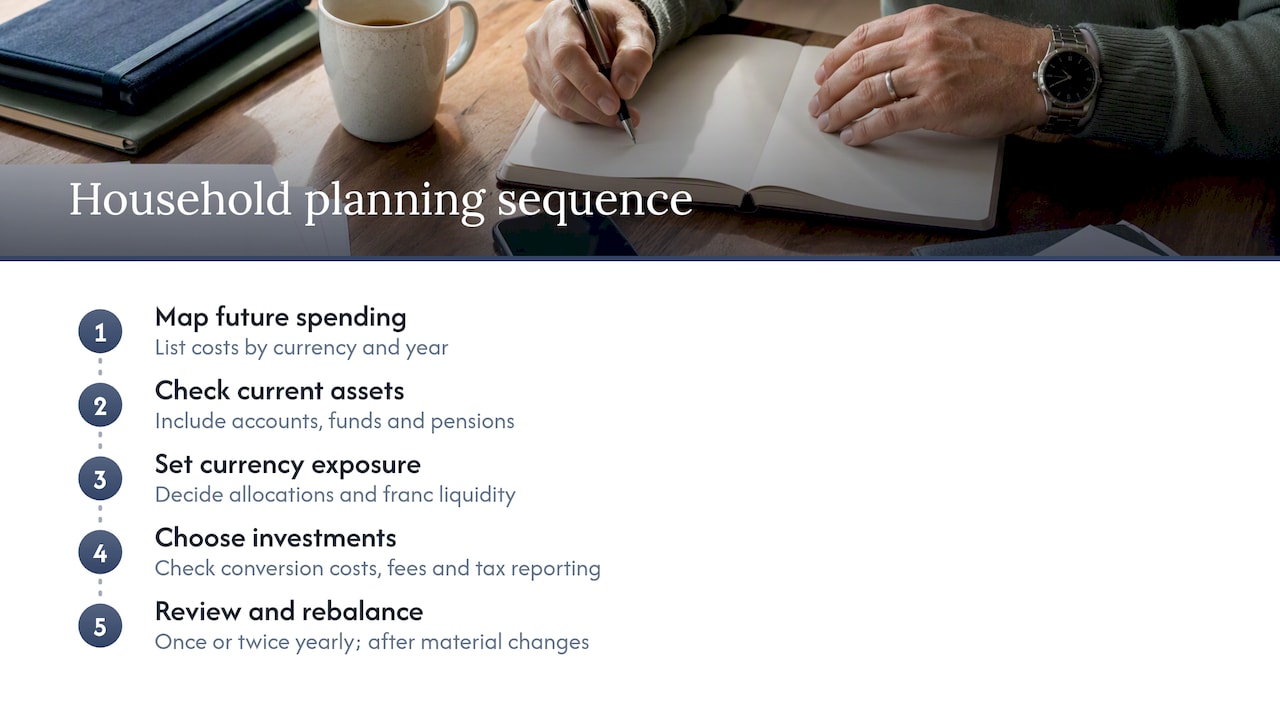
The following sequence works for most households. It is a framework, not personal advice.
Start by listing your future spending by currency and by year. Education, property, retirement, regular travel and support for relatives abroad all count.
Then compare that list with where your assets are today. Check not only your accounts, but also the currency exposure inside your funds and your pension arrangements.
Next, decide how much exposure to each currency you want, and what share of your wealth you must keep liquid in francs. Write down the reasoning, so you can review it calmly when markets are turbulent.
After that, choose investments that fit the plan, with attention to conversion costs, fund fees and tax reporting. Finally, review once or twice a year, and rebalance only when your plans or your allocation have changed materially, not because a rate moved last week.
Our perspective
We work with women and families in Switzerland and Europe, and the currency question comes up in nearly every first conversation. Often, a client has a franc account, a few foreign shares bought years ago, and a vague unease about the dollar or the euro. What she lacks is a clear rule.
Our approach is to start from life, not from forecasts. Where will you live, what will you pay for, and in which currency? Once that is written down, the allocation usually follows with little drama. We manage accounts in CHF, EUR and USD, and that is a deliberate choice: those are the currencies in which our Swiss and European clients most often earn and spend. We do not try to predict exchange rates, and we are cautious about anyone who says they can.
We also think that currency decisions are a good example of why financial education matters. Once the logic is explained in plain words, many clients find they are more comfortable with foreign exposure, not less. Our webinars and community events exist partly for this reason.
How Marmot can help
Marmot Finance is a FINMA-accredited wealth manager dedicated to women and families in Switzerland and Europe. We combine personal consultations with digital tools, so a currency strategy can be discussed in person and then tracked online. Our Marmot Easy, Premium and Select mandates carry published annual management fees of 0.65% per year for Easy, 1.0 to 0.8% per year for Premium and 0.8 to 0.4% per year for Select. For an overview of what we manage and how, see our wealth management service. If you would first like to learn more, our educational webinars and community events are open to people at every stage.
FAQ
Is investing in other currencies a good idea?
It can be, if it follows a purpose: matching future spending abroad or spreading your dependence on the franc. It is a weaker idea if it is meant to profit from guessing exchange rates. Size the exposure to your liquidity needs and your tolerance for swings.
Do I pay tax on currency gains in Switzerland?
Gains on private movable assets are generally tax-free, but frequent trading or other signs of a commercial activity can change that, as the ESTV circular on securities trading explains. Your foreign holdings are always converted into francs at official rates for the tax return. Ask a tax adviser about your specific case.
Should I hedge the currency risk?
Hedging can reduce swings but has its own cost and complexity. Many private investors prefer to match assets to future spending in the same currency, which acts as a natural hedge without extra instruments. The SNB itself does not hedge its foreign reserves.
Which currencies can Marmot manage?
We manage accounts in Swiss francs, euros and US dollars, and we serve clients in Switzerland and Europe. Other currencies are not part of our offer.
Sources
- SNB: Was bestimmt den Frankenkurs?
- SNB: Risikoprofil der Anlagen
- SNB: Aktuelle Zinssätze und Devisenkurse
- KMU-Portal: Risques de change, comment les PME peuvent se couvrir
- ESTV: Fremdwährungskurse
- ESTV: Denominierung des Kapitals in funktionaler Fremdwährung
- ESTV: Kreisschreiben Nr. 36, Gewerbsmässiger Wertschriftenhandel