The main benefit of tax planning in Zermatt is that you keep more of what you earn and invest, legally and predictably. You do it by using the deductions Swiss law gives you, by understanding how Valais and the municipality calculate your bill, and by keeping your private wealth clearly separate from anything that looks like a trading business. None of this is aggressive. It is mostly timing, documentation and knowing which rules apply to you.
This guide is written for women, families and international residents who live in, or are moving to, Zermatt and want to understand what tax planning can realistically achieve. It covers the pension deduction known as Pillar 3a, the way Valais sets its tax rates, the treatment of private capital gains and the mistakes newcomers tend to make. Tax rules change and personal situations differ, so treat it as a map and confirm the details for your own case with the Valais tax authority or a qualified tax adviser.
Marmot Finance
Plan Your Financial Future in Switzerland
Marmot Finance supports women and families in Switzerland with tailored investment management, financial coaching and digital tools for their financial journey.
TL;DR
- Pillar 3a contributions are the most accessible deduction: for 2026 the ceiling is CHF 7,258 with a Pillar 2 pension fund and CHF 36,288 without one, and they must be booked before 31 December.
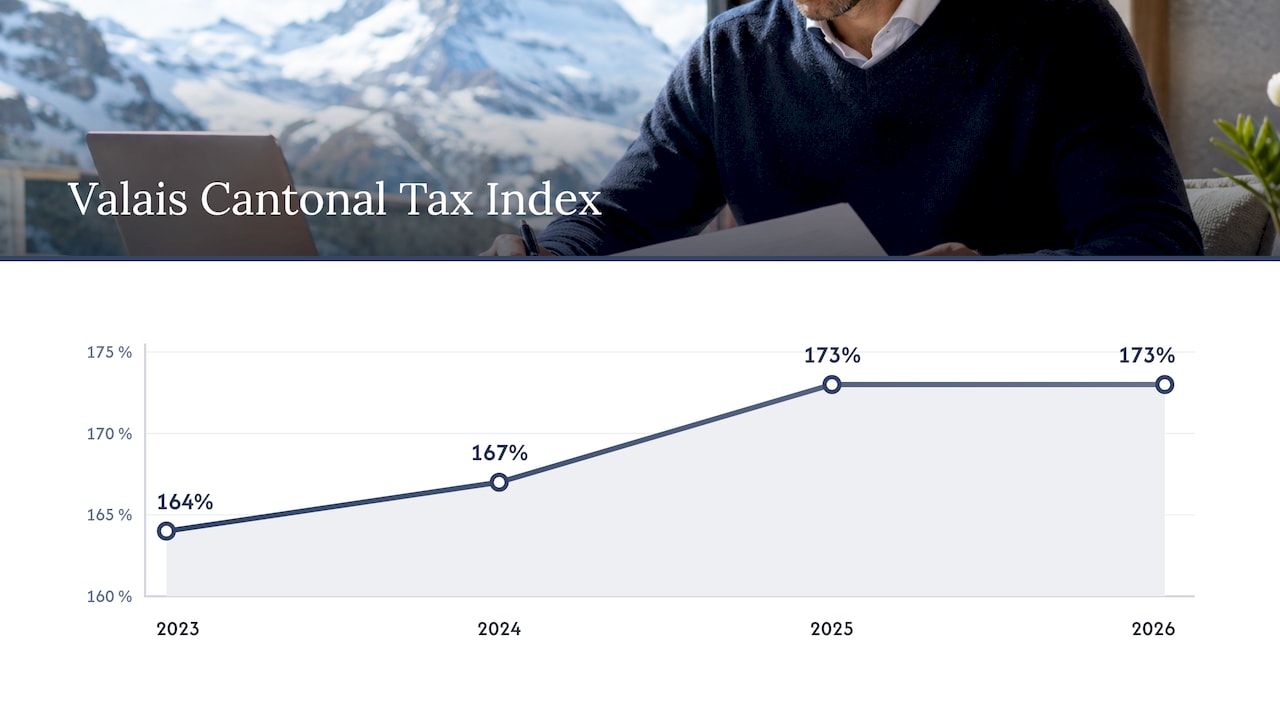
- Your Zermatt bill depends on two layers: the cantonal index for Valais (173% in 2026) and a municipal coefficient, so general Swiss tax comparisons only get you part of the way.
- Capital gains on private movable assets are generally tax-free, but only while your activity stays private and does not look like professional trading.
- Good planning is mainly about timing, records and clarity, and it pays most in the first years after you arrive.
Why Zermatt needs its own tax picture
Switzerland taxes individuals at three levels: the Confederation, the canton and the municipality. Zermatt sits in the Canton of Valais, so your income and wealth are taxed under Valais rules, and the village then applies its own multiplier on top. That is why a comparison of Swiss cantons, however useful, never tells you exactly what you will pay in Zermatt.
According to the Valais cantonal tax service, the cantonal index has risen from 164% in 2023 to 167% in 2024 and 173% in 2025, and stays at 173% for 2026. The same page explains that municipal coefficients apply in addition and, in the figures we were given, range from 1 to 1.5. Municipalities keep the autonomy to adjust their own multipliers, which means the total burden can differ from one village to the next even within the same canton.
We will not quote a single Zermatt percentage here, because the effective rate depends on your income, your wealth, your marital status and your confession-related and family deductions. What matters is the method: look at the cantonal tariff, apply the index, then apply the municipal coefficient for Zermatt. The Valais authority publishes the 2026 cantonal rate tables, and a separate table for cantonal and municipal wealth tax on individuals shows that wealth is taxed at both levels too.
The first benefit of planning is therefore simply clarity. When you know which layers apply, you can forecast your tax for the coming years instead of being surprised by an assessment. This is often overlooked by newcomers, who tend to rely on a national average or on what a friend in another canton pays.
Benefit 1: Pillar 3a lowers your taxable income
The Swiss pension system rests on three pillars: the state pension, the occupational pension through your employer, and private provision. The third pillar has a tied part, Pillar 3a, which the federal tax administration describes in its guidance on the tax treatment of Pillar 3a contributions and benefits. Contributions can be deducted from taxable income, within a yearly limit.
For the 2026 tax year the limits published by the federal tax administration are CHF 7,258 if you are already covered by a Pillar 2 fund, and CHF 36,288 if you are not. The second figure applies mainly to self-employed people without an occupational pension, which includes many female entrepreneurs who run their own business in the Valais tourism, hospitality or consulting sectors.
Here is how to think about the benefit. If you pay CHF 7,258 into Pillar 3a, your taxable income falls by CHF 7,258. The actual saving is that amount multiplied by your marginal tax rate, and that rate is the sum of the federal, cantonal and municipal parts. The higher your income, the more each franc of deduction is worth. We are deliberately not giving a franc figure, because it would be a guess without your assessment in front of us.
Two practical points matter at this time of year. First, the contribution must be fully booked before the end of the calendar year to count for that year, and practitioners warn that leaving it to the last days of December is a common bottleneck. Today is 18 October, so you still have a couple of months, but not unlimited time. Second, the money is tied: you cannot simply withdraw it when you like. That is the trade-off for the tax relief, and it is worth deciding consciously how much of your savings you are happy to lock in for the long term.

Benefit 2: Keeping private capital gains tax-free
One of the most attractive features of Swiss taxation for investors is that capital gains on private movable assets, such as shares or cryptocurrencies, are generally tax-free under federal tax law. The condition is that you are not classed as a professional securities dealer. If the authorities decide your activity amounts to self-employed trading, the gains become subject to income tax.
This is where planning earns its keep. The tax authorities look at the scale and the financing of your transactions to tell hobby investing from professional trading. Frequent trading, borrowed money and very large volumes are the kind of features that can tip the balance. A long-term, diversified portfolio of ETFs and funds, held for years and not financed with leverage, sits much more comfortably on the private side.
The practical advice from the experts we reviewed is simple: keep a clear record of your transactions. If you ever need to show that your activity stays within private wealth management, a tidy history of purchases, sales and the source of funds is your best evidence. This is a nuance that people moving to Switzerland often miss, particularly if they come from a country where every gain is taxed.
A note on what this does not cover. Dividends and interest are generally taxable as income, and your total wealth, including your portfolio, is subject to wealth tax at cantonal and municipal level. Tax-free gains are not tax-free investing. A sensible plan looks at all three: income, wealth and gains.
Benefit 3: A smoother start if you are new to Switzerland
People arriving in Zermatt, whether for work, for a second career or as part of a family relocation, often face the same set of questions in their first year. Which deductions can I claim? How are my foreign assets treated? What happens to my existing pension abroad? The earlier these are looked at, the more options remain open.
The benefit of early planning is that you can make decisions in the right order. For example, you can decide how much to pay into Pillar 3a before the year closes, structure your investment account so that your private status is documented, and set aside a cash reserve for the tax bill instead of discovering it later. Swiss tax is generally assessed after you file, which means the bill can arrive some time after the income was earned. Without a reserve, a good year can turn into a cash-flow problem.
For international residents there is also the question of how Swiss rules interact with the rules of the country you came from. The details depend on the countries involved and on any tax treaty, so this is a point for a specialist in cross-border tax. We would rather say that plainly than offer a rule of thumb that could be wrong for your passport and your situation.
Benefit 4: Fewer surprises, better cash flow
Planning is not only about reducing the amount. It is also about knowing it. Three things tend to improve once you plan.
The first is timing. Contributions, large purchases and the realisation of income can often be arranged within a calendar year, and the deadline that matters most for Pillar 3a is 31 December.
The second is documentation. The federal tax administration publishes a guide to deductions, rates and tariffs for the direct federal tax and short tax leaflets summarising income and wealth tax deductions across the cantons. The annual instructions for the 2026 tax return cover, among other things, how the income of minor children is treated, which matters if you are a family. Reading them once in autumn is far easier than reconstructing receipts in spring.
The third is alignment between tax and investment decisions. A portfolio built without regard to tax can be perfectly sensible and still leave money on the table. A portfolio built with your tax position in mind, for instance one that keeps trading low and uses Pillar 3a as part of the long-term plan, tends to be simpler and cheaper to run.
A short year-end review
The table below gives you a way to check your position over a coffee. It is a prompt for your own review, not a substitute for advice.
Our perspective
We work with women and families who are often very capable with money in their daily lives but have been handed tax and investment decisions in a language that was not written for them. What we see again and again is that tax planning feels intimidating until it is reduced to a handful of decisions made in the right order.
Our view is that tax planning should follow your life, not the other way round. A pension deduction is valuable, but only if you are comfortable locking the money away. A tax-free capital gain is valuable, but only if the portfolio behind it is built for the long term and is easy to document. A low tax rate in one municipality is valuable, but not if it drives a move that does not suit your family.
We also think the topic deserves more honesty. Tax planning in Switzerland is about optimising within the rules, and the benefit is mostly steady rather than spectacular. If someone promises you dramatic savings with little effort, ask them to show you the legal basis. Because we are a FINMA accredited wealth manager that works exclusively with women and families, we look at tax as one part of a broader financial plan: your goals, your family situation, your risk appetite and your timeline come first, and the tax layer fits around them.
We focus on Swiss and European clients and manage accounts in CHF, EUR and USD. For specific questions on how your personal tax return should look, a qualified tax adviser or the Valais tax authority remains the right contact, and we are happy to work alongside them.
What tax planning cannot do
It helps to be realistic. Tax planning does not remove the obligation to declare your income and wealth, it does not make a high-tax situation disappear, and it cannot protect you from changes in the law. Rates, limits and indices change: the Valais index moved from 164% to 173% in three years, and the Pillar 3a limits are adjusted regularly. A plan that works in 2026 should be reviewed each autumn.
It also cannot replace a sound investment strategy. A tax saving is never a reason to hold an investment that does not fit your goals. The better order is to decide what you want your money to do, build the portfolio that serves that, and then arrange it as tax-efficiently as the rules allow.
How Marmot supports you
Marmot Finance combines personal consultations with digital tools such as the Money Makeover Quiz and a financial planner. We offer three mandate levels, with annual management fees published on our pricing page: 0.65% per year for Marmot Easy, 1.0-0.8% per year for Marmot Premium and 0.8-0.4% per year for Marmot Select. The fee is tiered by the assets under management.
If you want to understand how your investments and your pension contributions fit together, our wealth management and financial coaching services are the place to start. If you would rather learn first, our educational webinars and community events are open to women and families who are not yet ready for a mandate.
Frequently asked questions
Is tax planning in Zermatt different from the rest of Switzerland?
The federal rules are the same everywhere, but your cantonal and municipal layers are specific to Valais and to Zermatt. The Valais index is 173% for 2026, and the municipality applies its own coefficient on top. That is why a national average is a poor guide to your own bill.
How much can I deduct for Pillar 3a in 2026?
The federal tax administration sets the maximum at CHF 7,258 if you are covered by a Pillar 2 fund and CHF 36,288 if you are not. The contribution has to be booked before the end of the calendar year. Your actual tax saving depends on your marginal rate.
Are capital gains on my investments taxed in Switzerland?
Gains on private movable assets are generally tax-free under federal tax law, as long as you are not treated as a professional securities dealer. If your activity is reclassified as self-employed trading, the gains become taxable income. Dividends, interest and your overall wealth are taxed separately.
When should I start planning my taxes?
As early as you can, and ideally before the year closes, because the Pillar 3a deadline is 31 December. If you are moving to Zermatt, start before you arrive or in your first months of residence, so that your options are still open.
Do I need an adviser to do this?
Not for every step. Many people handle a simple return and a Pillar 3a contribution themselves. If you have foreign assets, a business, a family situation that changes your deductions or a move between countries, a qualified tax adviser is worth consulting.
Sources
- Zinssätze und Höchstabzüge Säule 3a, direkte Bundessteuer (ESTV)
- Kryptowährungen: Besteuerung (ESTV)
- Calcul d'impôts Canton Communes (Service cantonal des contributions du Valais)
- Steuersätze Kanton 2026, Index 173 (Valais)
- Vermögenssteuer natürliche Personen, Tabelle 3 (Valais)
- Steuerliche Behandlung von Vorsorgebeiträgen und -leistungen der Säule 3a (ESTV)
- Abzüge, Ansätze und Tarife bei der direkten Bundessteuer (ESTV)
- Steuermäppchen (ESTV)
- Wegleitung zur Steuererklärung für natürliche Personen 2026 (ESTV)