For families in St Moritz, the strategies that hold up are the plain ones, done early: a valid will or inheritance contract, a matrimonial property arrangement that fits your marriage, a clear plan for the chalet or apartment, and a review whenever life changes. Swiss law decides much of the framework for you, so the real work is deciding what you want inside it, and writing it down in a form that a notary, a court or a tax office will accept.
This guide explains the main tools, the 2023 change to forced heirship, what to think about if you hold property or citizenship outside Switzerland, and how to begin. It is general information, not legal or tax advice. The documents themselves should be drafted or checked by a Swiss lawyer or notary, and tax questions belong with a tax adviser in your canton.
Marmot Finance
Plan Your Family’s Financial Future
Marmot Finance helps women and families in Switzerland navigate their financial journey with tailored strategies, personal consultations and digital tools.
TL;DR
- Without a will or inheritance contract, Swiss law decides who inherits a share, but not which asset each person receives. That is where disputes start.
- The main tools are a will, an inheritance contract, lifetime gifts and a matrimonial property arrangement. They differ in how binding they are and how easily you can change them.
- Forced-heirship rules were liberalised on 1 January 2023, but a compulsory share still limits what you can leave freely.
- If you have foreign property or nationality, plan the Swiss and foreign rules together, and check inheritance tax rules with the canton and the municipality.
- Review your plan after major life events, and consider a first review around age 50 or when you start a family.
Why estate planning matters in a place like St Moritz
St Moritz households often hold a mix that makes succession harder than a simple bank account would: a second home, sometimes a family business, investments in several currencies, and children or relatives living in different countries. Each of those pieces raises a question that the law answers by default if you do not.
The default answer is intestate succession. A Swiss practitioner article from 2024 explains that without a will or inheritance contract the law fixes who inherits a quota, but not which assets each person receives. Several heirs can then end up co-owning a mountain apartment that nobody agreed how to use, sell or pay for. Planning does not remove family differences, but it reduces the uncertainty that feeds them.
There is also a practical cost to doing nothing. Swiss legal commentary notes that without a plan, assets may not be immediately available to beneficiaries, because they can become tied up in lengthy court-governed procedures. For a spouse who relied on one partner's accounts, that delay matters.
When to start
The honest answer is earlier than most people do. A Swiss bank's guide suggests thinking about it from around age 50 or at a major life event, such as starting a family. An insurer's Swiss inheritance-law brochure makes the same point from the other side: do not wait too long, whether your situation is simple or complicated.
In practice, three moments tend to trigger a first plan: buying property, having children, and a change in marriage or partnership. A fourth, often missed, is moving to or from Switzerland.
The tools Swiss law gives you
Swiss estate planning is built from a small set of instruments. A Swiss law firm's overview lists wills, inheritance contracts, gifts and life insurance among them, and the 2026 Chambers practice guide adds advances on inheritance, loans, usufruct rights and family entities. The differences between them are what make a plan work.
Wills
A will is a unilateral act, which means you can change or revoke it whenever you like. The International Bar Association's Swiss chapter describes the recognised forms: a public will made before an official with two witnesses, a handwritten will that is dated and signed, and, in rare cases, an oral will.
For most people the handwritten will is the accessible option, but it has strict requirements. WWF Switzerland's inheritance FAQ stresses that it must be written entirely by hand, dated and signed. It also recommends listing your assets and debts, naming beneficiaries while respecting the compulsory portions, keeping the original somewhere safe, and thinking about an executor. A will typed on a computer and merely signed does not meet the handwritten standard, which is a common and costly mistake.
Within the legal limits, a will lets you appoint heirs, leave specific legacies, create a foundation or name substitute heirs, according to the same IBA overview.
Inheritance contracts
An inheritance contract is a bilateral agreement between you and one or more other people, typically heirs. A Swiss law overview explains that changing or cancelling it needs the consent of the other parties. That makes it far more stable than a will, and far less flexible.
It suits situations where someone must be able to rely on the arrangement: a child who will take over the family business and invest in it, or a spouse and children who agree on how the estate will be divided. The price of that certainty is that you cannot simply change your mind later, so it deserves careful thought and professional drafting.
Lifetime gifts
Gifts are immediate transfers. They can be used to manage tax, and they let you see your family benefit while you are alive. But the same law firm overview points out that cantonal clawback periods for such transfers typically run from 3 to 10 years, so a gift is not always final for tax or inheritance purposes. A gift made to one child can also be counted against their share later, depending on how it was documented.
The lesson is to document every significant gift in writing, stating whether it is an advance on inheritance, and to check the cantonal consequences before transferring anything of size, particularly real estate.
Matrimonial property arrangements
This is the tool most couples overlook. How your assets are treated within the marriage determines what actually falls into the estate before any will applies. The Chambers guide notes that matrimonial property arrangements decide how spouses' assets are treated, and that family holding companies or partnerships can support an orderly, gradual transfer of control and assets.
For a couple with a business or a property bought by one partner before the marriage, a short meeting with a notary about the marital property regime can change the outcome more than any will.
What changed in 2023 and what did not
Switzerland's revised inheritance law took effect on 1 January 2023. The Federal Office of Justice describes the aim as more flexibility, by lowering compulsory portions and enlarging the share you can dispose of freely. The IBA overview reads the result the same way: reduced forced-heirship rights and greater testamentary freedom.
Two cautions follow. First, freedom is greater, not unlimited. Chambers' 2026 guide still describes testamentary freedom in Switzerland as limited by forced-heirship rules. Second, a plan written before 2023 may no longer reflect what you would choose today. If you drafted a will years ago on the assumption that your children's compulsory share was larger, it is worth rereading it with a lawyer. The new room can be useful for leaving more to a partner you are not married to, to a stepchild, to a person who cared for you, or to a foundation.
Property and taxes in Graubünden
For St Moritz families, the home or holiday apartment is often the largest asset, and tax treatment depends on the canton and sometimes the municipality. Graubünden has been through a debate on this. In 2018 the canton published a proposal that would have exempted spouses, children, parents and cohabiting partners from inheritance and gift taxes, and would have let municipalities choose whether to levy the tax on other recipients, with a 20% ceiling.
That was a proposal from 2018, not a description of today's rules, so do not rely on it. Before you transfer a property, give a gift or draft a will that leaves assets to someone outside your immediate family, ask a local tax adviser or the cantonal tax office what applies now. The relationship between you and the beneficiary is typically what drives the rate in Switzerland, which is why leaving something to a partner, a friend or a godchild needs a specific check.
We discuss how property is usually treated as a long-term family asset in our piece on family office services in St Moritz, where the emphasis is on holding for the long term rather than turning assets over.
Foreign property, foreign passports
St Moritz has many residents and part-time owners with ties abroad, and cross-border estates are where mistakes get expensive. The Chambers guide says such estates require coordinated planning, and that foreign residents in Switzerland may be able to elect the law of their nationality for succession if certain conditions are met.
The same guide notes the risk of double taxation. Switzerland relies on bilateral conventions to reduce it, but treaties differ from country to country and do not cover everything. In practice, this means three things:
First, list every asset by country, including accounts, property and any business interests. Second, find out which country's succession law and tax rules could apply to each asset, since a flat in Italy or a house in France may follow local rules whatever your Swiss will says. Third, have one adviser, or a coordinated pair of advisers in each country, review the whole plan, so that a will valid in Switzerland does not clash with a foreign one.
If you are an expatriate, also ask whether choosing your national law is sensible. It can bring familiar rules but may also bring forced-heirship rules that are stricter than Swiss ones.
Documents beyond the will
Estate planning is not only about what happens after death. Incapacity is more likely than most people expect, and the documents for it are different.
The insurer's brochure describes a living will (a patient decree) as a record of the treatment you want or refuse if you can no longer express your wishes. It can name a trusted representative, should be dated and signed, and the brochure recommends renewing it about every two years. WWF Switzerland's FAQ also mentions a power of attorney and an advance healthcare directive alongside the executor. Add digital assets to the list: email, cloud storage and online accounts need a documented access plan, which the Swiss bank's guide includes under estate planning.
How to put a plan in place
The process is more manageable than it sounds if you take it in order.
Start with an inventory: all assets and debts, where they are held, in which currency and under whose name. Then write down what you want in plain language, for example that your spouse stays in the home, that one child takes over the business, or that part goes to a cause. Next, check that wish against the compulsory portions and the tax position in your canton and any other country involved. Only then choose the instruments: a will, an inheritance contract, gifts, a change to the marital property regime, or a family entity.

A lawyer or notary then drafts or reviews the documents. Keep originals safe and tell your executor where they are. Finally, set a review date. The Swiss bank's guide says regular reviews are needed to reflect life changes, your own wishes and changes in legislation. A marriage, a divorce, a birth, a death, a move abroad and a large purchase should each prompt one.
Where investing fits into the plan
A legal plan decides who receives what. It does not decide how the assets are invested in the meantime, and that matters, because a will cannot fix a portfolio that is concentrated, too cautious or poorly matched to your family's needs. Wealth that is meant to last across generations needs an investment strategy that makes sense for the people who will eventually inherit it, in the currency they will use.
This is where we come in. Marmot Finance is a FINMA-accredited wealth manager that works exclusively with women and families in Switzerland and Europe, and we manage CHF, EUR and USD accounts. We combine personal consultations with digital tools, and we build strategies around each client's profile, including ETF and fund portfolios and thematic approaches such as sustainability. For a surviving spouse or a daughter inheriting for the first time, a clear investment plan is often the most practical help available.
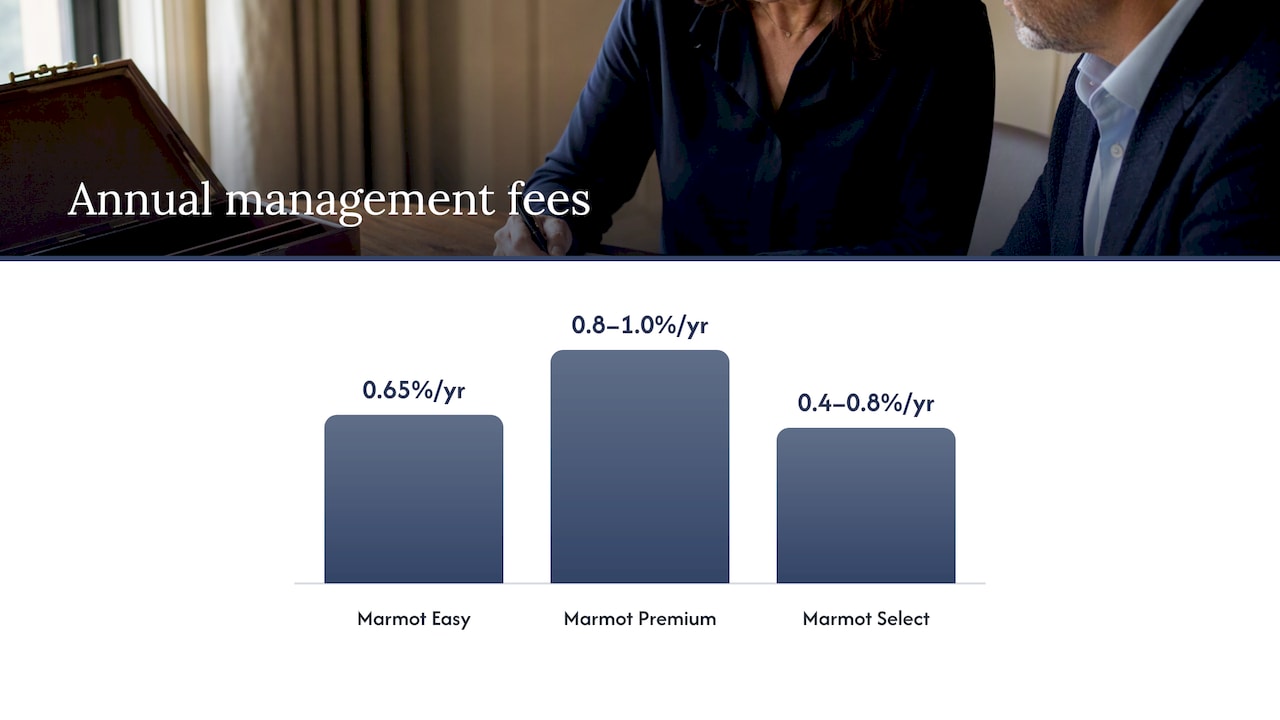
Our annual management fee depends on the service: Marmot Easy is 0.65% per year, Marmot Premium runs from 1.0% to 0.8% per year, and Marmot Select from 0.8% to 0.4% per year, depending on the assets managed. You can read how our wealth management and financial coaching work before deciding whether to talk to us. We do not draft wills or give legal advice, so your lawyer or notary remains the right person for the documents.
Our perspective
We meet many women who handled the household's decisions for years, yet find that the paperwork, the accounts and the investments sit in someone else's name, or that nobody has written anything down. Estate planning is often the moment a family realises how much was never discussed.
Our view is that the legal documents and the investment plan should be built together. A will that leaves a portfolio to three children is more useful if the portfolio is liquid, diversified and understood by the people who will receive it. We also think the conversation should include the next generation earlier than is traditional, because heirs who know the plan argue less about it.
We see the women we work with as decision-makers in their own right, not as an afterthought to a partner's plan. That is why we start with financial independence and long-term goals, and treat succession as a natural consequence of getting those right. Start early, write it down, and review it when your life changes.
FAQ
Do I need a will if I am married with children in Switzerland?
Yes, it is still worth having one. Without a will or inheritance contract, the law sets who inherits a quota but not which assets each person receives, which is where family disputes tend to start. A will lets you set out how the home, accounts and any business should be divided, within the compulsory portions.
Is a handwritten will valid in Switzerland?
Yes, provided it is written entirely by hand, dated and signed. Typed wills do not meet that standard. Keep the original somewhere safe and tell your executor where it is, and have a lawyer check it if your situation involves property, a business or foreign assets.
Can I leave my estate to whoever I want after the 2023 reform?
Not entirely. The reform that took effect on 1 January 2023 lowered compulsory portions and increased the share you can freely dispose of, but forced-heirship rules still limit your freedom. A lawyer can tell you exactly how much is free in your family situation.
What if I own property abroad or hold another nationality?
Plan the Swiss and foreign rules together. Foreign residents in Switzerland may be able to choose the law of their nationality for succession if conditions are met, and double taxation is a risk that treaties only partly reduce. Ask for a coordinated review covering every country where you hold assets.
How often should I review my estate plan?
Review it after every major life event, such as marriage, divorce, a birth, a death, a move or a large purchase, and whenever the law changes. A living will is commonly renewed about every two years, according to one Swiss insurer's brochure.
Sources
- Estate planning, your legacy in good hands (PostFinance)
- Why it is worth dealing with your own estate planning sooner rather than later (Legal 500)
- Swiss inheritance law brochure (Zurich)
- Why estate planning is essential for your wealth and family (Centro Law)
- Succession planning and tax optimisation (PBM Avocats)
- Estate planning in Switzerland (International Bar Association)
- Wills and probate in Switzerland (Lexology)
- Erbrecht (Federal Office of Justice)
- Succession & Estate Planning 2026, Switzerland (Chambers)
- Der Kanton wechselt zur Erbanfallsteuer (Kanton Graubünden)
- FAQ Testament und Nachlassplanung (WWF Schweiz)