The most effective retirement strategies right now are straightforward: check your AVS and LPP facts properly, use Pillar 3a top-ups to their full tax advantage, and weigh up a targeted Pillar 2 buy-in before relying on your pension fund’s projected annuity. Recent LPP reforms have lowered conversion rate assumptions, which makes an early, personalised review more urgent than it used to be. For many people, pairing this with advice from a regulated specialist such as Marmot Finance turns a vague plan into a concrete one, especially if you are considering retiring on the French Riviera.
TL;DR:
- Request your AVS statement and pension fund certificate, then confirm whether the fund blends mandatory and extra mandatory capital under an enveloping conversion rate.
- Contribute to Pillar 3a before the calendar year ends so the deduction applies that tax year, and check the current cap for your pension coverage.
- A Pillar 2 buy in may suit people five to fifteen years from retirement, but request a break even calculation because conversion rates vary.
- Budget separately for health insurance premiums and long term care, since premiums come out of pocket and insurance covers only part of care costs.
- Because Pillar 2 annuities are not automatically inflation indexed, compare their long term purchasing power with a diversified investment mix and revisit your plan periodically.
Marmot Finance
Plan Your Retirement With Confidence
Marmot Finance combines personal consultations and digital tools to help women and families in Switzerland manage investments around their financial profile.
Quick checklist: how to assess your current pension position
Before you can decide what to do, you need to know where you actually stand. Most people have not looked closely at their AVS statement or pension fund certificate in years, and the numbers often surprise them.
Start by requesting two documents: your individual AVS account statement and your pension fund’s current certificate, which should show both the mandatory (obligatoire) and extra-mandatory (surobligatoire) portions of your capital separately. This distinction matters because the surobligatoire part is not bound by the legal minimum conversion rate, so funds can apply a lower, blended rate to it, which changes your expected pension considerably.
Once you have the paperwork, work through these checks:
- Confirm the conversion rate your pension fund currently applies, and ask whether it uses an “enveloping” rate that blends mandatory and extra-mandatory portions.
- Add up any gaps from part-time work, career breaks or multiple employers, since these often reduce accumulated capital, something that affects women more often than men.
- Check your vested-benefits history if you have changed jobs, to make sure no capital was left behind in an old account.
These three checks alone usually reveal whether you are on track or need to act sooner rather than later.
Practical tactics that work: pillar 3a, pillar 2 and personal savings
Once you know your starting point, a handful of tactics do most of the heavy lifting. They are not exotic: the value comes from using them consistently and at the right time.
- Pillar 3a contributions: these reduce your taxable income each year and grow largely tax-free until withdrawal. The annual maximum is set by the ESTV, with different caps depending on whether you also contribute to a pension fund, so check the current figure before planning your top-up. Contributing before the end of the calendar year, rather than waiting until spring, means the deduction applies to that tax year.
- Pillar 2 buy-ins (“rachats”): these let you purchase missing contribution years, which increases your insured salary and future pension. They make most sense for people within five to fifteen years of retirement, where the tax saving and projected pension increase can be substantial, but always ask your fund for a break-even calculation first, since conversion rates vary by fund and buy-ins are not always cost-effective.
- Vested benefits: if you have left an employer, compare keeping the capital with a vested-benefits foundation against the fees and investment rules that apply, rather than letting it sit in a low-interest default account.
- Personal investments: outside the three pillars, diversified, low-cost ETFs matched to your time horizon tend to outperform ad hoc stock-picking, while keeping enough liquidity if retirement is near.
As a rough guide, younger investors should prioritise accumulation and a higher equity allocation, while those closer to retirement should weigh guaranteed income more heavily and consider buy-ins only where the numbers clearly work in their favour.
Pro Tip: Ask your pension fund for a written buy-in simulation before transferring any money: the paperwork alone often reveals whether the purchase is worthwhile.
How the LPP and AVS reforms change the picture
The LPP 21 reform proposal reduces the legal minimum conversion rate from 6.8% to 6.0%, which means the same retirement capital converts into a smaller annual pension than before. To soften this, the reform proposes compensatory measures, including changes to the coordination deduction and a transitional supplement for certain birth cohorts.
One figure worth sitting with: pension funds’ own regulatory conversion rates have been trending downward for years, and many already apply enveloping rates below the legal minimum. That means your fund’s actual projection may already be lower than the headline figure suggests, which is exactly why checking your own certificate matters more than following general reform commentary.
The AVS 21 reform also introduces more flexibility around the reference age, including options to anticipate or defer your AVS pension, with transitional supplements for certain cohorts of women. Lower coordination deductions under the reforms also tend to increase pension coverage for part-time and lower-income earners, a group that includes a disproportionate number of women, so it is worth checking whether a targeted 3a or 2nd-pillar top-up now would compound that benefit.
Working with an advisor: questions to ask and how a plan should look
A short meeting with the right advisor can save years of guesswork, provided you ask the right questions and bring the right paperwork.
Come prepared to ask:
- What conversion rate does my pension fund currently use, and is it an enveloping rate?
- What fees apply to my pension fund’s investments, and are they disclosed clearly?
- Can I buy back missing contribution years, and what would that cost versus the pension increase?
- What compensatory measures is the fund planning in response to the reforms?
A good advisor should set out trade-offs plainly: tax savings against liquidity, buy-in cost against the pension increase it buys, and investment risk against your target retirement income, rather than presenting one option as obviously correct.
Bring your AVS statement, pension fund certificate, recent tax return and any vested-benefits documents. A realistic timeline is around 90 days from first meeting to signed action, covering document collection, buy-in quotes and any transfers.
Implementation checklist and realistic timeline
Acting on advice matters more than collecting it, so here is a simple sequence.
- 0 to 3 months: request your AVS and pension fund statements, open or top up a Pillar 3a account before the tax year closes, and calculate the actual tax saving for your bracket.
- 3 to 12 months: request buy-in quotes from your pension fund, consolidate any vested-benefits accounts, and review your personal investment allocation against your retirement horizon.
- 1 to 5 years: schedule an annual review, watch for communications from your pension fund about reform-related changes, and adjust contributions or allocations as circumstances shift.
This sequence avoids the common trap of waiting for the “perfect” plan before doing anything at all.
A Marmot Finance perspective on getting this right
This advice recognises that generic retirement guidance often misses the gaps that part-time work, career breaks or lower average pension capital create. A modest Pillar 3a top-up combined with a well-timed buy-in can meaningfully shift projected retirement income, often more than expected from such a small adjustment. For those seeking a clearer picture of where they stand, tools like a Money Makeover Quiz or a short review can be a reasonable place to start.
Healthcare and long-term care costs deserve a place in your plan
Retirement planning conversations tend to focus on pension income and forget healthcare, yet health insurance premiums and potential long-term care costs can take a growing share of a retiree’s budget as they age. Compulsory health insurance premiums rise with age and vary by canton, and they are paid entirely out of pocket rather than deducted from salary once you stop working, which changes your monthly budgeting in retirement.
Long-term care, whether at home or in a care facility, is only partially covered by health insurance, with the remainder typically falling to the individual, complementary insurance, or, where eligible, supplementary benefits (prestations complémentaires). Building a buffer for these costs into your retirement projections, rather than assuming your pension alone will stretch to cover them, avoids an unpleasant surprise in your seventies or eighties.
A practical approach is to review your health insurance deductible and complementary coverage well before retirement, when premiums are generally more manageable, and to ask whether your current policy includes any long-term care provisions. Setting aside a dedicated reserve, separate from your core retirement capital, for potential care costs gives you a cushion that a standard pension projection will not show. This is also a useful topic to raise directly with an advisor, since the right balance between insurance and self-funded reserves depends heavily on your health, family history and existing coverage.

Estate planning and inheritance considerations for your retirement assets
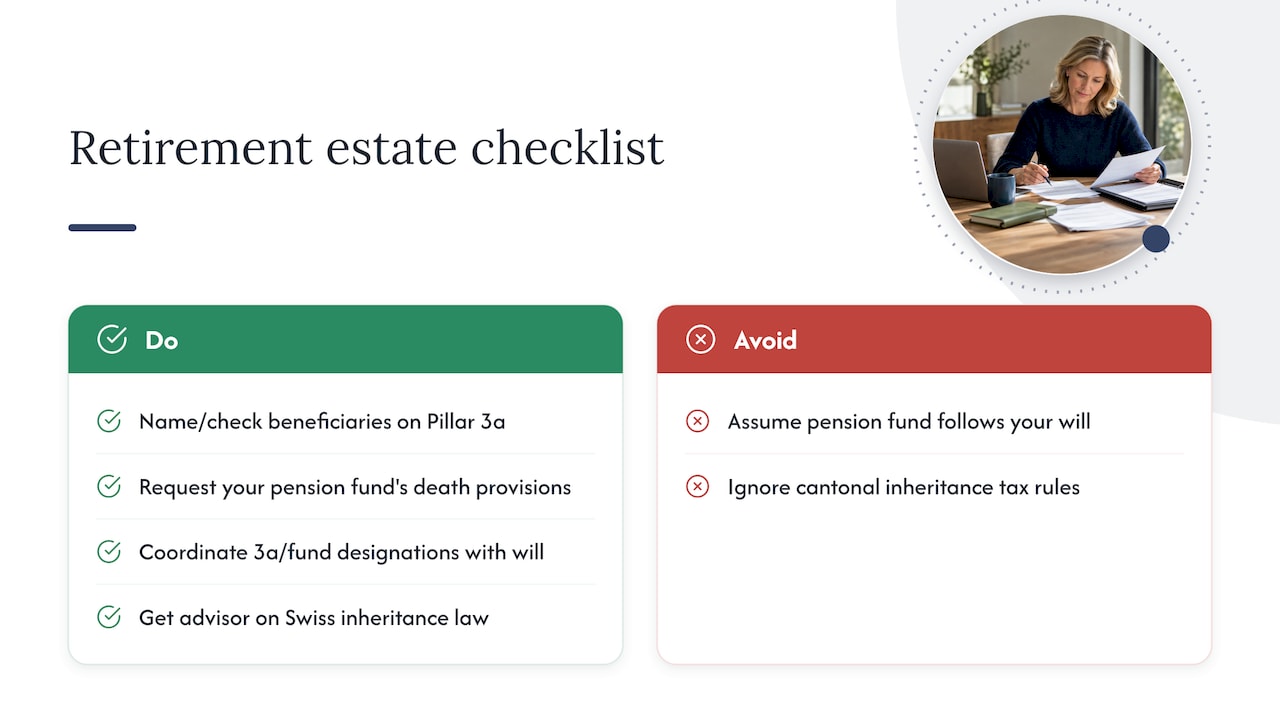
Pillar 3a and Pillar 2 vested-benefits capital are treated differently from other assets when it comes to inheritance, and getting this wrong can mean money going to unintended beneficiaries or facing an avoidable tax bill. Pillar 3a accounts allow you to name beneficiaries directly, within a legally defined order of priority that typically favours a surviving spouse or registered partner, then children, ahead of other heirs, so checking your beneficiary nomination with your 3a provider is a simple but often overlooked step.
Pension fund (Pillar 2) death benefits follow the fund’s own regulations, which can differ from the default inheritance rules that apply to your general estate, so it is worth requesting a copy of your fund’s death benefit provisions rather than assuming they mirror your will. Inheritance and gift tax rules in Switzerland are set at cantonal level, and spouses are generally exempt, while rates for other heirs vary considerably depending on the canton and the relationship to the deceased.
If part of your retirement planning involves eventually passing on wealth, it makes sense to coordinate your 3a and pension fund beneficiary designations with your broader will and any marriage or inheritance contracts, rather than treating them as separate matters. An advisor who understands both wealth management and the practicalities of Swiss inheritance law can flag mismatches between what you intend and what your current paperwork actually says, before it becomes a problem for your family.
Why inflation changes your retirement income math
A pension that looks comfortable today can lose real purchasing power over a retirement that might last twenty-five years or more, which is why inflation deserves explicit attention rather than an afterthought. AVS pensions are adjusted periodically to reflect wage and price trends, but occupational pension (LPP) annuities are not automatically indexed to inflation in the same way, so the real value of a fixed Pillar 2 pension can erode steadily over time.
This is one of the stronger arguments for not relying entirely on annuity income and instead keeping a portion of your retirement savings invested in diversified assets that have historically kept pace with inflation better than cash or fixed pension payments. It also means that when you compare a lump-sum withdrawal against an annuity option at retirement, you should factor in how each will hold up against rising living costs over the decades that follow, not just the figure quoted on day one.
Reviewing your retirement income plan every few years, rather than setting it once and leaving it, lets you adjust your withdrawal rate or investment mix if inflation runs higher than expected. For residents, this is particularly relevant given how property and daily living costs tend to rise over time in Swiss cities, which makes a static plan risk feeling comfortable now and considerably tighter a decade into retirement.
Our take: the reforms reward action, not worry
The LPP and AVS reforms generate plenty of headlines, but the practical takeaway is simpler than the coverage suggests: conversion rates are falling, and the sensible response is to accumulate more and check your own numbers, not to panic about the system changing beneath you. Conventional advice often stops at “contribute to Pillar 3a,” which is correct but incomplete. It treats the three pillars as a single, uniform system when in practice your pension fund’s own enveloping rate and buy-in cost structure matter just as much as the legal minimums that everyone discusses.
What we think gets underweighted is timing: a buy-in or top-up made five years before retirement can behave very differently from the same move made fifteen years out, yet most general guidance treats all working adults as one audience. If you take one thing from this, let it be to request your own figures first, rather than assuming national averages or reform headlines describe your situation. The individual review is where the real decisions get made, and for women with interrupted career patterns, that review often uncovers more room to act than they expected.
How we can help you build a plan around these numbers
Working out the right mix of Pillar 3a top-ups, buy-ins and investment allocation is easier with a second pair of eyes, particularly one that understands how career breaks and part-time work shape Swiss pension outcomes. We offer three ways to get that support, scaled to how much guidance you want.
- Marmot Easy charges an annual management fee of 0.65% and suits readers who want straightforward, low-cost portfolio management alongside their pension planning.
- Marmot Premium, with fees ranging from 1.0% down to 0.8% depending on assets managed, adds more hands-on coaching and tailored strategy work.
- Marmot Select, priced from 0.8% down to 0.4%, is built for larger portfolios needing closer, ongoing attention.
If you are weighing a buy-in, a 3a top-up, or simply want someone to check your numbers, our wealth management and coaching services are a sensible next step, and you can review current plans and fees on our pricing page.
This article is general information, not a substitute for advice from a qualified financial advisor. Consult a qualified financial professional about your own circumstances before acting on anything here.
FAQ
Which Swiss pension fund has the best performance?
Performance varies significantly between pension funds depending on their investment strategy, conversion rate and funding ratio, so there is no single fund that performs best for everyone. Your own fund’s annual report and the CHS PP conversion rate data are the most reliable way to check how your specific fund compares.
What is the average Swiss pension?
Pension amounts depend heavily on individual contribution history, salary level and whether someone has gaps from part-time work or career breaks, so there is no single figure that applies broadly. Checking your own AVS statement and pension fund certificate gives a far more useful picture than any national average.
Is Pillar 2 mandatory in Switzerland?
Occupational pension coverage (Pillar 2) is mandatory for employees earning above a certain threshold under the LPP reform framework, while self-employed individuals can generally join voluntarily. The exact entry threshold and coordination deduction are subject to the ongoing reform changes, so it is worth confirming current figures with your pension fund.
How does the pension system work in Switzerland?
The system rests on three pillars: a state pension (AVS) that everyone contributes to, an occupational pension (LPP) built through employer contributions, and a voluntary private pillar (3a) for additional tax-advantaged savings. The AVS 21 reform overview explains how the first two pillars interact and what recent changes mean for claiming age and transitional supplements.
Sources
- Réforme de la prévoyance professionnelle (LPP 21) — presentation
- Déductions maximales pilier 3a — ESTV