Families set up single-family offices to centralise control over their wealth, protect their privacy and secure a structured path for passing assets to the next generation, provided the costs and governance demands are justified by the size and complexity of what needs managing. An SFO is not a trophy. It is a working solution to a specific problem: fragmented advice, scattered reporting and no single point of accountability for a family's financial life.
TL;DR:
- A major liquidity event, such as a business sale, often triggers an office, especially when family wealth must be separated from an operating company.
- Choose a single family office for cross border assets, operating businesses, or urgent succession; simpler portfolios may need only outsourced functions or shared staff.
- Set decision rights before hiring: a family constitution, dispute process, investment committee, and independent audits can limit founder bias and protect collective interests.
- Because salaries, compliance, and office overhead remain fixed during quiet markets, test outsourced tax or investment services before committing to permanent staff.
Marmot Finance
A Different Approach to Family Wealth
For Swiss families weighing how to manage wealth, Marmot combines personal consultations with digital tools for tailored investment management.
Core reasons families set up single-family offices
Most families who reach the point of creating a single-family office are not chasing prestige. They are solving a practical problem that grew too large for a handful of external advisers to manage well.
Privacy sits near the top of the list. A single-family office keeps records, decisions and family matters inside one controlled structure rather than spread across banks, law firms and accountants, each holding a partial picture. The EY family office guide notes that common triggers for setting one up include a sudden liquidity event, such as selling a business, and the need to separate family wealth from an operating company once that company no longer needs daily family oversight.
Alignment of interest matters just as much. When a family hires its own staff rather than relying on external providers who are also selling products, the incentives point in one direction: the family's long-term goals, not a quarterly sales target. The Fundssociety commentary describes this alignment of interest as the chief benefit industry experts point to when asked why SFOs exist at all.
Beyond alignment, families typically set up an SFO to cover direct holdings and real estate, bespoke mandates in private equity, direct holdings and real estate that standard advisory relationships rarely accommodate well.
- Direct investing and bespoke mandates in private equity, direct holdings and real estate that standard advisory relationships rarely accommodate well.
- Succession planning, with the office acting as custodian of family governance documents, trusts and the practical mechanics of transferring wealth.
- Operational consolidation of tax reporting, estate planning, philanthropy and day-to-day financial administration under one roof.
Benefits and trade-offs: what an SFO can deliver and what it costs
An SFO's biggest selling point is also its hardest to quantify: better oversight. When one team sees the whole balance sheet, across asset classes, entities and family members, it can spot concentration risk or liquidity gaps that three separate advisers, each seeing only their slice, would miss.
That oversight tends to produce a few concrete gains:
- Customised reporting that consolidates holdings across banks, custodians and asset classes into one coherent view.
- Faster decision-making, since the family does not need to coordinate several external parties before acting.
- Continuity of institutional knowledge, because staff stay with the family across years rather than rotating through a bank's client list.
None of this comes free. An SFO carries fixed costs, staff salaries, compliance infrastructure and office overheads, that do not shrink when markets are quiet. The EY family office guide links the recent growth in family offices to wealth creation and a desire for control, direct investing and governance, but that growth has also exposed a less visible cost: governance risk. Reporting from Finews warns that SFOs can develop double-agency problems, where staff serve the founder's wishes rather than the family's collective interest, and family-blockholder dynamics that quietly erode value when no one is holding management to account.
Pro Tip: Before hiring your first SFO employee, write down who that person answers to when family members disagree, because that question is far harder to resolve after the hire than before.
Governance, succession and practical design choices
Centralising money in one office only helps if the people around that money agree on how decisions get made. This is where governance tools earn their keep.
A family constitution sets out shared values, decision rights and expectations before conflict arises, often alongside a family council that gives members, including those not in daily management, a formal voice. Dispute-resolution clauses, written in before anyone is angry, give the family a process to fall back on rather than a stalemate. Boards or advisory committees sit between professional staff and family members, so day-to-day authority rests with trained managers while the family retains oversight through regular reporting, investment committee reviews and periodic external audits.
The need for this structure is not theoretical. Swiss single-family offices commonly build bespoke governance structures, yet many lack formal mechanisms for resolving intrafamily disputes, a gap that research from the University of St.Gallen flags as a real risk to preserving wealth across generations. The same research found that a significant share of Swiss SFOs still include at least one operating family business, meaning the office is often custodian of corporate continuity as much as financial continuity.
Practical design choices that reduce friction include:
- Setting a fixed reporting cadence so family members see the same numbers at the same time, rather than hearing updates informally.
- Giving an investment committee, not any single family member, authority over major allocation decisions.
- Bringing in an external auditor on a regular schedule, independent of any staff member hired by the founding generation.
When to consider an SFO and what alternatives to evaluate
Asset size alone rarely tells you whether an SFO makes sense. A family with a straightforward portfolio and one jurisdiction to manage may need far less infrastructure than a family with the same wealth spread across several countries, multiple operating businesses and three generations with different priorities.
The better questions to ask are about complexity, not just scale:
- How many jurisdictions, entities and asset classes does the family need to track and report on consistently?
- How dispersed is the family geographically, and how much does that complicate communication and decision-making?
- How urgent is succession planning, and is there already a documented process in place?
- Would a leaner, outsourced model solve most of the same problems at a fraction of the fixed cost?
Alternatives exist for families who want some of the benefits without the full staffing commitment. A multi-family office shares infrastructure and staff across several families, cutting fixed costs but also cutting the degree of bespoke attention any one family receives. A virtual family office outsources specific functions, tax, reporting, investment management, to specialist providers while keeping a small internal coordinating team. Outsourcing single functions, rather than building a full office, often makes sense for families still working out exactly what they need.
The Swiss and European context: domicile and institutional drivers
Switzerland remains one of the jurisdictions families weigh most carefully when deciding where to base a single-family office, and the reasons are more institutional than tax-driven. Research from the University of St.Gallen found that Swiss SFOs cite political stability, legal certainty and the owners' personal ties to the country as the leading reasons for their presence there, with tax treatment and quality of life playing a smaller, though still relevant, role.
That ordering matters for any family weighing where to base an office. A jurisdiction's tax rules change with political cycles; legal certainty and institutional stability change far more slowly, and that is what SFOs appear to value most when the decision is for multigenerational planning rather than short-term optimisation.
For families already living in Switzerland or considering it as a base, a few practical points follow from this research:
- Banking expertise built up over decades gives Swiss-based offices easier access to specialist custodians and advisers.
- Networking with peer SFOs, often through membership organisations, is a common and valued channel for sharing governance and risk practices.
- Tax treatment should factor into the decision, but families who treat it as the only factor often discover later that legal certainty and continuity mattered more.
Each family's own tax and residency position should be confirmed with a qualified adviser, since rules vary by canton and by individual circumstance.
Historical development and evolution of single-family offices
Single-family offices are not a recent invention, though the term has become more common only in the last few decades. The model traces back to wealthy families managing estates and business interests through dedicated staff, a pattern that goes back well over a century among established European and American dynasties.
What has changed is scale and sophistication. Early family offices often amounted to a trusted accountant or lawyer managing a family's affairs alongside other clients. The modern single-family office, by contrast, tends to be a dedicated entity with its own investment staff, legal counsel and operational infrastructure, built specifically because a family's wealth and its complexity outgrew what any single external adviser could manage well.
The EY family office guide ties much of the recent growth in family offices to wealth creation events, particularly the sale of operating businesses, combined with a growing appetite for direct investing and a desire for governance structures that external providers cannot fully replicate. This growth has not been evenly spread: it clusters in regions with stable legal systems and deep financial expertise, which helps explain why certain European centres, Switzerland among them, have become natural homes for this kind of structure.
Typical organizational structures and staffing of single-family offices
There is no single blueprint for how a single-family office is staffed, because the structure tends to follow the family's actual needs rather than a standard template. That said, a few roles appear consistently once an office reaches a reasonable size.
A chief executive or chief investment officer typically leads day-to-day decisions, often supported by a small investment team handling asset allocation and manager selection. Legal and tax specialists, whether in-house or closely contracted, manage the structures that hold family wealth across jurisdictions. Administrative staff handle reporting, bill payment and the practical machinery that keeps the office running. Larger offices add dedicated roles for philanthropy, real estate or direct private equity deals, reflecting whatever the family's wealth is concentrated in.
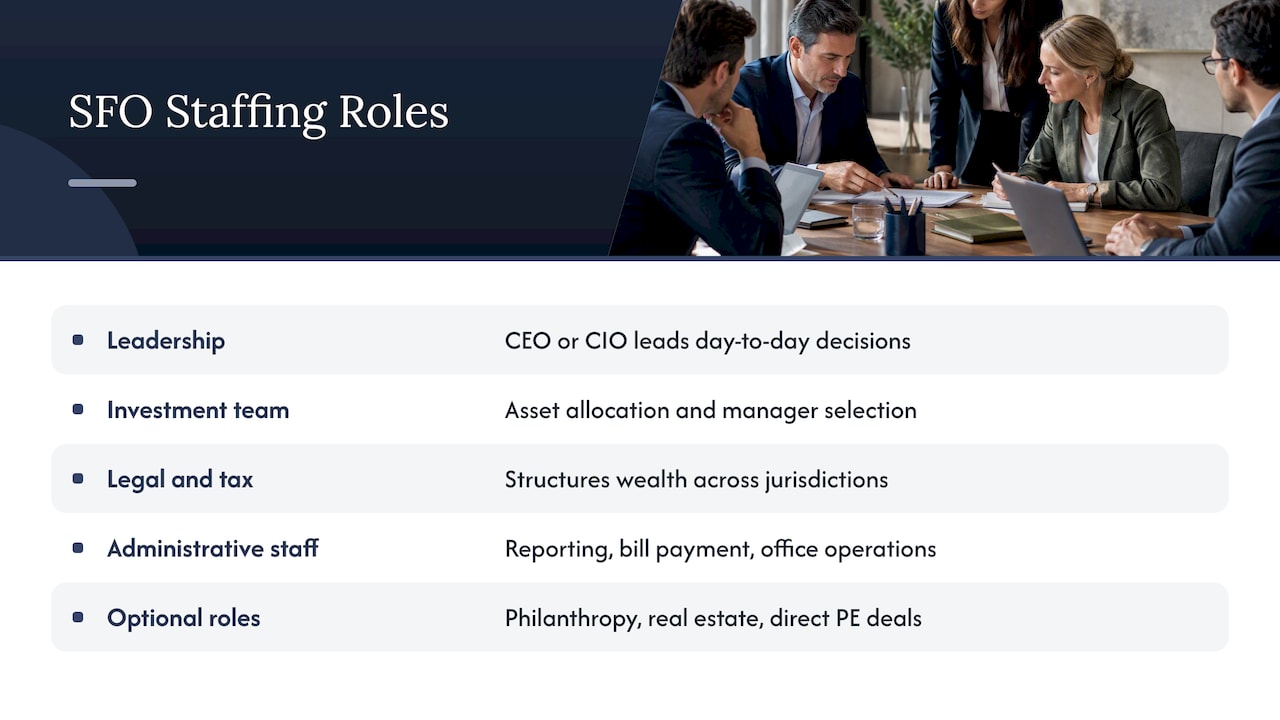
Staffing size varies enormously. Some offices run with two or three people handling everything; others employ dozens across investment, legal, tax and concierge functions. The deciding factor is usually complexity rather than headline wealth: a family with one jurisdiction and a simple portfolio can run a lean office, while a family spread across several countries with multiple operating businesses typically needs more hands, and more specialised ones, to keep things coherent.
Key challenges single-family offices commonly face and how they overcome them
The challenges that follow families into their SFO are rarely about investment performance. They are usually about people and process.
Governance gaps are the most persistent issue. Research from the University of St.Gallen found that many Swiss SFOs have bespoke governance arrangements but lack a formal process for resolving disputes between family members, a gap that becomes costly precisely when it is needed most, during a succession event or a family disagreement over strategy.
A second challenge is the double-agency problem described by Finews: staff hired to serve the founder may end up serving that individual's preferences rather than the family's collective interest, especially once the founding generation steps back. Families typically address this through independent advisory committees, clear contractual terms for staff and regular third-party audits that hold management accountable to the whole family, not just the person who signed the first employment contract.
Talent retention is a quieter but real challenge too. Skilled investment and legal professionals have options at banks and asset managers, so keeping good staff inside a single-family office often means offering a level of autonomy and interesting mandates that a larger institution cannot match.
Role of technology and digital tools in modern single-family offices
Technology has changed what a lean single-family office can realistically do. Consolidated reporting platforms now pull data from multiple custodians, banks and asset managers into one dashboard, work that used to take a team of analysts days to assemble by hand.
This matters most for oversight. A family office that can see its full exposure across asset classes and jurisdictions in real time is far better placed to spot concentration risk or a liquidity gap before it becomes a problem, which is exactly the kind of centralised oversight that makes an SFO worth its cost in the first place. Digital tools also support simpler administrative functions: secure document storage for legal and estate papers, automated tax reporting, and communication platforms that keep dispersed family members informed without constant in-person meetings.
None of this replaces judgment or governance. Technology makes information easier to gather and share, but the decisions about what to do with that information, how much risk to take, how to resolve a family disagreement, still rest with people and the governance structures they have agreed to follow.
Impact of changing regulatory landscapes on single-family office operations
Regulation around family offices has tightened in several jurisdictions in recent years, and that trend shows no sign of reversing. Reporting requirements around beneficial ownership, cross-border tax transparency and anti-money-laundering rules have all expanded the compliance workload that a single-family office needs to carry, regardless of where it is based.
For families, this has a practical consequence: compliance has moved from being a background cost to a core function that needs dedicated staff or outside specialists. A SwissBanking panel on the evolving needs of family offices noted that sustainability reporting and broader regulatory demands are becoming a bigger part of what family offices are expected to manage, alongside their traditional investment mandate.
This shift reinforces a point that comes up throughout any honest look at why SFOs exist: the model only works well when it has the governance and staffing to keep up with its obligations. A family office built to handle yesterday's reporting requirements, with no capacity to adapt, becomes a liability rather than an asset as rules continue to evolve. Families weighing whether to build or expand an SFO should factor in that compliance costs are a moving target, not a fixed line item.
Publisher perspective: pragmatic steps families should take next
Before anyone talks about structure, staff or office space, we think the honest first question is: what problem are you actually trying to solve, and who gets to make decisions once it exists? Governance clarity has to come before infrastructure, not after.
A staged approach tends to serve families better than committing to a full office from day one. Outsourcing one or two functions, tax reporting, investment management, as a pilot lets a family test what it actually needs before building permanent staff and overhead around assumptions that may not hold.
We work with families and individuals on exactly this kind of clarity, combining personal advice with practical wealth management and financial coaching built around each family's own goals rather than a generic template.
Ready to bring clarity to your family's financial planning?
Working out whether you need a full single-family office, a leaner outsourced model, or simply better coordination of what you already have, starts with an honest look at your own complexity, not a comparison with what other families have built. We offer exactly that kind of starting point: personal advice paired with digital tools that keep your whole financial picture in one place, rather than scattered across several advisers who never quite see the full board.
Our plans, from Marmot Easy through to Marmot Premium and Marmot Select, are built to scale with how complex your situation actually is, with annual management fees that reflect the level of tailoring you need rather than a flat one-size-fits-all rate. If you are weighing whether your family's wealth has reached the point where more structure makes sense, book a conversation with our team and we will help you work out what fits, honestly, before you commit to anything.
This article is general information, not a substitute for advice from a qualified financial advisor. Consult a qualified financial professional about your own circumstances before acting on anything here.
FAQ
What is the purpose of a single-family office?
A single-family office exists to centralise a family's financial decisions, records and strategy under one roof, rather than spreading them across multiple external advisers. Its purpose is to align staff incentives with the family's long-term goals, protect privacy and support succession planning across generations, as the Fundssociety industry commentary describes.
Why do family offices exist?
Family offices exist because managing significant wealth across multiple jurisdictions, asset classes and family members eventually outgrows what a handful of external banks or advisers can coordinate well. Common triggers include a major liquidity event, such as selling an operating business, and the need to professionalise management ahead of a succession, according to the EY family office guide.
Does Mark Zuckerberg have a family office?
We cannot confirm specific details about any individual's private family office arrangements, since that information is not publicly listed in verified industry sources. What is well documented is that very high net worth founders and entrepreneurs commonly turn to single-family offices once their wealth and its complexity exceed what standard private banking relationships can manage.
What is the purpose of a family office?
The core purpose is the same whether the structure serves one family or several: centralised oversight, aligned incentives and a dedicated team managing investments, tax, estate planning and succession in one coordinated way. This consolidation is what allows families to spot risks and opportunities that fragmented, external advice often misses.
Sources
- The Swiss single-family office landscape (University of St.Gallen, 2026)
- The family office dynamic: pathway to successful family and wealth management (Fundssociety)
- EY family office guide (Centre for Family Business HSG / EY)
- Family offices: governance pitfalls and staff dynamics (Finews)