

A women investment portfolio guide is a practical framework for building and managing wealth in ways that reflect the financial realities unique to women, including longer life expectancy, career interruptions, and distinct risk preferences. Women investors in Switzerland have a genuine structural advantage: research shows they outperform men by 0.4% to 1.8% annually, driven by disciplined buy-and-hold behaviour and lower speculative trading. That edge compounds significantly over decades. The challenge is not ability. It is having the right structure, the right assets, and the confidence to start. This guide covers both.
What does a women investment portfolio guide actually cover?
A women’s investment portfolio, known in professional wealth management as a goal-based portfolio, is a collection of assets structured around your specific financial timeline, income pattern, and life goals. The term “goal-based investing” is the industry standard here, and it matters because it shifts the focus from beating a benchmark to funding your actual life: retirement in Zürich, a property in Zug, or financial independence after a career break.
Women in Switzerland face a particular set of financial circumstances. Life factors unique to women such as longer longevity, part-time work phases, and lower cumulative earnings mean that a generic portfolio template built for a 45-year-old male professional simply does not fit. You need a higher savings rate, a longer investment horizon, and a plan that accounts for income variability. Getting those three things right is what this guide is designed to help you do.

What do you need in place before you start investing?
Laying the foundation before you invest is not optional. Without it, even a well-designed portfolio becomes hard to maintain when life gets complicated.
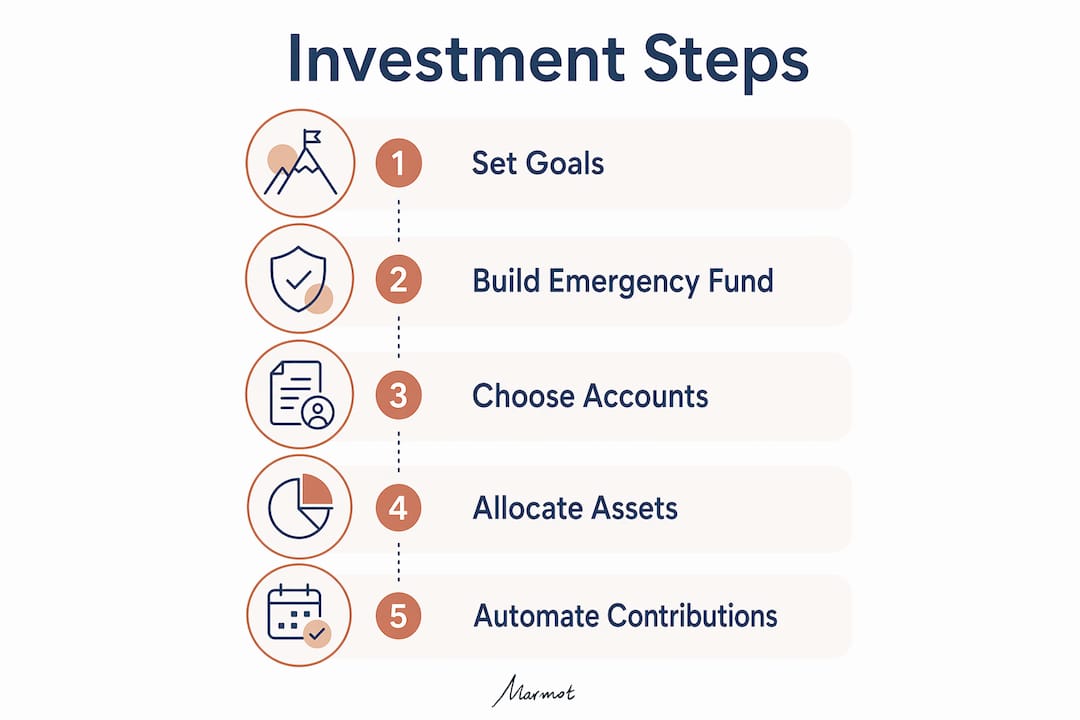
The first step is an emergency fund covering three to six months of living expenses, held in a liquid Swiss franc account. This is not an investment. It is your buffer, and it protects your portfolio from being raided during a job change or unexpected expense. Once that buffer exists, every franc beyond it is working against you if it sits idle in cash. Excess cash beyond emergency funds erodes purchasing power silently over time, which is why deploying surplus into diversified assets is the logical next step.
For Swiss investors, the account structure matters. Your pillar 3a retirement account is the most tax-efficient starting point available, allowing you to deduct contributions from taxable income each year. Beyond that, a standard brokerage account with a Swiss-regulated provider gives you access to global ETFs, Swiss equities, and fixed income instruments. Platforms like Swissquote or PostFinance are widely used by retail investors in Switzerland and offer access to the instruments you will need.
Pro Tip: Set up an automatic monthly transfer into your brokerage or pillar 3a account on the day your salary arrives. Automating contributions removes the decision entirely and turns good intentions into consistent habits.
Portfolio tracking is the final prerequisite most people skip. Aggregating all your accounts, including pillar 2, pillar 3a, and any brokerage holdings, into a single view gives you an accurate picture of your actual net worth and asset allocation. Without that visibility, you are managing blind.
How should you design your asset allocation as a Swiss woman investor?
Asset allocation is the single biggest driver of long-term portfolio returns, more so than individual stock picks or market timing. The standard starting point for a ten to twenty year horizon is a 60% equities and 40% bonds split, which balances growth potential against downside protection. For Swiss investors, this translates into a mix of global equity index funds, Swiss Market Index exposure, and Swiss franc-denominated bonds or bond funds.
Within the equity allocation, Swiss stocks deserve a deliberate position. Companies listed on the SIX Swiss Exchange, particularly in the healthcare, consumer goods, and financial sectors, provide both currency stability and dividend income. Nestlé, Novartis, and Roche are the most widely held, but a broader Swiss equity ETF gives you diversified domestic exposure without concentration risk.
Private equity is increasingly accessible to Swiss retail investors through structured products and feeder funds, and it adds a layer of return potential that public markets alone cannot replicate. Real estate, whether through direct Swiss property or Swiss real estate investment trusts, provides inflation protection and income. If you are considering building a real estate component within your portfolio, understanding how property fits alongside equities and bonds is worth the time.
The cost of your funds matters more than most investors realise. Low-cost index funds with expense ratios between 0.03% and 0.05% outperform 85% of active fund managers over a ten-year period. That is not a marginal difference. On a CHF 200,000 portfolio, the fee gap between a 0.05% index fund and a 1.2% active fund compounds into tens of thousands of francs over twenty years.
Pro Tip: As you approach retirement or a major life event, shift your allocation gradually toward lower-volatility assets. A common rule is to subtract your age from 110 to get your target equity percentage. A 40-year-old would hold roughly 70% in equities, adjusting downward over time.
| Allocation component | Suggested range | Purpose |
|---|---|---|
| Global equity index funds | 40–50% | Long-term growth engine |
| Swiss equities (SIX-listed) | 10–15% | Currency stability and dividends |
| Bonds and fixed income | 25–35% | Capital preservation and income |
| Private equity or real estate | 5–15% | Inflation hedge and return diversification |
What steps should you follow to build and manage your portfolio?
Building a portfolio is a process, not a single decision. The clearest way to approach it is in stages, each one building on the last.
Start by writing down your financial goals with specific numbers and dates. “Retire comfortably” is not a goal. “Accumulate CHF 800,000 by age 62 to fund thirty years of retirement in Lausanne” is a goal. The specificity forces you to work backwards and calculate how much you need to invest each month to get there. Swiss women live longer on average than their European counterparts, so your retirement funding period is likely longer than you assume. Tailored financial planning that accounts for longevity and career breaks is not a luxury. It is a necessity.
Once your goals are clear, select your instruments. For most Swiss women investors, a core portfolio of three to five low-cost ETFs covering global equities, Swiss equities, and bonds covers the majority of what you need. Add a pillar 3a fund for tax efficiency, and consider a small allocation to Swiss real estate funds if your horizon is ten years or more.
Automate everything you can. Set your monthly contribution, set your rebalancing trigger (most advisors recommend reviewing allocation when any asset class drifts more than five percentage points from its target), and then leave it alone. Women’s lower trading frequency is a genuine competitive advantage. The investors who check their portfolios least often tend to make fewer costly mistakes. Patience is not a passive quality here. It is an active strategy.
When markets fall, as they did in 2022 and briefly in early 2025, the instinct to sell feels rational. It rarely is. Staying invested through volatility and continuing to contribute during downturns is how long-term wealth is built. Understanding your own risk appetite and behaviour before a downturn happens means you are less likely to make reactive decisions when it does.
What common mistakes do women investors in Switzerland make?
The most costly mistake is holding too much cash for too long. Many women keep significant sums in savings accounts well beyond their emergency fund, often out of a desire for security. Excess cash holdings reduce long-term wealth by losing purchasing power to inflation, which in Switzerland has averaged around 1.5% to 2% annually in recent years. Every year that CHF 50,000 sits in a savings account earning 0.5% while inflation runs at 1.8% is a year of real wealth destruction.
The second mistake is falling for products marketed specifically as “women’s investment funds.” These products are often well-intentioned but specialised women-centric funds do not consistently outperform standard low-cost index funds and frequently carry higher fees. The gender of a fund’s marketing team does not improve its returns. A Vanguard FTSE All-World ETF or a UBS Swiss equity fund will almost always serve you better than a niche product with a pink logo and a 1.5% management fee.
The third mistake is managing your portfolio without full visibility. Women in Switzerland often hold assets across multiple accounts: a pillar 2 with a former employer, a pillar 3a at a bank, a brokerage account, and perhaps a savings account. Without aggregating these into a single view, you cannot know your true allocation or whether your overall risk level matches your goals. Seeking professional portfolio guidance is particularly valuable when your financial picture spans multiple institutions.
“The gender investment gap is primarily an infrastructure issue. Women have the behavioural traits for investing success. What they often lack is the system to make those traits work consistently.”
If you are based in Zürich, Geneva, Basel, or Davos and feel uncertain about where to start, working with a fee-based adviser who understands the Swiss pension system and local tax implications is worth the cost.
Key takeaways
Building a successful investment portfolio as a woman in Switzerland requires goal-based thinking, low-cost diversified assets, and the discipline to automate contributions and stay invested through market cycles.
| Point | Details |
|---|---|
| Start with an emergency fund | Hold three to six months of expenses in cash before investing a single franc. |
| Use goal-based allocation | A 60/40 equity-bond split is a proven starting point for a ten to twenty year horizon. |
| Keep costs low | Index funds at 0.03% to 0.05% outperform 85% of active managers over ten years. |
| Automate and stay invested | Lower trading frequency is a structural advantage. Automate contributions and avoid reactive selling. |
| Avoid excess cash and niche products | Cash beyond your emergency fund loses value. Women-only funds rarely justify their higher fees. |
Why I think the biggest barrier for women investors is not knowledge
After working with women investors across Switzerland, the pattern I see most often is not a lack of financial knowledge. Most women I speak with understand the basics. They know what an ETF is. They know they should be investing. The real barrier is inertia combined with a feeling that the system was not built for them, and honestly, for a long time it was not.
What changes things is not a masterclass or a spreadsheet. It is seeing someone in a similar situation who has already done it. Peer learning and community have a measurable impact on women’s financial confidence and outcomes. When you hear a colleague in Zürich or a friend in Lucerne describe how they set up their pillar 3a and started a brokerage account, the whole thing feels less abstract.
The behavioural edge women have in investing is real and well-documented. Patience, lower trading frequency, and a tendency to think in decades rather than quarters are qualities that compound into better outcomes. The work is in building the infrastructure around those qualities so they translate into consistent action. Automate your contributions. Review your allocation once a year. Do not let a volatile quarter convince you to undo a decade of good decisions. The women I have seen build genuine wealth in Switzerland are not the ones who found the cleverest strategy. They are the ones who started, stayed consistent, and did not overcomplicate it.
— Sophie Steinmann
How Marmot supports women investors across Switzerland
Marmot is a FINMA-accredited wealth manager dedicated exclusively to women and families in Switzerland, with clients across Zurich, Geneva, Basel, Davos, and beyond. If you are ready to build or optimise your investment portfolio, Marmot’s advisers combine personal consultations with digital tools to create a strategy that fits your specific goals, timeline, and risk profile.
Whether you are starting from scratch or reviewing an existing portfolio, Marmot offers tailored wealth management in CHF, EUR, and USD accounts. Over 350 women have already worked with Marmot to take control of their financial future. You can begin with the Money Makeover Quiz or book a consultation directly through Marmot’s guide to find the right starting point for your situation.
FAQ
How much do I need to start investing in Switzerland?
There is no minimum threshold. Many Swiss brokerage accounts allow you to start with as little as CHF 500, and pillar 3a contributions can be made in any amount up to the annual maximum.
What is the best asset allocation for a Swiss woman investor?
A 60% equity and 40% bond split is the standard starting point for a ten to twenty year horizon, with adjustments based on your age, income stability, and specific goals.
Are women-only investment funds worth it?
Specialised women-centric funds do not consistently outperform standard low-cost index funds and often carry higher fees. A diversified global index fund is almost always the more cost-effective choice.
How often should I rebalance my portfolio?
Review your allocation annually or when any asset class drifts more than five percentage points from its target. Rebalancing more frequently than that tends to generate unnecessary transaction costs without improving returns.
Do I need a financial adviser to invest in Switzerland?
Not necessarily, but an adviser adds real value if your financial picture includes multiple pillar accounts, cross-border income, or significant assets. Fee-based advisers who specialise in Swiss women investors, like those at Marmot, offer guidance without product-driven conflicts of interest.

.webp)





.jpeg)



.png)

.svg)


