

Demands for ethical investing are growing, and the data from Switzerland makes this clear. The Swiss sustainable investment market reached CHF 1,940 billion in 2025, growing at a compound annual rate of around 30% over the past decade. Women are at the centre of this shift, not as passive participants but as the primary force shaping where capital flows and why.
Why women are leading the ethical investing movement in Switzerland
The growth of sustainable investing in Switzerland is not accidental. Sustainability has moved from a niche preference to a mainstream expectation, driven in large part by investors who demand standardised labels, measurable impact, and genuine transparency. Women, particularly those managing family wealth or ultra-high-net-worth portfolios, are disproportionately represented in this demand.
83% of women globally want their investments to reflect their personal values, and 70% of European women plan to increase their ESG allocations within three years. These are not aspirational figures. They reflect a fundamental shift in how women approach capital allocation, prioritising climate action, gender equality, and health innovation alongside financial returns.
Key facts shaping this movement in Switzerland:
- The Swiss sustainable investment market has shown substantial growth over the past decade, reaching a high market volume by 2025.
- 83% of women globally want value-aligned investments; 70% of European women plan to increase ESG exposure.
- Female ultra-high-net-worth individuals in Switzerland typically allocate 10–20% of their portfolios to impact investments.
- Nature-related risks, including extreme weather events, are now financially material, influencing portfolio construction across Swiss institutions.
- Regulatory frameworks in Switzerland are tightening definitions of what qualifies as a sustainable investment, reducing greenwashing risk.
- Marmot Finance serves women navigating this market with FINMA-accredited, values-aligned wealth management.
How women can align investments with ethical values in Switzerland
Translating values into a portfolio requires more than good intentions. It demands a clear process, the right vehicles, and the discipline to verify impact claims rather than accept them at face value.
Practical steps for women investors in Switzerland:
- Define your core values. Identify what matters most: climate resilience, gender equity, healthcare access, or community development. This shapes every subsequent decision.
- Choose your impact themes. Renewable energy and women-led ventures are among the most investable areas with proven market structures. Biodiversity-specific strategies remain less mature.
- Select appropriate vehicles. Green bonds, ESG funds, and venture capital each carry different risk profiles. Entry points for green bonds and ESG mutual funds can be as low as €5,000, while some private equity funds require €250,000 or more.
- Set measurable KPIs. Define both financial and social performance targets before committing capital. This is the most effective defence against greenwashing.
- Use digital platforms for monitoring. Transparency tools that track portfolio performance across asset classes make it possible to verify that capital is doing what it claims.
- Seek specialist advice. Women investment portfolio guidance tailored to the Swiss market helps navigate regulatory complexity and cultural capital requirements.
Ethical investing in Switzerland is a knowledge-intensive activity. Navigating competing standards, auditing impact claims, and avoiding label inflation requires thorough due diligence. Research consistently shows that women tend to conduct more preparatory research before committing capital, which partly explains their stronger representation in this space.
Pro Tip: When evaluating an ESG fund, ask the provider for its independent audit report. Swiss regulations now require mandatory independent audits for collective investment schemes claiming sustainable status. If a provider cannot supply one, treat that as a warning sign.
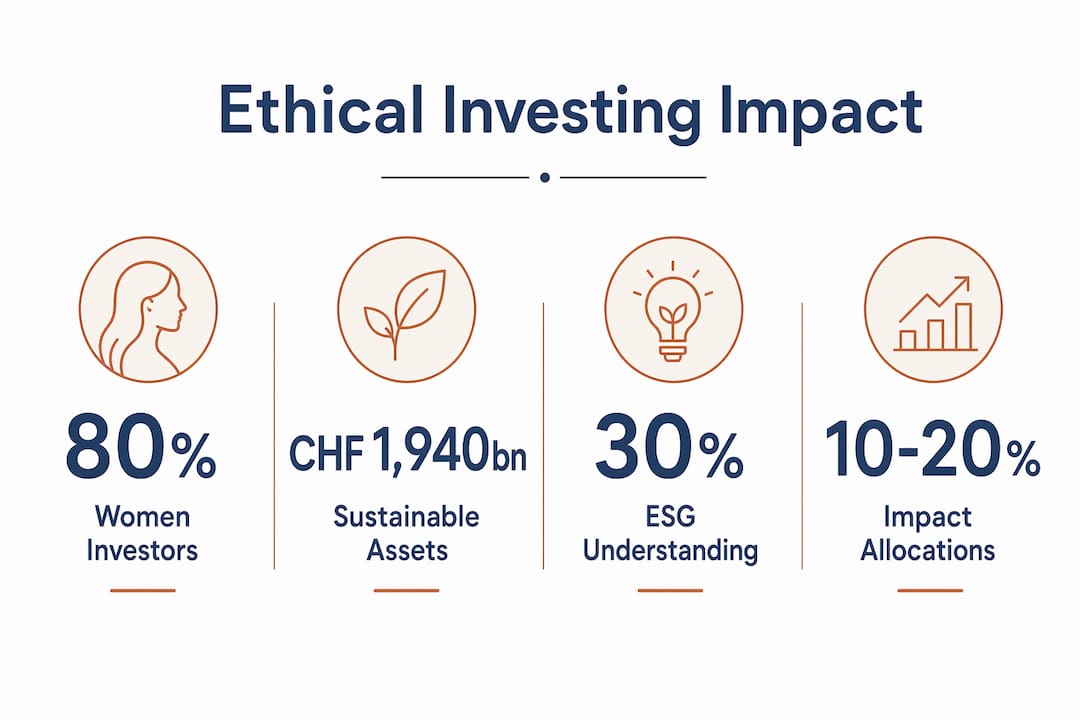
Only about 30% of Swiss sustainable investors understand how ESG is measured, despite 37% already holding sustainable securities. Closing that knowledge gap is not optional. It is the difference between genuine impact and expensive marketing.
Does ethical investing affect portfolio performance?
The short answer is: not negatively, and often positively over longer horizons. 80% of women surveyed by Lombard Odier believe sustainable investments will perform as well as, or better than, traditional investments over a five-year period. Just over 30% expect sustainable strategies to outperform.
Nature-related risks are increasingly translating into real financial losses. A notable share of Swiss investment respondents have experienced direct financial impacts from climate-related events on their portfolios. Allocating to climate-adaptive infrastructure and renewable energy is therefore both an ethical and a risk-management decision, not a trade-off between the two.
Female ultra-high-net-worth investors in Switzerland typically allocate 10–20% of their portfolios to impact investments, maintaining this alongside conventional holdings. This blended approach allows for measurable social contribution without sacrificing diversification. For a practical framework on structuring such a portfolio, the guidance on portfolio diversification in Switzerland is a useful reference.
Swiss women shaping ethical finance
Switzerland’s Gender Lens Initiative, coordinated through Sustainable Finance Geneva, is one of the most structured efforts globally to mobilise capital for gender lens investing and advance SDG 5. It brings together Swiss-based institutions to establish industry standards, conduct market research, and promote financial products that explicitly address gender equity.

Women in Swiss family offices are increasingly taking on lead roles in intergenerational wealth decisions, directing capital toward thematic strategies that reflect shared family values. Legacy building is a consistent priority: preserving wealth over the long term and passing it to the next generation, while ensuring that wealth funds a better world, ranks among the top stated priorities for female high-net-worth investors across Europe. Thinking through family financial milestones as part of a broader values-based plan is a practical starting point for this kind of intergenerational planning.
The Gender Lens Initiative for Switzerland also highlights how Switzerland’s position as a global hub for sustainable finance creates a distinctive environment. Women investors here are not operating in isolation. They are part of a broader institutional movement that is reshaping capital allocation at scale.
How ethical investments are measured and reported in Switzerland
Measurement is where ethical investing either holds up or falls apart. Switzerland’s regulatory framework has tightened considerably. The Swiss Funds and Asset Management Association (AMAS) framework, now in versions 2.1 and 2.2, explicitly lists exclusions, ESG integration, and voting as insufficient on their own to qualify a product as sustainable. A mandatory independent audit by a state-regulated firm is now required.
For investors, this means the bar for what counts as a genuine sustainable investment has risen. Third-party verification, self-reporting frameworks, and increasingly blockchain-based tracking are becoming standard tools for verifying that capital creates the impact it claims. Digital platforms that consolidate reporting across asset classes make this verification practical rather than theoretical.
The Swiss Bankers Association introduced a member policy in 2024 requiring banks to survey new clients on their ESG preferences. This has since extended to existing clients, embedding sustainability preferences into the standard advisory process across Swiss institutions.
Marmot Finance: ethical wealth management built for women in Switzerland
Marmot Finance is the only FINMA-accredited wealth manager in Switzerland dedicated exclusively to women and families. Where most wealth managers treat sustainable investing as an add-on, Marmot Finance builds it into the core of every client relationship, combining personal consultations with digital tools that provide genuine transparency over portfolio performance and impact.
Over 350 women have already worked with Marmot Finance to align their financial goals with their values, supported by financial coaching, bespoke portfolio construction, and a community of like-minded investors. The gender gap in wealth management is real, and Marmot Finance addresses it directly, with expertise in CHF, EUR, and USD accounts for Swiss and European clients.
For women who want their capital to reflect what they stand for, without sacrificing performance or transparency, Marmot Finance offers a clear and accountable path forward.
Key takeaways
Women are the primary force behind the growth of ethical investing in Switzerland, supported by a CHF 1,940 billion sustainable market and tightening regulatory standards that reward genuine impact over marketing claims.
Recommended
- Best Asset Classes for Women Investors in Switzerland | Marmot Finance
- Gender Gap Wealth Management: A Guide for Swiss Women | Marmot Finance
- Women Investment Portfolio Guide for Swiss Investors | Marmot Finance
- Women Investment Advice Explained: Your Swiss Guide | Marmot Finance

.webp)





.jpeg)



.png)

.svg)


