

The single most important step for any family with assets in Zermatt is to commission a cantonal-aware succession and tax model, then formalise it in a written will or succession pact before anything else. Swiss law still protects certain heirs through reserved shares under the Swiss Civil Code, cantonal inheritance tax rates vary considerably across Switzerland, and the 2025 updates to the Private International Law Act (PILA) have changed which rules govern cross-border estates. Waiting until a health event or a family dispute forces the issue almost always produces worse outcomes, legally and financially.
Immediate practical steps to take now:
- Conduct a full asset audit covering Swiss and international holdings, pension assets (pillars 2 and 3), real property, and business interests.
- Hold a structured family meeting to align on priorities, succession intentions, and any family business considerations.
- Appoint a Swiss-qualified lawyer or notary in Valais to draft or update your will and, where appropriate, a succession pact (Erbvertrag).
- Request cantonal tax modelling from a financial adviser with Valais expertise, covering inheritance tax, wealth tax, and transfer timing.
- Contact Marmot Finance for a discovery meeting to map your full planning picture and identify gaps.
Pro Tip: Book the lawyer and the financial adviser in parallel, not sequentially. Legal drafting and tax modelling inform each other, and doing them separately adds months and often produces documents that do not align.
Key takeaways
Family wealth planning in Zermatt requires combining Swiss succession law compliance, cantonal tax modelling, and family governance into a single coordinated plan, and the 2023 reform means the legal options are now broader than most families realise.
What does family wealth planning actually cover for a Zermatt family?
Family wealth planning is not simply writing a will. For a high-net-worth family in Zermatt, it spans at least six interconnected areas, and missing any one of them tends to create problems in the others.
Governance sets the rules for how the family makes decisions about shared assets, business interests, and philanthropy. Without it, even well-drafted legal documents become contested. Succession instruments are the legal tools, primarily wills, succession pacts, and marital property agreements, that translate governance intentions into enforceable rights under Swiss law. Tax and residency modelling examines how cantonal inheritance tax, wealth tax, and income tax interact with your specific asset mix and family structure, and it matters enormously in Valais given the canton’s particular rate profile.
Family office structure addresses whether the family’s assets are best managed through a single-family office, a multi-family office mandate, or a direct advisory relationship, each of which carries different regulatory implications under FINMA and FINSA. Pensions and social benefits covers the interaction between pillar 2 occupational pension assets, pillar 3a and 3b savings, and the broader estate, since pension assets do not always pass through the estate in the way families expect. Philanthropy and liquidity planning rounds out the picture, particularly for families with illiquid assets such as property or business stakes, where heirs may face inheritance tax bills without readily available cash.
For families with international assets or multiple citizenships, the sequence of priorities shifts. Cross-border elements should be addressed early, since choice of governing law under PILA must be documented in the will itself to be effective.
Pro Tip: Start with the asset audit and the succession instruments. Governance and philanthropy are important, but they cannot be finalised until you know what the legal and tax constraints actually are.
How does Swiss succession law affect your family in Zermatt?
The single most important legal fact for Zermatt families is this: reserved shares still bind, but the 2023 reform meaningfully increased the portion of your estate you can dispose of freely.
What changed in 2026
Under the 2023 succession reform, the reserved share for descendants was reduced from three quarters to one half of their statutory entitlement. The spouse’s reserved share remains at one half. Crucially, the reserved share for parents was abolished entirely. In practical terms, this means a larger freely disposable portion is now available for gifts, charitable bequests, or directing assets to specific children or a surviving partner beyond their statutory share.
For a family with two adult children and a surviving spouse, the practical effect is that a larger share of the estate can now be directed by will to the spouse, to one child over another, or to a foundation, without triggering a forced-heirship claim. That additional flexibility makes professional drafting more valuable, not less, because the options are now more complex.
The Chambers and Partners practice guide for Switzerland notes that cantonal inheritance tax rates and exemptions vary widely, with direct descendants often exempt or taxed at low rates in many cantons, while unrelated heirs can face relatively high rates in some jurisdictions. This variance alone justifies a canton-specific model before any transfer decision is made.
Cross-border families and PILA
As of January 2025, updates to the PILA allow cross-border families more fine-tuned selection of the governing law for parts of an estate with international assets. Choosing your national law in a will is a powerful tool, but it must be accompanied by congruent marital property regime choices and correctly drafted wills in each relevant jurisdiction. A choice of law clause that conflicts with local formalities in another country can be overturned, as Goldblum’s practitioners consistently emphasise in their guidance on international estates.
A short illustrative scenario: A couple domiciled in Zermatt, one Swiss and one German national, with property in both countries. Without a choice of law clause, Swiss law governs the Swiss estate and German law the German property, potentially triggering two sets of reserved-share rules and two inheritance tax regimes. A well-drafted will with a PILA choice of law clause, coordinated with a German notary, can simplify this considerably.
Pro Tip: If you hold assets in more than one country, always confirm with a Swiss lawyer whether your existing will contains a valid choice of law clause. Many older wills do not, and the gap becomes expensive at the point of settlement.
For a broader overview of estate planning formalities in Switzerland, the estate planning essentials guide covers practical implementation steps for affluent families.
Why does your canton of residence matter so much for tax planning?
Cantonal residence and asset location materially change tax outcomes for Zermatt families. This is not a minor detail; it can represent a difference of hundreds of thousands of francs across a generation.
Valais and the Zermatt tax profile
Valais is generally considered a moderately favourable canton for direct descendants. Inheritance between spouses and to direct descendants is exempt from cantonal inheritance tax in Valais, which aligns with the pattern across many Swiss cantons. Wealth tax applies at the cantonal and communal level, and Zermatt’s communal multiplier is relevant when modelling the annual cost of holding significant assets in the municipality.
For families considering lump-sum taxation (Pauschalbesteuerung), the Family Office Advisory jurisdictional guide documents that cantonal expenditure floors vary considerably: Zug sets a floor of CHF 400,000, Geneva at CHF 800,000, and Vaud at CHF 1,000,000. A federal proposal noted in November 2023 would raise the federal floor to CHF 500,000 and tighten the rental multiplier to nine times; this remains pending but should be factored into any long-term modelling. Zermatt itself does not offer lump-sum taxation, so families seeking that regime need to consider cantonal relocation as a separate decision.
Practitioners routinely model a ten-year after-tax projection across alternative cantonal domiciles when advising families on relocation or family office establishment, factoring in proposed legal changes and modest portfolio growth assumptions.
What a canton model needs to include
A realistic cantonal tax model for a Zermatt family requires the following inputs:
- Current asset values by category (financial assets, real property, business interests, pension assets).
- Family structure (number of heirs, residency status of each, any non-Swiss nationals).
- Anticipated transfer timing and likely sequence of deaths or gifts.
- Any planned changes to asset mix, such as a business sale or property acquisition.
- Existing legal instruments (wills, succession pacts, marital property agreements).
Pro Tip: Ask your adviser to run the model under at least two scenarios: one assuming current law and one incorporating the pending federal lump-sum changes. The difference in outcomes often clarifies whether a structural change is worth pursuing.
Local formalities in Zermatt and Valais include registration of wills with the cantonal register, notarisation requirements for succession pacts and certain gifts, and coordination with the Valais cantonal tax authority (Service cantonal des contributions) for any significant transfer or business succession event.
Which legal instruments do Swiss families in Zermatt typically use?
Wills, succession pacts, and gifts with reserved usufruct are the most frequently used instruments for families in Zermatt. Life insurance and family foundations play important supporting roles, and offshore trusts appear in cross-border structures, though they are not recognised as a domestic legal form in Switzerland.
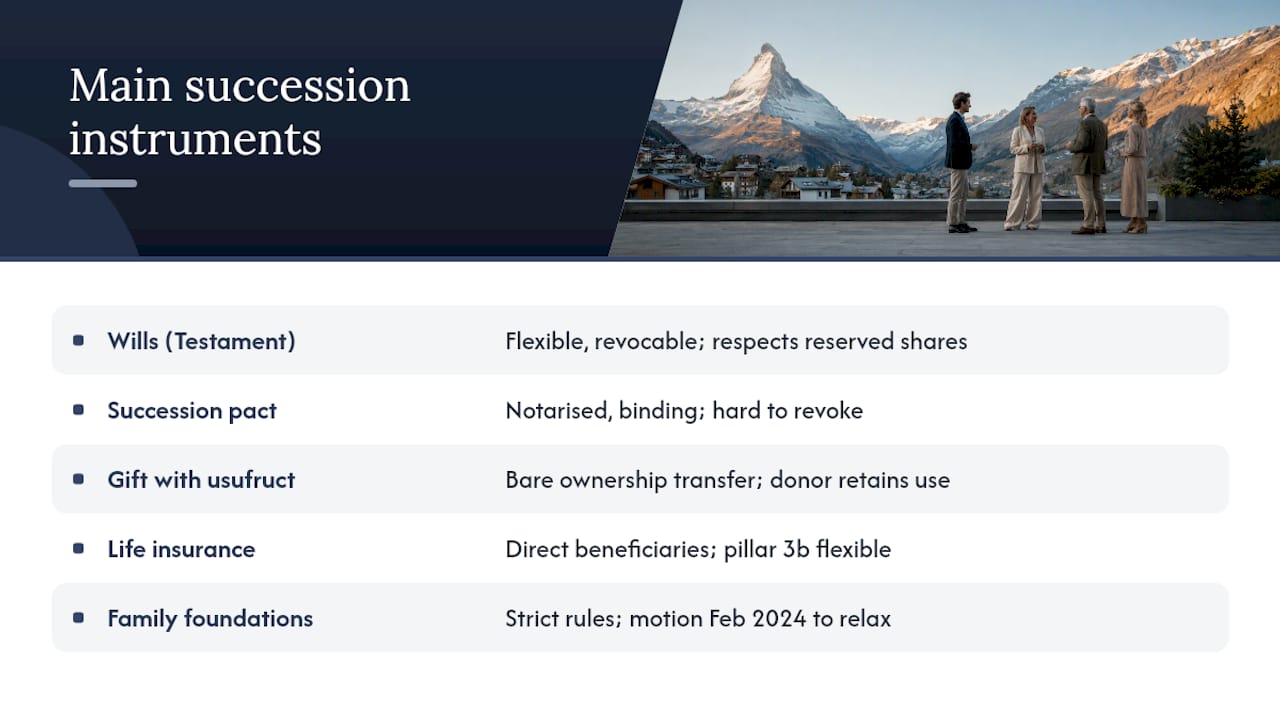
The main instruments and how they work
Wills (Testament) are the starting point. They are flexible, revocable, and can incorporate choice of law clauses for cross-border estates. Their main constraint is that they must respect reserved shares and can be challenged by heirs within a statutory period.
Succession pacts (Erbvertrag) are binding agreements between the testator and one or more heirs, requiring notarisation. They are harder to revoke unilaterally, which makes them useful for business succession or where certainty of outcome matters more than flexibility. Goldblum’s succession guidance highlights that the interaction between marital property regime and succession pact is a recurring complexity, particularly where one spouse brings significantly more wealth into the marriage.
Gifts with reserved usufruct allow a parent to transfer bare ownership of an asset, typically real property, to a child while retaining the right to use or receive income from it during their lifetime. This reduces the taxable estate at death while preserving the parent’s economic position. PBM Avocats identifies this as one of the primary tax optimisation techniques in Swiss succession planning.
Life insurance serves dual purposes in Swiss planning. It allows direct beneficiary designation outside the estate settlement process, providing immediate liquidity to pay inheritance taxes or estate costs. Third-pillar B (pillar 3b) policies are particularly flexible for beneficiary designation and can partially circumvent the delays of estate administration. For a detailed look at how life insurance structures wealth transfer, the mechanics of beneficiary designation and tax treatment are worth reviewing before structuring a policy.
Swiss family foundations exist as a domestic vehicle but operate under strict rules on permissible distributions and governance. A parliamentary motion approved in February 2024 instructed the Federal Council to draft legislation relaxing some of these constraints, which PwC Switzerland notes could meaningfully expand the usefulness of foundations in family planning once enacted. Until that legislation is in force, foundations remain a specialist tool requiring careful legal advice.
Offshore trusts are used by some Swiss-resident families with international assets, typically governed by Jersey, Guernsey, or Liechtenstein law. Switzerland does not have a domestic trust law, but it recognises foreign trusts under the Hague Convention. Tax treatment depends on the specific structure and the canton of residence of the beneficiaries.
For families with a business to transfer, robust valuation of company shares is non-negotiable. Mismatches between the family’s valuation and the tax authority’s assessment can jeopardise favourable treatments or create unexpected cash compensation obligations for heirs who receive non-business assets.
Pro Tip: Combining a gift with reserved usufruct on the family property with a life insurance policy designated to the same heir can provide both an immediate ownership transfer and a liquidity buffer at death, without restructuring the reserved shares in the estate.
For practical guidance on business asset transfers, the business succession planning guide for Schwyz covers valuation and transfer mechanics in detail.
Why does family governance matter as much as legal documents?
Governance prevents disputes and aligns expectations before a crisis forces the issue. A legally perfect will can still produce years of family conflict if the underlying intentions were never communicated and agreed upon while the principal generation was alive.
Practical governance tools
A family charter is a non-legally-binding document that sets out the family’s shared values, decision-making processes, and expectations for the next generation. It typically covers who can participate in family meetings, how disputes are escalated, what criteria apply to family members joining a family business, and how philanthropic priorities are set. It does not replace legal instruments but gives them context and reduces the likelihood of challenge.

Structured family meetings with a defined agenda and a neutral facilitator are more effective than informal conversations. They create a record of decisions, allow the next generation to ask questions, and surface disagreements early when they are still manageable. A meeting cadence of once or twice a year is common for families with significant shared assets.
Education programmes for the next generation, covering financial literacy, investment principles, and the responsibilities that come with inherited wealth, reduce the risk of poor decisions after a transfer. Several Swiss private banks and independent advisers offer structured programmes for this purpose.
Decision protocols for significant asset transactions, such as selling a property or changing the investment mandate, prevent unilateral actions that damage family relationships or trigger tax events.
A governance checklist for families to adapt:
- Define who holds decision-making authority for each asset class.
- Set a meeting cadence and appoint a family secretary or coordinator.
- Agree communication rules (what is shared with all family members, what remains confidential).
- Document succession criteria for any family business involvement.
- Review the charter every three to five years or after a significant family event.
Pro Tip: Involve the next generation in governance discussions before they inherit anything. Families that wait until after a transfer to introduce governance structures almost always find the conversation harder, not easier.
For a broader discussion of governance within a long-term wealth framework, the generational wealth management guide covers the intersection of governance and investment strategy.
Single-family office, multi-family office, or advisory mandate: which fits your situation?
A single-family office (SFO) typically becomes economically viable when a family’s investable assets exceed a high threshold and the complexity of their affairs justifies a dedicated team. Below that threshold, a multi-family office (MFO) mandate or a direct advisory relationship with a regulated wealth manager generally delivers comparable quality at a fraction of the cost.
Cost and regulatory considerations
Operating a single-family office in Switzerland involves staffing costs, compliance infrastructure, and ongoing regulatory attention. The Family Office Advisory jurisdictional guide documents that Swiss family offices benefit from an exemption under FINSA when managing assets exclusively for lineal relatives. However, if a second branch of the family or any non-lineal relatives are included, or if third-party capital is managed, portfolio-manager licensing and prudential reporting obligations under FINMA can be triggered. Families should document the scope of services and the family membership they serve precisely, since small procedural slips can activate oversight requirements.
A regulatory checklist for families considering a Swiss family office structure:
- Confirm whether all beneficiaries are lineal relatives; if not, assess FINSA licensing requirements.
- Register with an anti-money laundering (AML) supervisory organisation if required.
- Maintain documentation of the family membership scope and services provided.
- Appoint a compliance officer or external compliance adviser if the structure grows beyond the lineal exemption.
- Review the structure annually as family membership changes through marriage, divorce, or birth.
For families below the SFO threshold, an MFO or advisory mandate with a FINMA-accredited manager provides regulatory protection, professional governance, and access to institutional-quality investment management without the overhead of a dedicated entity. The family office services guide for St Moritz illustrates how this model works in practice for Alpine families with complex wealth.
A six-step planning process for Zermatt families
The six steps are: asset audit, family analysis, tax and legal modelling, scenario development, implementation, and periodic review. This sequence, recommended by Swiss advisers and law firms including PBM Avocats, ensures that each stage informs the next and that implementation is coordinated with local notaries and tax authorities.
Documents and information to bring to a first planning meeting:
- Current wills, succession pacts, and any existing marital property agreements.
- Asset schedule or recent bank and custody statements.
- Details of any business interests, including shareholding structure and recent valuations.
- Pension fund certificates (pillar 2) and pillar 3 account details.
- Details of any existing life insurance policies and their beneficiary designations.
- Residency and citizenship details for all family members.
- Any existing cross-border legal arrangements (foreign trusts, offshore structures).
Pro Tip: The asset audit almost always reveals gaps: pension assets with no nominated beneficiary, property held in a personal name that should be in a structure, or a will that predates a significant asset acquisition. Starting there saves time in every subsequent step.
For a detailed walkthrough of the long-term planning process, the generational wealth planning guide for Switzerland covers the full arc from audit to review.
How do you choose the right adviser for family wealth planning near Zermatt?
The single most important attribute is direct experience with Swiss succession law and cantonal tax modelling, specifically in Valais or neighbouring cantons. General financial planning experience is not sufficient for a family with significant assets, cross-border elements, or a business to transfer.
Questions to ask a prospective adviser
- How many Swiss succession mandates have you completed in the past three years, and can you describe a cross-border case?
- Do you work with a qualified Swiss lawyer or notary, and how is that relationship structured?
- Are you FINMA-accredited or operating under a FINMA-supervised institution?
- How do you handle conflicts of interest, particularly where one heir is also a client?
- What is your fee model: percentage of assets under management, hourly, fixed project fee, or a combination?
- Can you provide references from families with a similar asset profile and complexity?
- How do you stay current with cantonal tax changes and federal legislative proposals?
Red flags to watch for
- No established relationship with a local Swiss lawyer or notary in Valais.
- Promises of “tax secrecy” or structures that go beyond what Swiss law currently permits.
- Vague or undisclosed fee arrangements, particularly where product commissions are not disclosed.
- Inability to explain the 2023 succession reform or the PILA changes in plain terms.
- A one-size-fits-all approach with no canton-specific modelling.
Marmot Finance is a FINMA-accredited wealth manager with specific experience in family and succession planning for Swiss and European clients. The firm offers cantonal-aware financial advisory services, multi-currency portfolio management in CHF, EUR, and USD, and a structured planning process aligned with the six-step methodology described above. To arrange a discovery meeting, contact Marmot Finance directly through their wealth management services page.
Pro Tip: Ask any adviser to walk you through a real (anonymised) canton modelling exercise from a previous client. An adviser who can do this clearly and without jargon is almost certainly the right kind of specialist.
A note from Marmot Finance
At Marmot Finance, we work with families across Switzerland who are navigating exactly the questions this guide addresses: how to protect what they have built, how to pass it on fairly, and how to do so without creating unnecessary tax costs or family conflict. Our approach combines rigorous financial modelling with genuine attention to the human side of wealth planning, because the two are inseparable. We are FINMA-accredited, independent, and focused exclusively on Swiss and European clients. We do not believe in generic solutions, and we do not work with families whose situations we cannot serve well. If you are based in or near Zermatt and want a clear picture of where your planning stands, we would be glad to have that conversation.
Marmot Finance: family wealth planning services for Zermatt families
Marmot Finance offers something that most traditional wealth managers do not: a genuinely integrated service that covers financial modelling, investment management, and succession planning coordination in one place, without the overhead of a full single-family office. For families in Zermatt with CHF, EUR, or USD assets, this means cantonal-aware tax modelling, multi-currency portfolio management, and structured planning support from a FINMA-accredited team that understands both the Swiss legal framework and the practical realities of cross-border family wealth.
The firm’s services map directly to the planning dimensions that matter most: succession and estate planning coordination, cantonal tax modelling, family governance support, and investment mandate management. Marmot Finance works with families across a range of net-worth profiles, from those establishing their first formal plan to those managing multigenerational structures. Fee arrangements are transparent and asset-based, with no undisclosed product commissions.
To start, request an introductory meeting through the Marmot Finance wealth management page. Bring your current asset schedule, any existing legal instruments, and a note of your family structure. The first conversation is a planning diagnostic, not a sales process.
Sources
The following sources informed this guide and are worth consulting directly for further detail.
- Succession Planning and Tax Optimisation | PBM Avocats
- Succession & Estate Planning 2026 - Switzerland | Global Practice Guides | Chambers and Partners
- Family office Switzerland jurisdictional guide | Family Office Advisory
- Succession & Estate Planning Switzerland | Goldblum
- New opportunities for the Swiss family foundation | PwC Switzerland
This article is general information, not a substitute for advice from a qualified financial advisor. Consult a qualified financial professional about your own circumstances before acting on anything here.
Recommended
- Long-term wealth planning in Switzerland: securing generational wealth
- Asset Protection Strategies in Zermatt: Safeguarding Wealth | Marmot Finance
- Wealth Management in Zermatt | Marmot Finance
- Estate Planning Essentials in Switzerland for Affluent Families | Marmot Finance

.webp)




.jpeg)



.png)

.svg)


