

Start by checking whether your will still reflects the law. The 2023 inheritance reform gave Swiss testators more freedom to decide who gets what, and in Nidwalden, close relatives often pay no inheritance tax at all. Before anything else, review your existing documents, confirm what applies to your family under the new compulsory portion rules, and check the cantonal tax position. This article walks through the legal basics, a practical checklist, and the local steps that matter in Stansstad.
TL;DR:
- The 2023 inheritance reform in Switzerland significantly reduced protected shares for descendants and removed parental protected claims, giving testators more freedom to allocate their estate.
- Swiss estate planning tools like holographic, notarial, and inheritance contracts require updating if drafted before 2023, to reflect the law’s new provisions on compulsory shares.
- Nidwalden’s inheritance tax exemption for close relatives like spouses and children lowers costs for families in Stansstad, but expatriates or distant heirs may still face higher taxes.
- Proper estate documentation, asset valuation, and liquidity planning are crucial to prevent disputes, especially with complex assets like real estate, pensions, and gifts.
- International families should coordinate legal and tax strategies across borders to avoid conflicting laws and double taxation issues.
How Swiss intestacy and the parentel system work, and the 2023 reform explained
When someone dies without a will, Swiss law decides who inherits through what’s called the parentel system. It groups relatives into three tiers, or “parentels”: descendants first, then parents and their descendants (siblings, nieces, nephews), then grandparents and their lines. Within each group, shares are split head by head. If no heir exists in any of the three parentels, the estate goes to the state where the deceased was domiciled, under article 466 of the Civil Code.
How this plays out depends entirely on your family shape:
- Descendants only, no spouse: children split the estate equally among themselves.
- Spouse plus descendants: the spouse typically receives half, with the other half divided among the children.
- Childless, with surviving parents: before 2023, parents held a protected claim. That protection has now been removed entirely.
That last point is the real shift. The reform that took effect on 1 January 2023 cut the compulsory portion for descendants from three quarters of their statutory share down to one half, and it struck parents off the list of protected heirs completely, according to a detailed breakdown of the 2023 reform’s changes to the ZGB.
Here’s what that means with numbers. Say a childless widow dies with both parents still alive. Under the old rules, her parents could claim a compulsory share that limited how much she could freely direct elsewhere. Under the current rules, that claim no longer exists, so she can leave the entire estate to a partner, a charity, or anyone else she chooses, through a valid will. The compulsory portion for descendants has been reduced, which means a much larger freely disposable slice of the estate than was possible before the reform.
Wills, inheritance contracts and practical drafting points
Swiss law recognises three main tools for planning outside the statutory defaults, and choosing the right one (or combining them) shapes how smoothly your estate gets settled.
- Holographic will – handwritten, dated, and signed entirely by the testator. Cheap and private, but easy to get wrong on formalities.
- Notarial will – drafted with a notary and witnesses, giving stronger evidentiary weight and reducing the risk of a formal challenge later.
- Inheritance contract (Erbvertrag) – a binding agreement between the testator and one or more heirs, often used to settle succession in family businesses or blended families in advance.
Alongside these, usufruct arrangements under Article 473 let a surviving spouse use and enjoy assets, such as the family home, while ownership eventually passes to the children. This remains one of the most common tools for balancing a spouse’s security against children’s inheritance rights.
The most frequent drafting trap isn’t a missing signature. It’s language that references old compulsory-portion fractions as if they still applied. A will drafted in 2019 that splits the estate around a “three-quarters compulsory share” for children may now produce a result the testator never intended, since the actual protected portion has since dropped to one half. Advisers increasingly recommend converting these into either percentage-of-current-law language or specific-amount legacies, precisely because static wording ages badly when the law changes underneath it, a point practitioners have raised directly in analysis of the reform’s practical impact.
Pro Tip: If your will or inheritance contract was drafted before 2023, don’t assume it still says what you think it says. Have a notary check whether the compulsory portion language needs rewording to match current law.
Cantonal inheritance tax and what Stansstad families should check
There’s no federal inheritance tax in Switzerland. Instead, each canton sets its own rules, and the one that applies is decided by where the deceased was last domiciled, not where the heirs live, according to a comparison of inheritance tax rules by canton. Some cantons, such as Schwyz, don’t levy inheritance tax at all; others tax distant heirs heavily while exempting close family.
Nidwalden exempts spouses, children, grandchildren, parents, grandparents and their spouses, along with certain long-term cohabitants, from inheritance tax entirely. More distant relatives pay 5% (siblings), 10% (aunts and uncles), or 15% for everyone else, and the canton also applies an annual allowance of CHF 20,000 per recipient, according to Nidwalden’s own tax authority.
For a family in Stansstad, this is genuinely good news if your estate is going to a spouse, children, or grandchildren; the exemption removes a layer of cost that families in stricter cantons still face. It’s worth checking a few details before assuming the best case applies to you:
- Confirm your exact domicile status, since long absences abroad can complicate this.
- Check whether any heir falls outside the exempt categories (a niece or unrelated partner, for example).
- Ask whether your municipality applies any local surcharge on top of cantonal rates.
For more detail on how these rules compare with other cantons, see this breakdown of inheritance tax basics in Switzerland. When in doubt, the cantonal tax office in Nidwalden is the authority to contact directly, particularly if your estate includes assets or heirs in more than one canton.
A practical checklist: documents, decisions and timeline
Good inheritance planning isn’t a single afternoon of paperwork. It’s a short sequence of decisions, done in the right order.
- Gather your documents. Property titles, bank and investment statements, pension certificates, insurance policies, and any existing will or inheritance contract. Without these, no adviser or notary can give you accurate guidance.
- Identify heirs and executors. Decide who inherits what, who you’d trust to administer the estate, and whether any lifetime gifts make sense now rather than later. This is also the point to consider a notarial will or inheritance contract if your family situation is anything other than straightforward.
- Value your assets and check liquidity. An estate can be asset-rich and cash-poor. If a family home or business makes up most of the value, work out in advance how heirs will cover tax bills or buy each other out without a forced sale.
- Set a review timeline. Revisit your documents every few years, or immediately after a major life event: marriage, divorce, a new grandchild, or a move between cantons.
Pro Tip: Liquidity problems cause more family disputes than disagreements over who gets what. If most of your wealth sits in property or a business, plan the cash side of the inheritance as carefully as the ownership side.
How to handle major asset classes: property, pensions and gifts
Different assets follow different rules once you’re planning an estate, and treating them all the same is a common mistake.
Real estate needs a land register check early on, since mortgages don’t disappear at death and co-ownership structures can complicate a transfer. If keeping the family home matters, usufruct arrangements or a buy-out mechanism agreed in advance, covering how a joint owner or surviving partner remains in the property without triggering a forced sale, work far better than leaving it to be sorted out after the fact, a point Swiss Life’s estate planning notes make clear.
Pension assets, particularly Pillar 3a, are commonly excluded from the estate itself and follow their own beneficiary rules. Review these alongside your will, not as an afterthought.
Lifetime gifts matter too. Gifts made in the years before death are often added back (“reunified”) when calculating whether compulsory portions have been respected, so a large gift to one child can’t simply bypass another’s protected share.
- Life insurance payouts can equalise value between heirs without splitting a physical asset.
- Staggered payments help when one heir buys out another’s share of an illiquid asset over time.
Guidance for blended families, cohabitants and childless couples
Family shape changes the right strategy considerably.
Blended families often use usufruct to let a surviving spouse remain in the family home while the children from a first marriage hold eventual ownership as reversionary heirs. This structure balances a spouse’s security against children’s long-term inheritance rights, and it’s worth discussing explicitly rather than assuming everyone agrees on the arrangement.
Cohabitants face a harder truth: unmarried partners have no statutory inheritance right under Swiss law, regardless of how long the relationship has lasted. The only way to provide for a partner is through a will or inheritance contract, drafted while both partners are able to agree on terms.
Childless couples now have considerably more freedom since parents were removed from the protected heirs list. That change enables:
- Leaving a larger share, or the whole estate, to a spouse or partner.
- Directing meaningful amounts to charitable causes.
- Structuring bequests to nieces, nephews, or close friends without a parental claim reducing what’s available.
Role and appointment of executors or estate administrators
An executor manages the practical side of settling an estate: paying debts, distributing assets according to the will, and liaising with authorities and heirs. Swiss law doesn’t require you to appoint one, but naming an executor in your will or inheritance contract avoids a lot of friction, especially where heirs disagree or where the estate includes a business or property that needs active management.
You can appoint anyone you trust, a family member, a friend, or a professional such as a notary or lawyer. For larger or more complex estates, a professional executor tends to be worth the fee, since they bring independence and legal familiarity that a family member often lacks, and they’re less likely to be caught in the emotional dynamics between heirs.
If no executor is named, the cantonal authority overseeing the estate can appoint one, or heirs may need to administer the estate jointly, which works fine when everyone agrees and badly when they don’t. Naming someone in advance, and telling them you’ve done so, removes a layer of uncertainty at exactly the moment your family can least afford it.
Executors also need to formally accept the estate (or renounce it) and typically compile an inventory of assets and debts. This inventory becomes the basis for tax filings with the cantonal authority, which is another reason a document checklist prepared in advance saves real time.
Handling of debts and liabilities in the inheritance process
Heirs inherit debts along with assets. This surprises people more often than it should. If the deceased had a mortgage, personal loans, or unpaid tax, those liabilities transfer to the estate and reduce what’s ultimately distributed.
Swiss law gives heirs an important safeguard: they can reject an inheritance if debts outweigh assets or request a public inventory (Öffentliches Inventar) to assess the estate’s true financial position before deciding whether to accept it. This is a genuinely useful step when a family isn’t certain whether the deceased’s finances were in good order, and it buys time to make an informed decision rather than accepting an estate blind.
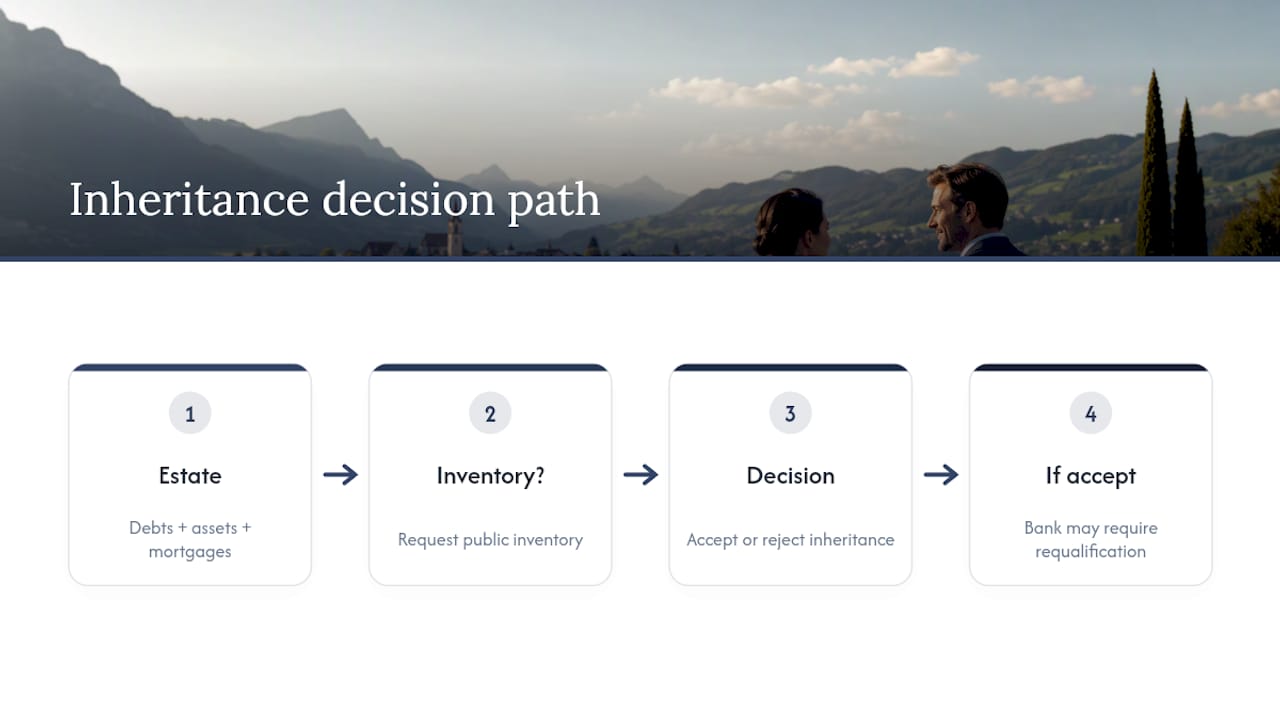
Mortgages on property don’t vanish simply because ownership passes to heirs; a bank will usually require the new owner to requalify for the loan or restructure it. This is another reason liquidity planning matters as much as asset planning. An estate that looks substantial on paper can leave heirs scrambling if most of the value sits in an illiquid property with an outstanding mortgage and no cash reserve to manage the transition.
Where debts are unclear or disputed, it’s worth involving a notary or lawyer before accepting the estate outright rather than after.
Dispute resolution mechanisms and how to handle potential conflicts among heirs
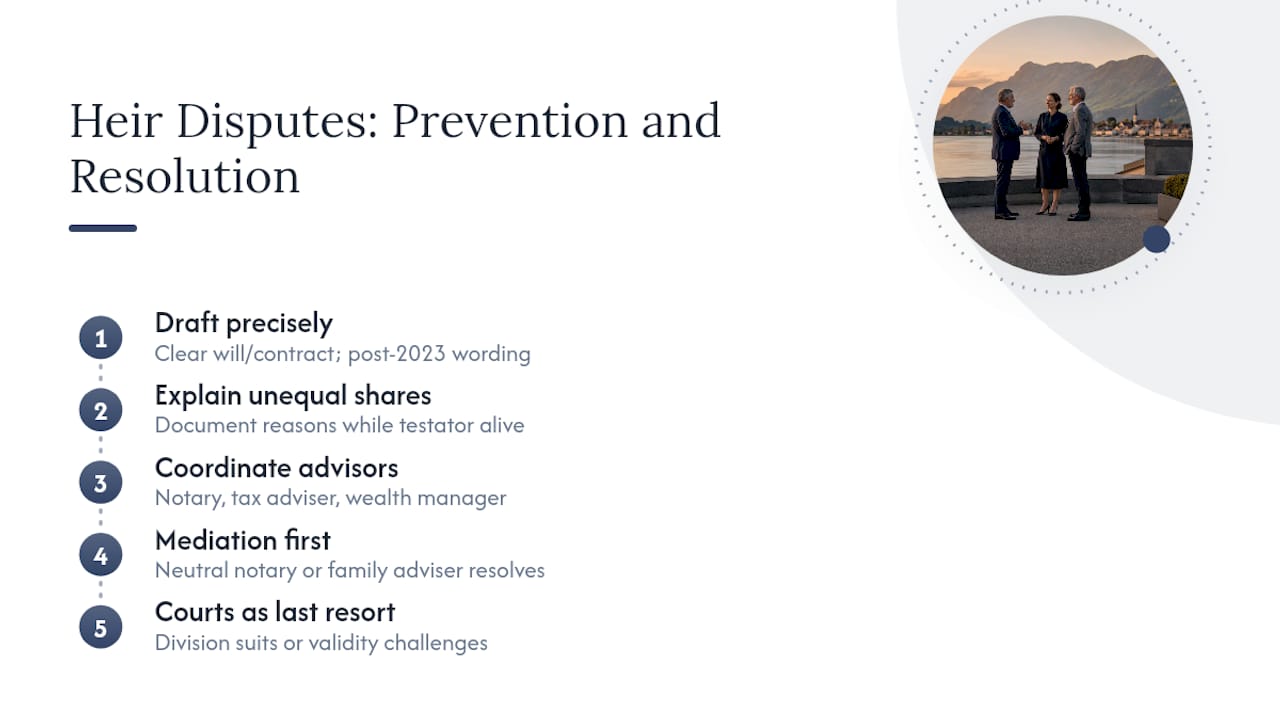
Disagreements among heirs usually come from one of two places: unclear wording in a will, or unequal treatment that wasn’t explained while the testator was alive. Both are largely preventable.
The first line of defence is a well-drafted will or inheritance contract that leaves as little room for interpretation as possible, particularly around compulsory portions and specific bequests. Clear, current wording, especially post 2023, closes off many of the arguments that arise from ambiguous or outdated clauses.
Where disputes do arise, Swiss law offers formal routes: mediation through a notary, a division proceeding (Erbteilungsklage) before the courts if heirs can’t agree on distribution, or a formal challenge to a will’s validity if there are grounds to contest it (undue influence or lack of capacity, for example). Courts are a last resort. Mediation, ideally involving a neutral notary or family adviser, resolves most disputes faster and at lower emotional and financial cost.
Coordinating a notary, tax adviser, and wealth manager early tends to reduce the risk of forced sales of illiquid assets when an estate has to meet liabilities or equalise shares among heirs, a pattern local practitioners see often in Nidwalden estate matters. Getting that coordination in place before a dispute starts, rather than after, is the real difference between a smooth transition and a drawn-out family conflict.
Impact of cross-border elements if family members or assets are abroad
Families rarely fit neatly inside one country’s borders anymore, and that complicates things. If you hold property abroad, have heirs living outside Switzerland, or are a foreign national domiciled in Nidwalden, more than one legal system can potentially claim jurisdiction over parts of your estate.
Swiss private international law generally applies Swiss inheritance law to the estate of someone domiciled in Switzerland at death, but real estate located abroad is often governed by the law of the country where it sits. That can create a split estate: Swiss law for movable assets and Swiss property, foreign law for a holiday home in France or Italy, for example.
Double taxation is a real risk too. Some countries impose their own inheritance or succession tax regardless of Swiss domicile, and without a treaty or careful planning, an estate can face tax claims from two jurisdictions on the same assets. Switzerland has a limited number of bilateral inheritance tax treaties, so it’s worth checking early whether your specific situation is covered.
For families with international elements, whether that’s heirs living overseas, foreign property, or dual nationality, a coordinated approach involving a Swiss notary and a cross-border tax adviser isn’t optional. It’s the only reliable way to avoid contradictory claims on the same estate.
Marmot Finance: how specialist wealth management supports your inheritance plan
Marmot Finance is FINMA accredited and works exclusively with women and families across Switzerland and Europe, which means inheritance planning isn’t a side conversation, it’s part of how we build a client’s financial plan from the start. In practice, that looks like reviewing older wills against the 2023 reform, designing liquidity plans so a family isn’t forced to sell property or a business to cover tax or equalise shares, and advising on lifetime gifting or business succession where it genuinely fits a family’s goals.
None of this replaces a notary or tax adviser. It sits alongside them, coordinating the financial side so legal decisions and money decisions actually align.
How Marmot Finance can help families in Stansstad
Some firms offer an alternative to traditional banks or generalist advisory firms for inheritance planning in Nidwalden by providing ongoing coordination between notaries, tax advisers, and investment strategy to align financial plans with practical realities.
Services may include wealth management tailored to a family’s asset mix, estate coordination alongside legal advisers, and support for more complex situations, as well as financial coaching for clients seeking to better understand their decisions. A first consultation typically covers your current documents, your family shape, and where liquidity gaps might cause problems later, then sets out next steps you can act on immediately.
If you want a clearer picture of your wealth management options, start with a consultation, or explore wealth management support in Basel if you’re looking for a local point of contact.
Sources
For rates and exemptions, check Nidwalden’s cantonal tax office page directly. For the legal detail behind the 2023 reform, see this practitioner briefing on the ZGB changes. Locally, Engelberger Anwälte & Notare serve Stansstad and the surrounding area for notarial and inheritance law matters.
This article is general information, not a substitute for advice from a qualified financial advisor. Consult a qualified financial professional about your own circumstances before acting on anything here.
- Erbschafts- & Schenkungssteuer - Steuern Nidwalden
- Switzerland’s 2023 Inheritance Reform: What Changed Under the ZGB | Recording Law
- Erbrechtsrevision und wesentliche Auswirkungen auf die Planungspraxis (Ius UZH paper)
- Inheritance law in Switzerland – Swiss Life guide on the 2023 reform
Recommended
- Inheritance tax in Switzerland
- Wealth Management in Nidwalden
- Preserving Generational Wealth: Private Wealth Management in Switzerland
- Estate Planning Essentials in Switzerland for Affluent Families
.webp)



.jpeg)



.png)

.svg)


