

Budget automation makes saving automatic, removes the monthly willpower battle, and protects your long-term financial goals by routing money before you can spend it. The role of budget automation for young professionals is straightforward: replace daily financial decisions with a small set of standing rules that execute on payday, leaving a clear “safe-to-spend” figure for everything else.
TL;DR — what automation does for you:
- Moves savings and investments out of your account before you see them
- Covers fixed Swiss costs (health insurance, rent, Pillar 3a) without manual transfers
- Reduces decision fatigue and month-end anxiety
- Creates a reliable habit without requiring ongoing effort
Quick-start: three steps you can do in your bank app in under five minutes
- Open your e-banking app and create a new standing order (Dauerauftrag).
- Set the execution date to the day after your salary lands, and the destination to a separate savings account.
- Start with CHF 50 or whatever feels manageable. You can increase it next month.
That single standing order is the foundation. Everything else builds on it.
Why does budget automation matter for young professionals?
The honest answer is that willpower is unreliable. When your salary lands and your account looks healthy, spending feels justified. By the end of the month, the savings you intended to make have quietly disappeared into restaurants, subscriptions, and impulse purchases. Automation replaces willpower with rules, and rules do not have bad days, as explored in crypto trading automation benefits: smarter, safer investing.
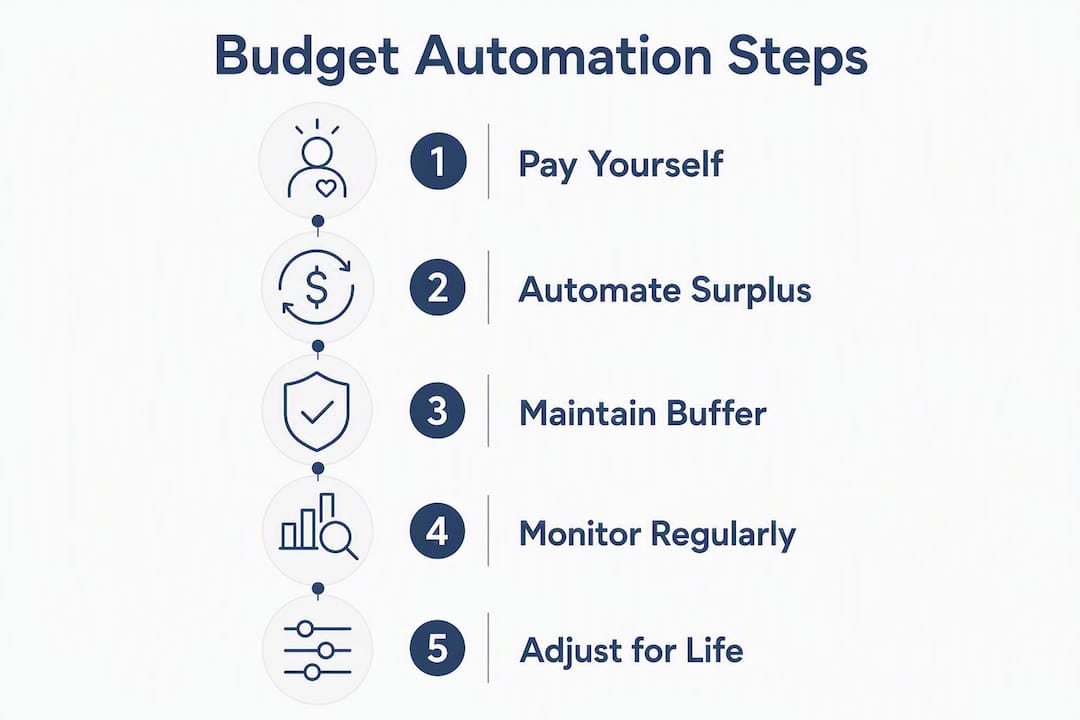
Behavioural research consistently shows that habit formation works best when the desired action requires no active decision. Removing the choice entirely, by routing money automatically, is more effective than relying on motivation. The “pay yourself first” principle works precisely because the money is gone before you frame it as a trade-off.
For young professionals in Switzerland, the practical context makes automation especially valuable:
- Swiss salaries typically arrive monthly, creating a single high-stakes moment each month when spending decisions are made.
- Health insurance premiums (Krankenkasse) are due monthly and vary by canton and provider, making them a predictable but easy-to-forget fixed cost.
- Rents in Zürich and Geneva regularly consume a large portion of a young professional’s net income, leaving less margin for error than in lower-cost cities.
- The Swiss tax year runs to 31 December, meaning Pillar 3a contributions must be made before year-end to qualify for that year’s deduction.
Swiss financial education guidance recommends automating transfers, tracking fixed and variable costs separately, and conducting quarterly budget reviews. The 50/30/20 rule — 50% to needs, 30% to wants, 20% to savings or debt repayment — offers a useful starting point, though Swiss experts note that high rents in major cities often push the “needs” category above 50%, requiring the savings and wants allocations to be recalibrated accordingly.
Statistic callout: The 50/30/20 rule allocates a portion of net income to savings and debt repayment — a meaningful amount that automation can protect before discretionary spending begins.
Three rules that make your money save itself
Every effective automated budget rests on three principles. Applied consistently, they remove the need for monthly financial willpower.
Rule 1: Pay yourself first
Transfer your savings and investment contributions on the same day your salary arrives, before any discretionary spending occurs. This is the single most reliable wealth-building habit for young earners. The psychological effect is significant: money that leaves your account immediately feels less like a sacrifice and more like a fixed cost, similar to rent.

A practical starting point: automate CHF 50 per month to a savings or investment account if your income allows, adjusting based on your fixed costs. Even a small monthly contribution invested consistently compounds meaningfully over a decade.
Rule 2: Automate your surplus
After fixed costs and savings are covered, treat the remaining balance as your spending budget for the month. This “safe-to-spend” figure eliminates the daily mental calculation of whether you can afford something. Some Swiss budgeting apps calculate this figure automatically by aggregating your accounts and subtracting upcoming fixed obligations.
Rule 3: Keep a buffer
Maintain a small buffer in your current account above your expected monthly expenses. This prevents standing orders from failing due to timing differences between salary arrival and bill execution dates, and it avoids overdraft fees. Swiss banks do not universally offer overdraft facilities, so a buffer is a practical necessity rather than a luxury.
Adapting these rules to Swiss cost structures requires honesty about your actual fixed costs. If rent and Krankenkasse consume a majority of your net income, the standard 50/30/20 split needs adjustment. A more realistic allocation might be above 50% needs, with the savings portion protected by automation regardless of how the other categories shift.
Essential automations to set up now
The most useful automations for a young professional in Switzerland cover five areas: paycheck splits, standing orders for fixed costs, subscription tracking, emergency fund top-ups, and investment contributions. Setting all of them to execute immediately after payday creates a self-managing system.
Paycheck split (Dauerauftrag to savings)
- Log into your e-banking portal and create a standing order to a separate savings account.
- Set the execution date to one or two days after your salary date.
- Start with CHF 50, or a fixed CHF amount you are confident you will not need.
Standing orders for fixed costs
- List every recurring fixed cost: rent, Krankenkasse, mobile, internet, gym, streaming services.
- Set individual standing orders or verify that direct debits (LSV) are already in place for each.
- Swiss banks recommend using separate accounts for fixed costs and discretionary spending to make the split visible.
Subscription sweep
- Once per quarter, review your bank statements for recurring charges you no longer use.
- Cancel any subscription that you have not actively used in the past 30 days.
- Subscription creep — the gradual accumulation of small monthly charges — is one of the most common budget leaks for young professionals.
Emergency fund top-up
- Set a monthly standing order to a dedicated emergency account until it reaches several months of fixed costs.
- Once the target is reached, redirect that standing order to an investment account.
Automated ETF and Pillar 3a contributions
- ETF savings plans in Switzerland can start from as little as CHF 25–50 per month, making them accessible even on a modest income.
- Set up a monthly Dauerauftrag to your 3a provider or configure an in-platform savings plan directly within your broker account.
- Timing matters: execute these transfers on the day after salary arrives, not mid-month.
Which tool categories work well in Switzerland?
The right tool depends on what you need it to do. Transaction routing, investment execution, and spending overview are three distinct functions, and different categories of tool handle each one.
A few practical notes on each category:
- Budgeting apps without bank links — , such as BudgetHub, offer a full spending overview in CHF with Swiss categories, without requiring you to connect bank credentials. This suits readers who prioritise data privacy.
- Apps with bank sync — , such as Zouma, aggregate multiple accounts into one view and can show a real-time safe-to-spend figure. Some Swiss apps recalculate this figure daily based on upcoming fixed obligations, which is genuinely useful for managing cash flow across multiple accounts.
When choosing between apps that sync with your bank and those that do not, weigh convenience against data privacy. Some users prefer manual CSV imports or no-link apps to avoid sharing bank credentials with third parties, which is a reasonable position given the sensitivity of Swiss financial data.
Pro Tip: If you use multiple banks — common among expats in Switzerland — a multi-bank aggregation app can give you a single overview without requiring you to log into three separate portals each week. Weigh the privacy trade-off carefully before connecting accounts.
How to build your first automated budget: a 30/90-day plan
The approach is simple: choose your accounts, set one rule, then monitor and adjust. Most people overcomplicate the setup and never start. One standing order on day one beats a perfect system that takes three months to configure.
Step 1: Choose your accounts (Days 1–3)
- Open a dedicated savings account if you do not already have one. Most Swiss banks offer these at no additional cost.
- Identify your current account as the “flow” account: salary arrives here, fixed costs leave from here.
- Consider a third account for discretionary spending if your bank allows it, funded by a fixed monthly transfer.
Step 2: Set your first standing orders (Days 3–7)
- Create a Dauerauftrag from your current account to your savings account, timed for the day after salary.
- Verify that your Krankenkasse premium is on direct debit (LSV) or set a standing order for it.
- Confirm your rent payment is automated. If it is not, set a standing order now.
Step 3: Add investment automations (Days 7–14)
- Open a brokerage account or Pillar 3a account if you do not have one.
- Set a monthly ETF savings plan starting at CHF 25–50, or configure a Dauerauftrag to your 3a provider.
- Set the execution date to two days after salary arrives, giving the paycheck-to-savings transfer time to settle.
Step 4: 30-day review
- Check that all standing orders executed correctly.
- Confirm your safe-to-spend balance at mid-month feels accurate.
- Adjust amounts if any transfer caused a shortfall.
Step 5: 90-day review
- Review your subscription list and cancel anything unused.
- Increase your ETF or 3a contribution by CHF 25–50 if your budget allows.
- Assess whether your emergency fund is on track for a three-month target.
Sample CHF template for a CHF 6,000 net monthly salary:
- CHF 2,400 rent (40%)
- CHF 400 Krankenkasse (varies by canton and plan)
- CHF 50 to savings account (Dauerauftrag, day after salary)
- CHF 100 to emergency fund (until target reached)
- CHF 50 ETF savings plan (broker, automated)
- CHF 200 Pillar 3a (monthly Dauerauftrag or in-platform)
- Remaining balance: discretionary spending
How does automating Pillar 3a and ETF savings plans work in Switzerland?
Automating Pillar 3a contributions and ETF savings plans is the most tax-efficient financial habit a young professional in Switzerland can build. The Pillar 3a (third pillar) is a voluntary, tax-advantaged retirement savings vehicle: contributions are deductible from taxable income, and the savings grow tax-free until withdrawal. For employees affiliated with a pension fund (Pensionskasse), the annual contribution limit is set by the Swiss Federal Social Insurance Office and reviewed periodically.
The practical setup is straightforward. Most app-based 3a providers allow you to set a recurring monthly contribution directly within their platform, eliminating the need for a separate standing order. Alternatively, you can set a Dauerauftrag from your current account to your 3a account. Automating Pillar 3a contributions via a monthly standing order is a widely recommended tactic for young earners to build long-term wealth and capture tax advantages from the first year of employment.
For ETF savings plans, many Swiss and EU-based broker platforms allow in-platform savings plans that pull funds automatically on a chosen date from a linked account, removing the need for a separate standing order entirely. Starting amounts can be as low as a small monthly contribution, making this accessible even during the early years of a career when disposable income is limited.
Pro Tip: Set both your 3a contribution and your ETF savings plan to execute on the second or third day after your salary arrives. This gives your paycheck time to clear and your savings transfer time to settle, preventing failed transactions due to timing gaps.
Statistic callout: ETF savings plans in Switzerland can start from CHF 25–50 per month. At CHF 50 per month over 30 years, with a modest average annual return, the compounding effect is substantial — the key variable is starting early, not starting large.
Raiffeisen’s guidance on early pension saving confirms strong uptake of Pillar 3a among 18–30 year-olds and recommends monthly Daueraufträge as the most reliable contribution method. For readers who want a deeper explanation of how the third pillar fits into long-term planning, Marmot Finance’s guide on Pillar 3a and long-term wealth covers the mechanics and tax treatment in detail.
How do you monitor automated budgets and avoid common mistakes?
Automation reduces effort, but it does not eliminate the need for periodic review. Set calendar reminders for 30, 90, and 180 days after your initial setup. These reviews take 20–30 minutes and catch problems before they compound.
Common errors and how to fix them:
- Wrong execution dates: A standing order set for the 25th of the month will fail if your salary arrives on the 28th. Always set transfers for one to two days after your confirmed salary date, not a fixed calendar date.
- Missed payments: If a standing order fails due to insufficient funds, your bank may not retry it automatically. Check your e-banking notifications and set up SMS or push alerts for failed transactions.
- Duplicated automations: After switching banks or opening a new 3a account, it is easy to have two standing orders running for the same purpose. Audit your active Daueraufträge every 90 days.
- Subscription creep: Small recurring charges accumulate quietly. A quarterly statement review, filtering for amounts under CHF 30, typically surfaces three to five forgotten subscriptions.
- Privacy over-sharing: Connecting every financial account to a single app creates a consolidated data risk. Consider whether the convenience of full aggregation outweighs the exposure, particularly for accounts holding significant balances.
Monitoring checklist (30/90/180-day cadence):
- Confirm all standing orders executed on the correct dates.
- Check your savings account balance against your target trajectory.
- Review your ETF and 3a account balances and contribution history.
- Scan bank statements for unfamiliar recurring charges.
- Assess whether your income or fixed costs have changed and adjust amounts accordingly.
- At 180 days, review your emergency fund progress and redirect the top-up transfer if the target is reached.
Life changes — a salary increase, a new flat, a change in Krankenkasse provider — should trigger an immediate review rather than waiting for the next scheduled check. Automation works best when the rules reflect your current situation, not the one you had when you set them up.
Key takeaways
Budget automation works because it removes the decision from the equation: money moves to savings and investments before discretionary spending begins, creating consistency that willpower alone cannot sustain.
The case for starting before you feel ready
There is a common misconception that budget automation is something you set up once your finances are “sorted.” In practice, the opposite is true. The earlier you automate, the less sorting your finances need, because the system does the sorting for you.
The readers who benefit most from automation are not those with complex portfolios or high incomes. They are young professionals who have just started earning, who face high Swiss living costs, and who have not yet formed strong saving habits. For them, a single CHF 50 standing order on payday is not a small step. It is the difference between building wealth and not building it.
The automation principles discussed here — pay yourself first, cover fixed costs, invest the surplus — are not sophisticated. They are reliable. And reliability, compounded over years, is what actually builds financial security. The technology to implement all of this exists in every Swiss bank’s e-banking portal and in a growing range of Swiss-focused apps. The barrier is not access; it is starting.
For women and families in Switzerland, where the gender pension gap remains a structural concern, automating contributions to Pillar 3a and ETF savings plans from the first year of employment is one of the most direct ways to address long-term financial inequality. Marmot Finance’s financial life-cycle guide for women in Switzerland explores this in more depth for readers who want to understand how automation fits into broader lifecycle planning.
Personalised help from Marmot Finance
For young professionals who want more than a checklist, Marmot Finance offers personalised wealth management and financial planning for women and families across Switzerland. Where DIY automation handles the mechanics, Marmot adds the strategy: which accounts to prioritise, how to structure Pillar 3a alongside a broader investment plan, and how to adjust as income and goals evolve.
Marmot Finance is FINMA-accredited and has guided over 350 women through meaningful improvements to their financial situations, combining personal consultations with practical digital tools. The approach is hybrid: you get the clarity of a structured plan and the support of an adviser who understands the Swiss system, without the opacity of traditional private banking.
If you would like a tailored review of your automated savings setup, speak with the Marmot Finance team or explore the Marmot guide hub for downloadable resources and next steps.
Trusted Swiss sources and practical next steps
For further reading on the topics covered in this article, the following Swiss authority sources are worth bookmarking:
- Moneyland: 50/30/20 rule explained — a clear breakdown of the allocation framework and how to adapt it for Swiss living costs.
- Moneyland: ETF savings plans in Switzerland — a practical guide to setting up automated ETF investments, including starting amounts and platform options.
- Raiffeisen / Blick: early pension saving — guidance on starting Pillar 3a contributions early and the case for monthly Daueraufträge.
- 5ms.ch: financial education for young adults — Swiss-focused financial literacy guidance covering automation, tracking, and review cadences.
- Marmot Finance: the third pillar explained — a deeper look at Pillar 3a mechanics, tax treatment, and how it fits into a long-term plan.
- Marmot Finance: financial planning for expats in Switzerland — relevant for international professionals navigating Swiss financial structures for the first time.
Your next three steps:
- Set one standing order today: CHF 50 or more, timed for the day after your next salary.
- Configure a CHF 25–50 ETF savings plan through your broker, or set a monthly Dauerauftrag to your Pillar 3a account.
- Schedule a 30-day calendar reminder to check that both transfers executed correctly.
This article provides general financial information for educational purposes. It does not constitute personal financial or tax advice. Confirm current Pillar 3a contribution limits and tax rules with the Swiss Federal Tax Administration or a qualified financial adviser.
Recommended
- Cross-Border Financial Planning in Zürich for International Professionals | Marmot Finance
- Finanzplanung für Expats in der Schweiz | Marmot Finance
- Grenzüberschreitende Finanzplanung in Zürich für internationale Fachkräfte | Marmot Finance
- Financial Planning for Expats in Switzerland | Marmot Finance


.webp)





.jpeg)




.png)

.svg)


