

If you own a business in Schwyz, the single most important thing you can do this quarter is start a formal multi-year succession project, not wait for a buyer or a health scare to force your hand. That means three concrete moves: commission an independent valuation, request a cantonal tax ruling before restructuring anything, and bring in a tax advisor and notary to map your legal documents against your actual wishes. Succession planning for business owners in Schwyz works best when it runs on a timeline measured in years, not months. Most successful transitions take between five and twelve years from the first serious conversation to full handover, and owners who start late tend to lose control over price, successor choice, and timing.
Here’s where to begin this month:
- Book an independent business valuation from a qualified advisor, not a rough back of envelope figure
- Contact a Schwyz tax advisor about requesting a pre-implementation ruling before any transfer structure is set
- Speak to a notary about whether your will and any shareholders’ agreement actually say what you think they say
- Start a personal finance review, including your pension situation, alongside the corporate planning
Pro Tip: Don’t wait until you have a buyer or a successor lined up before getting the valuation done. An independent number, refreshed every couple of years, gives you a realistic anchor for every negotiation that follows.
Key Takeaways
Succession planning for business owners in Schwyz works best as a five to twelve year project that treats the valuation, the tax ruling, and the owner’s personal finances as one connected plan, not three separate tasks.
This article is general information, not a substitute for advice from a qualified financial advisor. Consult a qualified financial professional about your own circumstances before acting on anything here.
What does a complete succession plan for a Schwyz business owner include?
A succession plan isn’t a single document. It’s five interlocking workstreams that all affect each other, which is exactly why so many owners get stuck: fix one piece and another one moves.
Legal structure first. A will and an inheritance contract are not interchangeable. A will can be changed unilaterally and contested; an inheritance contract is binding once signed by all parties, which makes it far more useful when multiple heirs or business partners are involved. Swiss succession guidance recommends pairing either document with a clear shareholders’ agreement and appointing an executor, because without one, heirs often need unanimous consent to act, and that can freeze a business for months.
Valuation comes second, and it’s where most plans go wrong. Four methods dominate in Switzerland:
- Discounted cash flow (DCF), which values future earnings potential but is sensitive to overly optimistic assumptions
- Multiples based on comparable transactions in your sector
- Earnings-based methods, weighting historical profit more heavily
- The formula (Praktikermethode) value, a blend of asset and earnings value still used informally by many Swiss valuers
The most common mistake isn’t picking the wrong method. It’s overvaluing the business because the owner hasn’t adjusted for concentration risk (one big client, one key employee) or hasn’t had the number checked externally.
Financing shapes everything that follows. A seller loan keeps you exposed to the buyer’s success but can bridge a financing gap. Bank financing shifts risk to the successor but requires collateral they may not have yet. An earn-out ties part of your payout to future performance, which softens the price gap in negotiations but adds years of financial entanglement with a business you no longer control.
Governance and personal readiness round it out. Appoint a transitional advisory body, even informally, to support a new owner through the first two years. Decide honestly what role you want after handover: consultant, board member, or a clean exit. And check your own numbers: BVG pension position, liquidity needs, and the tax treatment of whatever proceeds land in your personal account.
How do Schwyz cantonal tax rules change your succession plan?
Inheritance and gift tax in Switzerland is set canton by canton, and this is where owners get caught out even when the general picture looks favourable. Schwyz and Obwalden currently levy no inheritance or gift tax in most cases involving direct descendants and spouses, which is genuinely good news if you’re planning a family transfer. But that headline fact hides a more complicated reality underneath.
Cantonal administrative practice can override a formula valuation entirely. A transfer priced using a standard method might still trigger an unexpected tax assessment if the tax authority’s own practice treats the transaction differently, particularly around related-party sales or preferential pricing.
The Aargau practice solution is a useful illustration from a neighbouring canton: transfers at preferential prices can avoid immediate taxation, but only when strict conditions are met and a ruling is obtained beforehand. Schwyz applies its own practice, and the cantonal memorandum on business transfers at death sets out exactly how business assets, usufruct arrangements, and reporting duties are handled when an owner dies holding the business. It’s worth reading before you assume the “no inheritance tax” headline covers your situation.
This is why a pre-implementation tax ruling matters so much. A ruling locks in how the tax office will treat your specific transaction before you sign anything, which removes the risk of a costly reclassification years later.
When should you request one? As soon as you have a valuation and a proposed structure, ideally 18 to 24 months before the transfer completes. What to prepare:
- An independent valuation report
- A clear statement of the planned purchase price and financing structure
- Restructuring documents if you’re forming a holding company
- Evidence that the successor intends genuine operational continuity
Bring your tax advisor and notary into the same conversation early. A ruling requested in isolation, without the notary’s input on the legal structure, often needs to be redone.
Which succession model fits your business, and what does each cost you in tax and time?
There’s no single right answer here. The right model depends on who’s taking over, how much cash they have, and how much control you’re willing to give up early.
- Family transfer often qualifies for tax relief such as deferral (stundung) or partial exemption, but conditions attach to that relief, typically requiring the business to continue operating for a minimum period. Transfer the shares and then sell the business within two years, and you can lose the relief retroactively.
- Management buyout (MBO) usually blends seller financing with bank debt, since the management team rarely has enough capital of its own. This is where formula valuation risk bites hardest: if the tax office decides the internal sale price was too low compared to its own valuation practice, the difference can be reassessed as a taxable benefit to the buyer.
- Sale to a third party demands the most preparation. Buyers run proper due diligence, so contracts, financials, and client concentration all need to withstand scrutiny months before a deal closes. Timing matters too: sector conditions and buyer appetite shift, and preparing the business years ahead of a sale materially improves the price you get.
- Holding structures (Erbenholding) can let multiple heirs share ownership without forcing an immediate sale, but they need to be set up well before the transfer, not scrambled together at signing. Retrofitting a holding structure after a death has occurred is far harder and often more expensive than building one during the owner’s lifetime.
Each route carries a different mix of tax exposure and operational risk, and combining two (a partial family transfer alongside an MBO for the rest, for instance) is common in Schwyz businesses with several children or long-serving managers.
What does a six-phase succession timetable actually look like?
Owners who treat succession as a single event tend to run out of time. Owners who treat it as a six-phase project tend to keep more control over price, successor, and timing.
- Personal preparation (10 to 15 years out). Clarify what you want financially and personally after exit. Start the personal finance and pension review now.
- Company readiness (5 to 10 years out). Reduce concentration risk, document processes, build a management team that can function without you. This is the phase that drives sale multiples more than any other.
- Successor search (3 to 6 years out). Whether that’s a family member, an internal manager, or a market process, start conversations early enough to have a genuine choice.
- Valuation and structure (2 to 3 years out). Commission the independent valuation, decide the model, and request your tax ruling.
- Transfer and transition (0 to 2 years out). Sign the legal documents, complete financing, and begin the operational handover.
- Post-handover support (0 to 2 years after). Stay available in an advisory capacity if agreed, and monitor whether the transition is holding.
If circumstances force an accelerated transfer, whether due to illness or an unplanned exit, the priority order shifts: get an emergency valuation, confirm who has legal authority to act (check your inheritance contract and any power of attorney), and contact your tax advisor before signing anything, even under time pressure.
How Marmot Finance supports owners through the personal side of a transfer
Succession planning tends to focus on the business. What often gets ignored until the last minute is the owner’s own financial life after the transfer completes, and that’s a gap Marmot Finance was built to close. Marmot Finance is a FINMA accredited wealth manager working exclusively with women and families across Switzerland and Europe, and more than 350 clients have used its guidance to build clearer, more confident financial plans.
For an owner heading into a business transfer, three things matter most:
- A personal finance review that maps what you’ll actually need once business income stops, using tools like the Money Makeover Quiz as a starting point
- BVG pension optimisation, since business owners often carry pension gaps that only surface once regular contributions stop
- Liquidity planning for the handover period itself, when proceeds may arrive in stages rather than as one lump sum
None of this replaces your tax advisor or notary. It sits alongside them, focused specifically on what happens to your own money once the business is no longer the plan.
What Schwyz-specific rules affect your business registry entry during succession?
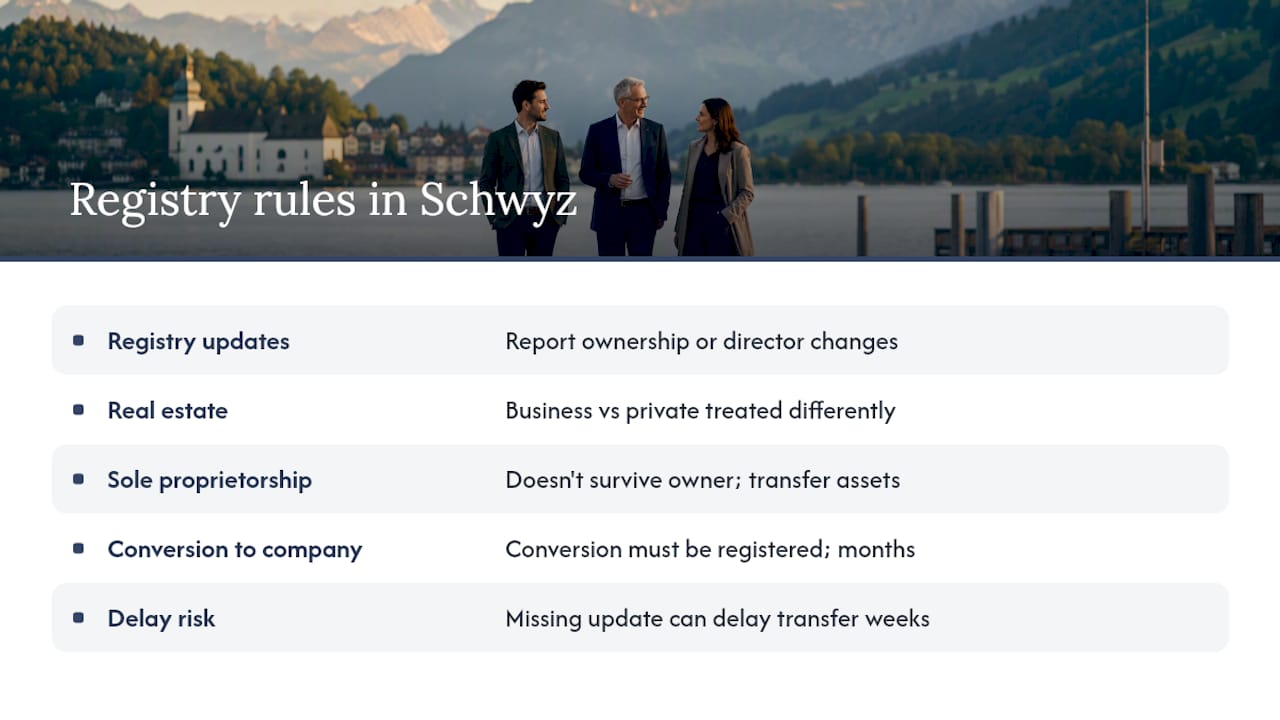
Schwyz follows the federal commercial register framework, but a few local realities catch owners out. Any change in ownership, whether a share transfer, a change of legal form, or a new managing director, needs to be reported to the Handelsregisteramt Schwyz, and delays here can hold up financing or contracts with counterparties who check the register before signing.
If your business holds property, Schwyz treats business real estate differently from private real estate on transfer, and the cantonal memorandum on business assets at death spells out when property is treated as business versus private wealth. That distinction affects both the tax bill and which authority needs to sign off.
Sole proprietorships and partnerships face a subtly different registry process from limited companies or an AG. A sole proprietorship doesn’t survive its owner in the same legal sense a company does, so succession there is really about transferring assets and contracts individually, not shares. If you’re planning to convert a sole proprietorship into a GmbH or AG ahead of a transfer, precisely to make the succession cleaner, that conversion itself needs to be registered and typically takes a few months to complete, so it belongs in phase four of your timetable, not phase five.
None of this is exotic, but missing a registry update at the wrong moment can delay a transfer by weeks while paperwork catches up.
How do you protect minority shareholders during a Schwyz business transition?
Minority shareholders are where succession plans quietly unravel. A family business with three siblings holding unequal stakes, or a company where a long-serving employee holds a small equity slice, needs a plan that addresses their rights explicitly, not just the majority owner’s exit.

Swiss company law gives minority shareholders statutory protections, including information rights and, in certain circumstances, the right to challenge decisions that disadvantage them unfairly. A shareholders’ agreement should go further than the legal minimum and set out, in plain terms, what happens to minority stakes when the majority owner exits: do they have a right of first refusal, a drag-along obligation to sell alongside the majority, or a tag-along right to sell on the same terms?
Where the succession plan involves a holding structure or an MBO, minority holders often worry about dilution or about losing influence they previously had informally. Address this directly and early, ideally during phase four of your timetable, rather than presenting minority shareholders with a finished deal. A transfer that blindsides a 15% shareholder can trigger legal disputes that delay completion by months and damage relationships that matter for the business afterwards, particularly in family firms where that shareholder is also a relative.
What governance changes should follow a Schwyz business handover?
The handover date is rarely the point where a transition actually finishes. The first 18 to 24 months afterwards determine whether the change sticks.
A transitional advisory board, even a small one with the outgoing owner, the successor, and one independent voice, gives the new leadership somewhere to test decisions without the full weight of sole responsibility. This works particularly well in family transfers, where a successor may be capable but lacks the informal authority the previous owner built up over decades.
Decide the outgoing owner’s role explicitly rather than leaving it vague. A former owner who lingers without a defined function tends to undermine the new leadership, even unintentionally, simply by being present and remembered as “the boss.” Options range from a clean exit, a fixed-term consultancy, to a formal seat on the board with clearly bounded authority.
Document decision rights clearly, particularly around financing, hiring, and major client relationships, since these are the areas where a successor’s judgement gets tested earliest. Schwyz businesses with strong local client relationships often underestimate how much of that trust was personal to the outgoing owner, and a governance structure that eases that trust across gradually, through joint client visits in year one, for example, tends to outperform a hard handover date.
Why the standard succession advice undersells the personal side
Most succession guidance treats the business and the owner’s personal finances as separate problems, solved in sequence. That’s backwards. The tax ruling, the valuation, and the legal structure all shape how much money actually lands in the owner’s account, and when, which makes personal financial planning a design input for the corporate structure, not an afterthought once the deal closes.
The conventional advice also underweights how long good preparation actually takes. Five to twelve years sounds abstract until you map it against a typical Schwyz business owner’s own retirement timeline: many owners realise they need to start the company readiness phase at almost the same time they start thinking seriously about their own pension position, not years apart.
If there’s one priority to take from this, it’s sequencing. Get the valuation and the tax ruling process moving before you fix the succession model, because the numbers from both will change which model actually makes sense for your situation.
Ready to plan the personal side of your transfer?
Every succession plan eventually reaches the point where the business questions are settled and the personal ones remain. That’s where Marmot Finance’s wealth management services fit directly into what you’ve read here: pension optimisation to close BVG gaps before contributions stop, financial coaching to plan what proceeds need to fund, and portfolio management for whatever lands in your account once the transfer completes. Unlike a generalist advisor juggling every type of client, Marmot works exclusively with women and families across Switzerland and Europe, which means the personal finance conversation stays central rather than an afterthought bolted onto corporate advice. Start with the Money Makeover Quiz to get a clear picture of where your personal finances stand today, or book a wealth management review directly to talk through how your business transfer timeline should shape your personal plan.
Sources
- Die Wirtschaft — Unternehmensnachfolge planen: KMU guide
- Schwyz canton — Merkblatt: Todesfall Spezialfälle
- Lex Futura — the tax treatment of employee equity
- ADB — Unternehmensnachfolge richtig strukturieren
Recommended
- Business Succession Planning in Schwyz | Marmot Finance
- Unternehmensnachfolge in Schwyz | Marmot Finance
- Erbschaftsplanung in Wollerau | Marmot Finance
- Long-term wealth planning in Switzerland: securing generational wealth


.webp)





.jpeg)




.png)

.svg)


