

Andermatt offers many households a genuinely lower effective income tax burden and a competitive wealth tax position compared with the Swiss average, but the real gain depends on how you weigh it against local living costs. Someone earning CHF 100,000 pays around 11.6% in effective income tax in Andermatt, against a Swiss average closer to 15.7%. That gap matters, but it only becomes real wealth building when paired with the right tools.
Before you commit to anything, focus on three levers:
- Residence choice: which commune within Uri you settle in, since the municipal multiplier changes your final bill.
- Pillar 3a: maximise your contribution this tax year for an immediate, guaranteed deduction.
- Holding structures: if property or business income is involved, get the ownership structure right before you buy, not after.
Run a quick income and wealth calculation, top up your Pillar 3a where you can, and speak to a FINMA-accredited adviser before making any residence change or setting up a holding structure.
Key Takeaways
Andermatt can genuinely lower your effective tax burden, but only households that also use Pillar 3a, model pension timing, and choose the right holding structure capture the full benefit.
This article is general information, not a substitute for advice from a qualified financial advisor. Consult a qualified financial professional about your own circumstances before acting on anything here.
Tax efficient wealth management in Andermatt: what the numbers actually show
The headline figure is straightforward. A resident in Andermatt earning CHF 100,000 faces an effective income tax burden of roughly 11.6%, or CHF 11,647, compared with a Swiss average of about 15.7%. That difference, over a working lifetime, adds up to a meaningful sum when reinvested rather than spent.
Wealth tax works differently. Uri assesses residents on their net worldwide assets as they stand on 31 December each year, and the effective rate for many married taxpayers sits around 0.20%, which is genuinely low by Swiss standards. Municipal multipliers, known locally as the “steuerfuss”, then sit on top of the cantonal tariff and can shift your final bill more than people expect.
Andermatt at a glance: effective income tax around 11.6% on CHF 100,000 income, median 3.5-room rent near CHF 2,323 a month, and health insurance averaging roughly CHF 376 a month for one adult.
That rent figure matters because Andermatt’s rental market is tight, driven by the resort’s growth since 2012. A tax saving of a few thousand francs a year loses its shine if housing costs eat it straight back up. The honest way to think about it:
- Calculate your likely tax saving against the Swiss average for your income bracket.
- Compare that saving to local rent and insurance costs for your household size.
- Only then decide whether Andermatt makes financial sense, not just fiscal sense.
How does lump-sum taxation work for residents in Uri?
Uri offers lump-sum taxation, sometimes called the forfait regime, to foreign nationals who move their main residence to the canton without taking up gainful employment in Switzerland. Rather than declaring worldwide income line by line, qualifying residents are taxed on their living expenses instead, which typically suits retirees, investors living off portfolio income, or those with complex international earnings who want predictability. KPMG’s overview of the regime notes that eligibility and calculation methods vary by canton, so what applies in Uri won’t necessarily mirror another canton’s rules.
Within Uri, the commune you choose still matters enormously, because municipal multipliers are layered on top of the cantonal rate. Two neighbouring villages can produce noticeably different final bills for otherwise identical taxpayers.
Before assuming you qualify, work through these steps:
- Confirm your residence permit category and whether it allows lump-sum taxation.
- Time your move carefully, since the tax year in which you arrive can affect your first assessment.
- Gather documentation on your worldwide assets and expenses early, as the cantonal tax office of Uri will want a clear picture before agreeing terms.
- Get written confirmation from the cantonal tax office of Uri before you relocate, not after.
What tax tools should you use this year?
Some of the most effective tax planning happens well before you ever think about moving house. Pillar 3a, Switzerland’s private pension scheme, remains one of the most reliable tools available to any taxpayer, and it works the same way whether you live in Andermatt or anywhere else in the country.
Here’s how to put it to work:
- Max out your Pillar 3a contribution before December 31. For a single person earning CHF 100,000, a full contribution can generate an immediate tax saving of around CHF 1,173 in that tax year alone. That’s not a projection, it’s money off your bill this year.
- Review how your 2nd pillar pension interacts with your 3a savings. If you’re approaching retirement, the timing of any pension withdrawal changes both your taxable income in that year and your wealth tax exposure afterwards, since a lump-sum withdrawal is taxed separately at a reduced rate but still adds to your net assets once received.
- Think about mortgage structure if you own or plan to buy property. Carrying a mortgage reduces your net taxable wealth, because Swiss wealth tax is calculated on net assets, not gross assets. This only makes sense when the interest cost is lower than what you’d otherwise earn by paying the mortgage down, so it needs proper modelling rather than a rule of thumb.
- Pull your documents together now, even if you’re not moving yet: pension statements, property valuations, and a summary of worldwide assets. Any adviser worth their fee will ask for these before giving you real numbers.
Pro Tip: Don’t treat Pillar 3a as a once-a-year January chore. If your income fluctuates, whether through bonuses, self-employment, or investment gains, review your contribution capacity every quarter so you never leave deduction room on the table.
None of this is about finding a loophole. It’s about using the tools Switzerland already gives every taxpayer, and using them properly. A household that maxes 3a contributions every year for a decade, and coordinates pension withdrawal timing sensibly, will typically end up meaningfully ahead of one that just moves to a lower tax commune and stops there.
Should you buy property directly or through a holding company?
This is where a lot of people get it wrong, because the answer depends entirely on your situation rather than a fixed rule. Private ownership is simpler: you deduct actual maintenance costs or a lump-sum allowance, and mortgage interest, directly against your income. It suits owner-occupiers and most family buyers.
An Immobiliengesellschaft, a property holding company, works differently. It can improve net cashflow for certain investor profiles by allowing business-level deductions and more predictable timing of distributions, though comparative analysis from LCA Tax makes clear the optimal structure is case-specific, not universal. It tends to suit investors with multiple properties, rental portfolios, or plans to bring in family members as shareholders later.
Andermatt has its own quirk worth knowing: the resort benefits from an exception to the usual Lex Koller restrictions that normally limit foreign nationals buying Swiss property, and Andermatt Swiss Alps runs a formal rental programme for owners who want their property let out when they’re not using it.
A few things worth weighing early:
- Private ownership keeps things simple for a single family home, but structures matter more once you own several properties.
- Succession planning gets far easier when the ownership structure is decided before a death or divorce forces the question. Our guide to preserving generational wealth covers this in more depth.
When should you bring in a FINMA-accredited wealth manager?
The moment your decision involves more than one variable, residence, pension timing, and property structure at once, is usually the moment DIY planning starts costing you more than it saves. Modelling these interactions properly needs someone who can see the whole picture, not just one tax return.
Marmot Finance is FINMA accredited and works exclusively with women and families across Switzerland and Europe, combining personal advisory sessions with digital tools such as the Money Makeover Quiz. Over 350 women have already used Marmot’s guidance to restructure their finances. The services that map most directly onto the decisions covered in this article include:
- Residence and relocation modelling, comparing your current tax position against a move to Andermatt or elsewhere in Uri.
- Pillar 3a and pension optimisation, timed against your income and retirement plans.
- Holding structure analysis for property or business assets, including whether an Immobiliengesellschaft makes sense for you.
- Estate and succession planning, particularly where cross-border family ties are involved.
Before a first meeting, have your recent tax returns, pension fund statements, and any property valuations ready. Fees vary by engagement type, whether it’s a one-off consultation or ongoing portfolio management, so ask for a clear fee structure upfront rather than assuming a flat rate applies.
How do you avoid double taxation on cross-border assets?
If you hold assets, income, or a pension outside Switzerland, double taxation is a real risk without proper planning, and it’s one of the most commonly mishandled areas for internationally mobile families. Switzerland has signed double taxation agreements with most European countries and many others worldwide, and these treaties generally determine which country has the primary right to tax a given type of income, such as employment earnings, dividends, rental income, or pension payouts.

The practical starting point is working out your tax residency status correctly, since treaty relief only applies once residency is established under the treaty’s own tie-breaker rules, not simply where you spend most nights. For dividends and interest from abroad, Swiss residents can often reclaim withholding tax deducted at source under the relevant treaty, though the process and reclaimable percentage differ by country.
Property income sits in its own category. Rental income from a property abroad is typically taxed where the property is located, but Switzerland still requires it to be declared for rate-setting purposes, meaning it affects the tax rate applied to your Swiss income even though it isn’t taxed twice on the same franc. Pension income crossing borders gets particularly messy, since the source country, the treaty terms, and Swiss rules on lump-sum versus periodic withdrawals can all interact differently depending on where the pension originated.
For anyone with meaningful cross-border holdings, whether that’s a family property in Italy or investment accounts held abroad, getting a coordinated view across both jurisdictions before filing anything is worth the cost of proper advice. Structuring guidance from Marmot Finance covers this kind of cross-border coordination in more detail, and comparing Switzerland’s approach against other regimes, such as Italy’s flat tax framework for high-net-worth individuals, helps clarify just how different these systems can be from one country to the next.
What are the inheritance and gift tax rules for Andermatt?
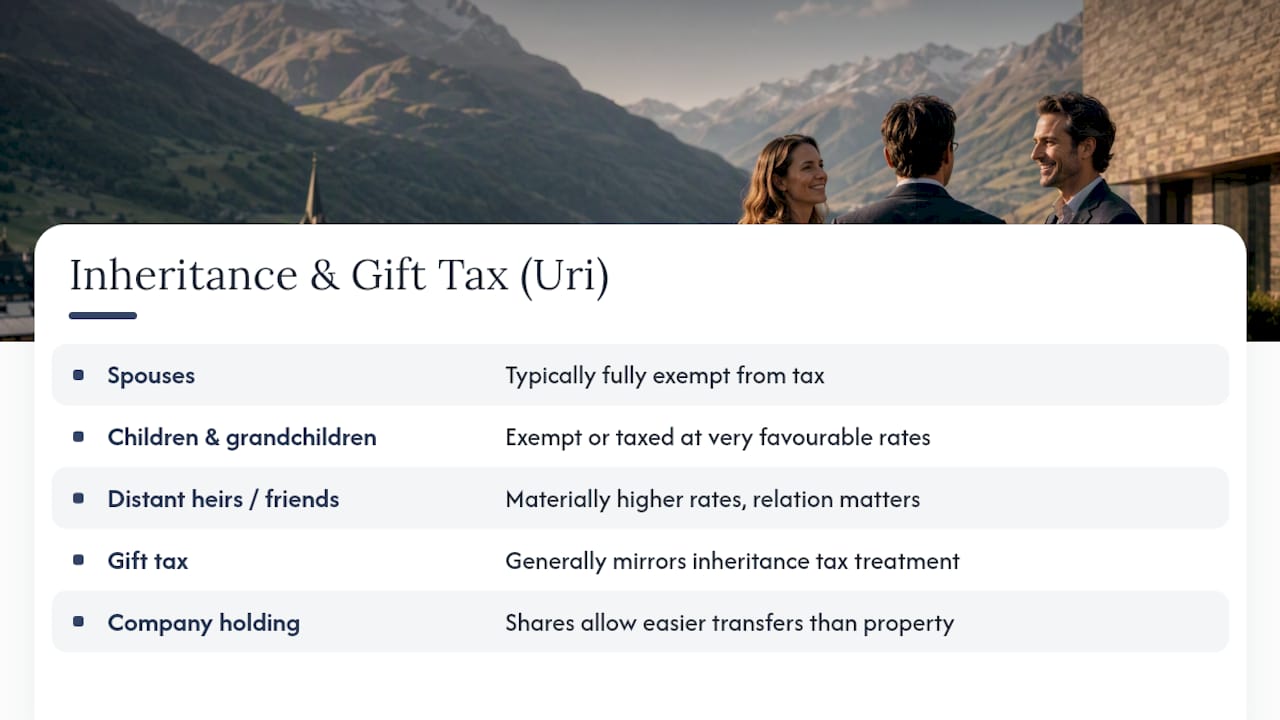
Inheritance and gift tax in Switzerland is set cantonally, not federally, which means Uri’s rules are what matter here, not a national standard. Direct descendants, meaning children and grandchildren, are generally exempt or taxed at very favourable rates in most Swiss cantons, and Uri follows this pattern, which makes it comparatively generous for family succession planning versus cantons that tax direct heirs more heavily.
Spouses are typically fully exempt from inheritance tax in Uri, as is common practice across Switzerland. Where things get more expensive is with unrelated heirs or more distant relatives, such as nieces, nephews, or friends, who can face materially higher rates depending on the relationship and the value transferred.
Gift tax generally mirrors inheritance tax treatment, since Swiss cantons use gift tax partly to prevent people avoiding inheritance tax by simply giving assets away before death. If you’re planning to pass property or investment assets to children while you’re still alive, the timing and structure of that gift can affect both your own wealth tax position and the eventual inheritance calculation.
For families with property in Andermatt specifically, the choice between holding that property privately or through a company structure, discussed earlier, has direct knock-on effects here too. Shares in a holding company can sometimes be transferred more flexibly than a physical property, particularly when multiple heirs are involved and nobody wants to co-own a chalet. Getting this structured correctly, ideally years before it’s needed, avoids forcing a rushed decision during what is already a difficult time for a family.
Editorial take: what most guides get wrong about Andermatt
The conventional advice on relocating for tax reasons treats the decision as a spreadsheet exercise: compare rates, pick the lowest, move. That’s backwards. The research here supports a different order of operations. Get the tools right first, Pillar 3a, pension timing, sensible mortgage structuring, because those work regardless of where you live in Switzerland. Only then does the residence question become worth answering properly.
What’s overrated is the headline tax rate itself. What’s underrated is the municipal multiplier inside Uri itself, since two communes a few kilometres apart can produce meaningfully different bills, and almost nobody checks this before signing a lease.
If you take one thing from this article, prioritise the pension and Pillar 3a review before you touch the residence question at all. It’s the lever you control entirely, this year, regardless of where you eventually settle.
A clearer path to tax-efficient wealth planning
Working through residence choices, Pillar 3a timing, and holding structures on your own is doable, but it’s easy to miss an interaction that costs you more than it saves. Marmot Finance is built specifically for women and families navigating exactly this kind of decision, combining personal advisory sessions with digital tools like the Money Makeover Quiz so you get a plan shaped around your actual numbers, not generic guidance. If you’re weighing Andermatt against your current situation, or already own property there, our wealth management services can model the residence, pension, and structure questions together rather than in isolation. Start by working through our financial planning guide to see where your current setup stands before making any move.
Sources
- Taxes in Uri — Standort Uri
- Steuern bei Immobilien: Vergleich Privatvermögen vs Immobiliengesellschaft — LCA Tax (Airoldi)
Recommended
- Tax-Efficient Wealth Structuring in Switzerland: Investor guide | Marmot Finance
- Asset Protection Strategies in Zermatt: Safeguarding Wealth | Marmot Finance
- Wealth Management in Andermatt | Marmot Finance

.webp)





.jpeg)



.png)

.svg)


