

Wealth preservation is defined as the practice of protecting existing assets from erosion caused by market downturns, inflation, and tax drag, while keeping long-term financial goals intact. For residents and investors in Kilchberg, effective wealth preservation strategies during market volatility centre on three pillars: portfolio segmentation, diversification across uncorrelated asset classes, and tax-aware planning that accounts for local municipal rates. Kilchberg sits within the canton of Zurich, and its approximately 72% municipal tax multiplier makes after-tax returns a defining factor in any preservation plan. Generic market advice rarely accounts for this. The approaches that actually work here are specific, structured, and built around your life goals rather than market predictions.
How does portfolio segmentation enhance resilience against market volatility?
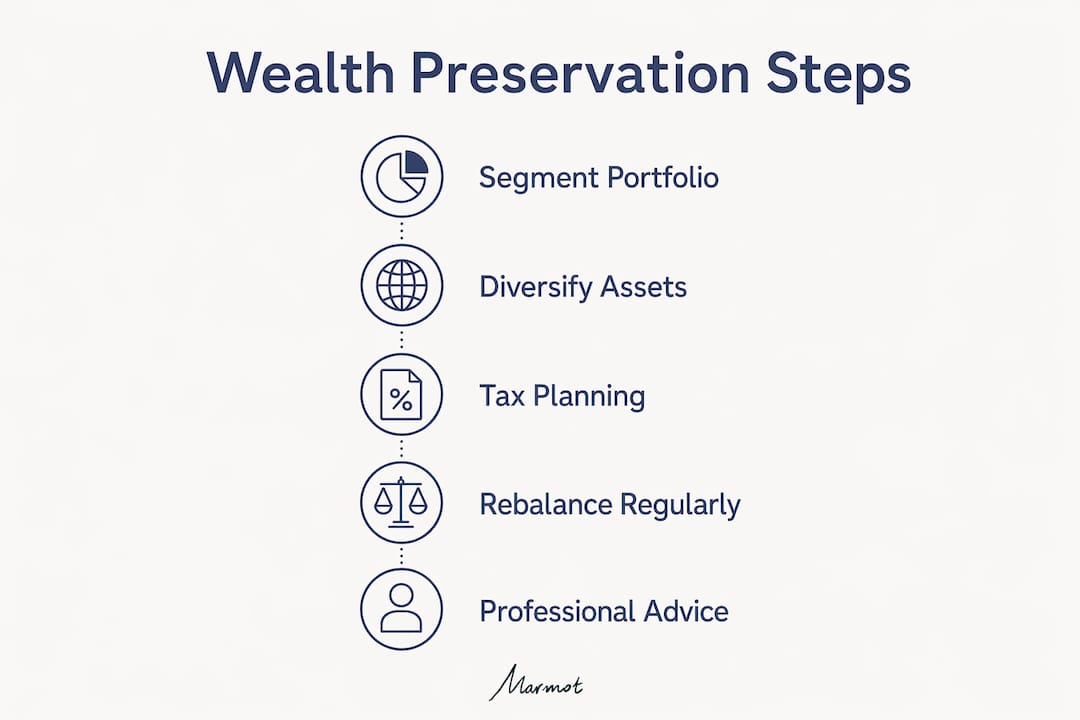
Portfolio segmentation is the practice of dividing your wealth into distinct pools, each serving a different purpose and time horizon. The most practical structure uses three segments: a cash portfolio for immediate needs, a preservation portfolio for medium-term goals, and a growth portfolio for long-term objectives. Wealth managers recommend this multi-portfolio resilience framework precisely because it prevents a single market disruption from threatening your entire financial plan.
The logic is straightforward. When markets fall sharply, the instinct is to sell. If your short-term living expenses are already held in cash, you have no reason to touch your growth assets at the worst possible moment. That separation is what keeps your long-term plan intact. Liquidity layering with a dedicated cash buffer and a preservation layer means you can meet near-term needs without liquidating growth assets prematurely.
Each segment should be sized according to your actual goals, not abstract percentages. Your cash portfolio might cover 12–24 months of living costs. Your preservation portfolio might hold bonds, Swiss real estate funds, or other lower-volatility assets tied to a goal five to ten years away. Your growth portfolio can then hold equities and other higher-return assets with a genuine long-term horizon.
- Map your goals and assign each one a time horizon.
- Allocate assets to each segment based on when you will need the money.
- Review the sizing annually or after a major life change.
- Resist the urge to merge segments when markets are calm.
Pro Tip: Keep your cash portfolio in a separate account, not just a mental category. Physical separation makes it far easier to resist drawing on growth assets during a downturn.
What role does diversified asset allocation play in protecting wealth in Kilchberg?
Diversification is the most reliable tool for reducing downside risk in volatile markets. The principle is simple: spreading risk across assets that do not move in unison means a loss in one area is not amplified across your entire portfolio. When Swiss equities fall, income-producing real estate may hold its value or even rise under the same macro conditions. That offset is the practical benefit of genuine diversification.
For Kilchberg investors, diversification should span both asset classes and geographies. Holding only Swiss equities concentrates your risk in a single market. Adding European bonds, global equity funds, and Swiss real estate investment trusts creates a portfolio where different segments respond differently to the same economic event. Allocations should be constructed so that no two major segments rise and fall together under the same market scenario.
Rebalancing is the discipline that keeps diversification working over time. Without it, a strong equity rally will leave your portfolio overweight in growth assets, increasing your exposure just when valuations are stretched. A practical rebalancing schedule, whether quarterly or triggered by a set percentage drift, keeps your risk profile aligned with your original goals. Marmot’s portfolio diversification guide for Swiss investors covers the mechanics of this in detail.
Pro Tip: Diversification across uncorrelated assets is not about owning many things. It is about owning things that behave differently from each other. Quality matters more than quantity.
How does Kilchberg’s tax environment influence wealth preservation?
Kilchberg’s municipal tax multiplier of approximately 72% is one of the most concrete local factors shaping investment strategy here. Tax drag, the cumulative reduction in returns caused by annual tax obligations, can significantly affect how much wealth you actually preserve over a decade. Tax effects often determine the ultimate preservation outcome in Switzerland over multiple years, particularly for investors who ignore post-tax returns when comparing asset classes.
The practical implication is that two portfolios with identical gross returns can produce very different outcomes depending on how they are structured for tax efficiency. Assets generating regular taxable income, such as high-yield bonds or dividend-heavy equities, carry a higher tax cost in Kilchberg than assets that grow through capital appreciation. Switzerland does not tax private capital gains on movable assets for individuals, which makes growth-oriented structures genuinely attractive from a tax perspective.
Volatility planning in Switzerland is inseparable from tax planning. Your asset allocation decisions should account for where income is generated, how assets are held, and whether structures such as pillar 3a pension contributions can reduce your taxable base. Marmot’s tax-efficient structuring guide for Swiss investors provides a practical framework for integrating these considerations.
Pro Tip: Review your portfolio’s income-generating assets each year. Shifting from income-heavy to growth-oriented holdings can meaningfully reduce your annual tax bill without changing your risk profile.
What practical steps can Kilchberg investors take to implement a preservation plan?
Building a resilient, tax-aware portfolio does not require a complete overhaul of your finances. It requires a clear structure and consistent discipline. A consolidated view of your assets alongside a clear tax and wealth transfer plan provides the clarity needed to make good decisions under pressure.
Start with a full picture of what you own, what it earns, and when you will need it. Many investors in Kilchberg hold a mix of Swiss pension assets, real estate, and investment accounts without a clear map of how they interact. That lack of clarity is what leads to poor decisions during downturns.
- List all assets and assign each to a segment: cash, preservation, or growth.
- Identify which assets generate taxable income and consider whether that is still appropriate.
- Set a rebalancing trigger, either a fixed date or a percentage drift from your target allocation.
- Build a cash buffer covering at least 12 months of expenses before increasing growth exposure.
- Review your plan with a qualified adviser at least once a year, and after any significant market move.
Seeking professional advice is not a sign of uncertainty. It is the most reliable way to avoid the costly mistakes that come from acting on emotion rather than structure. Marmot offers expert wealth management tailored to Swiss investors, combining personal consultations with practical digital tools to help you build and maintain a plan that holds up through volatility.
Pro Tip: Write down your investment plan and your rebalancing rules before the next market correction arrives. A written plan is far easier to follow than a mental one when markets are moving fast.
How do resilience-first approaches help avoid common investor pitfalls?
The biggest threat to wealth during volatile markets is not the market itself. It is the decisions investors make in response to it. Selling growth assets at the bottom of a correction, moving entirely to cash after a sharp fall, or abandoning a long-term plan because of short-term noise are the behaviours that turn temporary losses into permanent ones.
Portfolio segmentation helps avoid anxiety-driven, short-term decisions by giving you a clear structure aligned with long-term goals. When you know your immediate needs are covered by your cash segment, the volatility in your growth portfolio becomes easier to tolerate. The goal of segmentation is not to predict markets. It is to increase resilience and help you stay the course.
Common pitfalls that a structured plan prevents:
- Selling equities at a loss to fund short-term expenses that a cash buffer would have covered.
- Overconcentrating in a single asset class after a period of strong returns.
- Ignoring tax drag when comparing investment options.
- Failing to rebalance, leaving the portfolio misaligned with original goals.
- Making allocation changes based on news headlines rather than personal financial goals.
“The purpose of a resilience-first framework is not to eliminate volatility. It is to ensure that volatility never forces you to make a decision you would not otherwise make.”
Disciplined investors who maintain their structure through downturns consistently achieve better long-term outcomes than those who react. That discipline is not innate. It is built through clear planning, regular reviews, and the confidence that comes from understanding exactly what your portfolio is doing and why.
Key takeaways
Effective wealth preservation in Kilchberg requires portfolio segmentation, tax-aware asset allocation, and the discipline to maintain a structured plan through market disruptions.
What I have learned about wealth preservation in Kilchberg
By Sophie Steinmann
The investors I see struggle most during volatile markets are not those with the wrong assets. They are those without a clear structure. When markets fall and there is no written plan, every decision feels urgent. That urgency is where wealth gets destroyed.
What works in Kilchberg specifically is combining the resilience-first segmentation approach with a genuine understanding of local tax implications. The 72% municipal multiplier is not a footnote. For investors holding income-generating assets, it shapes the real return on every franc invested. Ignoring it is expensive.
The other thing I have observed is that women and families who engage with their finances regularly, even briefly, make significantly better decisions during downturns than those who only look when something goes wrong. A quarterly review is not a burden. It is the habit that keeps a good plan working.
My honest view is that most investors in Kilchberg do not need more complex products. They need a clearer structure, a tax-aware allocation, and a trusted adviser who understands the local context. That combination is more valuable than any single investment idea.
— Sophie Steinmann
How Marmot can support your wealth preservation goals
Marmot is a FINMA-accredited wealth manager with deep expertise in Swiss financial planning for women, families, and international clients. If you are based in Kilchberg and want to build a portfolio that holds up through market volatility, Marmot combines personal consultations with practical digital tools to create a plan tailored to your goals and tax situation.

Marmot’s advisers understand the Zurich region’s wealth management landscape, including the municipal tax considerations that affect after-tax returns in Kilchberg. Whether you are starting from scratch or reviewing an existing portfolio, Marmot builds structures that balance liquidity, preservation, and long-term growth. Over 350 clients have already improved their financial outcomes with Marmot’s guidance. Speak with an adviser through Marmot’s contact page to take the next step.
FAQ
What are wealth preservation strategies in Kilchberg?
Wealth preservation strategies in Kilchberg are structured approaches to protecting assets from market losses and tax drag, typically involving portfolio segmentation, diversification across uncorrelated asset classes, and tax-efficient allocation that accounts for the local 72% municipal tax multiplier.
How does portfolio segmentation protect against market volatility?
Portfolio segmentation divides wealth into cash, preservation, and growth segments aligned with different time horizons. This structure prevents short-term market disruptions from forcing premature sales of long-term growth assets.
Why does Kilchberg’s tax rate matter for investment safety?
Kilchberg’s municipal tax multiplier of approximately 72% increases the tax drag on income-generating assets. Structuring a portfolio to favour capital growth over regular income can meaningfully improve after-tax preservation outcomes over time.
What is the most common mistake investors make during market downturns?
The most common mistake is selling growth assets at a loss to cover short-term expenses that a dedicated cash buffer would have handled. Portfolio segmentation directly prevents this by separating funds by purpose and time horizon.
How often should Kilchberg investors review their wealth preservation plan?
A formal review at least once a year is the standard recommendation, with an additional review triggered by any significant market move or personal life change. Regular reviews keep the portfolio aligned with goals and prevent drift from the original allocation.
Recommended
- Preserving Generational Wealth: Private Wealth Management in Switzerland | Marmot Finance
- Wealth Management in Küsnacht | Marmot Finance
- Wealth Management in Klosters | Marmot Finance
- Wealth Management in Herrliberg | Marmot Finance


.webp)





.jpeg)




.png)

.svg)


