Effective estate planning means having clear, legally sound control over who inherits your assets and who manages your affairs if you lose capacity to decide for yourself. In Switzerland, that control rests on a handful of specific documents, not good intentions. The first practical step, whatever your age or wealth, is building a full asset inventory and appointing a Vorsorgeauftrag. Marmot Finance can help you turn that first step into a working plan.
TL;DR:
- A comprehensive estate plan requires regularly updating an asset inventory, beneficiary designations, and legal documents every three to five years or after major life events.
- The four key legal documents in Swiss estate planning are the will, inheritance contract, Vorsorgeauftrag, and Patientenverfügung, each addressing different planning needs and bindingness levels.
- Canton-specific inheritance taxes and rules significantly influence estate structuring, making it essential to consider domicile and potential cross-border issues when planning.
- Special situations like business succession, blended families, and unmarried partners require tailored legal tools, explicit beneficiary designations, and careful valuation to avoid disputes.
- Digital assets and cross-border assets add complexity, necessitating detailed access lists and knowledge of jurisdictional differences to ensure proper inheritance transfer.
Marmot Finance
Bring Your Financial Plan Together
Marmot Finance helps women and families in Switzerland navigate their financial journey through personal consultations and digital tools.
What effective estate planning covers: a concise framework
A good estate plan is not one document. It is a cycle, and most people in Horw only ever complete the first stage before life gets busy again.
The cycle runs like this: you inventory what you own, decide who gets what and who manages things if you cannot, put those decisions into legally valid documents, check the tax consequences, and then review the whole thing periodically. Skip a step and the plan usually fails exactly where it mattered most, often at the point someone loses capacity rather than when they die.
Charles Russell Speechlys, a firm that regularly advises international clients with Swiss assets, makes a point worth taking seriously: start with your objectives, not with a document template. Ask who needs to be provided for, what liquidity they will need immediately (school fees, mortgage payments, business costs), and what happens if you are alive but unable to make decisions. Only once those questions are answered should you pick the legal tools.
A working plan generally includes:
- A complete inventory of assets, liabilities, and where to find account details
- Clear beneficiary decisions, including named substitutes if a primary beneficiary predeceases you
- A Vorsorgeauftrag naming who manages your affairs if you become incapable
- A Patientenverfügung setting out your medical wishes
- A will or Erbvertrag matching your actual family situation
- A tax review based on where you and your heirs are domiciled
Most people should start this process the moment they buy property, marry, have a child, or open a business, whichever comes first. After that, advisers commonly recommend a review every three to five years, or immediately after a divorce, birth, death in the family, or a move to a different canton.
Key legal documents in Switzerland and what each does
Four documents do almost all the work in Swiss succession planning, and each one solves a different problem.
The will (Testament). A will lets you direct how your estate is divided, but it operates within limits set by the Swiss Civil Code (ZGB). Since the 2023 reform, children's compulsory shares were reduced to half their previous statutory share, which gives you meaningfully more freedom over the disposable portion of your estate than earlier generations had. A handwritten will must be entirely in your own handwriting, dated, and signed. A public will, drafted with a notary, is harder to challenge and better for larger or more complex estates.
The Erbvertrag (inheritance contract). This is the most binding tool available. Unlike a will, an Erbvertrag requires public notarisation and cannot be changed unilaterally once signed. It suits situations where you need mutual guarantees, such as a business succession where a child agrees to take over the company in exchange for specific compensation to siblings. Because all parties must consent to any change, it offers certainty a will simply cannot.
The Vorsorgeauftrag (advance mandate). This document names who manages your financial and personal affairs if illness or accident leaves you unable to decide for yourself. Without one, the KESB, the child and adult protection authority, may step in and appoint someone on your behalf, who may not be who you would have chosen.
The Patientenverfügung (advance healthcare directive). This sets out your medical wishes and names someone to make healthcare decisions if you cannot. Paired with a Vorsorgeauftrag, it keeps intimate decisions with people you trust rather than an appointed third party.
Store originals with a notary or the civil registry office, and keep a note of their location with someone you trust. A document nobody can find is functionally the same as no document at all.
Tax and cantonal considerations that change the plan
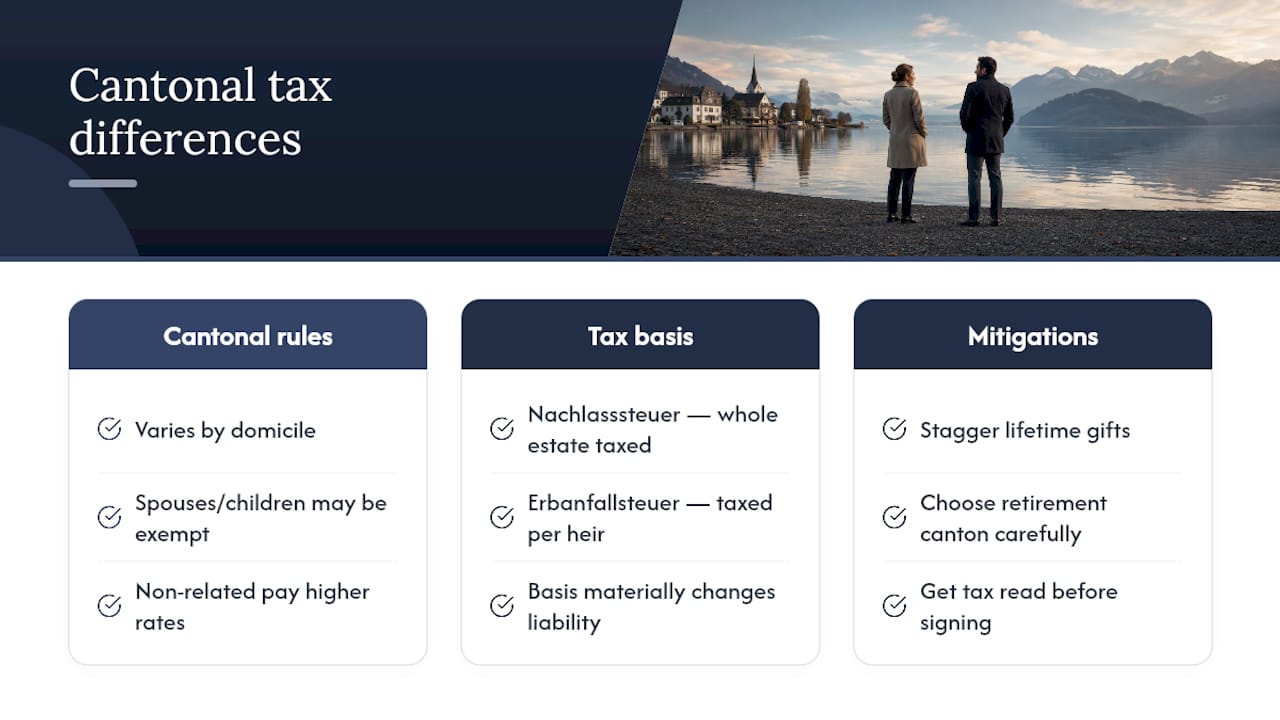
Inheritance and gift tax in Switzerland is not set nationally. It is levied at the cantonal level, and your domicile, or your heirs' domicile, decides which rules apply. This single fact changes more estate plans than any other variable.
Some cantons charge spouses and direct descendants nothing at all. Others apply meaningful rates even to children, and non-related beneficiaries can face considerably higher bands almost everywhere. The Swiss Federal Tax Administration confirms this cantonal variation extends to how the tax itself is structured, with some cantons taxing the estate as a whole (Nachlasssteuer) and others taxing what each heir actually receives (Erbanfallsteuer). That distinction alone can change what a beneficiary owes.
Common, entirely lawful ways to manage this exposure include staggered lifetime gifts that use up annual or periodic exemptions rather than transferring everything at death, and, for some families, a considered decision about which canton to be resident in during retirement. None of this is about avoiding tax owed. It is about not leaving money on the table through poor timing.
Pro Tip: If you or a beneficiary might move canton, or already live in different cantons from each other, get a tax read on the plan before you finalise the will. A document that works perfectly for one domicile can create an unnecessary tax bill under another canton's rules.
Tax should shape the mechanics of a plan, timing gifts, choosing between an Erbanfall or Nachlass structure, deciding when to transfer property, but it should rarely be the reason you cut someone out or favour one child over another. Family fairness and legal tax efficiency can usually be achieved together, but only if you sequence the decisions correctly, and only if you get advice on cantonal inheritance tax exposure before rather than after signing.
Practical steps to create an effective estate plan you can act on today
Here is the sequence worth following, roughly in order:
- Build a full inventory. List every account, property, insurance policy, pension asset, and business interest, along with where the paperwork lives and who has access.
- Decide beneficiaries and substitutes. Name who receives what, and name a backup for each beneficiary in case they predecease you.
- Choose guardians for minor children. If you have children under 18, name a guardian and a financial trustee for their inheritance until they come of age.
- Appoint your executor and any co-signatories. Decide who will actually administer the estate, and confirm they are willing to do it.
- Sign a Vorsorgeauftrag. Name who manages your finances and legal affairs if you lose capacity, and be specific about their authority.
- Complete a Patientenverfügung. Set out your medical wishes and name a healthcare proxy.
- Draft or update your will or Erbvertrag. Match the tool to the situation: a will for flexibility, an Erbvertrag for binding mutual commitments.
- Store everything properly. Register your Vorsorgeauftrag with the civil registry office and keep your will with a notary or in a place your executor knows about.
- Set a review date. Put a reminder in your calendar for three years from now, and again after any major life event.
Pro Tip: Bring your completed inventory to your first meeting with a notary or adviser. It cuts the initial consultation time roughly in half and means the conversation starts on strategy rather than paperwork gathering.
None of these steps require huge amounts of money or a complicated estate. They require about a weekend of focused effort, and then a legal appointment to make the documents formal. The essentials of building an estate plan apply whether your estate is modest or substantial, only the complexity of the tax and structuring conversation changes.
Special situations: business succession, blended families, and unmarried partners
Standard planning assumptions break down quickly once your situation gets more complicated than a single marriage and biological children.
Business succession. If you own a company, an Erbvertrag is usually the more reliable tool because it locks in agreed terms that cannot be unilaterally reversed, which matters when a successor child needs certainty to justify staying in the business rather than selling out. Staged transfers, where ownership shifts gradually over several years, also give you time to see whether the chosen successor actually performs before handing over full control.
Blended families. Statutory inheritance rules were built around traditional nuclear families and often leave stepchildren with no automatic claim at all, even after decades of a shared household. If you want a stepchild to inherit, you generally need to name them explicitly in a will or Erbvertrag, since the law will not do it for you as explained in this recherche d'héritiers dans une succession guide.
Unmarried partners. Long-term partners without a marriage certificate typically have no statutory inheritance rights whatsoever in Switzerland, regardless of how long the relationship lasted. This makes a will or Erbvertrag essential, not optional, for anyone in this situation.
Real estate and Nutzniessung. Transferring property to a child while retaining a usufruct (Nutzniessung) is common, but the value of that usufruct gets capitalised for tax purposes and can trigger consequences you did not anticipate. Get the valuation and the tax treatment confirmed before signing, not after.

Common mistakes and how to avoid them
Most estate planning failures in Switzerland come down to the same handful of avoidable errors.
- Informal family promises. A verbal agreement that "the house will go to whoever stays and cares for us" has no legal standing. Put it in writing, and notarise it if the value is significant.
- Skipping incapacity planning. Without a Vorsorgeauftrag, the KESB may step in on your behalf, which often means delays and decisions made by someone who does not know your family.
- Undocumented property transfers. Gifting a property to one child without a fixed, notarised valuation invites siblings to later argue the transfer was really an advance inheritance, and Swiss courts have recalculated exactly these situations.
- Letting documents go stale. A will written before a divorce or a second marriage rarely reflects what you actually want anymore.
Each of these has a fix that takes far less time than the dispute it prevents.
Cross-border estates and multiple citizenships near Horw
Horw sits close to Lucerne and within easy reach of the German and other European borders, so it is common for residents to hold assets, citizenship, or family ties across more than one country. That combination changes the planning conversation considerably.
Switzerland generally applies its own succession law to residents domiciled here, but a foreign national with property abroad, or Swiss nationals with assets in another EU country, can find two legal systems claiming jurisdiction over the same estate. Some countries, unlike Switzerland, do not recognise an Erbvertrag as valid at all, which can leave a carefully negotiated business succession agreement unenforceable the moment a beneficiary or asset sits outside Swiss borders.
Dual citizens and foreign nationals resident in Horw should also check whether an international treaty or a specific choice-of-law clause in their will actually applies to their situation, since assumptions that work for a purely domestic Swiss estate often do not transfer cleanly across a border. Real estate abroad is usually governed by the law of the country where it sits, regardless of what a Swiss will says.
If your family, your assets, or your own citizenship crosses a border, a Swiss-only will drafted without checking the other jurisdiction is a genuine risk, not a minor technicality. This is one area where a specialist conversation, rather than a template document, earns its cost quickly.
Digital asset management and inheritance planning
Photos in a cloud account, cryptocurrency wallets, online banking logins, and loyalty points with real cash value all sit outside the traditional inventory most people write down, and yet they are often worth real money or carry genuine sentimental value.
The core problem is access. A password nobody else knows effectively locks that asset away forever, cryptocurrency held in a private wallet with no recorded seed phrase is generally unrecoverable once you are gone, and most standard online accounts have no built in mechanism for transferring ownership to an heir at all.
Practical handling starts with a written, securely stored list of accounts, providers, and where access credentials can be found, kept separately from the will itself for security reasons but referenced within your Vorsorgeauftrag or held by your executor. For cryptocurrency specifically, note the wallet type, where recovery phrases are stored, and who understands how to access them, since a technically inexperienced executor may not know where to begin otherwise. Review this list at the same interval you review the rest of your plan, since digital accounts and their providers change far more often than a property portfolio does.
How Swiss forced heirship laws shape your estate
Switzerland does not give you unlimited freedom to disinherit people. Certain relatives, principally children and, in some circumstances, a surviving spouse, hold a statutory right to a minimum share of the estate under the Civil Code, regardless of what your will says.
The 2023 reform genuinely changed the balance here: children's compulsory shares were reduced to half their previous statutory share, meaningfully increasing the disposable portion you can direct as you choose. Before the reform, testators had far less room to reward a caregiving child, provide for a stepchild, or leave more to a spouse; the reform opened up genuinely useful flexibility.
That said, forced heirship still exists. You cannot write a will that leaves a child nothing simply because you would prefer to, except in narrow disinheritance circumstances defined by law. What has changed is the size of the slice you control freely. Understanding exactly where your compulsory portion ends and your disposable portion begins is the single most useful piece of legal information in Swiss succession planning, and it is worth confirming with a notary rather than assuming based on general guidance, since your specific family structure (number of children, marital status, prior gifts) changes the calculation.
Expert perspective: what actually makes a Swiss estate plan effective
Most estate plans fail quietly, not dramatically. Documents may remain technically valid but disconnected from how the person's actual finances work by the time they die or lose capacity.
Effective planning treats succession as part of ongoing wealth management, not a separate legal errand you complete once and forget. Liquidity matters here more than people expect: an estate can be asset-rich and cash-poor, leaving an executor unable to pay inheritance tax bills or maintain a property without selling something quickly and badly. Investment choices, insurance structures, and how assets are held all feed directly into whether your succession plan actually works when it is tested.
There are wealth managers combining personal advisory conversations with digital planning tools rather than treating estate structuring as an afterthought to investing. It suits people who want their portfolio and their succession decisions considered together, not separately. A sensible first step is completing your asset inventory, then bringing it to an initial conversation.
How Marmot Finance can help you get started
Marmot Finance exists for exactly the gap most estate planning advice leaves open: the space between knowing what documents you need and actually having a financial structure that supports them. If you already have investments, a pension, or property scattered across accounts, aligning that picture with your Vorsorgeauftrag and will is where a hybrid adviser, combining real conversations with clear digital tools, genuinely earns its place.
A sensible starting point is the Money Makeover Quiz and financial planning tools, which map your current financial position before you sit down with a notary. From there, personalised wealth management support helps make sure your liquidity, investments, and succession documents are working towards the same goal rather than against each other. If you're based near Horw and want a local point of contact, Marmot's wealth management service in the region is a natural place to start that conversation.
This article is general information, not a substitute for advice from a qualified financial advisor. Consult a qualified financial professional about your own circumstances before acting on anything here.
Sources
- Nachlassplanung Schweiz 2026 — Checkliste, Steuern & Tipps
- Swiss gift & inheritance tax — RSM Switzerland
- Vorsorgeauftrag and Patientenverfügung (KESB guidance)
- Erbschafts- und Schenkungssteuern — ESTV
Recommended
- Estate Planning Essentials in Switzerland for Affluent Families
- Family wealth planning in Zermatt
- Inheritance tax in Switzerland
- Business Succession Planning in Schwyz