

Swiss family offices use special purpose vehicles (SPVs) as their standard tool for ring-fencing investment risk, enabling modular deal structures, simplifying cross-border banking, and supporting orderly succession planning. The logic is straightforward: rather than holding every asset directly inside the family estate or a single holding company, an SPV creates a clean, legally separate container for each investment or project.
The core reasons family offices reach for an SPV are:
- Risk isolation: creditors of one investment cannot touch the family’s other assets
- Tax and fiscal efficiency: Swiss participation relief (Beteiligungsabzug) and other benefits become accessible with the right structure
- Operational modularity: each deal has its own clean cap table, banking relationship, and reporting scope
- Banking and KYC ease: banks prefer standard corporate entities over complex trust or foundation arrangements
- Succession and transfer flexibility: shares in an SPV can be gifted, sold, or restructured far more simply than underlying assets
One Swiss caveat applies immediately: the tax and regulatory benefits of an SPV depend on demonstrable local substance, and certain activities can trigger FINMA licensing requirements under FINIG or related Swiss financial market law.
Key takeaways
Swiss family offices use SPVs primarily to ring-fence investment risk, access Swiss participation relief, and create clean succession paths, but only when the vehicle is backed by genuine local substance and rigorous governance.
Why family offices use SPVs: legal, tax and operational rationale
The decision to use an SPV sits at the intersection of three distinct business rationales, each of which maps to a concrete outcome a family office cares about.
Legal and risk isolation is the most fundamental driver. An SPV separates a project’s assets and liabilities from the wider family estate, so creditors of the project can only access assets held inside that vehicle, not the family’s other holdings. In Swiss practice, this matters most when a family holds operating businesses, development-stage real estate, or high-risk venture positions alongside more conservative wealth. A single bad outcome in one vehicle does not contaminate the rest of the portfolio.
Tax and fiscal efficiency is the second rationale. Swiss holding and SPV structures can access participation relief on dividends and capital gains, provided the company has genuine local substance. The Beteiligungsabzug effectively reduces the tax burden on qualifying participations, which is material for families holding significant equity stakes. Swiss tax authorities scrutinise SPV designs closely: to obtain participation relief, they expect documented board decisions in Switzerland, local directors with real authority, and local office arrangements. Without those, the tax benefit can be re-attributed to the family directly.
Operational and reporting efficiency is the third rationale. For alternative assets such as private equity or real estate, SPVs offer modular, plug-and-play investment structures that reduce recurring fund-level administration for each deal. Each SPV has its own accounts, its own banking relationship, and its own investor reporting scope. When a deal is done, the vehicle can be wound up cleanly without disturbing the rest of the portfolio.
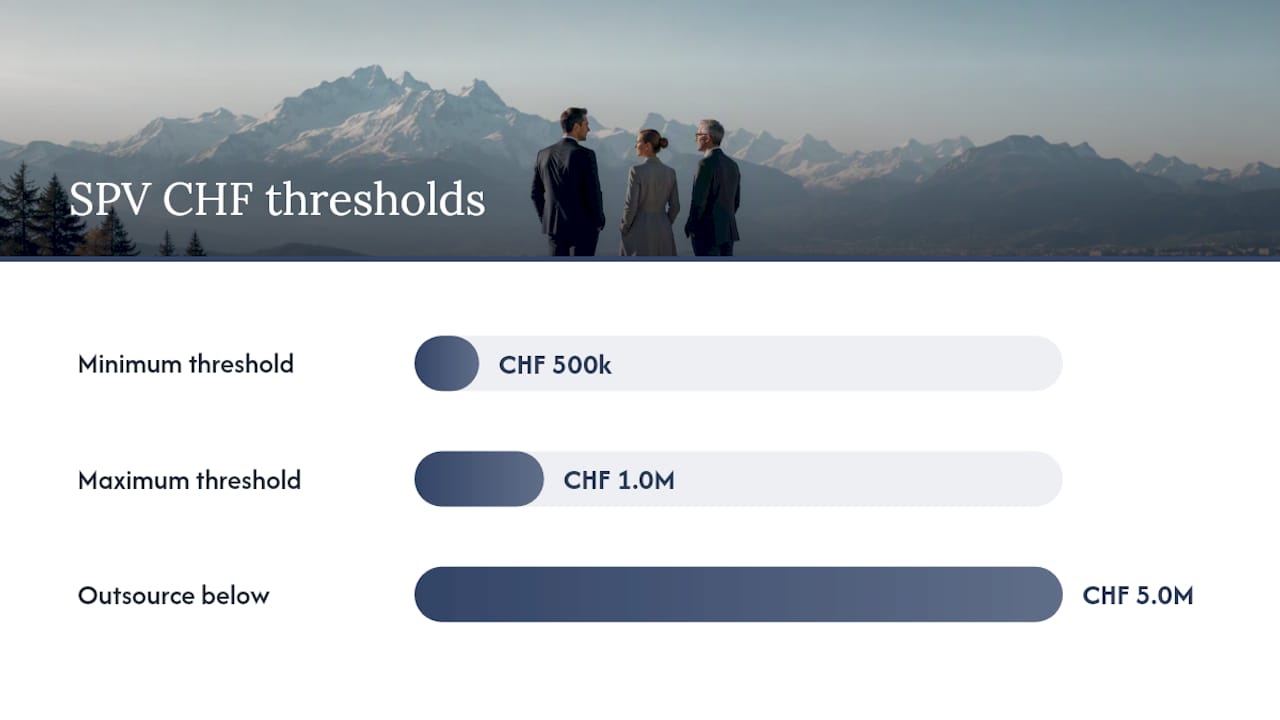
Pro Tip: Match the SPV to the risk profile of the asset. Use a separate vehicle for high-risk operating assets, development projects, or co-investments with third parties. For small passive holdings below CHF 500,000 with no liability exposure, the administrative cost of a standalone SPV often outweighs the benefit.
Common SPV use cases for Swiss family offices by asset class
The asset class largely determines whether an SPV is worth the setup cost and ongoing administration. The following are the situations where Swiss family offices most commonly reach for one.
- Residential and commercial real estate. Holding property inside an AG or GmbH allows a share transfer rather than an asset transfer on exit. Share deals can simplify due diligence and sometimes reduce transfer taxes compared with direct property transfers, though the tax treatment depends on cantonal rules and the specific circumstances. Swiss real estate transfer taxes and stamp duty apply differently to share deals versus asset deals, so a tax adviser should confirm the position for each canton before structuring.
- Private equity and venture capital stakes. Co-investments alongside a lead sponsor are almost always structured through an SPV. The vehicle holds the stake, receives distributions, and can be transferred or pledged without disturbing the family’s main holding structure. The SPV also provides a clean vehicle for any co-investors the family brings alongside.
- Infrastructure and energy assets. Long-duration assets with project finance debt are natural candidates for SPV structures. The lender’s security sits inside the vehicle, and the family’s recourse is limited to their equity contribution. This is standard practice in Swiss infrastructure co-investments.
- Lending and structured finance. When a family office extends a loan to a portfolio company or participates in a structured credit facility, an SPV can hold the receivable and issue notes or certificates. Combining SPVs with securitisation vehicles such as Actively Managed Certificates can create tradable exposures that improve liquidity for private assets while preserving control and auditability.
- Art and high-value tangible assets. Holding art, classic cars, or other collectibles inside a corporate vehicle simplifies insurance, ownership transfer, and cross-border transport documentation. It also separates the liability risk of physical assets from the family’s financial portfolio.
Cross-border note: When a Swiss family office invests in assets located outside Switzerland, the choice between a Swiss SPV and a foreign SPV (for example, a Luxembourg SARL or a Cayman exempted company) depends on where the asset is located, the applicable double tax treaty network, and the substance requirements of each jurisdiction. Swiss SPVs benefit from Switzerland’s broad treaty network but require genuine Swiss substance. Foreign SPVs may offer structural advantages for specific asset classes but introduce additional reporting obligations under CRS and FATCA.
Setting up an SPV in Switzerland: legal forms, substance and tax basics
The two most commonly used legal forms for a Swiss SPV are the Aktiengesellschaft (AG) and the Gesellschaft mit beschränkter Haftung (GmbH). Both provide limited liability, separate legal personality, and access to Switzerland’s double tax treaty network. The AG is generally preferred for larger structures or where share transferability and confidentiality of shareholders matter; the GmbH is simpler and cheaper to incorporate but has its shareholder register publicly accessible.

Tax residence is established at the registered seat of the company. The company must file Swiss corporate tax returns and is subject to federal and cantonal corporate income tax. The effective rate varies by canton: Zug, Nidwalden, and Lucerne are among the most competitive for holding structures.
The substance checklist that Swiss tax authorities apply when assessing whether participation relief is genuine includes:
- Board meetings held in Switzerland, with documented minutes
- At least one director resident in Switzerland with real decision-making authority
- A physical office address (not merely a registered address with a fiduciary)
- Bank accounts held with a Swiss bank
- Key investment decisions documented as having been made in Switzerland
- Adequate staffing or contracted services to manage the assets held
Swiss participation relief and other tax benefits typically require demonstrable local substance; absent substance, tax authorities may re-attribute income to the family directly. This is not a theoretical risk: the Swiss Federal Tax Administration and cantonal tax authorities have challenged structures where the SPV’s directors were offshore and decisions were demonstrably made elsewhere.
The relief reduces the effective tax rate on qualifying dividend income and capital gains, making it a material benefit for families holding significant equity positions. For tax-efficient wealth structuring in Switzerland, the participation threshold and holding period requirements should be confirmed with a Swiss tax adviser before relying on the relief.
Regulatory caveat: An SPV that accepts capital from third parties, manages assets on a discretionary basis for others, or provides financial services to external clients may trigger licensing requirements under FINIG (the Financial Institutions Act) or FINMASA. Family offices should take legal advice before allowing any third-party participation in an SPV.
Pro Tip: Do not rely on a registered address with a fiduciary as your sole Swiss presence. Tax authorities look for genuine economic activity at the seat. A local director with documented authority and at least one annual board meeting held in Switzerland, with proper minutes, is the minimum credible substance position.
Regulatory, AML and reporting considerations under FINMA and Swiss rules
FINMA and related Swiss guidance require robust risk management, AML and operational controls for firms that provide regulated services. Family offices that cross into regulated activity should expect scrutiny. The triggers most commonly encountered in SPV contexts are:
- Accepting capital from investors outside the immediate family group
- Offering discretionary asset management to third parties through the SPV
- Issuing financial instruments (notes, certificates) to external investors
- Crossing the thresholds under FINIG that require registration as a portfolio manager or fund manager
For SPVs that remain within a single-family structure, FINMA licensing is generally not required, provided the vehicle does not solicit external capital or provide financial services commercially. However, the boundary is not always obvious, and a legal opinion is advisable when the structure involves any non-family participants.
AML and KYC obligations apply at the level of the Swiss financial intermediary (typically the bank holding the SPV’s accounts). The SPV must provide full beneficial ownership documentation, including the identity of the ultimate beneficial owners behind any trust or foundation that holds the SPV’s shares. CRS reporting applies to Swiss financial institutions that hold accounts for the SPV; the SPV itself may be a reportable entity depending on its classification under Swiss CRS rules.
Practical AML and compliance steps for SPVs include:
- Maintaining an up-to-date beneficial ownership register
- Providing the bank with a complete group structure chart at onboarding and updating it on any change
- Documenting the source of funds for each capital contribution
- Retaining records of all board decisions and investment approvals for at least ten years
- Reviewing CRS/FATCA classification annually with a Swiss tax adviser
Pro Tip: Get external compliance sign-off before the SPV is incorporated, not after. Reclassification from an unregulated family vehicle to a regulated entity is far more disruptive and costly than building the right structure from the start. A one-hour legal review at the outset can prevent months of remediation.
Operational lifecycle: formation, banking, accounting, reporting and exit
Formation steps
- Agree the legal form (AG or GmbH), registered seat, and share capital (minimum CHF 100,000 for an AG, CHF 20,000 for a GmbH).
- Appoint directors, at least one of whom is resident in Switzerland with genuine authority.
- Draft articles of association tailored to the SPV’s specific purpose and investment mandate.
- Incorporate before a Swiss notary and register with the commercial register (Handelsregister).
- Open a Swiss bank account. Banks will require full KYC documentation for the SPV and its beneficial owners; SPVs facilitate banking onboarding due to their standard corporate entity structure compared to trusts or foundations, with the SPV presenting corporate KYC documentation while beneficial ownership remains with trusts or foundations.
- Register for Swiss corporate tax at the cantonal tax authority.
- Decide on nominee versus direct ownership: whether the SPV’s shares are held directly by the family, by a trust, or by a foundation, each has different succession and reporting implications.
For capital deployment pacing, a practical liquidity framework recommends maintaining multi-tier liquidity reserves: immediate operational reserves covering 3–6 months, tactical reserves covering 6–12 months, and strategic reserves covering 12–24 months. SPVs must be funded in line with that pacing model to avoid forced asset sales.
Ongoing costs versus one-off costs
Exit and winding-up steps
- Confirm whether a share sale or asset transfer is more tax-efficient for the specific asset and buyer.
- Obtain a tax clearance or pre-ruling from the cantonal tax authority where material gains are involved.
- Check Swiss stamp duty (Umsatzabgabe) on the share transfer: at 0.15% for Swiss securities and 0.3% for foreign securities, this is a real cost on larger transactions.
- Distribute remaining assets to shareholders, settle all liabilities, and file for deregistration from the commercial register.
Pro Tip: When selecting a corporate services provider for SPV administration, prioritise firms with a demonstrable track record in Swiss family office structures rather than generic company formation agents. An independent director who understands the substance requirements and can chair board meetings credibly is worth the additional annual fee, particularly for structures where participation relief is being claimed.
Key risks, common pitfalls and mitigations when using SPVs
- Substance risk and tax re-attribution. If the SPV lacks genuine Swiss substance, the tax authority may treat income as arising directly to the family. Mitigation: document all board decisions in Switzerland, use a local director with real authority, and hold at least one annual board meeting in Switzerland with proper minutes.
- Liquidity constraints. SPVs holding illiquid assets (real estate, PE stakes) can face funding gaps if capital calls or operating costs arise unexpectedly. Mitigation: maintain committed liquidity buffers at the family office level and align SPV funding with the multi-tier liquidity reserve framework.
- Creditor challenge and interposition risk. If the SPV is thinly capitalised or if transactions between the SPV and the family are not at arm’s length, a creditor or liquidator may challenge the structure. Mitigation: ensure adequate capitalisation, document all intercompany transactions at market rates, and obtain independent valuations for significant asset transfers.
- Governance lapses. Failure to hold board meetings, maintain proper minutes, or update the commercial register can undermine both the legal and tax integrity of the structure. Mitigation: appoint a corporate secretary or administrator responsible for compliance calendar management.
- Regulatory reclassification. Allowing third-party investors into the SPV, even informally, can trigger FINMA licensing requirements. Mitigation: restrict participation to the immediate family group and take legal advice before any external capital is introduced.
- Operational complexity. Multiple SPVs create multiple sets of accounts, banking relationships, and reporting obligations. Mitigation: use a single corporate services provider across all vehicles and consolidate reporting at the family office level.
The importance of independent governance, documented minutes, and clear contractual flows between the holding trust or foundation and the SPV cannot be overstated. The interposition of an SPV between a fiduciary vehicle and underlying assets has become an industry standard precisely because it isolates liabilities, but that isolation only holds if the corporate formalities are maintained rigorously.
How to decide whether to use an SPV and governance best practices
Decision checklist
- Asset risk profile: does the asset carry liability risk that could affect other family holdings? If yes, an SPV is strongly warranted.
- Asset size: is the investment large enough to justify annual administration costs? For most Swiss structures, a minimum asset value of CHF 500,000–1,000,000 is a reasonable threshold.
- Liquidity needs: will the family need to access capital from this investment within 12 months? SPVs holding illiquid assets require a separate liquidity plan.
- Tax objectives: does the investment qualify for Beteiligungsabzug or another Swiss tax benefit that requires a separate holding entity?
- Succession planning: does the family want to transfer this specific asset to the next generation independently of the rest of the estate? An SPV makes that transfer far simpler.
- Third-party co-investors: are there external co-investors? If so, an SPV is almost always necessary to define rights, obligations, and exit mechanics clearly.
- Operational capacity: does the family office have the internal resource to manage another corporate entity, or will it need to outsource administration?
- Cost-benefit analysis: do the expected tax, legal, and operational benefits exceed the annual cost of maintaining the vehicle?
Do use an SPV when the asset carries meaningful liability risk, when the investment involves third-party co-investors, when a specific tax benefit requires a separate entity, or when the family wants a clean succession path for that asset.
Do not use an SPV for small passive holdings with no liability exposure, for short-term liquid investments, or when the family office lacks the capacity to maintain the corporate formalities that give the structure its legal and tax integrity.
Pro Tip: For smaller family offices managing assets below CHF 5 million, outsourcing SPV administration entirely to a specialist Swiss trustee or corporate services firm is usually more cost-effective than building internal capacity. The trustee handles incorporation, accounting, director services, and banking liaison, while the family office retains investment decision-making authority.
A Swiss practice example: how Marmot Finance approaches SPV structuring
Consider a Swiss family office holding a direct stake in a commercial property in Zurich alongside a minority PE co-investment. The family’s primary concern is that a liability event on the property should not affect the PE stake or the family’s liquid portfolio. A secondary concern is succession: the next generation should be able to inherit the property stake without triggering a full estate administration process.
Marmot Finance’s coordination role in a situation like this typically involves the following steps:
- Governance review: assessing whether the existing holding structure provides adequate ring-fencing, and identifying which assets warrant separate SPVs.
- Substance planning: working with the family’s Swiss tax adviser to confirm that the proposed SPV meets the substance requirements for Beteiligungsabzug, including director appointments and board meeting protocols.
- Bank onboarding support: preparing the group structure chart and beneficial ownership documentation that Swiss banks require for SPV account opening.
- Tax pre-check: coordinating with the tax adviser to confirm the cantonal tax treatment of the SPV and whether a tax ruling is advisable before the structure is finalised.
- Exit path planning: mapping the share transfer mechanics and stamp duty implications for a future sale or succession event, so the family understands the exit costs before committing to the structure.
For family office services in Switzerland, the coordination of tax, legal, and banking advisers around a single structure is often where the most value is created. Marmot Finance does not incorporate vehicles or provide legal opinions; those functions sit with qualified Swiss lawyers and notaries. Marmot’s role is to ensure that the strategy is coherent, that the advisers are aligned, and that the family understands what they are committing to before the structure is in place.
All decisions about specific tax treatment, regulatory classification, and legal structure should be confirmed with qualified Swiss tax and legal advisers. Swiss law and cantonal tax practice can vary materially, and a general framework is not a substitute for jurisdiction-specific advice.
When SPVs are worth it for Swiss family offices
SPVs deliver clear net value in the following situations: when an asset carries meaningful liability risk, when third-party co-investors are involved, when a specific Swiss tax benefit requires a separate holding entity, or when the family wants a clean and administratively simple succession path for a specific asset.
They are less likely to be worth the cost and complexity for small passive holdings, short-term liquid investments, or situations where the family office cannot maintain the corporate formalities that give the structure its legal and tax integrity.
Two immediate actions for any family office considering an SPV:
- Run the eight-point decision checklist above against the specific asset or investment in question.
- Book a coordination call with Marmot Finance and your Swiss tax and legal advisers to map the structure, substance requirements, and banking steps before incorporation.
What SPVs actually mean for long-term wealth stewardship
SPVs are practical tools, not sophisticated tax schemes. The family offices that use them well treat them as a governance discipline: each vehicle has a clear purpose, proper documentation, and a defined exit path. The ones that run into trouble are usually those that set up the structure for the tax benefit and then neglect the substance requirements that make the benefit legitimate.
From a wealth stewardship perspective, the most important thing a family office can do is be honest about its operational capacity. A well-maintained SPV with genuine substance is a genuinely useful structure. A poorly maintained one, with offshore directors, no board minutes, and a registered address that exists only on paper, is a liability waiting to materialise. For families in Switzerland, where the tax authorities are sophisticated and the regulatory environment is well-developed, the margin for error is narrow.
Marmot Finance works with women and families across Switzerland who are building and preserving intergenerational wealth. The SPV question comes up regularly, and the answer is almost always the same: the structure is only as good as the governance behind it. If you are considering an SPV for generational wealth planning, the starting point is not the legal form. It is the discipline to maintain it properly over time.
How Marmot Finance supports family offices with SPV structuring
Marmot Finance is a FINMA-accredited wealth manager working with families and family offices across Switzerland and Europe. For family offices considering an SPV, Marmot’s role is to coordinate the strategy: aligning your tax adviser, legal counsel, and banking relationships around a structure that is coherent, properly documented, and suited to your long-term objectives. Marmot does not incorporate vehicles or provide legal opinions, but it does ensure that the right specialists are engaged, that substance and governance requirements are understood from the outset, and that the investment rationale is clear before any structure is put in place.
If you are weighing an SPV for a specific asset or co-investment, the most useful first step is a structured advisory conversation. Book a wealth management consultation with Marmot Finance to map your options, identify the right advisers, and understand what a well-governed SPV structure looks like in Swiss practice.
Sources
Official and authoritative sources for further reading on SPVs, Swiss corporate law, and regulatory requirements:
- Family wealth structures: why special purpose vehicles matter — Ocorian
- Swissfirma
- Investment holding company in der Vermögensverwaltung — Lindemann Law
- Understanding SPVs and securitisation for family offices — Fundfront
For any binding question on tax treatment, regulatory classification, or legal structure, consult the official FINMA and ESTV pages directly and engage a qualified Swiss tax adviser or lawyer. Regulatory positions and cantonal tax practice can change, and published guidance should always be verified against the current official position.
This article provides general information about SPV structures in Switzerland and does not constitute legal, tax, or financial advice. Readers should confirm the current rules and their applicability to their specific circumstances with a qualified Swiss tax adviser, lawyer, or regulated financial intermediary.
Recommended
- Family Office Services in St Moritz: Managing Complex Wealth | Marmot Finance
- Family Office Dienstleistungen in St. Moritz: Verwaltung komplexer Vermögen | Marmot Finance
- Estate Planning Essentials in Switzerland for Affluent Families | Marmot Finance
- Preserving Generational Wealth: Private Wealth Management in Switzerland | Marmot Finance


.webp)





.jpeg)




.png)

.svg)


