

When one partner steps back from paid work in Switzerland, the financial impact reaches further than most couples expect. The immediate priority is threefold: adjust your household budget to reflect the reduced income, protect the non-working partner’s AHV pension contributions to avoid permanent gaps, and build or maintain an emergency fund before the break begins.
Here is a practical starting checklist:
- Recalculate your monthly budget based on one income, accounting for fixed costs such as rent, health insurance premiums, and tax instalments
- Confirm whether the non-working partner must pay the AHV minimum contribution independently, or whether the working partner’s contributions cover both
- Set aside three to six months of household expenses in a liquid savings account before the break starts
- Schedule a joint financial review every three months to reassess spending and savings targets
- Check the tax implications of one partner earning nothing, as combined taxable income will shift and filing strategies may change
These steps form the foundation. The sections below explain each area in depth, with specific reference to Swiss pension rules and tax considerations.
How a career break affects your AHV pension in Switzerland
The AHV pension is calculated on the number of contribution years and the average insured income across a working life. A gap of even one full year creates what Swiss pension law calls a Beitragslücke, a missing contribution year, and each missing year reduces the lifetime pension by 2.3%. On the current maximum individual pension, that translates to a noticeable monthly reduction for life.
The good news is that missing years can be paid back retroactively within a five-year window. After that window closes, the reduction becomes permanent. Couples should therefore check AHV account statements regularly and act quickly if a gap appears.
For married couples, the combined AHV pension is capped at CHF 3,780 per month in 2026, which represents 150% of the individual maximum. This cap, known as Plafonierung, means that even if both partners have full contribution records, their combined payout is lower than two individual pensions would be. Understanding this ceiling matters when planning retirement income together.
During a career break, the non-working partner remains AHV-liable as long as Swiss residency is maintained. If the working partner pays at least double the AHV minimum contribution, the non-working partner is considered covered. If not, the non-working partner must register with the cantonal AHV compensation office and pay the minimum contribution independently.
Pro Tip: Request an AHV account statement from your cantonal compensation office every two to three years. Gaps are far easier to close early than to address in the final years before retirement, when the five-year retroactive window may already be closing.
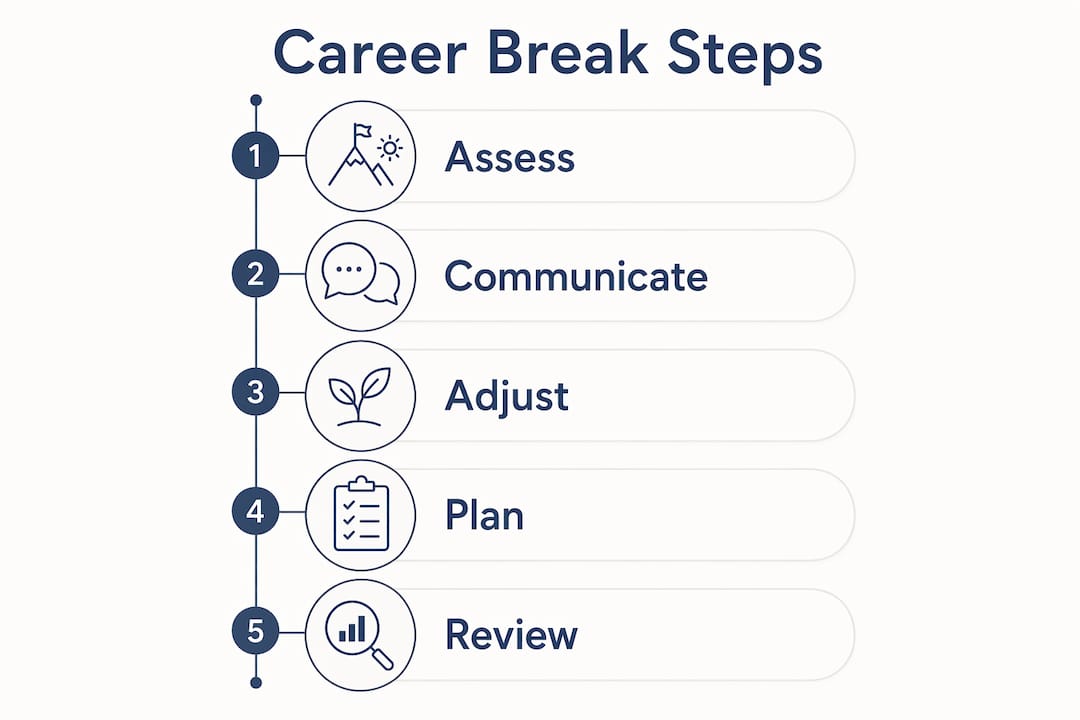
Practical money management during the career break
Budgeting on a single income requires more than trimming discretionary spending. The household cash flow needs a full reassessment, covering fixed obligations, insurance costs, and tax planning.
Key areas to address:
- Health insurance: Each partner in Switzerland holds an individual policy. Premiums do not change because one partner stops working, so budget for both policies in full. If the non-working partner previously received an employer subsidy, that benefit disappears and the full premium falls to the household.
- Pension fund (2nd pillar): During unpaid leave, employer and employee contributions to the pension fund stop. Some pension schemes allow voluntary continued contributions during a break. Where they do not, a pension fund buyback after returning to work can partially restore the lost capital.
- Joint versus individual assets: Switzerland does not automatically merge spouses’ assets or debts. Review which accounts, loans, and investments are held jointly and which are individual, particularly if the break changes who services which obligation.
- Tax filing: With one partner earning nothing, the household’s combined taxable income falls. This can reduce the marginal tax rate, but it also affects deductions. A tax adviser can identify whether adjustments to withholding tax instalments or voluntary pension contributions make sense for the current year.
Pro Tip: If your household has a Säule 3a account, the non-working partner cannot contribute in years with no AHV-liable income. The working partner should maximise their own 3a contributions during this period to keep private retirement savings on track.
Maintaining open communication about money is not just good practice. Couples who schedule regular financial check-ins, even a brief monthly review of actual spending against budget, tend to avoid the slow drift of untracked costs that can erode savings over a multi-year break.

Joint retirement planning: coordinating pensions and savings as a couple
The financial consequences of a career break compound over time, particularly for women. Research by the University of Neuchâtel, cited in the NZZ, found that a career interruption can lead to a lifetime income loss of up to CHF 900,000 for women, a figure that includes both the direct wage loss and the longer-term effect on pension entitlements. Only half of the women surveyed could correctly estimate the ten-year income impact of reducing their working hours after having children.
This is why joint retirement planning, not individual planning, is the right frame for couples facing a career break. Several Swiss-specific rules shape how that planning should work.
The AHV Plafonierung discussed above means that when both partners draw their pension simultaneously, the combined payout is capped. If one partner retires first and the other joins later, the first partner’s pension may be cut the moment the second begins drawing. Couples should model both scenarios before deciding on retirement timing.
On the pension fund side, staggering capital withdrawals across two separate tax years can save a material amount in taxes. Swiss tax authorities aggregate both partners’ capital withdrawals within the same calendar year, and progressive rates apply to the combined sum. Splitting withdrawals so that one partner draws at the end of one year and the other draws at the start of the following year breaks that progression.
Pension fund buybacks are another tool worth examining early. Buying back missing contribution years is financially more advantageous the sooner it is done, because the capital has more time to compound within the fund. A coordinated pension analysis, ideally starting around age 40, gives couples enough lead time to make buybacks, adjust retirement timing, and structure Säule 3a withdrawals across multiple years. Marmot Finance’s guide to Swiss pension optimisation covers this coordination in detail.
Pro Tip: Säule 3a accounts can be withdrawn from age 60 (women) or 61 (men), or deferred until age 70 if you continue working. Holding multiple 3a accounts and closing them in separate years is one of the most accessible tax-saving strategies available to Swiss residents.
Why professional financial advice matters for couples taking a career break
The interaction between AHV rules, pension fund regulations, tax law, and household budgeting is genuinely complex. A certified financial planner who specialises in Swiss pension and tax systems can identify gaps that a general budget review will miss.
Three areas where professional advice adds the most value for couples in this situation:
- Pension gap analysis: A planner can pull together AHV statements, pension fund projections, and Säule 3a balances to show the actual retirement income shortfall created by the break, and price the cost of closing it through buybacks or extended contributions.
- Tax coordination: Decisions about when to draw pension capital, how to split Säule 3a withdrawals, and whether to adjust tax instalments during the break all interact. Getting tax planning advice from a specialist who understands both partners’ positions together avoids costly mistakes.
- Gender impact awareness: Research consistently shows that the financial cost of career breaks falls disproportionately on women, through what economists call the “Child Penalty.” A planner who understands this dynamic can build strategies that protect the non-working partner’s long-term financial position, not just the household’s short-term cash flow. Marmot Finance’s financial advice for women addresses this directly.
Couples who seek advice proactively, before the break begins rather than after, have more options available. Retroactive AHV payments, pension fund buybacks, and tax-efficient withdrawal sequencing all require lead time to execute well.
Key takeaways
Swiss couples who plan shared finances carefully before a career break can protect both partners’ long-term pension entitlements and avoid unnecessary tax costs.
A financial planner’s perspective on career breaks and couples’ money
The couples who come to us having already taken a career break often share the same regret: they managed the immediate budget well but did not think about the pension until years later. By then, the five-year retroactive AHV window had closed on some of those missing years, and the pension fund buyback cost had grown considerably.
What I find underestimated, consistently, is the compounding nature of the loss. A two-year career break does not just remove two years of pension contributions. It often coincides with the years when pension fund savings rates are rising with age, when the compound growth on those contributions would have been highest, and when the working partner’s income was increasing. The gap in the pension statement looks small. The actual retirement income shortfall is much larger.
There is also a structural issue that couples rarely discuss openly: the career break almost always falls on the woman. Academic research from Switzerland shows that the lifetime income loss from a career interruption can amount to hundreds of thousands of francs for women, and that figure does not fully capture the pension reduction. The financial dependency this creates is real, and it deserves an honest conversation between partners, not just a budget spreadsheet.
The practical answer is joint planning, started early and revisited regularly. Not because the finances are impossibly complicated, but because the decisions interact in ways that are easy to miss when each partner manages their own accounts separately. A coordinated plan, covering AHV, the pension fund, Säule 3a, and tax timing, turns a series of individual decisions into a coherent strategy.
How Marmot Finance supports couples through career break planning
Marmot Finance is a FINMA-accredited wealth manager built specifically for women and families in Switzerland, and the career break scenario sits at the centre of what the firm does. Where a general financial adviser might review a budget, Marmot Finance coordinates the full picture: AHV gap analysis, pension fund buyback modelling, Säule 3a withdrawal sequencing, and tax-efficient investment management across CHF, EUR, and USD accounts.
The firm combines personal consultations with digital planning tools, so couples can track their household finances and investment positions between advisory sessions. For couples where the career break disproportionately affects one partner’s long-term financial security, that level of coordination is not a luxury. It is the difference between a plan that looks balanced today and one that holds up at retirement.
To discuss your situation with a specialist, get in touch with Marmot Finance and book an initial consultation.
Recommended
- Optimise family finances: Financial provision and planning
- Familienfinanzen optimieren: Finanzielle Vorsorge und Planung
- Financial independence for women: On the road to freedom
- Financial Advice for Women - Independent Clever Investing

.webp)





.jpeg)




.png)

.svg)


