
The first month in Lausanne decides more about your long-term finances than the next five years combined. Open a Swiss franc salary account, secure health insurance and a cash buffer, and start a Pillar 3a if you’re on a local contract. Get those three right, and everything else, including tax residency, investing, and retirement planning, becomes far easier to sort out. Financial advisers often guide expats through exactly this sequence, and the sections below walk through why it matters and what comes next on tax and pensions.
TL;DR:
- Opening a Swiss franc salary account, building an emergency fund of CHF 15,000 to CHF 30,000, and choosing the right health insurance franchise are critical in the first 90 days.
- Your tax residency depends on both presence and intent, with commune selection affecting your wealth and income tax rates significantly over your lifetime.
- Contributing to Pillar 3a offers immediate tax benefits, but delaying pension and investment decisions can reduce long-term wealth growth for expats.
- Multi-currency accounts and efficient international transfer strategies are essential if you hold assets or income in more than one currency to minimize costs and compliance issues.
- Prioritizing stable banking, insurance, and cash access first prevents exposure and makes subsequent tax and investment planning more effective.
Essential checklist for the first 90 days in Lausanne
Getting your finances stable in the first three months protects you from two things: paying more tax than necessary, and being caught without cover when something goes wrong. Here’s the order that actually works.
1. Open the right bank accounts. Most expats need at least two: a salary account for day-to-day spending and bill payments, and a separate savings account that isn’t linked to your debit card. If you still hold income or assets in another currency, a multi-currency account (either through a Swiss bank or a specialist provider) saves you from constant, costly conversions. Keep your investment capital separate from both, ideally with whoever manages your portfolio.
2. Set up salary routing and automated payments. Swiss rent, health insurance premiums, and utility bills are almost always paid via bank transfer or the country’s “orange slip” (bulletin de versement) system, not direct debit in the way many expats are used to. Set up standing orders for rent and insurance the moment you have a Swiss IBAN, so nothing lapses while you’re still finding your feet.
3. Build your emergency fund. A reasonable target is three to six months of essential expenses held in CHF, in an account you can access within a day or two, not locked into investments. For a single person in Lausanne, that typically means somewhere between CHF 15,000 and CHF 30,000 depending on your rent and family size.
4. Choose your health insurance franchise carefully. Basic health insurance is compulsory within three months of arrival, and you choose an annual deductible (franchise) that ranges from CHF 300 to CHF 2,500. A higher franchise means lower monthly premiums but more out-of-pocket cost if you actually need care. Guides for expats consistently recommend comparing franchise levels every year rather than sticking with your first choice, since your health needs and risk tolerance change.
5. Sort out pension registration immediately. If you’re employed locally, your employer registers you for the state pension (Pillar 1) and occupational pension (Pillar 2) automatically. Check your payslip to confirm contributions are actually being deducted correctly, and ask HR for your pension fund’s regulations document. If you’re eligible, open a Pillar 3a account within your first few weeks. It’s one of the few tax moves with an immediate, calculable return.
6. Gather your foreign paperwork now, not later. Foreign income statements, brokerage account summaries, property valuations, and previous tax returns all need to be declared once you’re a Swiss tax resident. Start a folder (digital or physical) from day one. Chasing this documentation from abroad six months later is a genuinely miserable experience.
What triggers Swiss tax residency, and why your commune matters
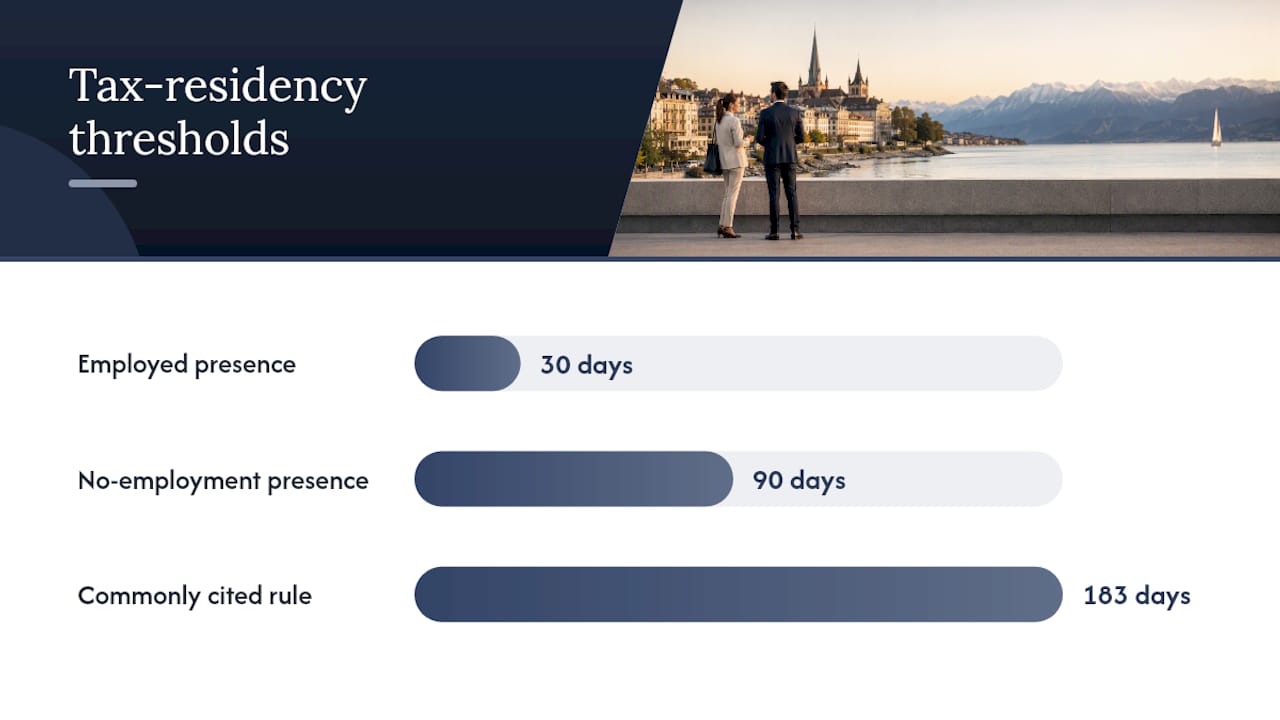
Many expats assume the 183-day rule is the whole story. It isn’t. Swiss tax authorities can treat you as resident well before that if you’ve moved with clear intent to settle, and presence rules can trigger unlimited tax liability after as little as 30 days of employed presence or 90 days without employment in some circumstances. Signing a permanent lease, enrolling children in local school, or bringing your household goods over all count as evidence of intent, regardless of what your passport stamps say.
There’s a meaningful difference between limited and unlimited tax liability. Under limited liability, generally tied to short-term employment presence, only your Swiss-source income is taxed. Under unlimited liability, which applies once you’re a genuine resident, Switzerland taxes your worldwide income and wealth, though double-taxation treaties usually prevent you from being taxed twice on the same income.
Switzerland also levies an annual wealth tax at both cantonal and municipal level, on top of income tax, and rates vary considerably depending on where you register. This is why canton and commune selection is often the single biggest discretionary tax lever available to an expat on a local contract, because moving a few kilometres within the Lausanne area can change your effective tax rate by a noticeable margin over a working lifetime.
Practical steps that make a real difference:
- Register with your commune’s population office within 14 days of arrival, and be consistent about your stated intentions.
- Keep organised, dated records of all foreign income and assets from your first month, not your first tax season.
- If you’re taxed at source (most non-permit-holders are), consider requesting an ordinary tax assessment, which can let you reclaim overpaid withholding tax and claim deductions the source-tax system doesn’t automatically apply.
For high-net-worth arrivals who aren’t taking up Swiss employment, lump-sum (forfait) taxation remains an option in Vaud, though it’s far from automatic. The minimum notional tax base is CHF 300,000, it requires a formal agreement with cantonal authorities, and it needs proactive legal advice well before you arrive, not after.
How do the Swiss pension pillars affect expat wealth?
Switzerland’s retirement system rests on three pillars, and understanding what each one does for you changes how you plan the next decade.
Pillar 1 is the state pension, funded through mandatory payroll contributions, designed to cover basic living costs in retirement. Pillar 2 is your occupational pension, run through your employer, and it’s where a meaningful chunk of your salary quietly accumulates over the years. Pillar 3a is the voluntary, tax-privileged personal pension, and for most salaried expats, it’s the highest-impact move available. Contributions are deducted from your taxable income up to an annual limit, which means the tax saving happens immediately, not in some distant future.
A few things worth knowing before you commit money:
- Pillar 3a contributions reduce taxable income the same year you make them, so timing your contribution before the year-end matters.
- You can choose between a cash-based 3a account or a securities-based one; the securities route carries more short-term risk but historically offers better long-term growth for money you won’t touch for years.
- Withdrawals are taxed separately from income, usually at a lower rate, and spreading withdrawals across several 3a accounts and several years can reduce that final tax bite.
- Voluntary buybacks into Pillar 2 can be worth considering if you have a gap in your contribution history, but they only make sense once you’ve modelled the tax saving against how long you’ll realistically stay in the Swiss system.
Pro Tip: Don’t rush into a Pillar 2 buyback in your first year. Buybacks are most valuable when you know you’ll stay long enough to benefit from the tax deduction and the eventual payout, and rushing one before your residency status is settled can backfire.
Leaving Switzerland eventually? Your occupational pension doesn’t just follow you home automatically. If you’re moving to another EU or EFTA country, mandatory Pillar 2 savings generally stay in a Swiss vested benefits account until retirement age, while the non-mandatory portion may be paid out, depending on your destination. Getting this wrong is one of the most common, and most costly, mistakes expats make on departure. Practical guides for expats consistently point to maximising Pillar 3a and getting pension exit planning right early as two of the three biggest levers available, alongside sensible long-term investing. Anyone weighing this up alongside broader investment decisions might find it useful to see how to prioritise investing, saving, and pension contributions laid out as a single framework.
Managing multi-currency banking and international transfers
If you’re earning in Swiss francs but still holding assets, income, or family obligations in another currency, your banking setup needs to do more than just hold money. It needs to move it efficiently.
Swiss retail banks are solid for day-to-day banking, mortgages, and building a local credit history, but their foreign exchange rates on international transfers are rarely competitive. Specialist multi-currency providers tend to offer tighter spreads and lower fees, particularly useful if you’re sending money home regularly or receiving rental income from a property abroad. The right setup usually depends on volume: occasional transfers might not justify switching providers, but a monthly remittance easily does.
A workable account structure for most expats looks like this:
- One CHF account for salary and local bills, kept simple and easy to reconcile.
- One separate account (Swiss or multi-currency) purely for your emergency cash buffer.
- Investment holdings kept apart from both, ideally with a manager who works across CHF, EUR, and USD so currency exposure doesn’t quietly erode returns.
To actually cut what you’re losing on transfers, compare providers’ real exchange rates rather than their advertised fees, since a “free transfer” with a poor rate often costs more than a small fee with a fair one. Larger sums benefit from limit orders, where you set a target exchange rate and the transfer executes automatically once the market hits it, rather than accepting whatever rate is live when you happen to log in. Batching several smaller transfers into one larger one also reduces the cumulative cost of fixed fees.
Pro Tip: Keep a simple spreadsheet logging every foreign transfer and account balance in its original currency. Swiss tax returns require you to declare foreign accounts and their year-end values, and reconstructing a year of currency conversions from memory in March is not how anyone wants to spend an evening.
For professionals managing income streams across borders, a cross-border financial planning approach built around consolidated reporting tends to catch these disclosure issues before they become a problem at filing time.
What does it really cost to live well in Lausanne?
Lausanne isn’t cheap, but the cost breakdown matters more than the headline number. Rent is usually the largest line item, and for expat families, international schooling often runs a close second, particularly if the local public system isn’t a fit for your children’s language stage. Health insurance premiums, transport, and groceries round out the core monthly budget, and each one has a lever you can actually pull.
Practical ways to soften the pressure on each bucket:
- Housing: shared or slightly smaller accommodation near Lausanne’s excellent public transport network often works out cheaper overall than a larger flat further out once you add commuting costs.
- Schooling: bilingual and local public options cost dramatically less than international schools, and Vaud’s public system has a strong reputation, worth genuinely considering rather than defaulting to the international option.
- Transport: an annual public transport pass (abonnement) usually beats pay-as-you-go fares if you’re commuting daily, and Lausanne’s metro and bus network covers most of the city well.
- Groceries: shopping at discount supermarkets rather than premium chains, and crossing into France for a monthly bulk shop, are common, unglamorous tactics that genuinely reduce household costs for newcomers.
Building a household budget that actually holds up means modelling more than one scenario. Run your numbers against your current commune’s tax rate, then check what changes if you moved even a short distance within the Lausanne area, since commune-level tax differences can shift your effective take-home income more than a modest pay rise would.
Choosing an adviser who understands cross-border finances
Not every financial adviser in Switzerland understands what it’s like to hold assets in three currencies, file taxes in two countries, and worry about a pension you might never fully collect if you leave early. Ask direct questions before committing to anyone.
Worth confirming on a first call:
- Are they FINMA accredited, and can they explain what that actually covers?
- Do they have genuine experience with cross-border tax situations, not just domestic Swiss clients?
- Can they show, even anonymised, how they’ve handled a Pillar 3a strategy or a Pillar 2 buyback decision for someone in a similar situation to yours?
- How are fees structured, and are they upfront about it before you sign anything?
- Do they understand Vaud’s specific cantonal rules, or are they applying general Swiss knowledge that doesn’t quite fit your commune?
A firm that can’t clearly explain how Pillar 3a interacts with your specific tax bracket, or dodges questions about buyback timing, isn’t ready for a cross-border client. Cross-border expertise shows up in the specificity of the answers, not the confidence of the pitch.
Some wealth management firms combine personal consultations with digital tools like the Money Makeover Quiz, so clients get a tailored strategy rather than a generic template, and pension planning that accounts for situations shaped by moving countries. Accredited managers working exclusively with Swiss and European clients across CHF, EUR, and USD accounts operate in the area this checklist describes.
Red flags worth walking away from: an adviser who can’t name your commune’s wealth tax rate off the top of their head, who pushes products before understanding your residency status, or who has no clear answer for what happens to your pension if you eventually leave Switzerland.
Your first-year financial calendar as an expat
Financial deadlines in Switzerland aren’t spread evenly through the year, they cluster. Missing a window often means waiting twelve months for the next one.
- January: review your Pillar 3a contribution limit for the year and set up automatic monthly payments so you’re not scrambling in December.
- Spring to mid-year: revisit your income projection, especially if you’ve had a raise or bonus, and start collecting receipts for anything tax-deductible, professional expenses, childcare, and further education included.
- Autumn: this is when fiduciary advisers typically recommend modelling whether a Pillar 2 buyback makes sense before year-end, and it’s also the sensible window to time any large asset sales or transfers for tax efficiency.
- Year-end: finalise every deductible expense, top up your Pillar 3a to the annual limit if you haven’t already, and check your emergency fund still covers three to six months of costs after a year of Swiss-priced living.
What should expats know before investing in Swiss property?
Buying property as a non-Swiss resident isn’t as simple as it is for citizens, and the rules genuinely depend on your residency permit. Permit C holders (permanent residence) are generally treated the same as Swiss citizens for property purchases. B permit holders and others often face restrictions under the Lex Koller foreign ownership rules, particularly around buying investment or holiday property rather than a primary residence.
Beyond the legal permissions, the financial mechanics matter just as much.
Property also interacts directly with your wealth tax bill, since Swiss cantons include your home’s taxable value in your overall net wealth calculation, not just your investment portfolio. That’s worth modelling before you buy, not after your first tax return arrives. And if you’re weighing property against other long-term holdings, remember that Swiss property is illiquid. Selling in a hurry, whether due to a job change or a move abroad, rarely happens on your timeline or at your preferred price.
For expats still renting, this is worth deciding deliberately rather than by default: buying ties up capital and reduces flexibility, but renting means your housing cost rises with the market indefinitely.
How Swiss inheritance law affects expat estate planning
Switzerland’s inheritance rules can catch expats off guard because they don’t work like a typical common-law will. Swiss law includes forced heirship, meaning a portion of your estate is legally reserved for close relatives, spouse and children primarily, regardless of what your will says. You can’t simply leave everything to a charity or a new partner if you have children with a statutory claim.
If you’re an expat with assets or family ties in more than one country, this creates real complexity. Which country’s inheritance law applies can depend on your nationality, your habitual residence, and sometimes an explicit choice you make in your will. Since 2013, Switzerland has allowed foreign nationals resident in Switzerland to elect for their home country’s inheritance law to apply instead, through a specific clause in their will, but this needs to be set up correctly and in advance. Leaving it unaddressed means Swiss forced heirship rules apply by default.
Practical steps that matter here:
- Draft or update your will after arriving in Switzerland, don’t assume a will written abroad automatically covers your Swiss assets correctly.
- Decide explicitly whether you want Swiss or your home country’s succession law to apply, and get that written into your will properly.
- If you hold property, investments, or accounts across multiple countries, coordinate your estate plan with advisers in each jurisdiction, since inheritance tax treatment also varies significantly by canton and by your relationship to the beneficiary.
Insurance that actually protects long-term wealth
Beyond the compulsory basic health insurance, a handful of insurance decisions genuinely protect the wealth you’re building, rather than just covering day-to-day risk.
Supplementary health insurance extends coverage beyond the basic mandatory policy, useful for private hospital rooms, alternative treatments, or dental work not covered by the basic scheme. It’s optional but worth weighing against your family’s actual health needs rather than buying reflexively.
Life insurance, particularly if you have dependents relying on your income, fills the gap that Pillar 1 and 2 survivor benefits don’t fully cover, especially in the early years before your pension has had time to build up. Term life policies are generally the most cost-efficient way to do this, without tying up capital the way whole-life or investment-linked policies do.
Disability and income protection insurance matters more for expats than many realise, because if you’re not yet vested in a strong occupational pension, a long-term illness or injury can hit your household finances harder than it would for someone with decades of Swiss pension contributions behind them.
Liability insurance (household and personal) is common practice in Switzerland and inexpensive relative to the protection it offers, covering everything from accidental damage to a landlord’s property to injuries you’re liable for.
The point of all four isn’t to insure everything possible, it’s to insure the specific gaps your particular situation as a newly arrived expat creates, which are usually different from the gaps a long-term Swiss resident has.
The conventional advice gets the order wrong
Most guidance aimed at expats leads with tax optimisation: maximise your Pillar 3a, model your wealth tax, chase the perfect canton. All genuinely useful, all genuinely secondary. If you arrive in Lausanne without a stable bank account, adequate insurance, and cash you can access within 48 hours, no tax strategy matters, because you’re financially exposed in ways that have nothing to do with the tax code.
The research here consistently supports a different priority order than most expats instinctively follow. Get compliant and secure first: banking, insurance, an emergency fund. Then optimise: Pillar 3a, residency planning, canton effects. Then grow: investing, pensions, property. Skipping straight to optimisation because it feels more sophisticated than opening a bank account is the single most common mistake this article’s research points to, and it’s an easy one to avoid once you see the sequence written down.
Get hands-on help with your Lausanne finances
Some firms exist for exactly the situation this article has walked through: an expat trying to make sense of Swiss pensions, cross-border tax exposure, and multi-currency accounts without a finance degree or a spare twenty hours a week. Unlike a traditional bank adviser who sees clients once a year, some firms pair a personal consultation with digital tools like the Money Makeover Quiz, so your Pillar 3a strategy, investment approach, and pension planning can be built around your actual situation, not a generic template. Accredited wealth managers working with clients across Switzerland and Europe manage CHF, EUR, and USD accounts, which matters if your finances span more than one currency.
If you’re based in the Lausanne area and want a clear next step, start with Marmot Finance’s wealth management service in Lausanne to see how a tailored plan would actually work for your situation, or explore the core wealth management approach to understand the process before booking a first conversation.
This article is general information, not a substitute for advice from a qualified financial advisor. Consult a qualified financial professional about your own circumstances before acting on anything here.
Sources
For rules that change or vary by canton, go straight to primary sources rather than relying on secondhand summaries.
- Saving money in Switzerland as an expat — Expatica
- OECD: Switzerland residency guidance
- Fiducompta: Optimising taxes in the canton of Vaud (2026)
Recommended
- Financial Planning for Expats in Switzerland
- Wealth Management in Lausanne
- Swiss Pension Optimisation in Lausanne
- Cross-Border Financial Planning in Zürich for International Professionals

.webp)





.jpeg)




.png)

.svg)


