

Where to start when you want to prioritise saving and investing in Switzerland
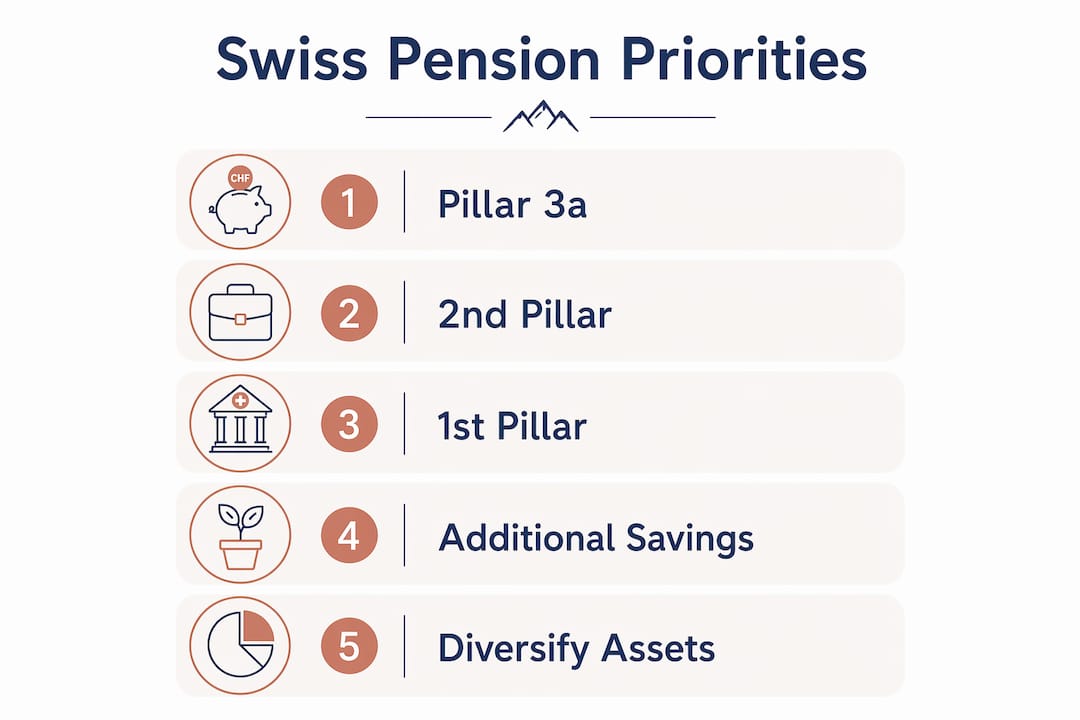
The most effective approach is straightforward: maximise your Pillar 3a contributions first, consider voluntary 2nd pillar buy-ins second, then invest in unrestricted assets third. Before any of that, an accessible emergency fund covering three to six months of expenses is non-negotiable.
- Step 1 — Emergency fund first. Pillar 3a funds are locked until five years before retirement. You cannot rely on them in a crisis, so liquid savings must come first.
- Step 2 — Maximise Pillar 3a. The annual limit for Pillar 3a contributions is CHF 7,258 for 2026; every franc contributed reduces your taxable income immediately, and investment gains inside the account accumulate free of income, wealth, and withholding tax.
- Step 3 — Voluntary 2nd pillar buy-ins. Once Pillar 3a is fully funded, voluntary buy-ins into your occupational pension fund are fully tax-deductible, though capital remains locked until retirement and interest rates are typically modest.
- Step 4 — Pillar 3b and unrestricted investing. Beyond the pension pillars, tax-efficient wealth structuring in unrestricted assets, such as equities, ETFs, or funds, offers liquidity and growth potential without federal tax deductibility.
- Step 5 — Adjust for life stage and family circumstances. Priorities shift considerably depending on whether you are building a career, raising children, approaching retirement, or managing a family office.
How the Swiss three-pillar system shapes your financial priorities
Switzerland’s three-pillar pension system is the foundation of every sound financial plan here. Understanding how each pillar functions determines where your money works hardest.
The 1st pillar (OASI/AHV) is state-run and pay-as-you-go: contributions from today’s workers finance current pensioners. Combined with the 2nd pillar, it is designed to replace around 60% of pre-retirement income for most employees. The 2nd pillar is mandatory for employees earning above CHF 22,680 annually, with contributions beginning from age 17 or 18. It operates on a funded model, meaning your contributions are invested and accumulate as personal retirement capital.
The 3rd pillar is where individual choice matters most. Pillar 3a is the tax-advantaged, restricted option. Stock-based 3a strategies have historically returned 5–7% annually, compared with roughly 0.5–1.5% in a standard 3a savings account, making equity allocation within 3a highly relevant for anyone with a time horizon beyond ten years. Pillar 3b covers all other voluntary private savings and investments. It lacks Pillar 3a’s federal tax deductibility, though certain cantons offer limited deductions on specific insurance premiums. It is the natural home for funds once 3a limits are fully used.

Pro Tip: Open multiple Pillar 3a accounts rather than one. Withdrawals are taxed as income at a reduced progressive rate, so staggering withdrawals across separate accounts and different tax years meaningfully reduces the total tax burden at retirement.
Life stage matters significantly. Women who take career breaks for family reasons often accumulate pension gaps in both the 2nd and 3rd pillars. Addressing those gaps early, through catch-up contributions or voluntary buy-ins, is particularly relevant for Swiss women’s wealth planning. For families, coordinating spousal withdrawals across tax years also prevents unnecessary progression into higher tax bands. Approaching retirement, the focus shifts from accumulation to liquidity planning and tax-efficient drawdown sequencing. For expats in Switzerland, understanding which pillars apply and how contribution gaps arise is equally pressing.
Precious metals such as palladium can also play a role in retirement portfolio diversification within unrestricted assets, though they sit firmly in the Pillar 3b category.
Marmot Finance: specialist wealth management for women and families in Switzerland
Marmot Finance is Switzerland’s only FINMA-accredited wealth manager dedicated exclusively to women and families. Where generic financial advice treats pension planning as a checklist, Marmot Finance builds strategies around each client’s actual circumstances, combining personal consultations with digital tools calibrated to Swiss pension regulations and tax law.
Over 350 women have already restructured their financial plans with Marmot Finance’s guidance. Whether the priority is closing a pension gap, optimising Pillar 3a allocation, or structuring unrestricted investments for long-term growth, the approach is always specific, not generic. Speak with a specialist to receive a personalised assessment of your pension and investment priorities.
Key takeaways
Prioritising saving and pension contributions in Switzerland means maximising Pillar 3a first, then voluntary 2nd pillar buy-ins, then unrestricted investing, always after establishing liquid emergency reserves.
Recommended
- Swiss Pension Optimisation in Lausanne | Marmot Finance
- Schweizer Rentenoptimierung in Lausanne | Marmot Finance
- Best Asset Classes for Women Investors in Switzerland | Marmot Finance
- Financial Planning for Expats in Switzerland | Marmot Finance


.webp)





.jpeg)




.png)

.svg)


