

Build an integrated structure, one that combines clear governance, a staged succession plan and professional stewardship, and you give family wealth a real chance of surviving three generations rather than dissolving after the second. The families in Herrliberg who preserve capital over decades treat structure, family rules and advice as one system, not three separate decisions. Marmot Finance works with families on exactly this kind of integrated planning.
TL;DR:
- Family governance and a written family constitution prevent disputes that could erode wealth and should be drafted with legal and financial advisors while relationships are calm.
- A coherent wealth structure involves designing ownership, residence, and succession together, with documented real substance and clear decision-making processes.
- Staged succession planning with formal legal documents and long timelines reduces the risks associated with sudden transfers or delayed preparation.
- Educating heirs through responsibility, mentoring, and practical training, especially in philanthropy, improves long-term stewardship far more than lump-sum inheritance.
- Diversifying investments beyond local real estate and understanding cross-border tax, inheritance, and residence laws are essential for preserving wealth in Herrliberg.
Why family governance and a family constitution protect wealth
Most family wealth doesn’t disappear because of bad investments. It disappears because siblings disagree, nobody wrote down who decides what, and a dispute drags on until the lawyers have taken a bigger share than the taxman ever would. A family constitution fixes that before it happens.

It’s a written document, agreed by the family, that sets out the purpose of the wealth (is it there to fund lifestyles, businesses, or philanthropy?), how decisions get made, and who holds which role.
A workable constitution usually covers:
- The family’s shared purpose for the wealth and what “success” looks like across generations
- Decision-making rules: who votes, what needs unanimous agreement, how deadlocks get resolved
- Roles and boundaries between family members, appointed trustees and external advisers
- A dispute-resolution process, agreed before anyone actually needs it
Draft it with a family lawyer and your wealth manager together, then revisit it every few years as the family grows. Governance frameworks combined with professional advice consistently outperform tax-driven structures alone when it comes to actually keeping wealth intact.
Pro Tip: Write the constitution while relationships are calm, not during a succession crisis. The document works precisely because nobody needed it yet when it was signed.
Designing a coherent wealth structure: holdings, foundations and substance
Piecemeal structuring is the quiet killer of family wealth. One adviser sets up a company for tax reasons, another opens an account for currency reasons, a third recommends a trust for privacy. None of them talk to each other, and five years later nobody can explain why the structure looks the way it does. That’s a problem, because tax authorities and courts increasingly ask for a defensible rationale behind every entity.
A coherent structure is built the opposite way: ownership, residence, succession and asset protection are designed together, so each part reinforces the others rather than working against them.
To document real substance behind a holding or foundation, check that you can show:
- A genuine board that meets and makes decisions, not a rubber stamp
- Actual premises or registered presence appropriate to the entity’s function
- Personnel or management involved beyond the family itself
- A clear economic reason for the structure, separate from tax savings alone
Holding companies work well as governance instruments when they include board rules, exit mechanisms and minority protections that prevent disputes years later. Foundations tend to suit families focused on long-term philanthropic purpose rather than commercial control.
Succession mechanics: staged handovers, legal instruments and timelines
Roughly 88% of Swiss companies are family-controlled, and a large share face a change of ownership within the next decade, according to research on Swiss family business succession. That statistic matters because most of those families start planning far too late.
A staged handover beats a single handover date almost every time. Give successors real responsibility gradually, test them on smaller decisions before larger ones, and build in formal checkpoints rather than one dramatic transfer.
The legal toolkit you’ll need alongside that plan includes:
- A will that reflects current family circumstances, reviewed after major life events
- A marriage contract or matrimonial property agreement, especially where spouses come from different jurisdictions
- Shareholder agreements with clear buy-sell clauses for family businesses
- Powers of attorney covering incapacity, not just death
For families with a business or major asset event on the horizon, a five to ten year runway gives successors time to be tested and gives the family time to adjust the plan. Waiting until retirement is, frankly, the riskiest possible approach.
Preparing heirs: education, values transfer and practical training
Structures and legal documents only work if the people inheriting them understand what they’re for. Teaching heirs stewardship through gradually increasing responsibility, under supervision, tends to work far better than handing over a lump sum and hoping for the best.
Families that do this well tend to use a mix of:
- Mentoring from senior family members or trusted external advisers
- Internships or shadow roles within the family business or investment committee
- Regular family council meetings where younger members can ask questions and voice opinions
- Retreats focused specifically on shared values and long-term goals, separate from business meetings
Responsibility should scale with age and demonstrated capability, not simply with birth order. A 22 year old managing a small discretionary allowance under guidance learns more than a 35 year old suddenly handed full control.
Philanthropy works particularly well as a training ground here. A modest family purpose fund lets younger members practise decision-making, budgeting and governance on something that matters to them, with far lower stakes than the main family balance sheet.
Pro Tip: Give the next generation a small pool of capital to manage themselves, with real oversight but real consequences too. Mistakes on £20,000 teach more than lectures ever will.
Investment policy and asset-protection measures for long-term capital preservation
Multigenerational portfolios need a different mindset to a typical growth portfolio. The goal isn’t maximum return this decade, it’s capital that still exists, in real terms, for grandchildren who haven’t been born yet.
That usually means a long-term allocation tilted towards durable, diversified assets, including a meaningful allocation to real assets and businesses with tangible substance, alongside liquid holdings that can fund tax bills or emergencies without forcing a bad sale.
Concrete protective measures worth putting in place early:
- Custody arrangements that segregate family assets clearly from operating business risk
- Adequate liability insurance for family members in governance or director roles
- Legal structures that separate personal exposure from business or investment risk
- Regular independent review of the whole portfolio, not just individual holdings
Families that combine clear governance with professional advice consistently preserve wealth better than those relying on tax engineering alone. Growth still matters, but it comes second to making sure the capital survives the next market downturn, the next divorce, and the next inheritance tax bill.
Tax, residence and legal points that materially affect wealth transfer
Residence decisions carry more weight than most families realise. Where you live changes how worldwide income is taxed, which succession law applies, and even which matrimonial property regime governs a marriage, so it needs to be modelled across the whole structure, never chosen for tax reasons in isolation.
Switzerland’s cantons apply different inheritance and estate tax rules, and families holding illiquid assets, property, a business, art, can face real liquidity pressure when a tax bill falls due unexpectedly. Early planning avoids forced, badly timed sales.
Before any major decision, involve:
- A tax lawyer familiar with cross-border and cantonal rules
- A notary for wills, marriage contracts and property transfers
- Your wealth manager, to keep the investment portfolio aligned with the legal plan
Liquidity planning for eventual tax obligations deserves its own conversation with advisers, ideally years before it’s needed. Our guide on estate planning essentials covers wills and matrimonial property agreements in more depth.
Family office and hybrid options: when to professionalise
Not every family needs a dedicated family office. Many are far better served by a hybrid model, a small internal team handling governance and reporting, with specialist tasks like tax structuring or alternative investments outsourced to external experts.
- In-house family office: makes sense once assets and complexity justify full-time staff, typically for the largest, most complex family fortunes
- Fully outsourced model: suits families who want professional management without building internal infrastructure
- Hybrid model: combines internal oversight with external specialists, offering scalability while preserving family control
Most families start hybrid. Keep governance and high-level decision-making close to home, and outsource investment execution, tax compliance and reporting to specialists. Review the arrangement every few years as the family’s needs change.
Local Herrliberg-specific investment opportunities and risks
Herrliberg sits on the Gold Coast of Lake Zurich, and that geography shapes both the opportunity and the risk for families based here. Property values along this stretch of the lake have historically held up well, which makes real estate an attractive core holding, but it also concentrates risk if a family’s wealth is disproportionately tied to a single house or a small cluster of local land.
The practical lesson is diversification away from the immediate area, not out of distrust of the local market, but because a family’s future shouldn’t depend on one postcode’s property cycle. Families here often already hold significant equity in a primary residence, so the investment portfolio should deliberately balance that concentration with liquid, globally diversified holdings.
There’s also a Swiss franc consideration specific to this kind of wealth. Currency strength has historically protected purchasing power for francs-based families, but it can quietly erode returns on unhedged foreign holdings if a portfolio isn’t actively managed with that in mind.
Local business ownership is common among Herrliberg’s wealthier households, often multi-generational firms with roots in the region. These carry the same succession risks discussed earlier, staged handovers and documented governance matter just as much for a family business based in Herrliberg as for one anywhere else in Switzerland. The risk isn’t unique to the location, but the concentration often is, given how many families here built their wealth through one enterprise rather than a diversified portfolio from the start.
Implications of Swiss banking secrecy and privacy for wealthy families
Swiss banking privacy has changed substantially over the past decade, and families still planning around the old assumptions are working from outdated information. Automatic exchange of information now applies between Switzerland and most major economies, meaning account details are routinely shared with tax authorities in a client’s country of tax residence. Privacy from other governments, in the traditional sense, is largely gone.
What remains, and it’s meaningful, is privacy from the general public and from business competitors. Swiss financial institutions still maintain strict confidentiality standards that prevent casual disclosure of account information to third parties without legal process. For families concerned about visibility in local communities, or protecting details of a family business from competitors, this still matters considerably.
The practical implication is that structuring should never be built around evading tax reporting, that approach carries real legal risk and increasingly doesn’t work anyway. Instead, families should focus on legitimate privacy protections: appropriate use of holding structures, careful control over who has access to financial information, and working with advisers who understand both the legal reporting obligations and the legitimate confidentiality tools still available.
Marmot Finance’s FINMA-accredited status means every client relationship operates within this modern, transparent regulatory framework, privacy protection without the legal exposure of outdated secrecy assumptions.
Impact of Swiss inheritance laws specific to Herrliberg on wealth preservation
Herrliberg sits in the Canton of Zurich, and cantonal law shapes inheritance planning here more than many families expect. Switzerland’s forced heirship rules mean a portion of an estate must legally pass to certain heirs, typically children and spouses, regardless of what a will states. This limits how freely a family can redirect wealth even with careful planning.
Zurich has its own cantonal rules on inheritance and gift tax, and rates differ depending on the relationship between the deceased and the beneficiary. Direct descendants and spouses generally receive more favourable treatment than more distant relatives or unrelated beneficiaries, so the structure of who inherits what can materially change the tax outcome, separate from the total value transferred.
Families with illiquid wealth, property, in particular, given Herrliberg’s real estate values, need to think carefully about how heirs would actually pay any tax due without being forced to sell a family home. This is where the liquidity planning discussed earlier becomes concrete rather than theoretical: a family with most of its wealth in a lakeside property needs a plan for covering inheritance tax obligations well before they arise.
Reviewing a will and estate plan against current cantonal rules, ideally with both a notary and a tax lawyer, should happen periodically, not just once. Cantonal law changes, family circumstances change, and a plan drafted a decade ago may no longer reflect either.
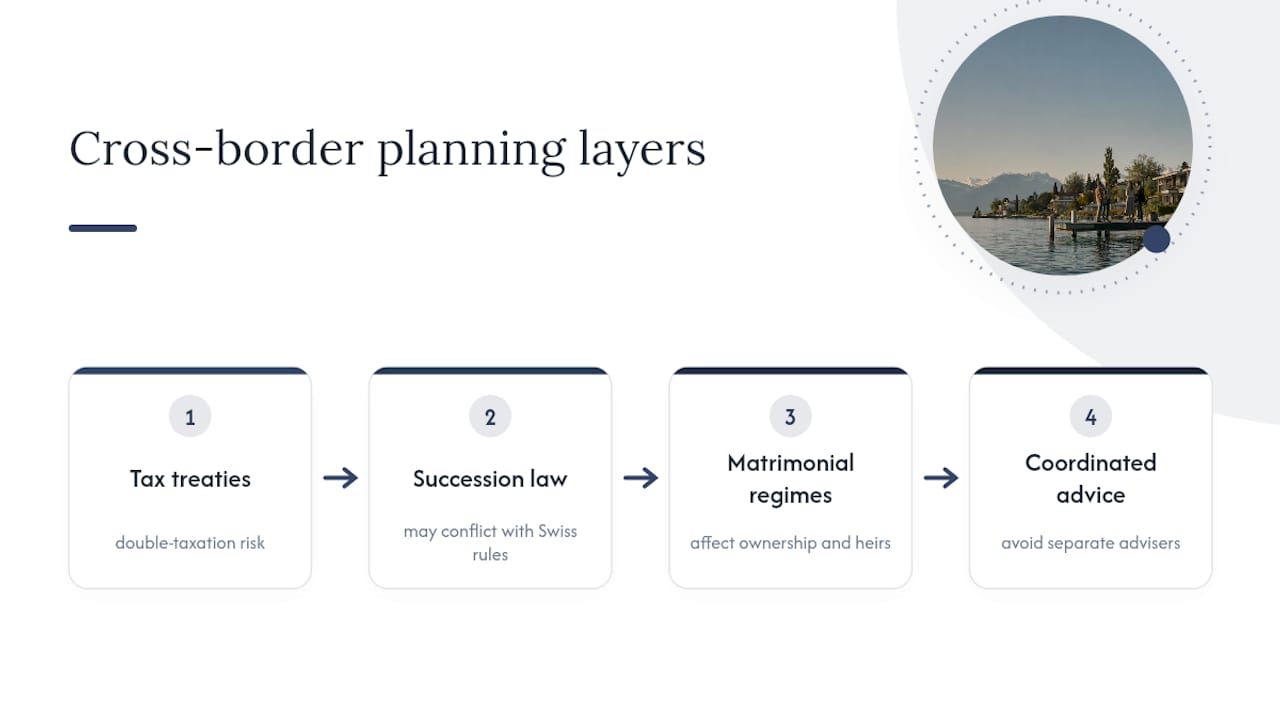
Cross-border considerations for families with international ties living in Herrliberg
Herrliberg’s international community means many households here have financial ties, family members, property, or business interests, spanning multiple countries. That cross-border reality adds real complexity to wealth preservation planning that purely domestic Swiss families don’t face.
The most immediate issue is double taxation risk. A family with income or assets in more than one country needs to understand how tax treaties between Switzerland and those countries actually apply, since the rules vary considerably by jurisdiction and asset type. This isn’t something to guess at; it needs specific professional review for each country involved.
Succession law adds a second layer. Different countries apply different rules on who inherits what, and those rules can conflict with Swiss forced heirship provisions. A family with a holiday property in another EU country, for example, may find that country’s succession law applies to that specific asset, regardless of what a Swiss will states. The EU Succession Regulation allows some choice of governing law for EU nationals, but Swiss residents need specific advice on how that interacts with Swiss rules.
Matrimonial property regimes compound this further for couples where each spouse holds a different nationality or was previously resident elsewhere. The regime governing a marriage can differ from what either spouse assumes, with direct consequences for what each party owns and what passes to heirs.
For any family in this position, the advice is consistent: don’t let separate advisers handle separate countries in isolation. A coherent structure has to account for every jurisdiction a family touches, or gaps between systems become the exact spot where wealth leaks out.
Marmot Finance: how we partner with families to preserve wealth
Marmot Finance is a FINMA-accredited wealth manager built specifically around the needs of women and families across Switzerland and Europe. We combine personal advice with digital tools, so families get both a real relationship and clear visibility into their own numbers.
Our clients use tools like the Money Makeover Quiz to get an honest first read on their financial position, then work with a coach or adviser on a tailored mandate that reflects their actual family situation, not a generic template. Over 350 women have already used Marmot’s guidance to build clearer, more confident financial plans, several with the multigenerational structures this article describes already in place.
— Tom
A clear next step: contacting Marmot Finance for an initial review
Marmot Finance is the alternative to a traditional Swiss private bank for families in Herrliberg who want governance, succession and investment strategy handled as one coordinated plan, not three separate conversations with three separate firms. Where many banks default to generic portfolios, Marmot builds a mandate around your actual family structure, your successors, and your long-term goals.
An initial review with Marmot typically covers your current structure, your succession timeline, and what documentation you already have in place, wills, marriage contracts, shareholder agreements. There’s no obligation attached to that first conversation, and no pressure to sign anything before you’re ready.
If you’re ready to see how an integrated plan would work for your family, start with our wealth management services page, or explore our local Herrliberg wealth management offering to see what a first conversation looks like.
This article is general information, not a substitute for advice from a qualified financial advisor. Consult a qualified financial professional about your own circumstances before acting on anything here.
Sources
- Wealth Structuring Switzerland | Goldblum and Partners
- Law
- Hybride Family-Office-Strategien im Wealth Management | Pictet
Recommended
- Wealth Management in Herrliberg
- Long-term wealth planning in Switzerland: securing generational wealth
- Preserving Generational Wealth: Private Wealth Management in Switzerland
- Sustainable Investing in Herrliberg


.webp)





.jpeg)



.png)

.svg)


