

The clearest way investors can manage risk after Davos is to act before the headlines fade: build a liquidity buffer, stress-test your core convictions against real scenarios, hold price discipline on anything fashionable, and spread exposure across sub-sectors rather than broad labels. The World Economic Forum frames this year’s Davos discussions about elevated geopolitical and systemic risk, which rewards portfolios built for resilience over ones built for headlines. A wealth manager with experience in Switzerland and Europe can help turn this kind of thinking into a concrete plan.
TL;DR:
- Building a liquidity buffer sufficient to cover several months of obligations prevents forced sales during market downturns.
- Conduct scenario testing and set clear risk budgets to prepare for systemic risks like geopolitical tensions and climate-related costs.
- Use granular sector and factor diversification to avoid concentration risks hidden within broad asset class labels.
- Implement specific, rule-based triggers for rebalancing and hedging to remove emotion from decision-making amid market shocks.
- Engage a FINMA-regulated Swiss wealth manager for tailored advice on structuring, cross-border planning, and applying Swiss-private banking tools.
Marmot Finance
Build A Clearer Investment Plan
Marmot Finance helps women and families in Switzerland and Europe manage investments through personal consultations and digital tools.
Immediate priorities after Davos: a quick checklist
Before anything else, run through this list. None of it requires a crystal ball, just discipline.
- Liquidity buffer: hold enough cash or near-cash to cover several months of planned withdrawals or obligations, so you’re never forced to sell into a falling market.
- Explicit risk budget: decide in advance how much your portfolio can lose in a bad quarter before you act, and write down what “acting” means.
- Granular diversification: spread bets within sectors, not just across them. Two “tech” holdings can behave identically if they share the same supply chain risk.
- Short-term hedges: currency forwards or index put options can smooth a rough patch, but they cost money and need a clear exit plan.
- Who to call: a FINMA-regulated wealth manager or private bank for anything involving structured products, cross-border tax, or protection vehicles like PPLI.
Most of this costs little beyond time and attention. The hedging and structuring pieces are where professional advice starts to earn its fee.
What do Davos themes actually mean for your portfolio?
Davos panels talk in big, sweeping terms. Geopolitical fragmentation. Climate transition. Technological disruption. The trick for an investor is translating that language into something you can actually price.
The World Economic Forum’s framework identifies six systemic risks that investors need to track, alongside a six-step process: Understand, Collaborate, Design, Invest, Transform, Monitor. Behind that framework sits a striking number: the WEF estimates a substantial annual investment gap to properly address these risks. That gap tells you something practical. Governments and institutions aren’t going to close it quickly, which means the risks it represents (climate transition costs, resource scarcity, health system strain) will keep showing up in market pricing for years, not quarters.
Geopolitical themes translate into investor risk through a handful of predictable channels. Trade tensions and export controls hit supply chains, which shows up first in input costs and delivery times before it ever reaches a company’s earnings call. Currency moves follow interest rate divergence between central banks, often triggered by exactly the kind of policy signalling that dominates Davos sideline conversations. Regulatory risk tends to cluster around whatever sector is politically convenient that year, energy and technology being the current favourites in both Europe and the US.
During and after the forum, a few signals are worth watching without overreacting to any single one. Sharp moves in the Swiss franc or the euro against the dollar often reflect shifting rate expectations rather than anything said in Davos itself. Commodity price swings, particularly in energy, tend to react faster to actual policy announcements than to panel discussions. And broad sentiment indices, credit spreads widening being the most useful one, tell you whether markets are pricing in more caution than the headlines suggest.
None of these signals demand instant trades. They demand attention, and a plan for what you’ll do if they persist.
What are the practical strategies for building resilience?
Resilience isn’t a mood. It’s a set of specific portfolio choices you make before the next shock arrives, not during it. The WEF’s own research on resilience as a value driver argues that institutions using scenario testing and explicit risk appetite recover faster and capture more upside than those reacting in real time. Here’s how that translates into an actual portfolio.
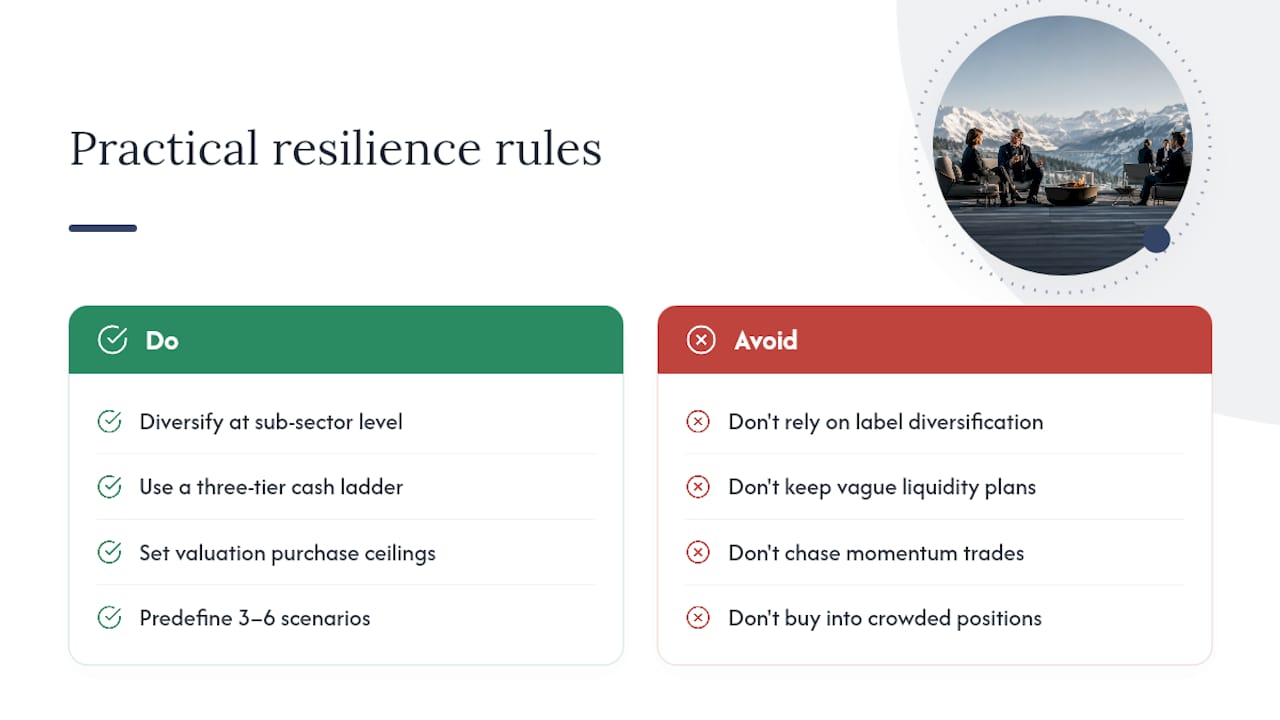
1. Granular diversification, not label diversification. Owning a “global equity fund” and an “emerging markets fund” can still leave you dangerously concentrated if both are exposed to the same semiconductor supply chain or the same interest rate sensitivity. Real diversification means looking inside the fund: how much overlap exists between your holdings at the sub-sector level? Multi-factor equity exposure (blending value, quality, and low-volatility factors rather than betting on one style) reduces the odds that a single macro surprise wipes out several positions at once. Private market allocations, where liquidity allows, add another layer that doesn’t move in lockstep with public markets.
2. Liquidity management with actual rules, not vague intentions. A useful structure is a three-tier cash ladder: immediate cash for 3 to 6 months of needs, high-quality short-duration bonds for the next 6 to 18 months, and everything else invested for growth. Laddering bond maturities (rather than buying one large tranche) means you’re never forced to sell at a bad moment just because a single bond matured at the wrong time. Backtesting against historical treasury yield data helps you see how a given ladder structure would have performed through past rate cycles, which is far more useful than guessing.
3. Price discipline, especially on Davos-fashionable trades. The WEF’s own guidance on building resilient portfolios points to price discipline and granular diversification as the two habits that separate long-term investors from momentum chasers. In practice, that means setting a valuation ceiling before you buy anything trending, and walking away when a position becomes crowded regardless of how compelling the story sounds on a Davos panel.
4. Explicit scenario allocations. Rather than one guess about the future, build 3 to 6 plausible scenarios (a rate shock, a trade disruption, a currency crisis, a benign continuation) and quantify roughly how each would affect your specific holdings. This kind of granular scenario testing with defined trigger points is what turns resilience from a buzzword into an actual decision framework. When a scenario starts playing out, you already know what you’ll do.
5. Hedging instruments, used sparingly. FX hedges reduce currency risk but cost ongoing premium and can drag on returns in calm periods. Options overlays offer defined downside protection but need active management and expertise most private investors don’t have time for. Tail-risk funds smooth extreme outcomes but typically underperform in normal markets, sometimes for years at a stretch. None of these are “set and forget” tools.
6. Governance rules that remove emotion from the equation. The simplest version: write down, in advance, the specific market conditions that would trigger a rebalance, and the specific conditions that would trigger a hedge. Then follow that document instead of your gut when the moment arrives.
Pro Tip: Write your rebalancing triggers down before the market moves, not after. A rule you set during a calm Tuesday afternoon is far more reliable than a decision made while watching a 4% drop unfold live.
Patient capital has a genuine advantage here. The WEF notes that long-horizon investors willing to provide flexible capital to climate-tech and private market projects as mentioned in the WEF guidance can capture opportunities that short-term traders miss entirely, precisely because those opportunities look unattractive on a one-year view.
When should you act: before, during, or after Davos?
Timing matters almost as much as the strategy itself. Rushing a portfolio change the week of the forum, when headlines are loudest and liquidity in some markets thins out, is rarely the right move.
Before Davos (weeks ahead): This is when the real work happens. Review your current exposures at the sub-sector level, not just the asset-class level. Set your scenario triggers and risk budget while markets are calm and you can think clearly. Size any hedges conservatively, since you’re buying insurance against uncertainty you haven’t yet seen play out.
- Confirm your liquidity buffer covers your actual near-term obligations, not a generic rule of thumb.
- Write down 3 to 6 scenarios and what each would mean for your specific holdings.
- Check whether any positions have become crowded or overvalued relative to your own entry rules.
During Davos week: Watch the signals you defined in advance (currency moves, commodity swings, credit spread changes) rather than every soundbite from every panel. Resist the urge to trade on a single headline. If something genuinely shifts your scenario probabilities, document why before acting, not after.
Three to six months after: This is the review window, and it’s where most investors underperform simply by skipping it. Reassess which of your scenarios actually played out, rebalance back toward your target allocations, and look specifically for opportunities that your price discipline rules created. Markets that overreacted to Davos-adjacent headlines often correct within this window, and disciplined investors who held cash for exactly this purpose are best placed to act.
Trading costs and tax timing deserve a mention here too. Frequent rebalancing may increase transaction costs and tax liabilities; quarterly or semi-annual reviews often better serve long-term investors. If your structure involves cross-border elements, a Swiss-based tax review before you rebalance is worth the conversation with an adviser.
What Swiss structures and advisers can help implement this?
Switzerland offers a genuinely useful toolkit for investors who want to move from plan to execution, provided you match the tool to the actual need rather than the fashionable one.
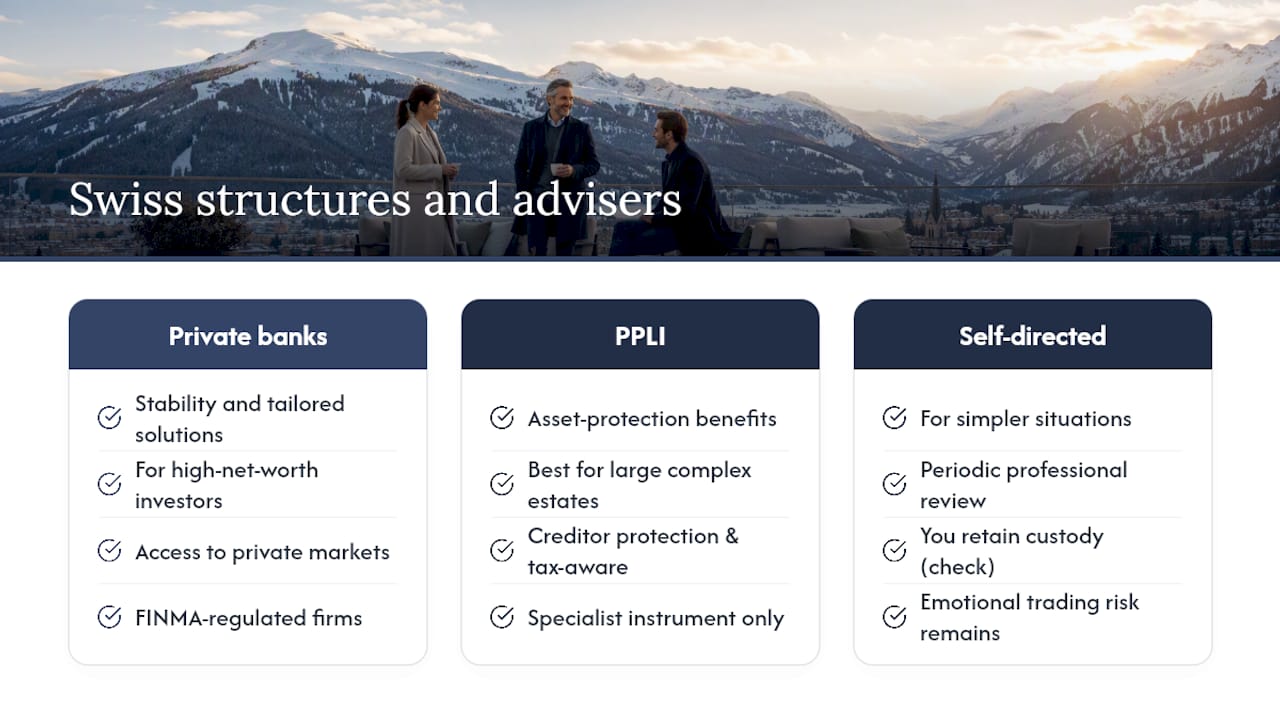
Swiss private banks and independent, FINMA-regulated wealth managers are built for exactly this kind of resilience work. Lombard Odier’s research notes that private banking in Switzerland offers stability and tailored solutions that help high-net-worth investors preserve and grow assets through uncertain periods, including access to private markets that individual investors typically can’t reach on their own.
For specific situations involving larger estates, cross-border families, or asset protection concerns, private placement life insurance (PPLI) under Swiss or Liechtenstein regimes can offer asset-protection benefits when used appropriately. Centrolaw’s analysis explains that PPLI can offer creditor protection and tax-aware structuring when set up correctly, but it’s a specialist instrument. It typically suits larger, more complex situations rather than a standard investment portfolio, and it absolutely requires bespoke legal and tax advice rather than a do-it-yourself approach.
Deciding between a delegated wealth-management mandate and managing changes yourself comes down to complexity and time. If your situation involves multiple jurisdictions, currencies, or a genuine need for scenario-based rebalancing discipline, a mandate removes the emotional trading risk entirely. If your needs are simpler, a self-directed approach with periodic professional review can work fine.
Whichever route you choose, run basic due diligence first: confirm FINMA regulation status, check how reporting is structured, and understand exactly who holds custody of your assets and under what arrangement.
How does Marmot Finance turn Davos themes into a client plan?
Marmot Finance builds Davos-style thinking into ordinary client conversations, not just annual reviews. When geopolitical or systemic themes surface at the forum, the practical question for a client isn’t “what does this mean for markets in general” but “what does this mean for my specific holdings, my currency exposure, and my timeline.”
That starts with the same scenario-testing discipline the WEF recommends: translating macro themes into a handful of concrete scenarios, then checking how a client’s actual portfolio would respond to each. For clients with cross-border ties or larger estates, that conversation extends to diversification structures designed to reduce concentration risk at the sub-sector level, not just across broad asset classes.
Liquidity planning follows the same logic. Rather than a generic cash rule, Marmot works through each client’s actual near-term needs, whether that’s a planned property purchase, a pension drawdown, or simply peace of mind, and sizes the buffer accordingly.
For readers who want to see where they currently stand, the Money Makeover Quiz is a genuinely useful starting point: it maps your existing exposures and risk tolerance before any conversation about changes begins. Financial coaching sessions then work through the specific triggers and rules that suit your situation, rather than applying a one-size template. If your circumstances involve complexity that goes beyond a standard portfolio review, that’s exactly the point at which speaking with a regulated adviser earns its cost.
Why resilience should be seen as a source of return, not just protection
Most investors treat resilience as insurance: a cost you accept to sleep better at night. That’s a mistake. The evidence from Davos-adjacent research consistently points the other way. Investors with patient capital and the discipline to hold price limits actually outperform reactive traders over full market cycles, not despite their caution but because of it. Panic selling locks in losses; disciplined rebalancing captures the recovery that follows.
The gap between knowing this and doing it is entirely about preparation. Write your rules down before you need them. For anything involving cross-border tax or protective structures, that’s where a regulated conversation matters far more than another article.
How Marmot Finance can help you put this into practice
Marmot Finance is the FINMA-regulated wealth manager built specifically for women and families across Switzerland and Europe who want a clear, disciplined plan rather than a reactive one. If the strategies above feel right in principle but you’re unsure how to size your own liquidity buffer or set realistic scenario triggers, seeking expert advice that combines personal consultations with digital tools can help ensure you aren’t guessing what to do next.
A sensible first step is the Money Makeover Quiz, which maps your current exposures and risk appetite in a few minutes. From there, you can request a portfolio review through Marmot’s wealth management services, or explore the dedicated Davos-area service page if you’re based nearby. For clients further afield, the Basel wealth management team offers the same regulated, hands-on approach. Book a review to see exactly where your portfolio stands against the risks discussed here.
Primary sources and further reading
The claims in this article draw on a small set of authoritative sources rather than general market commentary.
The World Economic Forum’s risk framework sets out the six systemic risks and the $6.27 trillion investment gap referenced throughout. Its companion piece on resilience as a value driver underpins the scenario-testing and governance recommendations. The Forum’s practical guide to building a resilient portfolio supports the price discipline and diversification strategies covered above. On Swiss-specific structures, Lombard Odier’s commentary covers private banking’s role for high-net-worth investors, while Centrolaw’s legal note explains PPLI’s use and limits under Swiss and Liechtenstein regimes.
This article is general information, not a substitute for advice from a qualified financial advisor. Consult a qualified financial professional about your own circumstances before acting on anything here.
Sources
- World Economic Forum press release: framework to help investors address six global risks
- Asset protection to safeguard wealth — Centrolaw
- Private banking in Switzerland: navigating market swings for HNWIs | Lombard Odier
Recommended
- How to prioritise investing, saving, and pension contributions in Switzerland
- Portfolio Diversification in Switzerland: Reducing Risk in 2026
- How to invest a lump sum in Switzerland
- The 3rd Pillar: More Than a Fad


.webp)





.jpeg)




.png)

.svg)


