

If your time horizon is ten years or more, the evidence is clear: deploy the full amount now into a diversified portfolio matched to your risk tolerance. Historical analysis shows that lump-sum investing outperforms dollar-cost averaging roughly 65–68% of the time when measured over typical long windows. The main exceptions are investors with a short horizon, an immediate liquidity need, or a genuine tendency to panic-sell during a downturn.
Before you act, run through three quick checks:
- Emergency buffer first. Keep three to six months of living expenses in an instant-access account before investing anything.
- Short-term goals. Any money needed within two to three years belongs in cash or a fixed-term deposit, not equities.
- Behavioural honesty. If a 20% paper loss would cause you to sell, a staged approach may serve you better in practice, even if it costs you in expected returns.
Your actionable next step, within 48 hours: confirm your cash buffer is in place, identify the account type you will use (brokerage, wealth manager, or pillar 3a), and draft a target allocation on paper before you transfer a single franc.
Pro Tip: Write your intended allocation down before you open any account. Investors who commit to a plan in writing are far less likely to deviate when markets move against them in the first weeks.

What counts as a lump sum, and where does it usually come from?
A lump-sum investment is a single, one-off transfer of capital into an investment portfolio, as opposed to the regular monthly contributions most people associate with pension saving or a standing order into a fund. The defining feature is that the money arrives all at once, and the decision of what to do with it must be made deliberately rather than by default.
In Switzerland, lump sums typically arise from a handful of well-defined events:
- Inheritance or gift. A bequest from a parent or grandparent, often including property, securities, or a bank account.
- Property sale. The proceeds from selling a second home, an investment property, or a primary residence after downsizing.
- Business exit. A founder selling their company, or a shareholder receiving a buyout.
- Employment bonus or long-term incentive. A senior executive receiving a deferred bonus or share-based award that vests in one tranche.
- Pension lump sum. A capital withdrawal from an occupational pension (pillar 2) at retirement, which is taxed separately from ordinary income in Switzerland.
- Divorce settlement or insurance payout. Less common, but equally significant in scale.
Consider a typical scenario: a woman in her mid-fifties sells the family’s second home in the Valais for CHF 800,000 after the children have left home. After repaying the remaining mortgage and paying cantonal transfer taxes, she receives a net CHF 580,000. She has no immediate need for the money, a pension already in place, and a fifteen-year horizon before she plans to draw on capital. That is precisely the situation this guide is written for.
Why does the decision matter so much? Because time in the market compounds. A sum left in a current account for twelve months while its owner deliberates is a sum that has already paid a real cost, even if no fee appears on a statement.

Pro Tip: If your lump sum includes a pension capital withdrawal from pillar 2, note that it is taxed at a reduced rate, separately from your other income, in the year of withdrawal. The canton of residence at the time of withdrawal determines the rate. Plan the timing carefully with a tax adviser before you request the payment.
Lump-sum investing versus staged investing: what does the evidence actually say?
The academic and practitioner consensus is consistent. Lump-sum investing outperforms dollar-cost averaging (DCA) in many historical scenarios, and the performance gap tends to widen the longer the DCA period runs. The logic is straightforward: markets rise more often than they fall over long periods, so money deployed immediately has more time to benefit from that upward drift.
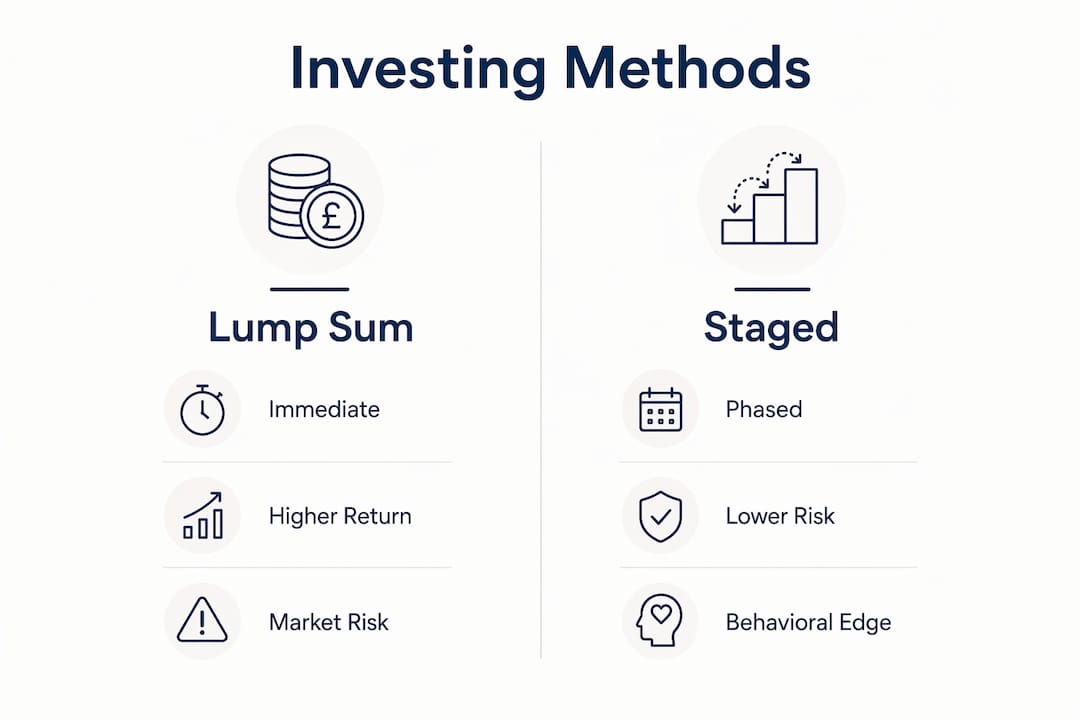
That said, the behavioural gap is real and should not be dismissed. If an investor would panic-sell after an early loss, staged investing may produce better realised outcomes for that person, even though expected returns are lower on paper. The correct strategy is the one the investor will actually stick with through a 20–30% drawdown.
Comparing the two approaches
Three scenarios illustrate the trade-off clearly:
- Rising market, stable investor. Immediate deployment wins. Every month of delay is a month of growth foregone.
- Falling market shortly after investment. DCA wins on paper, but only if the investor stays invested. An investor who sells after a 15% drop has lost the benefit of both strategies.
- Investor prone to panic-selling. DCA is the pragmatic choice, not because it is mathematically superior, but because it keeps the investor in the market. A staged schedule of 6–12 months is a common compromise in Swiss practice.
Statistic: Vanguard and other historical analyses report that lump-sum investing outperforms DCA roughly 65–68% of the time when measured over typical long windows.
A practical middle path: invest the bulk of the sum immediately and stage a smaller tranche over a few months. This preserves most of the statistical advantage of immediate deployment while giving the investor a psychological foothold during volatile early weeks.
Pro Tip: If the main reason you are considering staged investing is fear of an early loss, the more effective fix may be to reduce the equity allocation and invest the full amount now. Aligning portfolio risk to temperament often leads to better long-term adherence.
Where can you put a lump sum in Switzerland?
Switzerland offers a range of options, each suited to a different combination of time horizon, risk tolerance, and tax situation. The right answer is rarely a single asset class; it is usually a structured combination.
- Instant-access savings accounts. Safe, liquid, and currently paying modest interest. Appropriate for the emergency buffer and money needed within one to two years. Not suitable as a long-term home for a significant lump sum.
- Fixed-term deposits (Festgeld). Lock in a rate for a defined period, typically one to five years. Useful for a portion of the sum earmarked for a specific near-term goal, such as a property purchase.
- Swiss government bonds and collective bonds. Low risk, low return, and useful for capital preservation within a diversified portfolio. Swiss franc-denominated bonds reduce currency risk for CHF-based investors.
- Diversified ETF or fund portfolios. The core holding for most long-horizon investors. Low-cost, globally diversified ETFs tracking indices such as the MSCI World or SPI offer broad exposure with transparent fees. Fee differences compound significantly over time; a 0.5% annual difference in total expense ratio (TER) is material over a fifteen-year horizon.
- Direct property. Appropriate for investors with a long horizon and the capacity to manage illiquidity. In Switzerland, mortgage interest is tax-deductible, and a lump sum can be used to increase the equity stake in a property or fund a purchase outright. Note that financing a property in Switzerland involves specific cantonal rules on loan-to-value ratios.
- Pillar 3a (third pillar). Annual contributions are capped — CHF 7,258 for employed individuals and CHF 36,288 for the self-employed in 2026 — so a large lump sum cannot be deposited here in one go. However, pillar 3a contributions are tax-deductible and should be maximised each year as part of a broader plan. Pension lump sums from pillar 2 are a separate matter and are taxed at a reduced rate on withdrawal.
- Thematic and sustainable strategies. For investors who wish to align capital with values, thematic funds covering sustainability, gender diversity, or specific sectors are available through Swiss wealth managers. Marmot Finance offers dedicated strategies in this space.
- Private equity and alternatives. Appropriate only for high-net-worth investors with a long horizon and a high tolerance for illiquidity. Entry thresholds are typically CHF 100,000 or more per position.
Swiss lump-sum investment options at a glance
On platform choice: execution-only brokers offer the lowest cost but require the investor to make all decisions independently. Swiss banks provide custody and advice but typically charge higher fees. A FINMA-regulated wealth manager such as Marmot Finance sits between the two, offering personalised advice, tax-aware structuring, and managed execution, with transparent fee arrangements.
Pro Tip: Before selecting a platform or custodian, ask for a full breakdown of all annual costs: platform fee, fund TER, custody fee, and any FX conversion charges. The headline management fee is rarely the whole story.
Statistic: Even small fee differences compound materially over long periods; practitioners recommend favouring low-TER ETFs and transparent custody arrangements to protect net returns.
How do you decide what to do? A step-by-step checklist
Working through the following steps in order will translate the general guidance above into a plan specific to your situation.
- Clarify your goals. What is this money for? Retirement income, a property purchase, education funding, or wealth transfer to the next generation? Each goal implies a different time horizon and risk tolerance.
- Confirm your emergency buffer. Three to six months of expenses in an instant-access account, held separately from the investment portfolio.
- Identify your time horizon. Money needed within three years: cash or fixed-term deposits. Three to seven years: a conservative to balanced portfolio. Seven years or more: a growth-oriented allocation is appropriate.
- Assess your risk tolerance honestly. Not what you think you should tolerate, but what you would actually do if the portfolio fell 25% in three months. If the honest answer is “sell everything,” reduce the equity weight before you invest.
- Run a tax review. Understand the cantonal wealth tax implications of the new asset, whether a pillar 3a top-up is possible this year, and whether the lump sum interacts with any cross-border tax obligations. Estate and pension rules can materially alter which route is optimal.
- Choose your accounts. Brokerage account, wealth management mandate, pillar 3a, or a combination. Open accounts before you need them; account opening in Switzerland typically takes one to two weeks.
- Decide on immediate versus staged investing. Apply the framework from the comparative section above. If in doubt, invest the bulk now and stage a smaller portion.
- Set rebalancing rules. Decide in advance how far the portfolio can drift from its target allocation before you rebalance. Annual rebalancing is sufficient for most investors.
Example allocations by profile
- Conservative (horizon under seven years, low risk tolerance). 20% global equities, 50% bonds and fixed income, 20% cash or fixed-term deposits, 10% alternatives or property. Priority is capital preservation with modest real returns.
- Balanced (horizon seven to fifteen years, medium risk tolerance). 50% global equities (ETF-based), 30% bonds, 10% property or real assets, 10% thematic or sustainable strategies. Suitable for a family building long-term wealth with some near-term flexibility.
- Growth (horizon fifteen years or more, higher risk tolerance). 75% global equities, 10% bonds, 10% private equity or alternatives, 5% cash. Appropriate for a younger investor or one with a secure income stream who can absorb short-term volatility.
On timeline: a straightforward cash-to-ETF execution can be completed in days once an account is open. Add one to two weeks for account opening, and several months if the plan involves property transactions, pension restructuring, or cross-border tax filings.
Statistic: Simple cash-to-ETF execution can be completed in days; property or pension-related actions typically add weeks to months to the overall timeline.
Swiss tax, cantonal differences, and fees you need to understand
Switzerland’s tax system is decentralised, and the canton in which you are resident has a direct bearing on the net outcome of an investment decision. Cantonal differences in wealth tax, income tax, and available deductions can change outcomes by tens or hundreds of thousands of francs for significant estates. This is not a detail to leave until after the investment is made.
Key tax considerations for lump-sum investors in Switzerland:
- Wealth tax. Switzerland levies an annual wealth tax on net assets. Rates and thresholds vary by canton. Zug and Schwyz are among the lowest; Geneva and Vaud are among the higher. The asset class matters too: unlisted private equity is valued differently from listed securities.
- Income tax on investment returns. Capital gains on movable assets (shares, funds) are generally not taxed for private investors in Switzerland, which is a significant structural advantage. Dividend income and interest, however, are taxable as ordinary income. This makes accumulating ETFs more tax-efficient than distributing ones for Swiss-resident investors.
- Lump-sum taxation (forfait). This is a special regime available to foreign nationals who establish tax domicile in Switzerland for the first time, or after at least ten years abroad, and who are not gainfully employed in Switzerland. The federal floor for 2026 is CHF 435,000, and eligibility is strict. Canton practice varies considerably. The regime is administered by the Federal Tax Administration and is available to fewer than 0.1% of taxpayers. For those who qualify, it can materially change the optimal investment structure. Consult a Swiss tax specialist before assuming eligibility.
- Pillar 2 lump-sum withdrawal. Taxed separately from ordinary income at a reduced rate in the year of withdrawal. The canton of residence at the time of withdrawal determines the applicable rate, which creates a planning opportunity for those with flexibility on timing or location.
For a detailed overview of how tax-efficient structuring works across Swiss cantons, Marmot Finance’s investor guide covers the key variables in practical terms.
Fees to watch
- Platform or trading fees. Charged per transaction or as a flat annual fee. Execution-only platforms are cheapest; full-service wealth managers charge more but include advice and tax-aware structuring.
- Total expense ratio (TER). The annual cost of holding a fund or ETF, expressed as a percentage of assets. Passive ETFs typically run 0.05–0.20%; actively managed funds can reach 1.5% or more.
- Custody fees. Charged by the bank or custodian for holding securities. Often overlooked, but can add 0.1–0.3% per year.
- FX conversion charges. Relevant when investing in USD or EUR-denominated assets from a CHF account, or for cross-border clients. Rates vary widely between providers.
Pro Tip: Run a simple fee-sensitivity check before committing to a platform or fund. Model the difference between a 0.3% and a 1.0% annual cost over fifteen years on your specific sum. The result is usually sobering enough to justify spending time on fee negotiation or platform comparison.
For investors with cross-border complexity, particularly those with US connections or multiple residencies, tax planning for high earners requires specialist input beyond what a standard Swiss wealth manager typically covers.
When should you hire a professional, and what should you ask them?
Not every lump-sum investor needs a wealth manager. A straightforward sum, a clear goal, and a long horizon can be managed with a low-cost brokerage account and a simple ETF portfolio. But certain situations genuinely warrant professional advice, and recognising them early saves money and avoids costly errors.
Situations that typically require a specialist:
- High net worth with cross-border tax exposure (multiple residencies, foreign income, US person status).
- Estate and inheritance complexity, including assets in multiple jurisdictions or a blended family structure.
- Lump-sum taxation (forfait) eligibility assessment and structuring.
- A large or complex property sale with capital gains or reinvestment considerations.
- A business sale or management buyout with deferred consideration or earn-out structures.
- A significant pillar 2 capital withdrawal decision, particularly when the timing or canton of residence is flexible.
For families navigating generational wealth transfer, the interaction between inheritance law, cantonal tax, and investment structure adds a further layer of complexity that benefits from coordinated advice.
Questions to ask a Swiss adviser before you engage
- Are you FINMA-regulated, and in what capacity (asset manager, financial adviser, bank)?
- How are you remunerated? Do you receive retrocessions or third-party commissions from product providers?
- What is your experience with clients in my specific situation (cross-border, pension lump sum, business exit)?
- Can you provide a written fee schedule before we begin?
- Do you have in-house tax expertise, or will you refer me to a tax specialist for cantonal and cross-border matters?
- What is your investment philosophy, and how do you construct portfolios?
- How often will we review the plan, and what triggers an out-of-cycle review?
Red flags to watch for
- Vague or evasive answers on fee structure or retrocessions.
- Promises of guaranteed returns or “low-risk, high-return” strategies.
- Pressure to decide quickly or to commit before you have seen a written proposal.
- No clear explanation of how the portfolio will be managed during a market downturn.
For an initial meeting, bring a summary of your assets and liabilities, recent tax returns, any existing pension statements, and a written note of your goals and time horizon. Initial advisory fees in Switzerland vary, but a comprehensive financial planning engagement typically runs from CHF 2,000 to CHF 10,000 depending on complexity, with ongoing management fees charged as a percentage of assets under management thereafter.
Key takeaways
Investing a lump sum in Switzerland rewards those who act with a clear plan: deploy capital promptly into a diversified, fee-efficient portfolio matched to your time horizon, confirm your emergency buffer first, and address Swiss tax and cantonal considerations before execution.
Marmot Finance’s approach to lump-sum clients
When a client arrives at Marmot Finance with a lump sum, the first conversation is never about products. It is about understanding the full picture: where the money came from, what the client needs it to do, what their tax situation looks like across cantons or borders, and, honestly, how they would feel if the portfolio fell 20% in the first year. That last question is not rhetorical. It shapes the entire allocation.
Marmot Finance is FINMA-accredited and works exclusively with women, families, and high-net-worth individuals in Switzerland and Europe. The process for a lump-sum client typically begins with a personalised risk profile, followed by a tax-aware structuring review that considers cantonal wealth tax, pillar 3a opportunities, and any cross-border obligations. The Money Makeover Quiz is a practical starting point for clients who want to understand their financial position before a first meeting.
Where the situation is straightforward, Marmot manages the portfolio in-house using a combination of low-cost ETFs, thematic strategies, and, where appropriate, sustainable or gender-lens investing approaches. Where the situation involves complex cross-border tax, estate planning, or a significant pension decision, Marmot coordinates with specialist tax advisers rather than attempting to cover every discipline internally. That distinction matters: a wealth manager who claims to do everything often does nothing particularly well.
Over 350 women have worked with Marmot Finance to clarify and act on their financial plans. The hybrid model, combining personal consultations with digital tools, means clients have both the human relationship and the analytical infrastructure to make confident decisions, including the decision of what to do with a significant one-off sum.
Marmot Finance can help you put your lump sum to work
For women, families, and high-net-worth individuals in Switzerland who want a structured, tax-aware plan for a one-off sum, Marmot Finance offers a clear path from first conversation to fully invested portfolio. The service combines FINMA-regulated wealth management with personalised advice, covering everything from risk profiling and asset allocation to cantonal tax considerations and pillar 3a planning.
Marmot manages CHF, EUR, and USD accounts for Swiss and European clients, with service tiers suited to a range of portfolio sizes. An initial consultation is the natural next step: it costs nothing to understand what a structured approach would look like for your specific situation. To learn more about Marmot’s wealth management services or to book a first meeting, visit the services page. Clients in the Basel region can also explore local wealth management options tailored to their canton.
This article is general information, not personalised financial or tax advice. Confirm current rules and their application to your situation with a qualified Swiss adviser or the relevant cantonal tax authority.
Useful sources and further reading
The following Swiss and European sources provide authoritative detail on the topics covered in this guide.
- Federal Tax Administration: lump-sum taxation. The primary Swiss government source on expenditure-based taxation, eligibility criteria, and how the regime is applied across cantons. Consult this first if you are considering the forfait regime.
- Taxolution: Swiss lump-sum taxation guide. A detailed practitioner guide covering the 2026 federal floor, cantonal variation, and eligibility gates. Useful for wealthy arrivals assessing whether the regime applies to them.
- LawSupport: lump-sum taxation Switzerland. Covers cantonal tax differences and the practical implications for investment planning. Recommended for readers with significant assets across multiple cantons.
- Morgan Stanley: lump-sum investing vs DCA. A clear summary of the historical evidence on immediate versus staged investing, with scenario analysis.
- Mustachian Post: DCA vs lump sum. A Switzerland-focused practitioner perspective on the behavioural trade-offs, with practical staging guidance for Swiss investors.
- Marmot Finance: tax-efficient wealth structuring. Practical guidance on how cantonal tax rates and wealth taxes vary across Switzerland, with steps for structuring investments efficiently.
- Marmot Finance: pillar 3a explained. Detailed explanation of third-pillar rules, contribution limits, and how to integrate pillar 3a into a broader investment plan.
- Marmot Finance: financial planning for expats. Relevant for cross-border clients and those assessing residency-related tax planning alongside a lump-sum investment decision.
Recommended
- Financial Planning for Expats in Switzerland | Marmot Finance
- Women Investment Advice Explained: Your Swiss Guide | Marmot Finance
- Women Investment Portfolio Guide for Swiss Investors | Marmot Finance
- The 3rd Pillar: More Than a Fad | Marmot Finance
.webp)





.jpeg)




.png)

.svg)


