

The great wealth transfer is defined as the largest intergenerational movement of private assets in recorded history, with an estimated $84 trillion expected to pass from Baby Boomers to younger generations over the coming decades. This shift is already reshaping Wall Street’s business model, altering asset allocation patterns, and forcing wealth managers across Switzerland and Europe to rethink how they serve clients. The generational wealth shift is not a distant event. It is happening now, and its effects on investment behaviour, advisory relationships, and philanthropic priorities are measurable in 2026. For European investors and financial professionals, understanding the scale and direction of this transfer is no longer optional.
How the great wealth transfer is rattling Wall Street and European markets
Wall Street built its advisory model around Baby Boomers. That generation accumulated wealth through equities, property, and pension funds, and they trusted human advisors to manage it. As that wealth moves to Millennials and Generation Z, the assumptions underpinning traditional wealth management are being tested at every level.
Younger inheritors hold fundamentally different priorities. They favour digital assets, impact investing, and social entrepreneurship over the dividend-focused portfolios their parents preferred. This shift in preference is not marginal. 57% of Millennials are willing to engage with AI-driven advisory services, compared to 34% of Baby Boomers. That gap signals a structural change in how wealth management will be delivered, not just a generational preference.

In Switzerland, the effect is amplified by the scale of private property holdings. Swiss private households hold real estate worth approximately CHF 2,900 billion, representing nearly half of all private wealth in the country. When that property transfers between generations, it does not simply change ownership. It changes how that capital is deployed, taxed, and managed going forward.
European asset managers are responding by building out ESG product ranges, digital platforms, and impact-linked investment structures. Firms that fail to adapt risk losing assets to providers who already speak the language of the next generation of wealth holders.
- Younger investors prioritise ESG criteria, impact metrics, and transparency over pure return maximisation.
- Digital and automated advisory tools are becoming a baseline expectation, not a premium feature.
- Millennial investing preferences are reshaping product development across Swiss and European private banks.
- Family offices are increasingly being asked to integrate social and environmental outcomes into their mandates.
Pro Tip: If you manage assets for clients approaching retirement, begin introducing their adult children to your advisory process now. Waiting until after the transfer is too late to build the relationship that retains the assets.
What risks does the wealth transfer pose to advisors in Switzerland and Europe?
The threat to advisory businesses is concrete and quantifiable. 61% of Swiss financial advisors view the great wealth transfer as a direct threat to their business, compared to 46% globally. That higher concern rate in Switzerland reflects the concentration of private wealth in the country and the speed at which intergenerational transfers are now occurring.
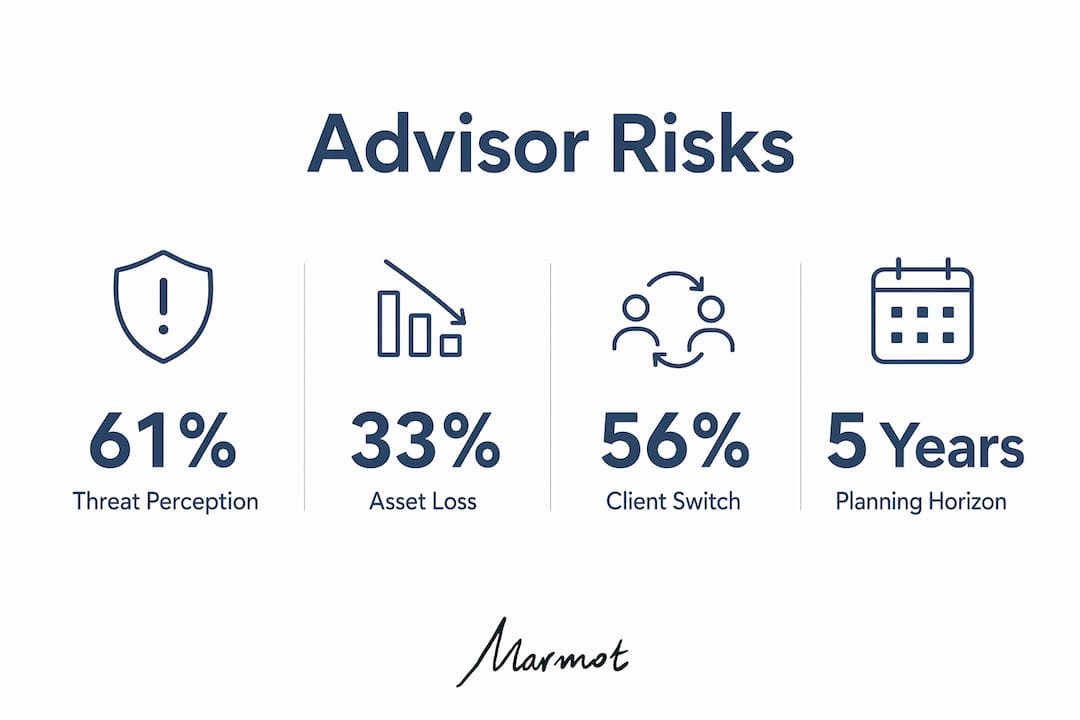
Asset loss is the most immediate risk. 33% of Swiss advisors report having already experienced significant asset loss as a direct result of intergenerational transfers. When a client passes wealth to their children, those children frequently choose a different advisor, a different platform, or a different investment philosophy entirely.
Gender dynamics add another layer of complexity. 56% of women clients are actively considering switching advisors, a figure that reflects longstanding dissatisfaction with how traditional wealth management addresses women’s financial needs. Advisors who have not invested in gender-aware service models face disproportionate client attrition as wealth moves to female inheritors. Marmot’s work on the gender gap in wealth management addresses precisely this gap.
The client retention challenge breaks down into four specific pressure points that advisors must address:
- Relationship continuity. Baby Boomers show 66% willingness to transfer assets to a new advisor, while younger clients actively resist switching once they have chosen a provider. Advisors must build relationships with the next generation before the transfer occurs.
- Technology expectations. Younger clients expect digital access, real-time reporting, and automated rebalancing as standard. Advisors operating on legacy systems will struggle to retain these clients.
- Investment philosophy alignment. Inheritors who prioritise impact investing will not remain with advisors who cannot offer credible ESG or impact-linked portfolios.
- Communication style. Younger clients expect direct, transparent, and frequent communication. Quarterly paper statements are not sufficient.
Pro Tip: Wealth managers who proactively engage with the next generation of a client family, even before any transfer is imminent, retain significantly more assets through the transition than those who wait to be introduced.
How should investors and advisors approach succession and estate planning?
Succession planning is a multi-year process. Family business succession should ideally begin at least five years before any planned handover. Starting earlier allows families to address tax structuring, ownership disputes, and valuation disagreements before they become crises.
One of the most common errors in Swiss succession planning is assuming that the business is the only significant asset. A thorough asset inventory must include real estate, securities portfolios, pension entitlements, insurance policies, and latent tax liabilities. Each of these carries its own valuation complexity, and disputes frequently arise when heirs discover assets they were not aware of.
Valuation timing matters enormously. The value of a company or a property at the moment of inheritance determines the tax base and the distribution among heirs. Families who plan ahead can structure transfers during periods of lower valuation or use legal instruments to fix values in advance, reducing both tax exposure and family conflict. Marmot provides estate planning guidance tailored to affluent Swiss families navigating exactly these decisions.
The practical steps for a well-structured succession plan include the following:
- Begin the process at least five years before the intended transfer date.
- Commission a full asset inventory that goes beyond the primary business or property holding.
- Obtain independent valuations for all significant assets, particularly real estate and private company shares.
- Appoint a professional estate executor with no financial interest in the outcome.
- Document the intended distribution clearly and update the plan after any major life event.
Setting family financial milestones well in advance of a transfer is one of the most effective ways to keep all parties aligned and reduce the risk of costly disputes.
How is the wealth transfer changing philanthropy in Switzerland and Europe?
The generational wealth shift is redefining what philanthropy means in practice. Younger wealthy individuals in Switzerland are moving away from traditional charitable giving and towards impact investing and social entrepreneurship. This is not a marginal trend. It reflects a fundamental change in how the next generation understands the relationship between capital and social outcomes.
“The great wealth transfer is the greatest philanthropic opportunity in history. The next generation of wealth holders in Switzerland is not asking whether to give. They are asking how to give in a way that creates measurable, lasting change. Impact investing and social ventures are their answer to that question.”
Maximilian Martin, Lombard Odier
Switzerland occupies a unique position in this shift. Over 13,000 foundations distribute approximately CHF 6 billion annually, making Switzerland one of the most concentrated philanthropy markets in the world. As younger wealth holders inherit control of these foundations, they are redirecting capital towards measurable social and environmental outcomes rather than traditional grant-making.
Financial institutions that serve this next generation must develop credible impact measurement frameworks, social venture advisory capabilities, and access to private market impact funds. Advisors who cannot speak fluently about impact metrics, blended finance structures, or social return on investment will find themselves excluded from conversations that matter to their wealthiest younger clients. The great wealth transfer is redefining philanthropy in ways that extend well beyond charitable giving into the core of portfolio construction.
Key takeaways
The great wealth transfer is the most significant structural shift in wealth management of this generation, and advisors who fail to adapt their service model, technology, and investment philosophy will lose assets at scale.
What I have learned watching this transfer unfold across Swiss client families
Working with families and investors across Switzerland, I have seen the wealth transfer play out in ways that the headline numbers do not fully capture. The most striking pattern is not the scale of assets moving. It is the speed at which relationships break down when advisors have not invested in the next generation.
Families who have planned well, who have had honest conversations about values, tax, and distribution years in advance, navigate the transfer with relatively little disruption. Families who have not done that work often find that the transfer triggers conflict that no legal document can fully resolve. The financial loss is real, but the relational damage is frequently worse.
The opportunity here is genuine. Advisors and wealth managers who build multigenerational relationships, who understand that a client is not one person but a family system, are positioned to grow through this transfer rather than shrink. The same applies to investors. Those who engage their heirs in financial education and planning early create the conditions for wealth to compound across generations rather than dissipate in disputes.
For European investors, the Swiss experience offers a useful preview. The concentration of private wealth, the complexity of property holdings, and the strength of the foundation sector make Switzerland a leading indicator of what the broader European wealth transfer will look like. The advisors and institutions that are adapting now will be the ones still standing when the bulk of the transfer completes.
— Martin Bürki
How Marmot supports families through the great wealth transfer
Navigating a generational wealth transfer requires more than good intentions. It requires a structured plan, independent advice, and a wealth manager who understands the full complexity of Swiss and European asset structures.
Marmot is a FINMA-accredited wealth manager specialising in private and family wealth management for clients in Switzerland and Europe. The team works with families on succession planning, estate structuring, and multigenerational investment strategy, combining personal consultations with digital tools that keep every family member informed and engaged. Whether you are preparing to transfer wealth or preparing to receive it, Marmot’s expert wealth management team provides the clarity and structure that complex transfers demand. Marmot also offers dedicated guidance on preserving generational wealth across family structures, ensuring that assets are protected and purposefully deployed for the long term.
FAQ
What is the great wealth transfer?
The great wealth transfer refers to the estimated $84 trillion in assets expected to pass from Baby Boomers to younger generations over the coming decades. It is the largest intergenerational transfer of private wealth in recorded history.
Why are Swiss financial advisors particularly concerned about the wealth transfer?
61% of Swiss advisors view the transfer as a direct threat to their business, a higher rate than the 46% global average, reflecting Switzerland’s high concentration of private wealth and the speed of current transfers.
How does the wealth transfer affect women clients specifically?
56% of women clients are considering switching advisors during or after an intergenerational transfer, making gender-aware advisory models a critical retention tool for wealth managers.
How early should succession planning begin in Switzerland?
Succession planning should begin at least five years before any intended handover. This timeline allows families to address tax structuring, asset valuation, and potential disputes before they become unmanageable.
How is the wealth transfer changing philanthropy in Switzerland?
Younger wealth holders are redirecting capital from traditional charitable giving towards impact investing and social entrepreneurship. Switzerland’s 13,000-plus foundations, which distribute approximately CHF 6 billion annually, are adapting their models under next-generation leadership.
Recommended
- Sharp Decline in Financial Markets. Why?
- The US Federal Reserve is tightening the screws.
- Strong quarterly earnings drive US stock market to an all-time high
- Wealth Management in Davos | Marmot Finance

.webp)





.jpeg)


.webp)


.svg)


