

Mothers in Switzerland can build lasting wealth by maximising Pillar 3a contributions, claiming parental credits (Erziehungsgutschriften), closing pension gaps, and investing consistently alongside family budgeting. The practical steps below apply whether you work full-time, part-time, or are taking a career break.
- Contribute up to CHF 7,258 annually to a Pillar 3a account and deduct the full amount from taxable income
- Claim parental credits worth CHF 45,360 per year per household for children under 16, boosting your AHV pension calculation
- From 2026, make retroactive Pillar 3a contributions for up to ten prior years where you had earned income
- Stay above the BVG entry threshold of CHF 22,680 per year to retain occupational pension coverage
- Build a diversified investment portfolio suited to your risk tolerance and time horizon
- Coordinate maternity pay, family allowances, and tax deductions as a single financial plan
- Seek professional advice from an advisor experienced in Swiss pensions and family finances
The mindset shift that underpins all of this is treating your own financial future as a non-negotiable priority, not an afterthought once the family’s needs are met.
Why motherhood demands a new approach to financial independence
Becoming a mother changes your financial position in ways that are not always obvious at the time. Women in Switzerland receive a retirement pension that is, on average, about one-third lower than that of men, largely because of career breaks, part-time work, and lower wages during the caregiving years. That gap compounds quietly over decades.
The most productive shift is moving from short-term household management to long-term financial independence as a goal in its own right. This means treating pension contributions, investment accounts, and tax planning as personal financial infrastructure, not optional extras. Many mothers find that once they frame their finances this way, the decisions become clearer.
- Prioritise your own pension contributions even during reduced-income periods
- Build financial knowledge progressively: understanding your pension statement is a concrete starting point
- Accept that financial setbacks during the early years of motherhood are structural, not personal failures
- Focus on passive income streams and long-term asset growth rather than only on monthly cash flow
- Review your pension entitlements annually so you can act on gaps before they widen
The financial life cycle for women in Switzerland has distinct phases, and motherhood is the one where the structural disadvantages are most acute. Recognising that is the first step toward addressing them deliberately.
Saving and investing strategies that work for busy mothers
The most effective saving strategy for mothers in Switzerland combines Pillar 3a contributions with a diversified investment portfolio, calibrated to the time and risk constraints of family life.

Pillar 3a is the clearest starting point. Contributions up to CHF 7,258 in 2026 are fully tax-deductible, and the savings grow free of income and wealth tax until withdrawal. If you use an investment-based 3a account rather than a standard savings account, long-term returns can meaningfully offset the pension capital lost during part-time working years. From 2026, the retroactive contribution option allows you to fill gaps from up to ten prior years, provided you had AHV-liable income in those years.
Beyond Pillar 3a, a well-structured investment portfolio for women typically balances equities for long-term growth with bonds or real assets for stability. The right allocation depends on your time horizon and income stability, both of which shift considerably during the motherhood years.
- Set a realistic monthly savings target and automate transfers so the decision is not made repeatedly
- Use a 3a investment account rather than a 3a savings account to benefit from market returns over time
- Consider low-cost index funds for the equity portion of your portfolio
- Explore side income compatible with family life: freelance consulting, tutoring, or digital services can supplement employment income without requiring fixed hours
- Coordinate savings goals with your partner so that pension contributions are not duplicated in one account while gaps open in another
Pro Tip: If your employer’s pension fund applies a proportional coordination deduction rather than the fixed CHF 26,460 deduction, your insured salary as a part-time worker increases substantially. Ask your HR department whether your fund offers this option.
How to use Swiss family benefits and tax rules to your advantage
Switzerland’s pension and tax system contains several mechanisms specifically designed to protect parents, but they only work if you claim them correctly and understand how they interact.
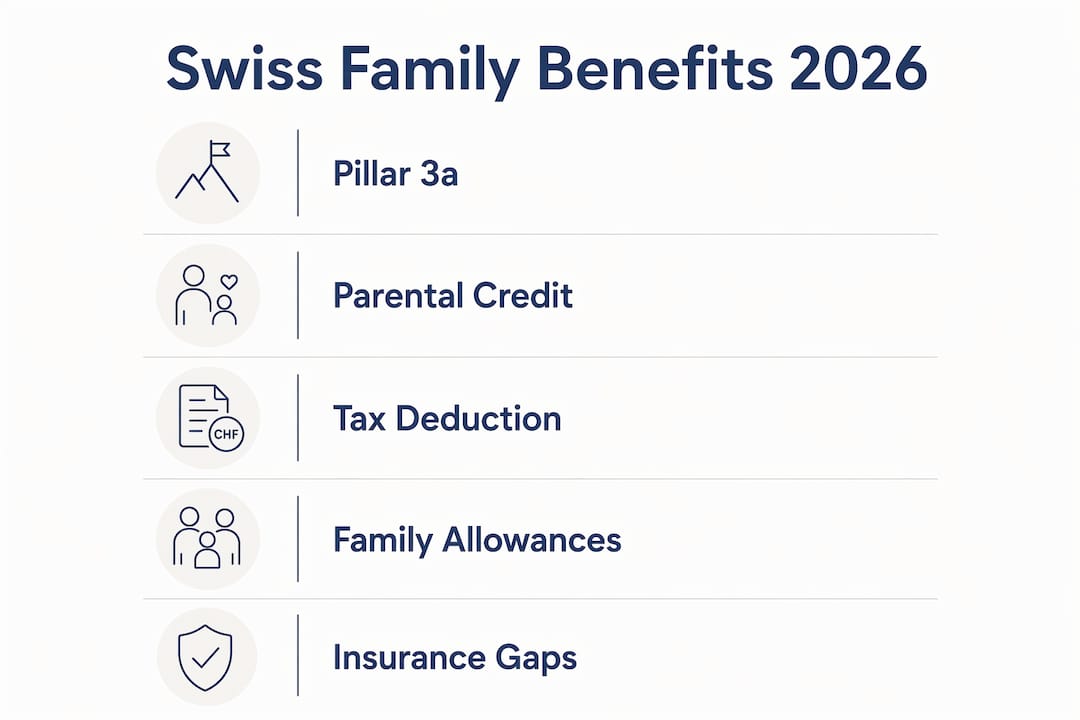
Parental credits are not cash payments. They are fictitious income figures added to your AHV pension calculation, amounting to a fixed, substantial sum per year for any year you held parental responsibility for a child under 16. For a married couple, the credit splits automatically equally. For unmarried or divorced parents, the allocation depends on parental authority and requires active registration with your cantonal AHV compensation office (Ausgleichskasse). If not registered, the credit is lost permanently.
Coordinated family tax planning that brings together maternity pay, childcare deductions, and Pillar 3a contributions can save significant amounts annually. Many families leave this money unclaimed simply because they treat each element separately.
- Deduct childcare costs in your cantonal tax return
- Make voluntary pension fund buy-ins after parental leave: these are fully tax-deductible and directly close occupational pension gaps
- If you are not employed, pay the minimum AHV contribution required for non-employed persons to avoid permanent gaps in your state pension record
- Check whether your employer’s pension fund applies a reduced coordination deduction proportional to your working percentage
Working with a financial advisor to plan your family’s future
Professional financial advice for families works best when it covers pensions, tax, insurance, and investments together rather than in isolation. A good advisor does not just review your portfolio; they map the interaction between your occupational pension, Pillar 3a, family allowances, and tax position to identify where money is being lost.
When selecting an advisor, look for someone with specific experience in Swiss pension law and family financial planning. Fee-based advisors, who charge by the hour rather than earning commission from product sales, tend to give more objective recommendations. Qualifications to look for include a federal certificate as a financial planner or a CAS in financial planning.
The topics a family financial review should cover include pension gap analysis, investment allocation suited to your income stage, tax efficiency across both partners, and estate planning. Regular reviews aligned with motherhood milestones, such as returning to work, a change in working hours, or a child starting secondary school, keep the plan current.
- Bring your pension fund statements (Vorsorgeausweis) for both partners to any initial consultation
- Ask the advisor to model the long-term pension impact of your current working percentage
- Discuss whether a voluntary pension fund buy-in makes sense in the current tax year
- Review your insurance coverage for disability and death, as gaps here are common in part-time arrangements
Marmot Finance specialises in wealth management for women and families in Switzerland, combining personal consultations with practical financial planning tools. As a FINMA-accredited wealth manager, Marmot Finance works with clients to address the specific pension and investment challenges that arise during the motherhood years.
Teaching children about money and planning for generational wealth
Financial literacy in children develops most effectively through early, practical involvement in household money decisions. Explaining why the family saves, how a bank account works, or what a budget means gives children a concrete framework that abstract lessons cannot replicate.
Age-appropriate methods matter. For younger children, a simple three-jar system for spending, saving, and giving builds the habit of allocation. Teenagers can be introduced to compound interest, investment accounts, and the concept of a pension, particularly relevant in Switzerland where understanding the three-pillar system early provides a genuine advantage.
On the structural side, long-term wealth planning for families in Switzerland should address wills, beneficiary designations on pension accounts, and, for larger estates, the use of trusts or structured gifts. Switzerland does not levy a federal inheritance tax, but cantonal rules vary, and direct descendants are typically exempt in most cantons. Gifts made during your lifetime may be subject to cantonal gift tax depending on the recipient and amount, so professional advice is worth taking before transferring significant assets.
- Open a savings account in your child’s name early and involve them in watching it grow
- Discuss the family budget at an age-appropriate level so money is not a taboo subject
- Review beneficiary designations on your Pillar 3a and pension fund accounts regularly
- Consult a notary or estate planning specialist when drafting or updating your will
Protection and insurance: what families in Switzerland often overlook
Insurance gaps are one of the most common and costly oversights in family financial planning. Most Swiss families carry duplicate accident insurance while leaving disability and income protection coverage inadequate, particularly after one partner reduces their working hours.
Disability insurance (Invalidenversicherung, IV) through the state provides a base level of coverage, but the replacement rate for part-time workers is often insufficient to maintain the family’s standard of living. Private disability cover, either through your employer’s pension fund or a standalone policy, fills this gap. Check your pension fund statement for the disability benefit figure and compare it to your actual monthly expenses.
Life insurance is particularly relevant for mothers who have reduced their income to care for children. If the family’s financial plan depends on two incomes returning to full capacity, the death or long-term disability of either partner creates a structural shortfall that insurance should address. Unmarried couples face additional exposure: without a registered cohabitation agreement, a surviving partner has no automatic claim on the deceased’s pension fund assets.
- Review all existing insurance policies annually and eliminate genuine duplicates
- Prioritise disability and income protection over supplementary health benefits
- Unmarried mothers should register their cohabitation with their pension fund to establish a beneficiary claim
- Consider term life insurance if your mortgage or family expenses would be unmanageable on a single income
Family financial planning: pensions, allowances, and long-term goals
A family financial plan in Switzerland needs to account for the three-pillar pension system, family allowances, and the specific milestones that define the motherhood years, from childcare costs through to university and eventually retirement.
Education costs are a concrete planning target. Costs for braces, university, and extracurricular activities can reach CHF 10,000–15,000 per child over the school years, and starting a dedicated savings plan early reduces the pressure considerably. A Pillar 3a account or a securities account in the child’s name are both practical vehicles, depending on the time horizon and tax position.
The family financial milestones that matter most are often the ones that arrive without warning: a partner’s redundancy, a health event, or a decision to extend a career break. Building three to six months of living expenses as a liquid reserve before investing aggressively is a standard recommendation for families, and one that is frequently skipped in favour of higher-return assets.
For mothers approaching retirement, the AHV 21 reform introduced flexible partial pension withdrawal in amounts ranging from 20% to 80%, allowing a gradual transition out of the workforce. Women born between 1961 and 1969 belong to the transitional generation and may be eligible for a monthly pension supplement of up to CHF 160, depending on year of birth and average income.
- Set specific savings targets for each major family milestone and review them annually
- Build a liquid emergency reserve before increasing investment contributions
- Model your projected AHV pension using your individual account statement from the cantonal compensation office
- For the gender gap in wealth, address the structural pension disadvantages proactively rather than assuming they will resolve over time
Key takeaways
Mothers in Switzerland who combine Pillar 3a contributions, parental credits, and coordinated tax planning can close the gender pension gap and build lasting family wealth across every stage of motherhood.
Recommended
- Gender Gap Wealth Management: A Guide for Swiss Women | Marmot Finance
- Long-term wealth planning in Switzerland: securing generational wealth
- Best Asset Classes for Women Investors in Switzerland | Marmot Finance
- Financial Life-Cycle Guide for Women in Switzerland

.webp)





.jpeg)



.png)

.svg)


