

For most private investors in Switzerland, a reverse stock split is a warning signal, not an opportunity. The split itself does not change what your holding is worth, but it almost always reflects underlying problems a company is trying to manage. Before acting, read the company’s stated rationale, check the fundamentals, and consider selling if you see signs of weak cash flow or imminent delisting risk on the SIX Swiss Exchange.
As FINRA notes, reverse splits do not alter a company’s overall value. They reduce the number of shares outstanding and raise the per-share price proportionally. The concern is what prompts them: healthy companies rarely need to do this.
How does a reverse stock split actually work?
A reverse stock split consolidates existing shares into fewer shares at a higher price. If you hold 1,000 shares at a low price, a 1-for-10 reverse split leaves you with fewer shares priced proportionally higher. Your total holding value stays the same. Nothing has changed economically, yet the optics look cleaner on a trading screen.

RatioShares beforePrice beforeShares afterPrice afterPortfolio value1-for-10Shares beforePrice beforeShares afterPrice afterPortfolio value1-for-10Shares beforePrice beforeShares afterPrice afterPortfolio value
Two practical effects follow immediately. First, if your holding does not divide evenly by the ratio, you receive a fractional share. Custodian banks typically round this down and pay you cash compensation for the remainder, which is handled automatically. Second, the post-split price appears on trading platforms immediately after the effective date, so do not be alarmed by what looks like a sudden price jump.
Pro Tip: Check your custodian statement on the effective date and confirm the new share count matches the ratio. Errors are rare but do occur, and catching them early avoids complications.
Why do companies carry out reverse splits?
The most common reason is listing compliance. Exchanges, including SIX, apply minimum price rules, and a company trading below those thresholds risks delisting. A reverse split raises the nominal price quickly without requiring any operational change.
Other motives include:
- Attracting institutional investors who are restricted from holding very low-priced shares
- Consolidating a fragmented shareholder base after a recapitalisation
- Improving the optics of a share price for retail perception
- Simplifying price handling on trading and settlement platforms
Some of these motives are relatively benign. A company that has genuinely repaired its balance sheet and uses a reverse split to reposition itself for institutional capital is in a different position from one that is simply delaying a delisting notice. Investopedia’s analysis confirms that finance academics view reverse splits as reactive moves that should prompt investors to inspect fundamentals rather than trust the optics.
Pro Tip: Read the full press release and any accompanying regulatory filing, not just the headline. A genuine turnaround announcement will reference debt reduction, new financing, or operational targets alongside the split.
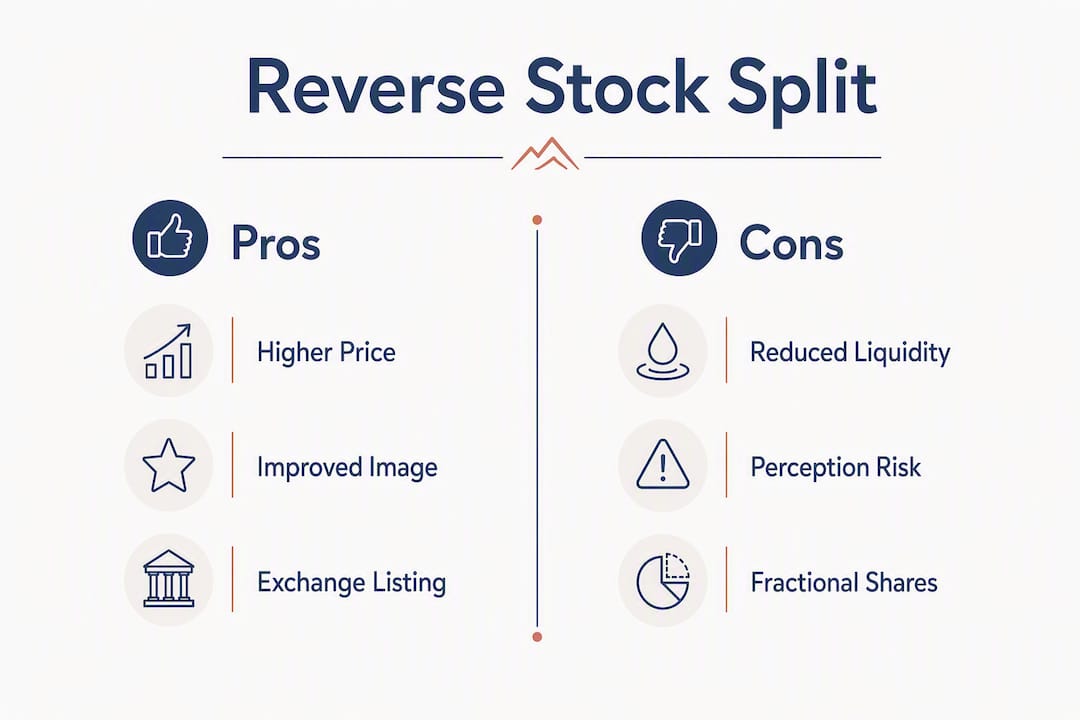
What are the pros and cons for shareholders?
The benefits are real but limited:
- Delisting avoidance, which preserves your ability to trade the stock at all
- A cleaner per-share price that may attract a broader investor base
- Possible improvement in institutional coverage if the price crosses key thresholds
The risks tend to outweigh these for most investors:
- Markets typically read a reverse split as a distress signal, which can trigger renewed selling pressure
- Reduced liquidity is a common outcome: fewer shares outstanding often widens bid-ask spreads, making it harder and more expensive to trade
- Fractional share cash-outs, while small, can force a partial disposal you did not choose
- If the underlying business does not improve, the stock may continue to decline regardless of the new price level
As The Motley Fool observes, successful long-term turnarounds following reverse splits do occur, but they are uncommon. The split alone rarely changes long-term prospects.
Pro Tip: Monitor bid-ask spreads and daily trading volume for several weeks after the split. Immediate price moves often reflect sentiment rather than any sustained change in the company’s position.
What should Swiss investors check specifically?
Switzerland has its own practical considerations that general guides tend to overlook.
- SIX Swiss Exchange applies listing rules that include minimum price and capitalisation thresholds; a company approaching those limits may announce a reverse split to buy time
- Custodian banks in Switzerland, including the major private banks and cantonal banks, are generally instructed to perform the conversion automatically, with no direct transaction cost to shareholders
- Cash compensation for fractional shares is standard practice, as documented in Swiss Steel’s shareholder Q&A, where the company financed compensation by selling the remaining fractional shares on market
- Post-split prices appear on SIX trading screens from the effective date; the record date and effective date are typically announced several weeks in advance
- Stamp duty on any automatic sale of fractional shares is generally borne by the company, not the investor, though you should confirm this with your custodian
Checklist for Swiss investors after an announcement:
- Note the record date, effective date, and ratio from the official announcement
- Contact your custodian to confirm how fractions will be handled
- Check whether any cash compensation will appear as a separate credit on your statement
- Review the company’s SIX filing for any concurrent measures (capital increase, debt restructuring)
- Assess whether the company’s FINMA-regulated disclosures reveal any material change in financial position
Pro Tip: If you hold the stock across multiple custodian accounts, check each account separately. Fractional rounding can produce different outcomes depending on the lot size held in each.
Should you buy, hold or sell after a reverse split?
Default to caution. Read the filings and check the fundamentals before making any move.
- Confirm the stated reason for the split and whether it is supported by accompanying measures
- Review recent trading volume and bid-ask spreads to assess liquidity
- Check the company’s debt levels, cash flow, and any recent earnings announcements
- Assess management credibility: have previous targets been met?
- Look for concurrent actions such as debt reduction, a rights issue, or new strategic partnerships
Red flags that would prompt a serious review of your position:
- A simultaneous earnings miss or profit warning
- No accompanying operational or financial improvement measures
- Governance changes such as board departures or auditor changes
- An imminent delisting notice or regulatory warning from FINMA
- Continued deterioration in trading volume after the split
For long-term investors, the key question is whether the business can generate cash and grow earnings over the next three to five years. The split is irrelevant to that question. For more speculative positions, the sharp decline in financial markets context matters: a reverse split during a broad market downturn carries different implications than one during a stable period.
Tax, fractional shares and settlement: what to expect in practice
The cash compensation for fractional shares is the most common practical consequence for Swiss private investors. As documented in Swiss Steel’s shareholder Q&A, companies typically round down to the nearest whole share and pay cash for the remainder, financing this by selling the fractional pool on market.
- Check your custodian statement on the effective date for both the new share count and any cash credit
- Confirm whether the cash compensation appears as a separate transaction line
- Note that a cash payment for fractional shares may constitute a taxable disposal in certain Swiss tax situations; this depends on your individual circumstances and the nature of the holding
Swiss private investors are generally subject to wealth tax on securities holdings and may face income tax on certain distributions, but capital gains on private securities are typically not taxed at the federal level for private investors. The fractional cash-out sits in a grey area that depends on the specific transaction structure.
Pro Tip: Keep a record of the cash compensation amount and the effective date. Your tax adviser will need this to determine whether it constitutes a taxable event under your cantonal tax rules.
This article provides general information only and does not constitute tax or investment advice. Consult a qualified Swiss tax professional and review the Swiss Federal Tax Administration guidance for your specific situation.
How Marmot Finance evaluates reverse splits for clients
Marmot Finance’s default position when a client holds a stock undergoing a reverse split is to treat the announcement as a prompt for a full fundamental review, not a reason to panic or to hold passively.
Two illustrative patterns emerge regularly. In one scenario, a company announces a reverse split alongside a credible debt-reduction plan and new management targets. Investors who hold through and monitor progress over six to twelve months sometimes see genuine recovery. In the other, more common scenario, the split is announced in isolation, with no accompanying measures, and the stock continues to decline as the underlying business fails to improve. The split bought time; it did not buy a turnaround.
Marmot Finance is FINMA-accredited and works exclusively with women, families, and high-net-worth households in Switzerland and Europe, providing bespoke analysis of corporate actions as part of ongoing portfolio management.
Pro Tip: If you are unsure whether to hold or sell, write down the three reasons you originally bought the stock. If none of those reasons still hold, that is your answer.
Key takeaways
A reverse stock split is neither automatically harmful nor beneficial; the outcome depends almost entirely on what the company does next.
A note from Marmot Finance to Swiss investors
When a corporate action like this lands in your portfolio, it can feel unsettling, particularly if you are managing investments alongside family responsibilities or a busy professional life. Marmot Finance works with clients to assess exactly these situations: what the announcement means, whether the holding still fits the portfolio, and what steps to take next. Every conversation is confidential, and the advice is tailored to your specific financial position, not a generic template. If you would like a second opinion on a holding or a broader portfolio review, we are here.
Marmot Finance wealth management for Swiss investors
Navigating corporate actions is one of the more demanding parts of private investing, and it is precisely where having a dedicated wealth manager makes a practical difference. Marmot Finance offers independent wealth management in Switzerland for women, families, and high-net-worth households, with FINMA accreditation and a focus on personalised, long-term portfolio strategy. When a reverse split or any other corporate action affects your holdings, Marmot Finance reviews the position, assesses the fundamentals, and advises on whether to hold, sell, or rebalance. To request a portfolio review or speak with an adviser, visit the Marmot Finance guide page and book a brief introductory conversation.
Useful sources
- Investopedia: Reverse stock splits — investor concerns and market perception
- The Motley Fool: Reverse stock splits — long-term turnaround context
- Swiss Steel shareholder Q&A — Swiss custodian practice and fractional share handling
- Tickerplace: Stock split explained — plain-language mechanics recap for new investors
Recommended
- US Elections: Detailed Analysis of the Current Polls
- How long will the correction in growth stocks last?
- Buy stocks of large or small companies?
- Sharp Decline in Financial Markets. Why?


.webp)





.jpeg)




.png)

.svg)


