

Tax optimisation for entrepreneurs is defined as the legal practice of structuring income, business activities, and assets to reduce tax liability while building long-term wealth. For entrepreneurs based in Meilen and the wider Zürich canton, the Swiss Federal Tax Administration, cantonal tax offices, and the Swiss social security system (AHV) together create a framework with genuine planning opportunities. The most effective tax optimisation approaches for entrepreneurs in Meilen combine pension pillar contributions, salary and dividend structuring, and cantonal incentives into a single, coordinated wealth management plan. Getting this right in 2026 requires understanding both the specific contribution limits and the regulatory boundaries that govern each strategy.
How pension pillar contributions reduce tax for Meilen entrepreneurs
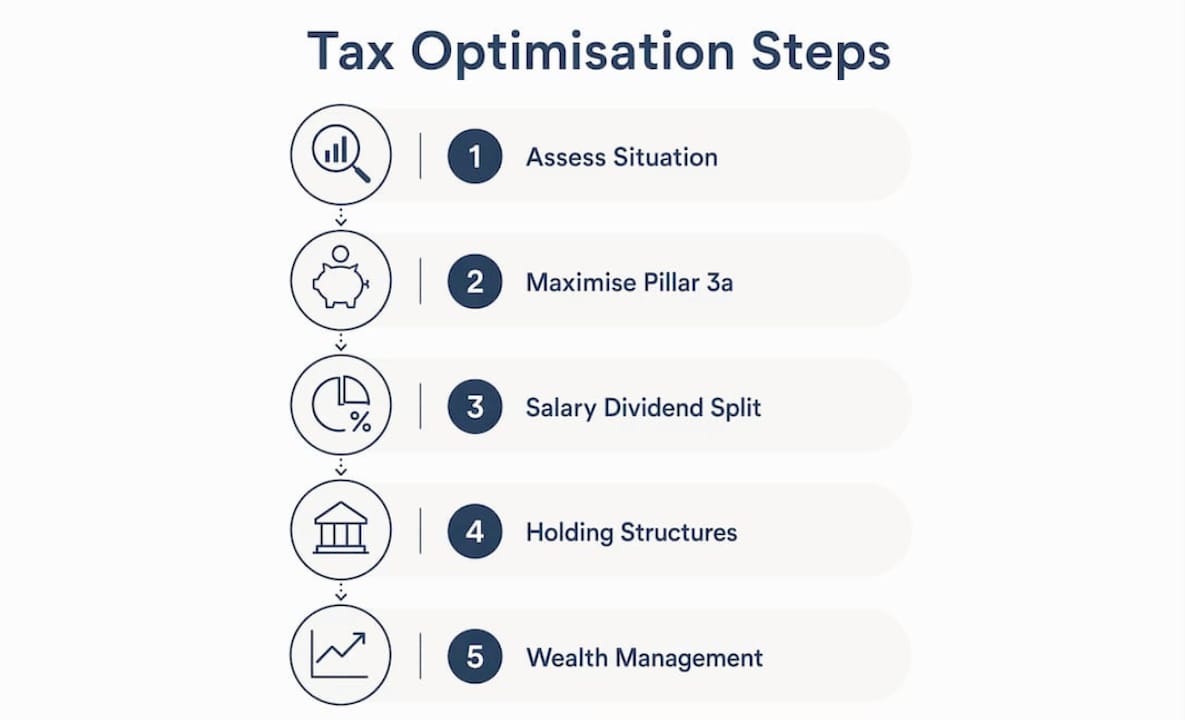
The Swiss pension system offers entrepreneurs one of the most direct and legal routes to reducing taxable income. Pillar 2 covers occupational pension contributions, while Pillar 3a is the private, voluntary savings scheme that delivers the most flexible tax benefits for self-employed business owners.
For 2026, the maximum Pillar 3a contribution is CHF 7,258 for employed individuals with an existing pension fund, and CHF 36,288 for those without one. That upper limit for the self-employed is substantial. An entrepreneur without a Pillar 2 arrangement who contributes the full CHF 36,288 can reduce their taxable income by that entire amount, generating annual tax savings of CHF 1,500 or more depending on their marginal rate.
The timing of contributions matters. Contributing in december rather than january of the following year accelerates the tax benefit by one full year. Entrepreneurs who run a GmbH or AG can also make voluntary buy-in contributions to their Pillar 2 scheme, which are deductible from corporate income. This is one of the most underused tools available to owner-managers in Switzerland.
Withdrawal planning is equally critical. Staggering pension withdrawals across multiple years, using separate Pillar 3a accounts, prevents a single large lump sum from pushing the entrepreneur into a steep progressive tax bracket. Opening multiple Pillar 3a accounts early in one’s career, rather than consolidating into one, gives far greater flexibility at retirement. Swiss tax law taxes each account withdrawal separately, so splitting them over three to five years can reduce the effective rate considerably.
Pro Tip: Open at least three separate Pillar 3a accounts as early as possible. When you retire, you can withdraw them in different tax years, keeping each payout in a lower bracket.
For entrepreneurs seeking deeper guidance on pension planning techniques, the interaction between Pillar 2 buy-ins and Pillar 3a contributions requires careful sequencing to avoid triggering anti-avoidance rules.
How does salary and dividend splitting work for GmbH and AG owners?
Entrepreneurs who own a GmbH or AG in Meilen can split their remuneration between a salary and dividends. This split reduces the overall social security burden because AHV contributions of approximately 10.6% apply to salary but not to dividends. Dividends are also taxed at a reduced rate: at the federal level, 70% of the dividend is taxable, and cantons apply rates between 50% and 70%.
To qualify for partial taxation on dividends, the entrepreneur must hold at least 10% of the company’s shares. This threshold is straightforward for most owner-managers to meet. The practical result is that a CHF 100,000 dividend may be taxed on only CHF 50,000–70,000 of income, while generating no AHV liability at all.
The risk lies at both extremes. Setting the salary too low triggers AHV compliance issues and reduces future social security entitlements, including retirement and disability benefits. Setting it too high increases income tax and AHV costs unnecessarily. The optimal salary level is typically the amount needed to maximise Pillar 2 contributions and maintain AHV entitlements, with surplus profits distributed as dividends.
Key considerations for the salary-dividend split:
- Salary must meet AHV minimum thresholds to preserve social security entitlements.
- Dividends require a minimum 10% shareholding to qualify for partial taxation.
- The split should be reviewed annually as profits, personal circumstances, and cantonal rates change.
- Pillar 2 contributions are calculated on salary, so a very low salary also reduces pension savings capacity.
Pro Tip: Work with a tax adviser to model the exact salary level that maximises your Pillar 2 buy-in capacity while keeping AHV costs proportionate. This single calculation often saves more than any other adjustment.
For entrepreneurs managing cross-border income or international assets alongside their Swiss business, cross-border financial planning adds another layer of complexity that warrants specialist advice.
What are the cantonal tax incentives for holding structures in Meilen?
Zürich canton, where Meilen is located, offers a competitive tax environment for holding companies. Swiss cantonal tax rates for holding companies can be as low as 0.6%–1%, and IP-Box regimes provide further reduced rates for income derived from intellectual property. For entrepreneurs with significant profits, a holding AG sits above the operating company and receives dividends largely free of corporate tax through the participation exemption.
The participation exemption applies when the holding company owns more than 10% of a subsidiary. Dividends received from qualifying subsidiaries are effectively exempt from corporate tax at the holding level. This allows profits to accumulate and be reinvested without triggering a full tax charge at each distribution. Holding structures become particularly beneficial once annual profits exceed CHF 200,000, at which point the tax deferral and reinvestment advantages outweigh the administrative costs.
Setting up a holding structure requires genuine substance. FINMA and cantonal tax authorities require that holding companies maintain local substance, including a registered office, local directors, and in some cases employees. Without substance, the structure risks being re-characterised, losing its favourable tax treatment entirely.
A practical approach to structuring for Meilen entrepreneurs:
- Establish a holding AG above the operating GmbH or AG.
- Ensure the holding company has a genuine registered office and at least one local director.
- Distribute profits from the operating company to the holding as dividends, qualifying for the participation exemption.
- Reinvest accumulated capital within the holding into financial assets or further business activities.
- Review the structure annually with a tax adviser to confirm compliance with cantonal substance rules.
Entrepreneurs who want to understand how tax-efficient wealth structuring works across Swiss jurisdictions will find that the principles applied in Zug translate well to Zürich canton with minor adjustments.
Wealth management techniques that complement tax planning
Tax planning and wealth management work best when treated as a single integrated discipline rather than separate exercises. J.P. Morgan Private Bank identifies five tax-aware wealth categories: location (the tax treatment of different asset types), smart withdrawals, investments, lending, and integrated planning through structures such as trusts and family offices. Each category represents a decision point where tax efficiency can be improved without changing the underlying investment objective.
Asset location is one of the most overlooked tools. Placing tax-inefficient assets, such as bonds generating regular interest, inside a pension wrapper reduces the annual tax drag. Growth-oriented equities held outside pension structures benefit from Switzerland’s absence of capital gains tax for private investors, making them well suited to taxable accounts.
Strategic borrowing also plays a role. Entrepreneurs can use loans secured against investment portfolios or property to fund business needs without triggering a taxable disposal. Interest on business-related borrowing is generally deductible, reducing the net cost of capital. This approach requires careful documentation to satisfy cantonal tax authorities.
Integrated planning, including gifting strategies and generational wealth preservation, becomes relevant as the entrepreneur’s wealth grows. Swiss inheritance tax rules vary by canton, and early planning can significantly reduce the eventual tax cost of transferring assets to the next generation.
Pro Tip: Review your asset location annually. Moving a bond portfolio into a Pillar 3a or Pillar 2 wrapper can eliminate the annual income tax on interest, compounding the benefit over decades.
For entrepreneurs considering retirement income planning, the interaction between pension withdrawals, investment income, and business sale proceeds requires a coordinated withdrawal strategy that begins years before retirement.
Common mistakes in Swiss entrepreneur tax planning
The most costly mistake Swiss entrepreneurs make is withdrawing all pension assets in a single year. A one-time lump sum from multiple Pillar 3a accounts and a Pillar 2 payout in the same tax year creates a large taxable event. Progressive tax rates mean the marginal rate on the final portion of that sum can be significantly higher than if the same total had been spread across three or four years.
The second common error is setting salary too low to minimise AHV contributions. While this reduces short-term costs, it erodes future social security entitlements and limits Pillar 2 contribution capacity. The long-term cost of reduced pension benefits frequently exceeds the short-term saving.
Ignoring substance rules for holding companies is the third major pitfall. Entrepreneurs who establish a holding AG without a genuine local presence risk having the structure disregarded by cantonal tax authorities. The consequences include back-taxes, penalties, and loss of the participation exemption.
Advanced tips for avoiding these errors:
- Model pension withdrawal scenarios at least five years before retirement, using multiple accounts to stage payouts.
- Set salary at a level that supports full AHV entitlements and meaningful Pillar 2 contributions, then distribute remaining profits as dividends.
- Document all holding company activities, board meetings, and local substance evidence annually.
- Engage a tax adviser for an annual review, not just at year-end, to catch structural issues before they become compliance problems.
For entrepreneurs who also need to address estate planning, integrating business succession with pension and tax planning early avoids costly restructuring later.
Key takeaways
Effective tax planning for entrepreneurs in Meilen requires coordinating pension contributions, salary and dividend structures, and holding company arrangements within Swiss regulatory boundaries to achieve the best long-term financial outcome.
What I have learned advising entrepreneurs in Meilen
Working with entrepreneurs in the Zürich lake region, I have seen the same pattern repeat itself. The business grows, profits accumulate, and the owner continues to draw a salary as if the company were still a start-up. By the time they engage a wealth adviser, they have paid years of unnecessary tax and missed the window for early Pillar 3a account separation.
The entrepreneurs who achieve the best outcomes are not necessarily those with the most complex structures. They are the ones who start planning early, review their arrangements annually, and treat the salary-dividend decision as a financial modelling exercise rather than a gut-feel choice. A well-calibrated salary, three separate Pillar 3a accounts opened in year one of the business, and a holding AG established at the right profit threshold will outperform almost any more elaborate arrangement.
What I find most underappreciated is the compounding effect of tax savings reinvested consistently. Saving CHF 2,500 per year in Pillar 3a tax relief, reinvested in a diversified portfolio over twenty years, produces a materially different retirement outcome than the same gross income taxed and spent. The maths is straightforward. The discipline to act on it is the harder part.
My honest recommendation: do not wait until the business is profitable enough to “justify” professional advice. The best time to structure your affairs correctly is at formation, not after the first large profit year has already been taxed.
— Sophie Steinmann
How Marmot supports entrepreneurs with tax-aware wealth planning
Marmot is a FINMA-accredited wealth manager with deep expertise in Swiss pension planning, business structure advice, and integrated wealth management for entrepreneurs and families. Whether you are reviewing your salary-dividend split, planning your first Pillar 3a account separation, or considering a holding structure, Marmot provides personalised guidance grounded in Swiss regulatory knowledge and long-term financial planning principles.

Marmot’s approach combines one-to-one consultations with practical digital tools, so you receive advice that fits your specific business structure and personal financial goals. Over 350 clients have already improved their financial outcomes with Marmot’s guidance. To discuss your tax and wealth planning needs, contact Marmot’s advisers directly and take the first step towards a more tax-efficient financial future.
FAQ
What is the maximum Pillar 3a contribution for self-employed entrepreneurs in 2026?
The maximum Pillar 3a contribution for self-employed individuals without a Pillar 2 pension fund is CHF 36,288 in 2026. This full amount is deductible from taxable income, generating significant annual tax savings.
How does the salary-dividend split reduce tax for GmbH owners?
Dividends are not subject to AHV social security contributions of approximately 10.6%, and are only partially taxable at 50%–70% depending on the canton. Splitting remuneration between salary and dividends reduces both social security costs and income tax on distributed profits.
When does a holding company structure become worthwhile in Switzerland?
A holding AG becomes practically beneficial for tax purposes once annual business profits exceed CHF 200,000. At that level, the participation exemption allows profits to accumulate and be reinvested largely free of corporate tax.
What are the substance requirements for a Swiss holding company?
FINMA and cantonal tax authorities require holding companies to maintain a genuine local presence, including a registered office, local directors, and in some cases employees. Without this substance, the holding risks losing its favourable tax treatment.
How can entrepreneurs avoid high tax on pension withdrawals?
Opening multiple Pillar 3a accounts early and staggering withdrawals across separate tax years prevents a single large lump sum from triggering steep progressive tax rates. Coordinating Pillar 2 and Pillar 3a withdrawals over three to five years is the most effective approach.
Recommended
- Tax-Efficient Wealth Structuring in Switzerland: Investor guide | Marmot Finance
- Swiss Pension Optimisation in Lausanne | Marmot Finance
- Cross-Border Financial Planning in Zürich for International Professionals | Marmot Finance
- Preserving Generational Wealth: Private Wealth Management in Switzerland | Marmot Finance


.webp)





.jpeg)




.png)

.svg)


